مراقبة التمارين باستخدام Ultralytics YOLO26

يؤدي رصد التمارين عبر تقدير الوضعية باستخدام Ultralytics YOLO26 إلى تحسين تقييم التمارين من خلال تتبع معالم الجسم والمفاصل الرئيسية بدقة وفي الوقت الفعلي. وتوفر هذه التقنية ملاحظات فورية حول أداء التمرين، وتتتبع روتين التمارين، وتقيس مؤشرات الأداء، ما يحسّن جلسات التدريب للمستخدمين والمدربين على حد سواء.
شاهد: كيفية مراقبة تمارين اللياقة باستخدام Ultralytics YOLO | القرفصاء ومدّ الساق وتمارين الضغط والمزيد
مزايا مراقبة التمارين#
- تحسين الأداء: تخصيص التمارين استناداً إلى بيانات المراقبة لتحقيق نتائج أفضل.
- تحقيق الأهداف: تتبّع أهداف اللياقة البدنية وتعديلها لقياس التقدم.
- التخصيص: إعداد خطط تمارين مخصصة استناداً إلى البيانات الفردية لتعزيز الفاعلية.
- الوعي الصحي: الكشف المبكر عن الأنماط التي تشير إلى مشكلات صحية أو الإفراط في التدريب.
- اتخاذ قرارات مستنيرة: اتخاذ قرارات قائمة على البيانات لتعديل الروتين ووضع أهداف واقعية.
تطبيقات واقعية#
| مراقبة التمارين | مراقبة التمارين |
|---|---|
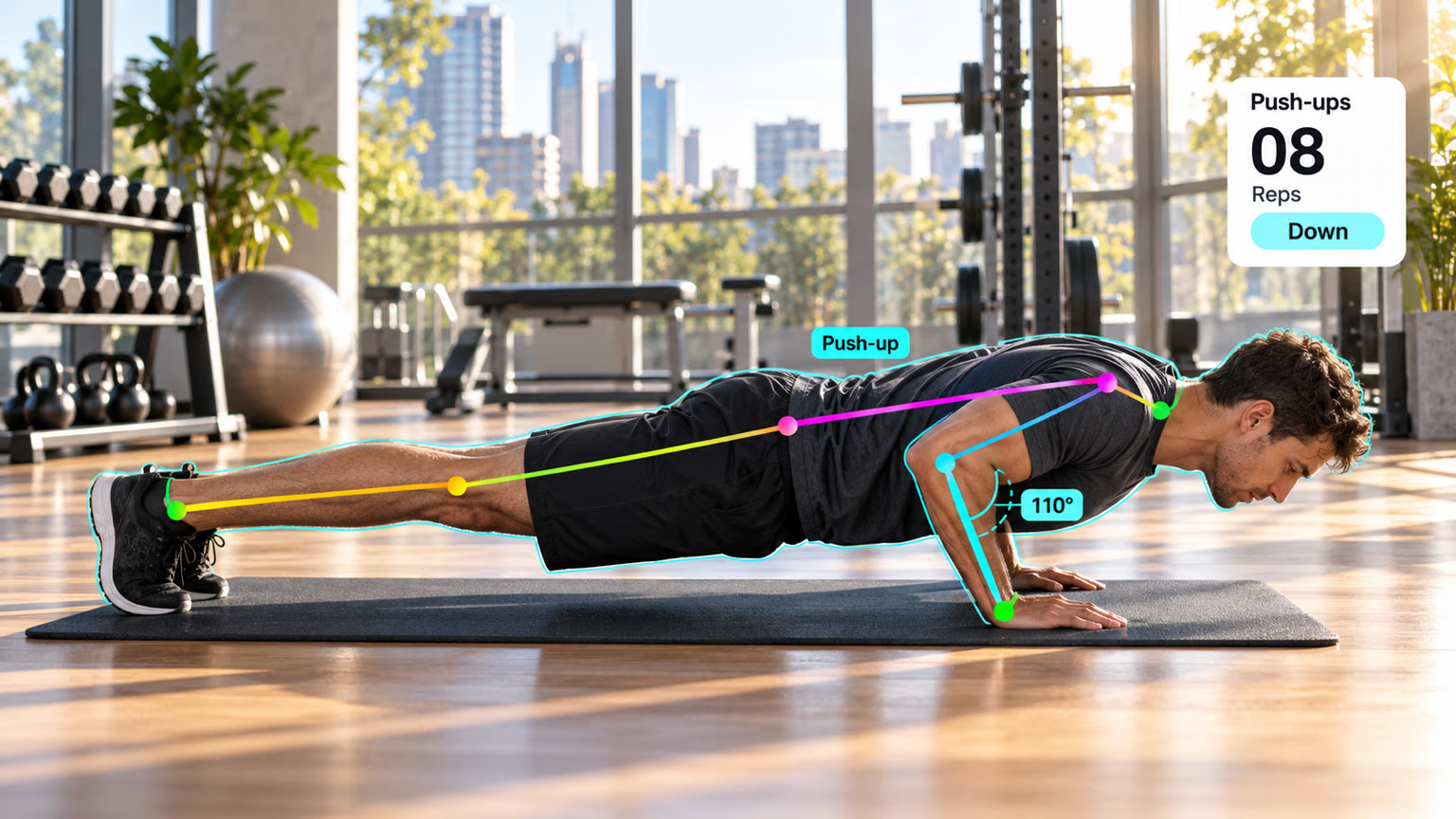 | 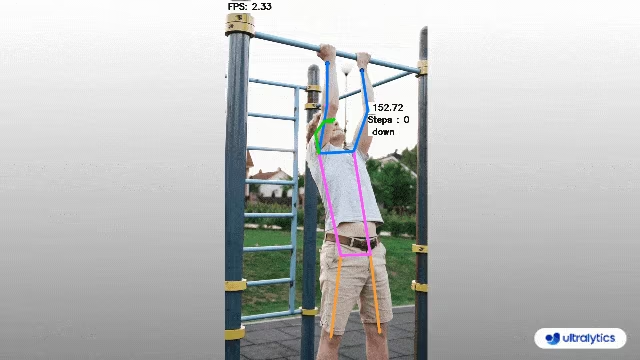 |
| عدّ تمارين الضغط | عدّ تمارين العقلة |
راقب التمارين باستخدام YOLO26#
يشغّل حل AIGym تقدير الوضعية باستخدام نموذج مثل YOLO26n-pose، ويعدّ التكرارات بقياس الزاوية التي تشكّلها ثلاث نقاط مفتاحية أثناء تحرك أحد الأطراف بين العتبتين up_angle وdown_angle. اختر النقاط المفتاحية للتمرين الذي تريد تتبعه باستخدام kpts، ثم شغّل الحل على الفيديو باستخدام واجهة Python البرمجية أو CLI.
# Run a workout example
yolo solutions workout show=True

# Pass a source video
yolo solutions workout source="path/to/video.mp4"

# Use keypoints for pushups
yolo solutions workout kpts="[6, 8, 10]"
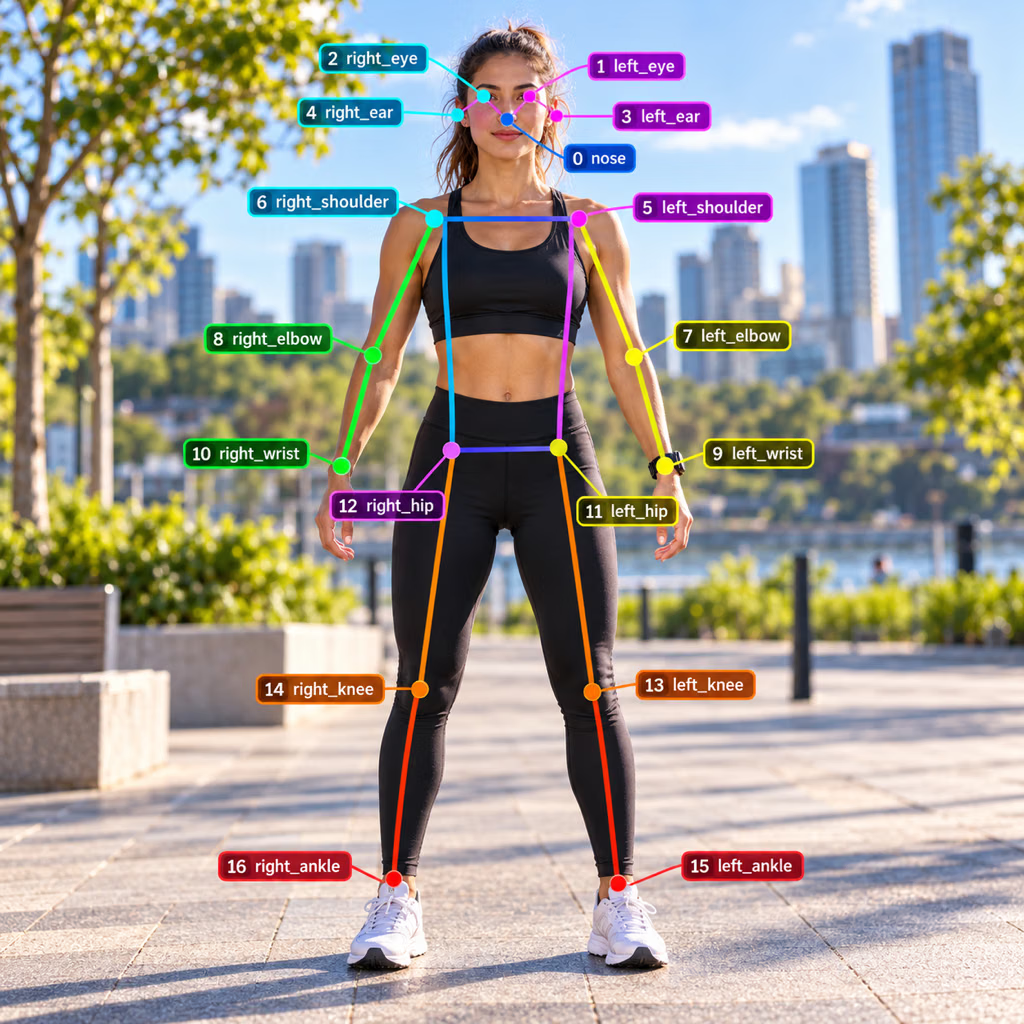
خريطة النقاط المفتاحية#
وسيطات AIGym#
إليك جدولًا بمعاملات AIGym:
| المعامل | النوع | الافتراضي | الوصف |
|---|---|---|---|
model | str | None | مسار ملف نموذج Ultralytics YOLO. |
up_angle | float | 145.0 | عتبة زاوية وضعية «الأعلى». |
down_angle | float | 90.0 | عتبة زاوية وضعية «الأسفل». |
kpts | list[int] | [6, 8, 10] | قائمة بثلاثة فهارس للنقاط المفتاحية تُستخدم لمراقبة التمارين. وتتوافق هذه النقاط المفتاحية مع مفاصل الجسم أو أجزائه، مثل الكتفين والمرفقين والمعصمين، في تمارين مثل الضغط والعقلة والقرفصاء وتمارين البطن. |
line_width | int | 2 | سماكة الخط للصناديق والنقاط المفتاحية والعدادات التي يرسمها الحل. |
verbose | bool | True | يفعّل سجل الحل لكل إطار، ويشمل شكل المدخل وعدد الفئات وسرعة المعالجة. يظل استدعاء التتبع نفسه صامتًا دائمًا. |
يدعم الحل AIGym أيضاً مجموعة من معلمات تتبّع الأجسام:
| المعامل | النوع | الافتراضي | الوصف |
|---|---|---|---|
tracker | str | 'tracktrack.yaml' | يحدد خوارزمية التتبع المطلوب استخدامها. الخيارات المضمنة: botsort.yaml، bytetrack.yaml، ocsort.yaml، deepocsort.yaml، fasttrack.yaml، tracktrack.yaml. |
conf | float | 0.25 | يضبط عتبة الثقة للكشوفات؛ إذ تسمح القيم الأقل بتتبع مزيد من الكائنات، لكنها قد تتضمن إيجابيات كاذبة. |
iou | float | 0.5 | يضبط عتبة التقاطع على الاتحاد (IoU) لتصفية الكشوفات المتداخلة. |
classes | list | None | يصفّي النتائج حسب فهرس الفئة. على سبيل المثال، لا يتتبع classes=[0, 2, 3] إلا الفئات المحددة. |
device | str | None | يحدد الجهاز المستخدم للاستدلال (مثل cpu أو cuda:0 أو 0). ويتيح للمستخدمين الاختيار بين CPU أو GPU محددة أو أجهزة حوسبة أخرى لتنفيذ النموذج. |
imgsz | int or tuple | 640 | حجم صورة الاستدلال المستهدف: عدد صحيح لصورة مربعة، أو زوج (height, width). تُعدّل الأبعاد وفقًا لخطوة النموذج. |
max_det | int | 300 | الحد الأقصى لعدد الكشوفات التي يُحتفظ بها لكل إطار قبل التتبع، ما يحد من عدد الكائنات التي يعالجها الحل في المشاهد الكثيفة. |
quantize | int or str | None | دقة الاستدلال: 16 (FP16) أو 32/unset (FP32) لنماذج PyTorch وTorchScript خارج CPU؛ أما التنسيقات الأخرى فتستخدم الدقة التي يحددها الملف الاصطناعي وبيئة التشغيل. يحل هذا الوسيط محل الوسيطة half المهملة. |
بالإضافة إلى ذلك، يمكن تطبيق إعدادات التصور التالية:
| المعامل | النوع | الافتراضي | الوصف |
|---|---|---|---|
show | bool | False | إذا كان True، يعرض الصور أو مقاطع الفيديو المشروحة في نافذة. يفيد ذلك في الحصول على ملاحظات مرئية فورية أثناء التطوير أو الاختبار. |
show_labels | bool | True | يعرض تسميات كل اكتشاف في المخرجات المرئية، ما يتيح فهم الكائنات المكتشفة فورًا. |
الأسئلة الشائعة#
لمتابعة تمارينك باستخدام Ultralytics YOLO26، يمكنك الاستفادة من إمكانات تقدير الوضعية لتتبع معالم الجسم والمفاصل الرئيسية وتحليلها في الوقت الفعلي. يتيح لك ذلك تلقي ملاحظات فورية حول أداء التمرين، وعدّ التكرارات، وقياس مؤشرات الأداء. يمكنك البدء باستخدام نموذج التعليمات البرمجية المقدم لتمارين الضغط أو العقلة أو تمارين البطن كما هو موضح:
import cv2 from ultralytics import solutions cap = cv2.VideoCapture("path/to/video.mp4") assert cap.isOpened(), "Error reading video file" w, h, fps = (int(cap.get(x)) for x in (cv2.CAP_PROP_FRAME_WIDTH, cv2.CAP_PROP_FRAME_HEIGHT, cv2.CAP_PROP_FPS)) gym = solutions.AIGym( line_width=2, show=True, kpts=[6, 8, 10], ) while cap.isOpened(): success, im0 = cap.read() if not success: print("Video frame is empty or processing is complete.") break results = gym(im0) cap.release() cv2.destroyAllWindows()يوفّر استخدام Ultralytics YOLO26 لمراقبة التمارين عدة فوائد أساسية:
- تحسين الأداء: يمكنك تحقيق نتائج أفضل من خلال تخصيص التمارين استناداً إلى بيانات المراقبة.
- تحقيق الأهداف: تتبّع أهداف اللياقة البدنية وتعديلها بسهولة لقياس التقدم.
- التخصيص: احصل على خطط تمارين مخصصة استناداً إلى بياناتك الفردية لتحقيق أفضل فاعلية.
- الوعي الصحي: الكشف المبكر عن الأنماط التي تشير إلى مشكلات صحية محتملة أو الإفراط في التدريب.
- اتخاذ قرارات مستنيرة: اتخذ قرارات قائمة على البيانات لتعديل الروتين ووضع أهداف واقعية.
يمكنك مشاهدة عرض توضيحي على YouTube للاطلاع على هذه الفوائد عملياً.
تتتبع نماذج تقدير الوضعية في Ultralytics YOLO26 معالم الجسم والمفاصل الرئيسية بدقة وفي الوقت الفعلي، وتوفر ملاحظات موثوقة حول أداء التمرين وعدد التكرارات. عملياً، تعتمد الدقة أيضاً على زاوية الكاميرا والإضاءة والحجب واختيار قيم مناسبة لكل تمرين لـ
kptsوup_angleوdown_angle.نعم، يمكن تكييف Ultralytics YOLO26 مع روتينات تمارين مخصصة. تكتشف الفئة
AIGymتكرارات التمارين باستخدام الوسائطup_angleوdown_angleوkptsarguments. يمكنك تحديد النقاط المفتاحية والزوايا لاكتشاف تمارين بعينها. إليك مثالاً على الإعداد:from ultralytics import solutions gym = solutions.AIGym( line_width=2, show=True, kpts=[6, 8, 10], # لتمارين الضغط - يمكن تخصيصها لتمارين أخرى )تتيح لك هذه المرونة متابعة تمارين متنوعة وتخصيص الروتينات وفقاً لأهدافك المتعلقة باللياقة البدنية.
لحفظ مخرجات مراقبة التمارين، يمكنك تعديل التعليمات البرمجية لتضمين كاتب فيديو يحفظ الإطارات بعد معالجتها. إليك مثالاً:
import cv2

from ultralytics import solutions

cap = cv2.VideoCapture("path/to/video.mp4")
assert cap.isOpened(), "Error reading video file"
w, h, fps = (int(cap.get(x)) for x in (cv2.CAP_PROP_FRAME_WIDTH, cv2.CAP_PROP_FRAME_HEIGHT, cv2.CAP_PROP_FPS))

video_writer = cv2.VideoWriter("workouts.avi", cv2.VideoWriter_fourcc(*"mp4v"), fps, (w, h))

gym = solutions.AIGym(
    line_width=2,
    show=True,
    kpts=[6, 8, 10],
)

while cap.isOpened():
    success, im0 = cap.read()
    if not success:
        print("Video frame is empty or processing is complete.")
        break
    results = gym(im0)
    video_writer.write(results.plot_im)

cap.release()
video_writer.release()
cv2.destroyAllWindows()
يحفظ هذا الإعداد الفيديو الذي تمت مراقبته في ملف إخراج، ما يتيح لك مراجعة أدائك في التمارين لاحقاً أو مشاركته مع المدربين للحصول على ملاحظات إضافية.


التعليقات41
اطرح سؤالًا، وشارك نتائجك، أو ساعد شخصًا آخر.
 流川疯
May I ask how to obtain the value of step and perform some logical operations, such as counting to 10 times for pop-up reminders,many thanks
1 Glenn JocherUltralytics(تم التعديل)
@wynshiter the
AIGymsolution counts repetitions for you: callresults = gym_object(frame)and readresults.workout_count(one entry per tracked person). Add your own logic on top, for exampleif any(c >= 10 for c in results.workout_count):to trigger a pop-up reminder. For further details, please refer to the documentation on workouts monitoring.nel-mv
Thanks for your answer, Glenn. And the documentation on workouts monitoring is just this same page (https://docs.ultralytics.com/guides/workouts-monitoring) we are commenting on?
And from the comments you gave above, we know that we can get the angles from the gym object: im0, angle_data = gym_object.start_counting(im0, results)
I was expecting we could get the 'step' value similarly via a return variable.
Do you know where we could see a list of return variables that the gym object gives?
- Glenn JocherUltralytics(تم التعديل)
The
AIGymresults provideworkout_count,workout_stageandworkout_anglefor each tracked person (results = gym_object(frame)), so repetitions are counted for you. To act on them, add your own logic in your processing loop, for example whenworkout_countreaches a target. For further details, please refer to the Workouts Monitoring documentation. DanishkhanOp
Where to get the model
- Glenn JocherUltralytics(تم التعديل)
@DanishkhanOp the pose model (
yolo26n-pose.ptby default) is downloaded automatically the first timeAIGymis initialized, or you can download it manually from the Ultralytics YOLO26 Model Documentation. You can also specifymodel="yolo26n-pose.pt"in yourAIGym()constructor as shown in the workout monitoring examples.
AhmedMostafa3m
hello, i guess i came a little late , it ssems that start_counting method is not available any more i want to know how can i use the code above after updating. results = model.predict(frame, verbose=False) frame = gym_object.start_counting(frame, results) thanks alot
- Glenn JocherUltralytics(تم التعديل)
@AhmedMostafa3m
start_countinghas been replaced: the solution is now called directly on the frame and runs pose tracking itself, so no separatemodel.trackcall is needed:from ultralytics import solutions gym = solutions.AIGym(model="yolo26n-pose.pt") # Initialize once results = gym(frame) frame = results.plot_imFor full implementation details, see the AIGym documentation.
Where i can get the model
- Glenn JocherUltralytics(تم التعديل)
@DanishkhanOp the pose estimation model is used automatically when you initialize the
AIGymclass as shown in the code examples. By default it isyolo26n-pose.pt, which you can also set withmodel="yolo26n-pose.pt"in yoursolutions.AIGym()call; it will be downloaded from our servers if not already cached. For more details on pose models, visit our Keypoint Estimation Docs.
AdadAlShabab
Hi. Suppose I'm detecting the angle between [8, 6, 12] and I wanna show text something like: "The angle between Shoulder and Wrist : {detected angle}" using cv2.putText. How3 can I do that?
- Glenn JocherUltralytics
@AdadAlShabab to display the angle using
cv2.putText, you can calculate the angle between the keypoints and then overlay the text on the image. Here's a minimal example:import cv2 import numpy as np # Assuming you have the coordinates of the keypoints shoulder = np.array([x1, y1]) elbow = np.array([x2, y2]) wrist = np.array([x3, y3]) # Calculate the angle angle = np.degrees(np.arctan2(wrist[1] - elbow[1], wrist[0] - elbow[0]) - np.arctan2(shoulder[1] - elbow[1], shoulder[0] - elbow[0])) # Display the angle cv2.putText(im0, f"Angle: {angle:.2f}", (50, 50), cv2.FONT_HERSHEY_SIMPLEX, 0.5, (255, 255, 255), 2)This will show the angle between the shoulder, elbow, and wrist on your video frame. Adjust the coordinates and text position as needed.
1 Hi Glenn. Thanks for your wonderful reply. Can you please tell the about the keypoints [x1, y1]? Like : "shoulder = np.array([x1, y1]) elbow = np.array([x2, y2]) wrist = np.array([x3, y3]" What values should I put here?
- Glenn JocherUltralytics
@AdadAlShabab to determine the values for keypoints like [x1, y1], you need to extract them from the model's output. When you run the model, it provides coordinates for each keypoint. For example,
results[0].keypointswill give you the keypoints, and you can access specific ones using their indices. Adjust these based on your specific use case. This code: " if result[0].keypoints is not None: keypoints = result[0].keypoints.data.cpu().numpy() # Access the actual keypoints data
                # Debugging: Print keypoints shape to understand the issue
                print(f"Keypoints shape: {keypoints.shape}")"
Providing me results for each frame: 0: 384x640 1 person, 45.3ms Speed: 2.0ms preprocess, 45.3ms inference, 0.0ms postprocess per image at shape (1, 3, 384, 640) Keypoints shape: (1, 17, 3) Person keypoints shape: (17, 3) Keypoint 0: (x=1086.50, y=456.84), Confidence=0.97 Keypoint 1: (x=1098.32, y=446.95), Confidence=0.95 Keypoint 2: (x=1077.20, y=450.47), Confidence=0.90 Keypoint 3: (x=1121.03, y=453.73), Confidence=0.87 Keypoint 4: (x=1068.29, y=461.00), Confidence=0.64 Keypoint 5: (x=1147.66, y=499.11), Confidence=0.99 Keypoint 6: (x=1054.84, y=529.72), Confidence=0.98 Keypoint 7: (x=1192.78, y=521.58), Confidence=0.98 Keypoint 8: (x=1061.91, y=577.40), Confidence=0.90 Keypoint 9: (x=1161.27, y=528.25), Confidence=0.95 Keypoint 10: (x=1100.56, y=558.10), Confidence=0.86 Keypoint 11: (x=1189.49, y=611.80), Confidence=0.99 Keypoint 12: (x=1134.91, y=632.54), Confidence=0.98 Keypoint 13: (x=1234.99, y=644.81), Confidence=0.97 Keypoint 14: (x=1194.94, y=665.07), Confidence=0.94 Keypoint 15: (x=1295.68, y=737.43), Confidence=0.88 Keypoint 16: (x=1300.56, y=750.85), Confidence=0.85
Are these the values you were talking about?
- Glenn JocherUltralytics(تم التعديل)
Yes, those are the keypoint values. You can use them to calculate angles between specific joints. For example, use the coordinates of keypoints 8 (elbow), 6 (shoulder), and 12 (hip) to compute the angle and display it with
cv2.putText. If you need further assistance, feel free to ask!
actionTurtle
If I wanted to count how many steps you took running. Would you just set the pose type to "running"? Or do I need to make my own model for running? Thank you
- Glenn JocherUltralytics
@actionTurtle to count steps for running, you'll need to customize the model since "running" isn't a predefined pose type like "pushup" or "pullup." You can adapt the existing model by training it with running-specific keypoints. For more details, please refer to the workouts monitoring guide.
"You can adapt the existing model by training it with running-specific keypoints."
Sorry, I still don't understand. Is there a walk though of how I would do that?
- Glenn JocherUltralytics
@actionTurtle to create a custom model for running, you'll need to train it with running-specific keypoints. Unfortunately, there's no built-in "running" pose type, so you'll need to gather a dataset of running poses and train the model accordingly. For a detailed guide on training custom models, please refer to the Ultralytics documentation.
Hi. The model is working pretty fine. But when I'm running the python file the detected angle data are shown in box. But I want to have the data stored in variable or maybe a list so that I can use them use outside or print in console. Please help.
- Glenn JocherUltralytics(تم التعديل)
@AdadAlShabab to store the detected angle data in a list, read
workout_anglefrom the results the solution returns for each frame. Here's a basic example:import cv2 from ultralytics import solutions cap = cv2.VideoCapture("path/to/video/file.mp4") assert cap.isOpened(), "Error reading video file" gym_object = solutions.AIGym(model="yolo26n-pose.pt", kpts=[6, 8, 10], show=True) angles = [] while cap.isOpened(): success, im0 = cap.read() if not success: break results = gym_object(im0) angles.append(results.workout_angle) # one angle per tracked person cap.release() cv2.destroyAllWindows() print(angles)This will store the angle data in the
angleslist for further use.2 Hi. I want detect angle of two hands simultaneously. So I wrote the code : gym_object = solutions.AIGym( line_thickness=2, view_img=True, pose_type="pushup", kpts_to_check={[8, 6, 12,],[5, 7, 9]}, )
But it giving me error: TypeError: unhashable type: 'list'
How to solve? Please let me know. TIA
- Glenn JocherUltralytics(تم التعديل)
kptsmust be a flat list of three keypoint indices, written with square brackets, for examplekpts=[6, 8, 10]. Curly braces raise the "unhashable type" error, and nested lists such as[[8, 6, 12], [5, 7, 9]]are not supported. To track two sets of keypoints, create oneAIGyminstance for each:gym_left = solutions.AIGym(kpts=[5, 7, 9]) gym_right = solutions.AIGym(kpts=[6, 8, 10]) Hi Glenn! Still it throwing error: im0 = gym_object.start_counting(im0, results) ^^^^^^^^^^^^^^^^^^^^^^^^^^^^^^^^^^^^^^^ File "E:\Bass fish streamlit.venv\Lib\site-packages\ultralytics\solutions\ai_gym.py", line 85, in start_counting k[int(self.kpts_to_check[0])].cpu(), ^^^^^^^^^^^^^^^^^^^^^^^^^^ TypeError: int() argument must be a string, a bytes-like object or a real number, not 'list'
- Glenn JocherUltralytics(تم التعديل)
The error occurs because
kptsshould be a flat list of three integers, not nested lists. To track both hands, create a separateAIGyminstance for each set of keypoints and run both on every frame. If you need further assistance, please check the latest documentation or update your package to the latest version.
 sg zhou
Can we train extra classes for pose prediction?
- Glenn JocherUltralytics
@Shengguang-Zhou yes, you can train extra classes for pose prediction by customizing the
AIGymclass and specifying the keypoints and angles for the exercises you want to monitor. For more details, please refer to the Workouts Monitoring Guide.
MarserHK
Hello, I would like to ask if there are any examples of using YOLOv8 for behavior recognition in electrical power field scenarios?
- Glenn JocherUltralytics
@MarserHK currently, we don't have specific examples for behavior recognition in electrical power field scenarios. However, you can adapt the pose estimation capabilities of YOLOv8 for such tasks by training on relevant datasets. For more details on pose estimation, you can refer to the workouts monitoring guide here.
duncanwaugh
Hello, it seems like it has to be setup for a specific type of workout eg. pushups and then it would track pushups, but if you started squatting it wouldn't track your squats. I'm curious if there is a way where U can have a live video feed where lets say you do 10 pushups, then 10 pullups, it will identify how its a different exercise and count it. Thanks.
- Glenn JocherUltralytics(تم التعديل)
Hello,
Thank you for your insightful question! You're correct that the current setup of the
AIGymsolution in Ultralytics YOLOv8 is designed to track specific types of workouts like pushups, pullups, and ab workouts individually. However, your idea of dynamically identifying and counting different exercises in a single session is quite intriguing and can be approached with some modifications.Dynamic Workout Detection and Counting
To achieve dynamic detection and counting of different exercises, you would need to implement a mechanism that can:
- Identify the type of exercise being performed: This could be done by analyzing the keypoint movements and angles to classify the exercise type.
- Switch the counting logic based on the identified exercise: Once the exercise type is identified, the corresponding counting logic can be applied.
Here's a conceptual approach to get you started:
- Exercise Classification: Use a simple heuristic or a machine learning model to classify the exercise based on keypoint movements.
- Dynamic Counting: Switch between different
AIGymconfigurations based on the classified exercise.
Example Code
Below is a basic example to illustrate this concept. Note that this is a starting point and may require further refinement based on your specific requirements.
import cv2
from ultralytics import YOLO, solutions

# Load the pose estimation model
model = YOLO("yolo26n-pose.pt")
cap = cv2.VideoCapture("path/to/video/file.mp4")
assert cap.isOpened(), "Error reading video file"
w, h, fps = (int(cap.get(x)) for x in (cv2.CAP_PROP_FRAME_WIDTH, cv2.CAP_PROP_FRAME_HEIGHT, cv2.CAP_PROP_FPS))

# Initialize video writer if needed
video_writer = cv2.VideoWriter("workouts.avi", cv2.VideoWriter_fourcc(*"mp4v"), fps, (w, h))

# Define a function to classify the exercise type
def classify_exercise(keypoints):
    # Placeholder logic for exercise classification
    # Replace with actual logic based on keypoint analysis
    if some_condition_based_on_keypoints:
        return "pushup"
    elif some_other_condition_based_on_keypoints:
        return "pullup"
    else:
        return "unknown"

# Initialize the AIGym object
gym_objects = {
    "pushup": solutions.AIGym(show=True, kpts=[6, 8, 10]),
    "pullup": solutions.AIGym(show=True, kpts=[6, 8, 10]),
    # Add other exercises as needed
}

frame_count = 0
current_exercise = "unknown"
while cap.isOpened():
    success, im0 = cap.read()
    if not success:
        print("Video frame is empty or video processing has been successfully completed.")
        break
    frame_count += 1
    results = model.track(im0, verbose=False)  # Tracking recommended

    # Classify the exercise based on keypoints
    keypoints = results[0].keypoints
    exercise_type = classify_exercise(keypoints)

    if exercise_type in gym_objects:
        gym_object = gym_objects[exercise_type]
        im0 = gym_object(im0).plot_im  # AIGym runs its own pose tracking

    video_writer.write(im0)

cv2.destroyAllWindows()
video_writer.release()
Next Steps
- Refine Exercise Classification: Develop a robust method to classify exercises based on keypoint data. This could involve machine learning models trained on labeled exercise data.
- Expand Exercise Types: Add more exercises to the
gym_objectsdictionary and their corresponding keypoint checks. - Optimize Performance: Ensure the solution runs efficiently in real-time, especially if processing live video feeds.
For more detailed guidance and advanced configurations, you can refer to our Workouts Monitoring Guide.
Feel free to experiment with this approach and let us know how it works for you! If you encounter any issues or have further questions, don't hesitate to reach out.
- Glenn JocherUltralytics(تم التعديل)
@duncanwaugh hello,
Thank you for your insightful question! You're correct that the current setup of Ultralytics YOLOv8 for workout monitoring is designed to track specific exercises like pushups, pullups, and ab workouts individually. However, your idea of having a live video feed that can dynamically identify and count different exercises in sequence is fascinating and certainly feasible with some modifications.
Dynamic Exercise Recognition
To achieve dynamic exercise recognition, you would need to implement a mechanism that can classify the type of exercise being performed in real-time and then switch to the matching
AIGymcounter. Here's a high-level approach to how you might achieve this:-
Exercise Classification: Use a classification model to identify the type of exercise being performed. This model can be trained to recognize different exercises based on the input video frames.
-
Counter Switching: Once the exercise type is identified, switch to the
AIGyminstance (keypointskpts) for that exercise. This can be done dynamically within the video processing loop.
Example Implementation
Below is a simplified example to illustrate this concept. This example assumes you have a model for exercise classification;
AIGymruns its own pose model.import cv2 from ultralytics import YOLO, solutions # Load models classification_model = YOLO("exercise_classification_model.pt") cap = cv2.VideoCapture("path/to/video/file.mp4") assert cap.isOpened(), "Error reading video file" w, h, fps = (int(cap.get(x)) for x in (cv2.CAP_PROP_FRAME_WIDTH, cv2.CAP_PROP_FRAME_HEIGHT, cv2.CAP_PROP_FPS)) gym_objects = { "pushup": solutions.AIGym(show=True, kpts=[6, 8, 10]), "pullup": solutions.AIGym(show=True, kpts=[6, 8, 10]), "squat": solutions.AIGym(show=True, kpts=[12, 14, 16]) } current_exercise = None frame_count = 0 while cap.isOpened(): success, im0 = cap.read() if not success: print("Video frame is empty or video processing has been successfully completed.") break frame_count += 1 # Classify exercise type every few frames if frame_count % 30 == 0: # Adjust frequency as needed classification_results = classification_model.predict(im0) current_exercise = classification_model.names[classification_results[0].probs.top1] # class name of the top-1 prediction if current_exercise: gym_object = gym_objects[current_exercise] im0 = gym_object(im0).plot_im # AIGym runs its own pose tracking cv2.imshow("Workout Monitoring", im0) if cv2.waitKey(1) & 0xFF == ord("q"): break cap.release() cv2.destroyAllWindows()Key Points:
- Exercise Classification: The
classification_modelpredicts the type of exercise. - Counter Switching: Based on the predicted exercise, the corresponding
AIGymobject is used. - Dynamic Processing: This setup allows for dynamic switching between different exercises during a workout session.
This approach provides a flexible and scalable solution for monitoring multiple types of exercises in a single session. For more detailed guidance and advanced configurations, you can refer to our Workouts Monitoring Guide.
Feel free to experiment with this setup and adjust it to better fit your specific use case. If you encounter any issues or have further questions, don't hesitate to reach out!
-
awesome thanks
- Glenn JocherUltralytics(تم التعديل)
@duncanwaugh hello,
Thank you for your enthusiasm! 😊
To address your query about dynamically identifying and counting different exercises within a single workout session, such as transitioning from pushups to pullups, you would need to implement a mechanism that can classify the type of exercise being performed in real-time and then switch to the matching
AIGymcounter.Dynamic Exercise Recognition
Here's a high-level approach to achieve this:
- Exercise Classification: Use a classification model to identify the type of exercise being performed. This model can be trained to recognize different exercises based on the input video frames.
- Counter Switching: Once the exercise type is identified, switch to the
AIGyminstance (keypointskpts) for that exercise. This can be done dynamically within the video processing loop.
Example Implementation
Below is a simplified example to illustrate this concept. This example assumes you have a model for exercise classification;
AIGymruns its own pose model.import cv2 from ultralytics import YOLO, solutions # Load models classification_model = YOLO("exercise_classification_model.pt") cap = cv2.VideoCapture("path/to/video/file.mp4") assert cap.isOpened(), "Error reading video file" w, h, fps = (int(cap.get(x)) for x in (cv2.CAP_PROP_FRAME_WIDTH, cv2.CAP_PROP_FRAME_HEIGHT, cv2.CAP_PROP_FPS)) gym_objects = { "pushup": solutions.AIGym(show=True, kpts=[6, 8, 10]), "pullup": solutions.AIGym(show=True, kpts=[6, 8, 10]), "squat": solutions.AIGym(show=True, kpts=[12, 14, 16]) } current_exercise = None frame_count = 0 while cap.isOpened(): success, im0 = cap.read() if not success: print("Video frame is empty or video processing has been successfully completed.") break frame_count += 1 # Classify exercise type every few frames if frame_count % 30 == 0: # Adjust frequency as needed classification_results = classification_model.predict(im0) current_exercise = classification_model.names[classification_results[0].probs.top1] # class name of the top-1 prediction if current_exercise: gym_object = gym_objects[current_exercise] im0 = gym_object(im0).plot_im # AIGym runs its own pose tracking cv2.imshow("Workout Monitoring", im0) if cv2.waitKey(1) & 0xFF == ord("q"): break cap.release() cv2.destroyAllWindows()Key Points:
- Exercise Classification: The
classification_modelpredicts the type of exercise. - Counter Switching: Based on the predicted exercise, the corresponding
AIGymobject is used. - Dynamic Processing: This setup allows for dynamic switching between different exercises during a workout session.
This approach provides a flexible and scalable solution for monitoring multiple types of exercises in a single session. For more detailed guidance and advanced configurations, you can refer to our Workouts Monitoring Guide.
Feel free to experiment with this setup and adjust it to better fit your specific use case. If you encounter any issues or have further questions, don't hesitate to reach out!
1
felipeca2
hello, this is possible whit CLI? thanks
 Paula DerrengerUltralytics(تم التعديل)
Hello,
Yes, you can monitor workouts using the CLI with the
workoutsolution:yolo solutions workout source=path/to/video/file.mp4 kpts="[6, 8, 10]"The
kptsargument selects the three keypoints whose angle is counted ([6, 8, 10]is for pushups). For more detailed information, please refer to the documentation.Happy training! 💪