Live-Inferenz mit einer Streamlit-Anwendung und Ultralytics YOLO26
Einführung#
Mit Streamlit lassen sich interaktive Webanwendungen einfach erstellen und bereitstellen. Die Kombination mit Ultralytics YOLO26 ermöglicht Objekterkennung und Analyse in Echtzeit direkt im Browser. Dank seiner Geschwindigkeit und Genauigkeit eignet sich YOLO26 für Live-Videostreams in Anwendungen wie Sicherheit und Einzelhandel.
Ansehen: So erstellst du mit Ultralytics YOLO26 und Streamlit eine Live-Inferenz-App | Erkennung und Segmentierung 🚀
| Aquakultur | Tierhaltung |
|---|---|
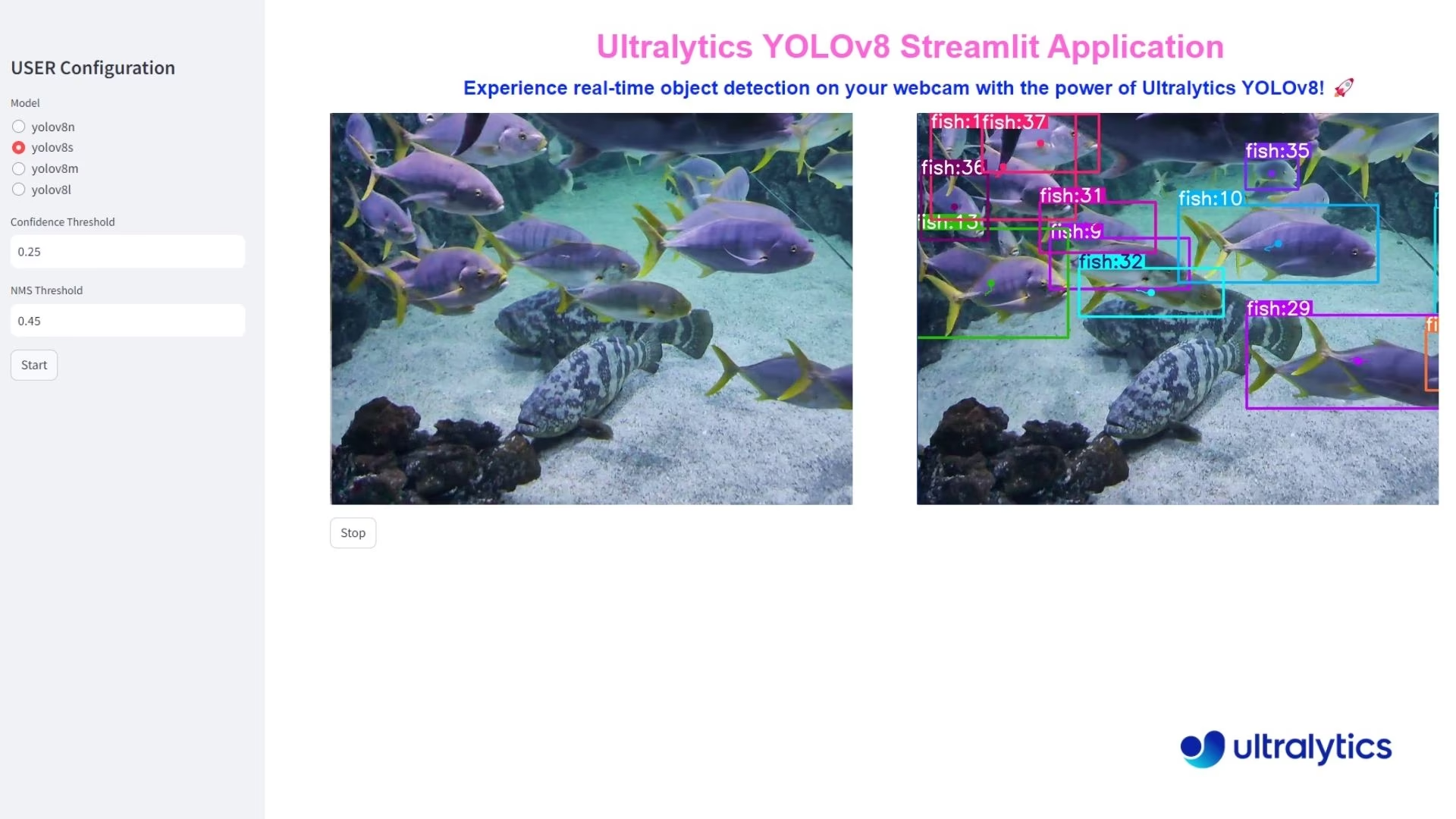 | 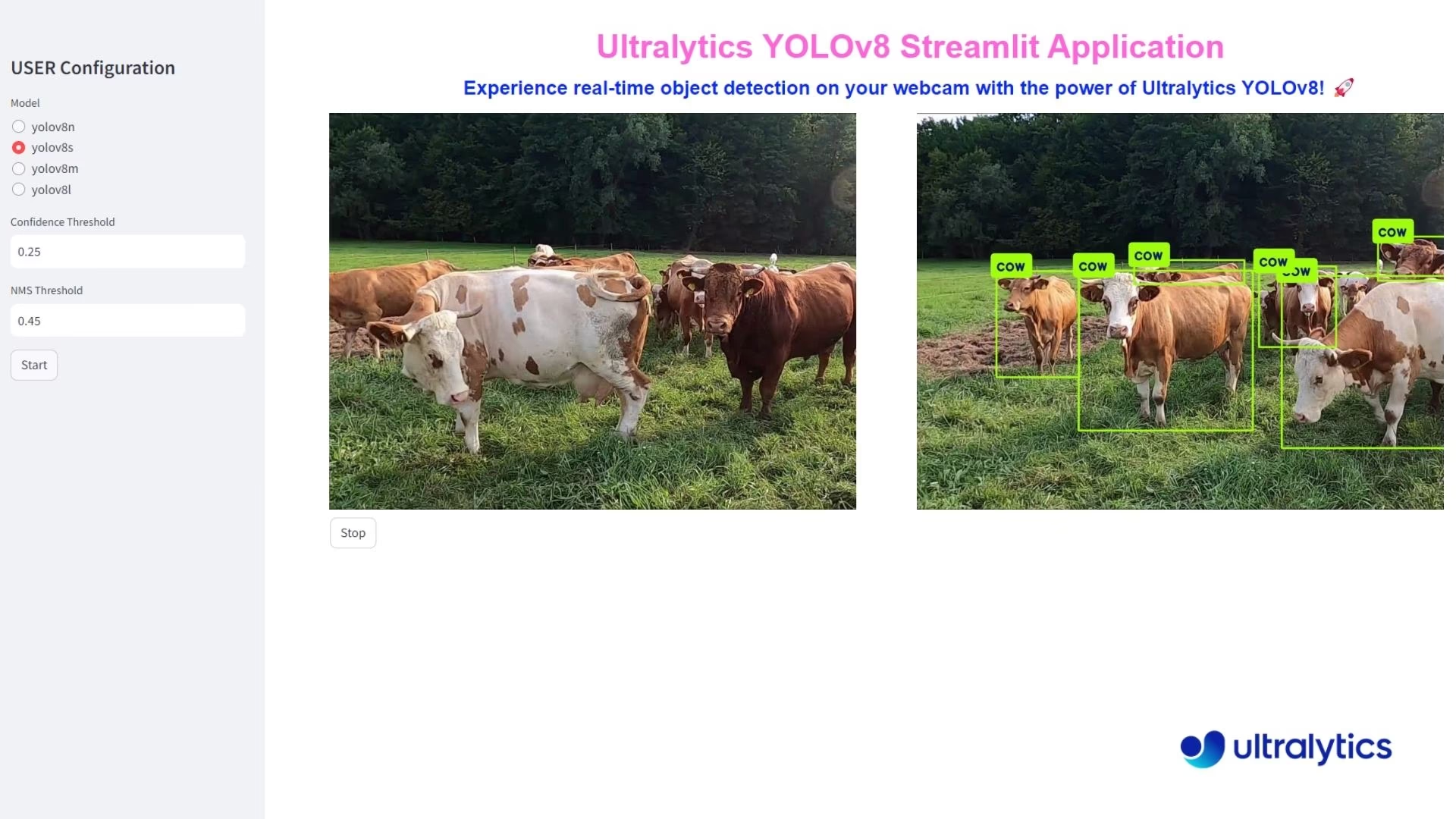 |
| Fischerkennung mit Ultralytics YOLO26 | Tiererkennung mit Ultralytics YOLO26 |
Vorteile der Live-Inferenz#
- Objekterkennung in Echtzeit: Mit Streamlit und YOLO26 kannst du Objekte in Echtzeit direkt im Webcam-Stream erkennen. Das ermöglicht sofortige Analysen und Erkenntnisse und eignet sich daher ideal für Anwendungen, die sofortige Rückmeldungen erfordern.
- Benutzerfreundliche Bereitstellung: Dank der interaktiven Oberfläche von Streamlit lässt sich die Anwendung ohne umfangreiche technische Kenntnisse einfach bereitstellen und nutzen. Die Live-Inferenz kann mit einem einzigen Klick gestartet werden, wodurch die Anwendung zugänglicher und einfacher zu bedienen ist.
- Effiziente Ressourcennutzung: Die optimierten Algorithmen von YOLO26 ermöglichen eine hohe Verarbeitungsgeschwindigkeit bei minimalem Rechenaufwand. Dank dieser Effizienz läuft die Inferenz über die Webcam selbst auf Standardhardware reibungslos und zuverlässig. So wird fortschrittliche Computer Vision einem breiteren Publikum zugänglich.
Streamlit-Anwendungscode#
Stelle vor dem Erstellen der Anwendung sicher, dass das Python-Paket Ultralytics installiert ist.
pip install ultralyticsyolo solutions inference
yolo solutions inference model="path/to/model.pt"
yolo solutions help # list the available solution commands and argumentsMit diesen Befehlen startest du die standardmäßige Streamlit-Oberfläche, die mit Ultralytics ausgeliefert wird.
Dadurch wird die Streamlit-Anwendung in deinem Standardbrowser gestartet. Du siehst den Haupttitel, den Untertitel und die Seitenleiste mit Konfigurationsoptionen. Wähle dein gewünschtes YOLO26-Modell aus, lege die Konfidenz- und NMS-Schwellenwerte fest und klicke auf die Schaltfläche „Start“, um die Objekterkennung in Echtzeit zu starten.
So funktioniert es#
Im Hintergrund verwendet die Streamlit-Anwendung das Ultralytics-Lösungsmodul, um eine interaktive Oberfläche zu erstellen. Wenn du die Inferenz startest, führt die Anwendung Folgendes aus:
- Erfasst Einzelbilder von deiner Webcam, aus einer hochgeladenen Videodatei oder aus hochgeladenen Bildern
- Verarbeitet jedes Einzelbild mit dem YOLO26-Modell
- Führt die Objekterkennung mit den von dir festgelegten Konfidenz- und IoU-Schwellenwerten aus
- Zeigt den Originalframe und den annotierten Frame in Echtzeit an
- Aktiviert bei Auswahl optional die Objektverfolgung
Die Anwendung bietet eine übersichtliche, benutzerfreundliche Oberfläche mit Steuerelementen zum Anpassen der Modellparameter und zum jederzeitigen Starten und Stoppen der Inferenz.
Fazit#
Mit dieser Anleitung hast du eine Anwendung zur Objekterkennung in Echtzeit mit Streamlit und Ultralytics YOLO26 erstellt. Die Anwendung führt YOLO26 über eine einfache Benutzeroberfläche auf dem Webcam-, Video- oder Bildeingang aus. Du kannst den Stream jederzeit anhalten.
Weitere Verbesserungen kannst du erkunden, indem du Funktionen wie das Aufzeichnen des Videostreams, das Speichern der markierten Einzelbilder oder die Integration mit anderen Bibliotheken für Computer Vision hinzufügst.
Häufig gestellte Fragen#
Eine Anwendung zur Objekterkennung in Echtzeit mit Streamlit und Ultralytics YOLO26 einzurichten, ist unkompliziert. Stelle zunächst sicher, dass das Python-Paket Ultralytics installiert ist:
pip install ultralyticsAnschließend kannst du eine einfache Streamlit-Anwendung erstellen, um Live-Inferenz auszuführen:
Streamlit-Anwendungfrom ultralytics import solutions inf = solutions.Inference( model="yolo26n.pt", # Du kannst jedes von Ultralytics unterstützte Modell verwenden, z. B. YOLO26 oder ein benutzerdefiniertes, trainiertes Modell. ) inf.inference() # Achte darauf, die Datei mit dem Befehl `streamlit run path/to/file.py` auszuführen.Weitere Informationen zur praktischen Einrichtung findest du im Dokumentationsabschnitt Streamlit-Anwendungscode.
Die Verwendung von Ultralytics YOLO26 mit Streamlit zur Objekterkennung in Echtzeit bietet mehrere Vorteile:
- Erkennung in Echtzeit: Erziele eine hohe Genauigkeit und erkenne Objekte in Echtzeit direkt in Webcam-Streams.
- Benutzerfreundliche Oberfläche: Die intuitive Oberfläche von Streamlit ermöglicht eine einfache Nutzung und Bereitstellung ohne umfangreiche technische Kenntnisse.
- Ressourcenschonend: Die optimierten Algorithmen von YOLO26 ermöglichen eine schnelle Verarbeitung bei minimalem Rechenaufwand.
Weitere Informationen zu diesen Vorteilen findest du im Abschnitt Vorteile der Live-Inferenz.
Nachdem du deine Streamlit-Anwendung mit Ultralytics YOLO26 programmiert hast, kannst du sie mit folgendem Befehl starten:
streamlit run path/to/file.pyDieser Befehl startet die Anwendung in deinem Standardbrowser. Dort kannst du YOLO26-Modelle auswählen, Konfidenz- und IoU-Schwellenwerte festlegen und die Echtzeit-Objekterkennung mit einem einfachen Klick starten.
Die Objekterkennung in Echtzeit mit Streamlit und Ultralytics YOLO26 lässt sich in verschiedenen Bereichen einsetzen:
- Sicherheit: Echtzeitüberwachung auf unbefugten Zutritt und Sicherheitsalarmsysteme.
- Einzelhandel: Kundenzählung, Regalverwaltung und Bestandsverfolgung.
- Wildtiere und Landwirtschaft: Überwachung von Tieren und Erntebedingungen zur Unterstützung von Naturschutzmaßnahmen.
Weitere ausführliche Anwendungsfälle und Beispiele findest du unter Ultralytics Solutions.
Ultralytics YOLO26 bietet gegenüber früheren Modellen wie YOLOv5 und Detektoren der R-CNN-Familie mehrere Verbesserungen:
- Höhere Geschwindigkeit und Genauigkeit: Verbesserte Leistung für Echtzeitanwendungen.
- Einfache Anwendung: Vereinfachte Oberflächen und Bereitstellung.
- Ressourcenschonend: Für höhere Geschwindigkeit bei minimalem Rechenaufwand optimiert.


Kommentare26
Stell eine Frage, teile deine Ergebnisse oder hilf jemand anderem.
j3dd4h
the manual execution using rknn model (yolo predict model='./best_rknn_model' source='ppe.jpg') is working but got an error when running under Streamlit.
TypeError: model='best_rknn_model/best-rk3588.rknn' is not a supported model format. Ultralytics supports: ('PyTorch', 'TorchScript', 'ONNX', 'OpenVINO', 'TensorRT', 'CoreML', 'TensorFlow SavedModel', 'TensorFlow GraphDef', 'TensorFlow Lite', 'TensorFlow Edge TPU', 'TensorFlow.js', 'PaddlePaddle', 'MNN', 'NCNN', 'IMX', 'RKNN') See https://docs.ultralytics.com/modes/predict for help.
1RizwanMunawar
@j3dd4h Hi, thanks for sharing the details. We currently don't support the rknn model, but you can adjust this check in code to make the application work for rknn models. We will add support for this soon.
Ok, got it
@j3dd4h opened the Pull request here: https://github.com/ultralytics/ultralytics/pull/22212
NNQHuong
AttributeError: module 'torch' has no attribute '__version__' Traceback: File "C:\Users\myname\AppData\Local\Packages\PythonSoftwareFoundation.Python.3.11_qbz5n2kfra8p0\LocalCache\local-packages\Python311\site-packages\streamlit\runtime\scriptrunner\exec_code.py", line 88, in exec_func_with_error_handling result = func() ^^^^^^ File "C:\Users\myname\AppData\Local\Packages\PythonSoftwareFoundation.Python.3.11_qbz5n2kfra8p0\LocalCache\local-packages\Python311\site-packages\streamlit\runtime\scriptrunner\script_runner.py", line 579, in code_to_exec exec(code, module.__dict__) File "C:\WasteSegregation\app.py", line 1, in <module> from ultralytics import solutions File "C:\Users\myname\AppData\Local\Packages\PythonSoftwareFoundation.Python.3.11_qbz5n2kfra8p0\LocalCache\local-packages\Python311\site-packages\ultralytics\__init__.py", line 11, in <module> from ultralytics.models import NAS, RTDETR, SAM, YOLO, FastSAM, YOLOWorld File "C:\Users\myname\AppData\Local\Packages\PythonSoftwareFoundation.Python.3.11_qbz5n2kfra8p0\LocalCache\local-packages\Python311\site-packages\ultralytics\models\__init__.py", line 3, in <module> from .fastsam import FastSAM File "C:\Users\myname\AppData\Local\Packages\PythonSoftwareFoundation.Python.3.11_qbz5n2kfra8p0\LocalCache\local-packages\Python311\site-packages\ultralytics\models\fastsam\__init__.py", line 3, in <module> from .model import FastSAM File "C:\Users\myname\AppData\Local\Packages\PythonSoftwareFoundation.Python.3.11_qbz5n2kfra8p0\LocalCache\local-packages\Python311\site-packages\ultralytics\models\fastsam\model.py", line 5, in <module> from ultralytics.engine.model import Model File "C:\Users\myname\AppData\Local\Packages\PythonSoftwareFoundation.Python.3.11_qbz5n2kfra8p0\LocalCache\local-packages\Python311\site-packages\ultralytics\engine\model.py", line 11, in <module> from ultralytics.cfg import TASK2DATA, get_cfg, get_save_dir File "C:\Users\myname\AppData\Local\Packages\PythonSoftwareFoundation.Python.3.11_qbz5n2kfra8p0\LocalCache\local-packages\Python311\site-packages\ultralytics\cfg\__init__.py", line 12, in <module> from ultralytics.utils import ( File "C:\Users\myname\AppData\Local\Packages\PythonSoftwareFoundation.Python.3.11_qbz5n2kfra8p0\LocalCache\local-packages\Python311\site-packages\ultralytics\utils\__init__.py", line 51, in <module> TORCH_VERSION = torch.__version__ ^^^^^^^^^^^^^^^^^This is the error I encountered when usingfrom ultralytics import solutionssolutions.inference(model =r'C:path\to\my\model.pt')method (VSCode), can you please explain it to me? For further information, I've tried using the method for CLI and it works, but not with VSCode. I wonder if there's any method for CLI that allows me to use my custom trained model? It's YOLO11n-cls version. Thank you for reading this!1 Glenn JocherUltralytics
@NNQHuong the error you're encountering suggests a possible issue with your PyTorch installation. Please verify that PyTorch is properly installed and compatible with your Python version by running:
import torch
print(torch.__version__)
If the error persists, ensure you're using the latest version of PyTorch and Ultralytics with:
pip install --upgrade torch ultralyticsRegarding your CLI query, you can use your custom-trained YOLO11 model by specifying the model path directly, like so:
yolo predict model=path/to/your/model.pt source=your_inputFor detailed examples, check the documentation here. Let me know if additional assistance is required!
2Hi @NNQHuong, thank you for sharing the error log! It appears that the issue might be related to your PyTorch version. You may need to upgrade or downgrade it to ensure everything works correctly.
However, if this still doesn't resolve the issue, please share your code here for further testing.
Thanks, Ultralytics Team!
1Thanks for your infomative reply, it worked smoothly! I'm kind of new to this field anyway, about 6 months , I bet you can see it in my words haha, so thanks for your patience too!
1
Tech-Watt
Is it posible to use different camera index ?. It picks up the default computer webcam and there's no means of changing it.
- Glenn JocherUltralytics(bearbeitet)
The
Inferenceclass has nosourceargument: selecting "webcam" in the sidebar always opens camera index0(self.vid_file_name = 0inultralytics/solutions/streamlit_inference.py). To use a different camera, make it your system's default camera or change that index in the file:inf = solutions.Inference(model="yolo26n.pt") inf.inference()Run it with
streamlit run <file-name.py>.
Vectorvin
streamlit 这个解决方案可以使用tensorRT格式或者onnx格式吗?似乎程序被写死了
- Glenn JocherUltralytics(bearbeitet)
@Vectorvin 您好!Streamlit 方案现在也支持导出的模型格式:除了
.pt,还可以把.onnx、.torchscript、.mlpackage、.engine(TensorRT)、OpenVINO 或 RKNN 模型路径传给solutions.Inference(model="yolo26n.engine")。导出步骤请参考导出文档。需要企业级部署支持请访问ultralytics.com/license。
sathyanarayanaRP
how does the streamlit gets is input , is it possible to push frames or is it possible to integrate machine vision cameras that does not support RTSP protocals. i need comprehensive knowledge how does it work as a streaming device
- Glenn JocherUltralytics
@sathyanarayanaRP streamlit can receive input directly from a webcam or video file. For cameras that don't support RTSP, you can use USB or other compatible connections. The Streamlit app processes frames in real-time, allowing for seamless integration with various camera types. For more details, please refer to the Streamlit documentation.
Cheikh-Ahmedand
hey!
Once I run the app my Laptop camera turns on, instead of My webcam. How to use my external webcam instead of my LAPTOP camera?
Best Regards!
- Glenn JocherUltralytics(bearbeitet)
@Cheikh-Ahmedand the Streamlit app has no
sourceargument: choosing "webcam" in the sidebar always opens camera index0(self.vid_file_name = 0inultralytics/solutions/streamlit_inference.py). To use your external webcam, make it the system's default camera, or change that index to1(or the index of your webcam) in the file.Run the app with
yolo solutions inference, or withstreamlit run <file-name.py>for your own script. Hey ! Thanks lot for your response, but the code couldn't work with streamlit code. I pasted the following code on my Laptop anconda PowerShell Prompt:
yolo streamlit-predict solutions.inference(source=1)
Still, my Webcam can't run, but my Laptop 's Camera.
Also, I tried the below code in jupyter notebook, but the problem still persists.
from ultralytics import solutions
solutions.inference() solutions.inference(source=1)
Make sure to run the file using command
streamlit run <file-name.py>Any help either from the Respectful Staff or others would be appreciated!!!
- Glenn JocherUltralytics(bearbeitet)
@Cheikh-Ahmedand the Streamlit app has no
sourceargument: choosing "webcam" in the sidebar always opens camera index0(self.vid_file_name = 0inultralytics/solutions/streamlit_inference.py). To use an external webcam, set it as your system's default camera or change that index in the file. Run the app withyolo solutions inference, orstreamlit run <file-name.py>for your own script. If issues persist, please check your system's camera settings.
AdadAlShabab
Can you please provide the stramlit .py file that we need to run?
- Glenn JocherUltralytics(bearbeitet)
@AdadAlShabab you can use the following code to run the Streamlit application for live inference:
from ultralytics import solutions

inf = solutions.Inference(model="yolo26n.pt")
inf.inference()
Run the file with the command
streamlit run <file-name.py>. For more details, please refer to the Streamlit Live Inference Guide.
ghost
Thank you for your quick and kind response and the problem is sorted. But there is another issue while switching model to different task like pose,seg or cls and getting error of open cv not having func()
- Glenn JocherUltralytics
@Charan2128 i'm glad to hear the initial issue is resolved. Regarding the error with OpenCV when switching tasks (pose, seg, cls), please ensure you have the latest versions of both the Ultralytics package and OpenCV. You can update them using:
pip install --upgrade ultralytics opencv-pythonIf the issue persists, please provide more details about the error message and the specific function that is causing the problem. This will help us diagnose and address the issue more effectively. For further guidance, you can also refer to our Streamlit Live Inference Guide.
That was a Quick Replay and Quick fix ,Thanks for your kind support on my issues. The problem is fixed now.
- Glenn JocherUltralytics
@Charan2128 i'm glad to hear the initial issue is resolved. For the new issue with switching tasks and encountering OpenCV errors, please ensure you have the latest versions of both the Ultralytics package and OpenCV installed. You can update them using
pip install --upgrade ultralytics opencv-python. If the problem persists, please provide the specific error message and function causing the issue so we can assist you further. For more detailed guidance, you can refer to our Streamlit Live Inference Guide.
AttributeError: module 'ultralytics.solutions' has no attribute 'inference' Traceback: File "C:\Users\DELL\AppData\Local\Programs\Python\Python312\Lib\site-packages\streamlit\runtime\scriptrunner\exec_code.py", line 75, in exec_func_with_error_handling result = func() ^^^^^^ File "C:\Users\DELL\AppData\Local\Programs\Python\Python312\Lib\site-packages\streamlit\runtime\scriptrunner\script_runner.py", line 574, in code_to_exec exec(code, module.dict) File "D:\YOLO\infer.py", line 3, in solutions.inference() ^^^^^^^^^^^^^^^^^^^ This is the error im getting while running this and i have installed necessary packages.
 Paula DerrengerUltralytics(bearbeitet)
@Charan2128 it looks like you're encountering an
AttributeErrorbecausesolutions.inferenceis not an attribute of theultralytics.solutionsmodule. Please ensure you are using the latest version of the Ultralytics package by runningpip install --upgrade ultralytics. Then launch the Streamlit app directly from the CLI withyolo solutions inference, or from Python withsolutions.Inference(model="yolo26n.pt").inference()run viastreamlit run <file-name.py>. For more details, you can refer to our Streamlit Live Inference Guide.