Knowledge Distillation#
Quickstart#
Train a smaller student model with guidance from a larger teacher model by adding the distill_model argument:
from ultralytics import YOLO

model = YOLO("yolo26n.pt")
model.train(data="coco8.yaml", epochs=100, distill_model="yolo26s.pt")
What is Knowledge Distillation?#
Knowledge distillation transfers knowledge from a large, accurate teacher model to a smaller student model. The student learns to mimic the teacher's internal feature representations, often achieving better accuracy than training from scratch.
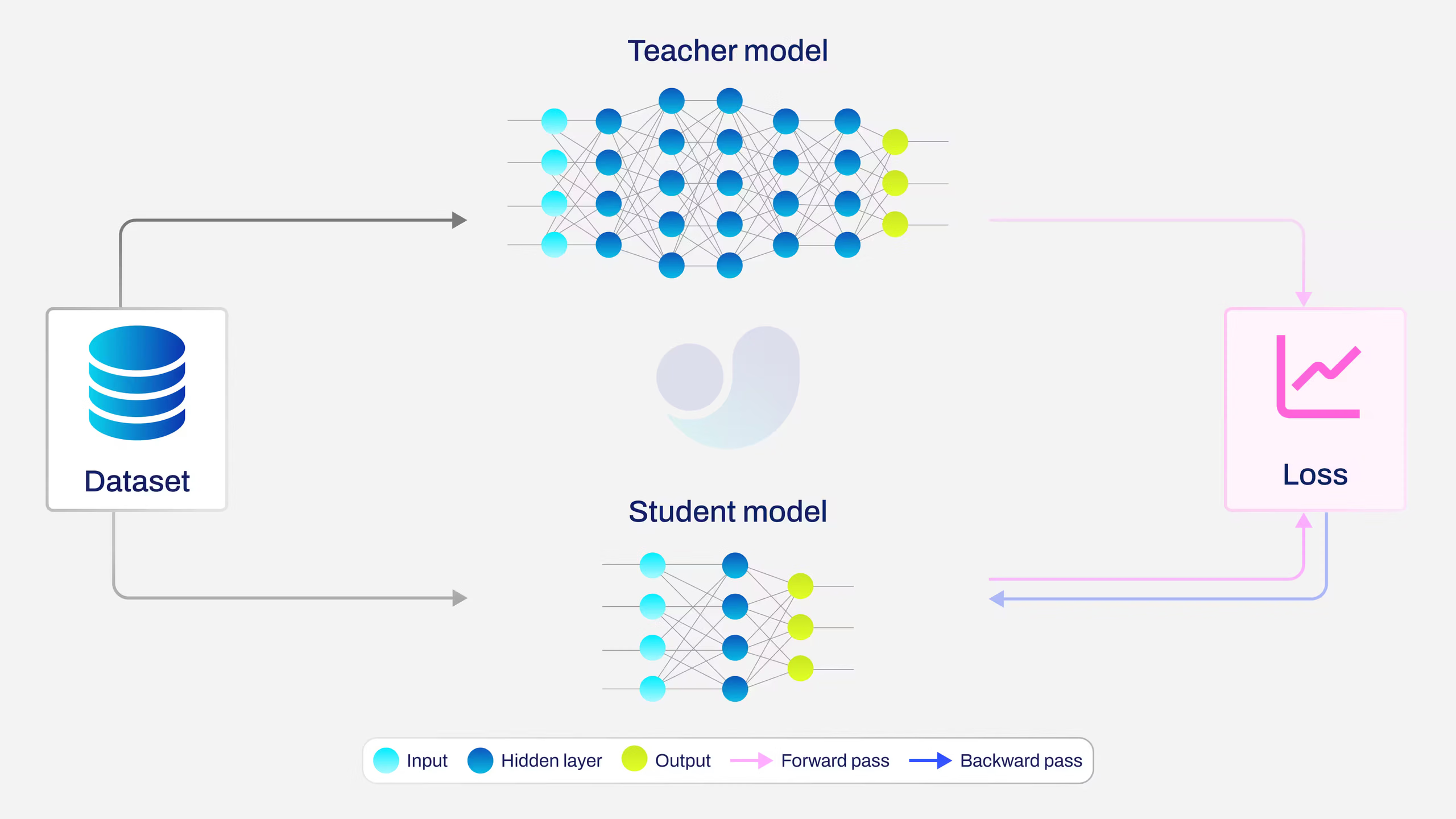
Use distillation when:
- You need a smaller, faster model for deployment
- You have a high-accuracy teacher model trained on the same data
- You want better accuracy than standard training provides
Knowledge distillation is implemented for detect, segment, pose, and obb tasks. Only detect has been experimentally verified for accuracy improvements for now.
Performance#
Knowledge distillation improves student mAP across the entire YOLO26 family on COCO, with no added inference cost. The table below compares the standard YOLO26 models (baseline) against the same models trained with distillation from their recommended teacher.
| Model | size (pixels) | mAPval 50-95 baseline | mAPval 50-95 distilled | mAPval 50-95 (e2e) baseline | mAPval 50-95 (e2e) distilled |
|---|---|---|---|---|---|
| YOLO26n-distill | 640 | 40.9 | 41.5 | 40.1 | 40.9 |
| YOLO26s-distill | 640 | 48.6 | 49.2 | 47.8 | 48.6 |
| YOLO26m-distill | 640 | 53.1 | 53.9 | 52.5 | 53.3 |
| YOLO26l-distill | 640 | 55.0 | 56.0 | 54.4 | 55.5 |
| YOLO26x-distill | 640 | 57.5 | 57.9 | 56.9 | 57.4 |
- mAPval values are for single-model single-scale on the COCO val2017 dataset.
Reproduce a distilled row withyolo val detect model=yolo26n-distill.pt data=coco.yaml device=0; addnms=Falsefor the e2e column. - e2e values use the NMS-free inference path (
nms=False); non-e2e values use default NMS post-processing (nms=None). See End-to-End Detection for details.
Prerequisites#
Before you begin, ensure you meet the following requirements:
- Trained teacher model: a
.ptcheckpoint from the same YOLO family as the student. - Matching task: use a teacher for the same task as the student and train it on relevant data.
- GPU resources: enough memory to hold both models; the teacher runs forward-only without gradients or optimizer state.
Recommended Model Pairs#
| Student | Recommended Teacher |
|---|---|
yolo26n.pt | yolo26s.pt |
yolo26s.pt | yolo26m.pt |
yolo26m.pt | yolo26x.pt |
yolo26l.pt | yolo26x.pt |
Cross-family distillation (e.g., YOLO11 teacher with YOLO26 student) is not supported.
Key Parameters#
| Parameter | Type | Default | Description |
|---|---|---|---|
distill_model | str | None | Path to the teacher model file (e.g., yolo26x.pt). Setting this enables knowledge distillation. |
dis | float | 6.0 | Distillation loss weight. Controls how much the distillation loss contributes to the total training loss. |
How It Works#
- The teacher model remains frozen in
evalmode and runs inference on each batch - The student model trains with standard task losses plus distillation guidance
- Features are extracted from both models at the three neck layers that feed the Detect-family head
- A projector of two 1×1 convolutions with ReLU aligns each student feature map to the teacher's channels
- A score-weighted L2 loss compares projected student features with teacher features, weighted by the teacher's classification confidence
- The distillation loss combines with standard losses using the
disweight
Task Support#
The distillation implementation extracts features from the three neck layers that feed the model's Detect-family head. Because the segment, pose, and obb heads inherit from the same Detect architecture, distillation is technically compatible with those tasks as well.
Classification, semantic segmentation, depth estimation, and RT-DETR do not use a compatible Detect-family head and are not supported.
Only detect has been experimentally benchmarked and verified. You can run distillation for segment, pose, or obb, but accuracy improvements for those tasks are not yet validated.
from ultralytics import YOLO

# Segment
model = YOLO("yolo26n-seg.pt")
model.train(data="coco8-seg.yaml", epochs=100, distill_model="yolo26s-seg.pt")

# Pose
model = YOLO("yolo26n-pose.pt")
model.train(data="coco8-pose.yaml", epochs=100, distill_model="yolo26s-pose.pt")

# OBB
model = YOLO("yolo26n-obb.pt")
model.train(data="dota8.yaml", epochs=100, distill_model="yolo26s-obb.pt")Training#
Basic Training#
Training with distillation is identical to standard training. Provide the distill_model path to enable it:
from ultralytics import YOLO

# Load a student model
student = YOLO("yolo26m.pt")

# Train with knowledge distillation from a larger teacher model
results = student.train(data="coco8.yaml", epochs=100, distill_model="yolo26x.pt")
Adjusting the Distillation Loss Weight#
The dis parameter (default: 6.0) controls distillation loss contribution:
from ultralytics import YOLO

student = YOLO("yolo26n.pt")
results = student.train(data="coco8.yaml", epochs=100, distill_model="yolo26s.pt", dis=10.0)
Resuming Distillation Training#
Distillation training supports resuming from checkpoints. The teacher model is rebuilt automatically from the distill_model path recorded in the checkpoint:
from ultralytics import YOLO

student = YOLO("runs/detect/train/weights/last.pt")
results = student.train(resume=True)
Training Output#
When distillation is enabled, an additional dis_loss column appears in training logs:
      Epoch    GPU_mem   box_loss   cls_loss    l1_loss   dis_loss  Instances       Size
      1/80      46.2G      1.566      5.404    0.003249      6.658        231        640
The exported model contains only the student weights—file size and inference speed match a normally trained student model.
FAQ#
- Verify teacher and student are from the same YOLO generation
- Confirm
distill_modelpath is correct and the file loads - Try increasing
disif the loss value is very small - Ensure the teacher model is trained on the same dataset
Add the
distill_modelparameter—everything else works identically. An extra distillation loss computes during training, but the saved model is a standard YOLO model with no overhead.Yes. The teacher adds a forward pass for every batch, so the time and memory overhead depend on the teacher/student pair. The teacher runs in
evalmode without gradients or optimizer state.Knowledge distillation works with detect, segment, pose, and obb tasks because it distills features from the three neck layers that feed the Detect-family head. Classify, semantic, depth, and RT-DETR are not supported.
Only detect has been experimentally verified for accuracy improvements. Segment, pose, and obb are technically compatible but not yet benchmarked.
The teacher and student must belong to the same YOLO family (e.g., YOLOv8, YOLO11, or YOLO26). Cross-family distillation (e.g., a YOLO11 teacher with a YOLO26 student) is not supported.