Tổng quan về dataset phát hiện đối tượng
Để huấn luyện một model phát hiện đối tượng mạnh mẽ và chính xác, cần có một dataset toàn diện. Hướng dẫn này giới thiệu nhiều định dạng dataset tương thích với model Ultralytics YOLO, đồng thời cung cấp thông tin về cấu trúc, cách sử dụng và cách chuyển đổi giữa các định dạng.
Các định dạng dataset được hỗ trợ#
Định dạng Ultralytics YOLO#
Định dạng Ultralytics YOLO là định dạng cấu hình dataset cho phép bạn xác định thư mục gốc của dataset, các đường dẫn tương đối đến thư mục ảnh huấn luyện/validation/kiểm thử hoặc các tệp *.txt chứa đường dẫn ảnh, cùng một dictionary tên class. Sau đây là ví dụ:
# Ultralytics 🚀 AGPL-3.0 License - https://ultralytics.com/license

# COCO8 dataset (first 8 images from COCO train2017) by Ultralytics
# Documentation: https://docs.ultralytics.com/datasets/detect/coco8
# Example usage: yolo train data=coco8.yaml
# parent
# ├── ultralytics
# └── datasets
#     └── coco8 ← downloads here (1 MB)

# Train/val/test sets as 1) dir: path/to/imgs, 2) file: path/to/imgs.txt, or 3) list: [path/to/imgs1, path/to/imgs2, ..]
path: coco8 # dataset root dir
train: images/train # train images (relative to 'path') 4 images
val: images/val # val images (relative to 'path') 4 images
test: # test images (optional)

# Classes
names:
  0: person
  1: bicycle
  2: car
  3: motorcycle
  4: airplane
  5: bus
  6: train
  7: truck
  8: boat
  9: traffic light
  10: fire hydrant
  11: stop sign
  12: parking meter
  13: bench
  14: bird
  15: cat
  16: dog
  17: horse
  18: sheep
  19: cow
  20: elephant
  21: bear
  22: zebra
  23: giraffe
  24: backpack
  25: umbrella
  26: handbag
  27: tie
  28: suitcase
  29: frisbee
  30: skis
  31: snowboard
  32: sports ball
  33: kite
  34: baseball bat
  35: baseball glove
  36: skateboard
  37: surfboard
  38: tennis racket
  39: bottle
  40: wine glass
  41: cup
  42: fork
  43: knife
  44: spoon
  45: bowl
  46: banana
  47: apple
  48: sandwich
  49: orange
  50: broccoli
  51: carrot
  52: hot dog
  53: pizza
  54: donut
  55: cake
  56: chair
  57: couch
  58: potted plant
  59: bed
  60: dining table
  61: toilet
  62: tv
  63: laptop
  64: mouse
  65: remote
  66: keyboard
  67: cell phone
  68: microwave
  69: oven
  70: toaster
  71: sink
  72: refrigerator
  73: book
  74: clock
  75: vase
  76: scissors
  77: teddy bear
  78: hair drier
  79: toothbrush

# Download script/URL (optional)
download: https://github.com/ultralytics/assets/releases/download/v0.0.0/coco8.zip
Mỗi train, val và test chấp nhận một thư mục, một tệp ảnh, danh sách thư mục hoặc tệp ảnh, hoặc tệp *.txt mã hóa UTF-8, liệt kê mỗi đường dẫn ảnh trên một dòng (các đường dẫn bắt đầu bằng ./ được phân giải tương đối với tệp *.txt). Tệp *.txt hữu ích khi huấn luyện trên một tập con của thư mục, bỏ qua ảnh chưa được gán nhãn hoặc kết hợp ảnh từ nhiều nguồn vào cùng một split.
path: datasets/coco8 # dataset root
train: train.txt # a directory, an image, a list e.g. [images/a, images/b], or a *.txt file
val: val.txt
names:
  0: person
(Tùy chọn) colors cung cấp cho mỗi lớp một màu hiển thị dưới dạng chuỗi "#rrggbb" đặt trong dấu ngoặc kép, được lập chỉ mục theo ID lớp, ví dụ: colors: ["#042aff", "#ff0000"]. Model đã huấn luyện và xuất giữ nguyên các màu này cho dự đoán; các lớp không có màu riêng sẽ dùng bảng màu mặc định. Bản ghi dataset NDJSON có thể chứa trường colors tương tự.
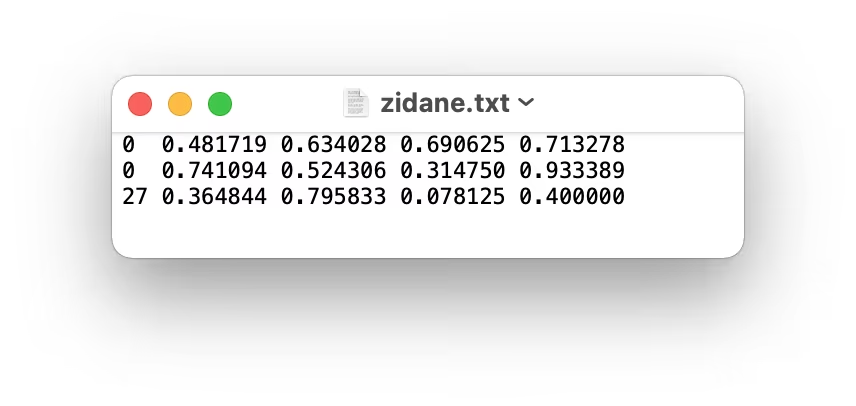
Nhãn cho định dạng này cần được xuất sang định dạng YOLO với một tệp *.txt cho mỗi ảnh. Nếu ảnh không có đối tượng nào thì không cần tệp *.txt. Tệp *.txt cần có định dạng gồm một hàng cho mỗi đối tượng, theo định dạng class x_center y_center width height. Tọa độ hộp giới hạn phải ở định dạng normalized xywh (từ 0 đến 1). Nếu hộp của bạn được xác định bằng pixel, hãy chia x_center và width cho chiều rộng ảnh, đồng thời chia y_center và height cho chiều cao ảnh. Tọa độ được tính theo cách người xem hiển thị ảnh, sau khi áp dụng hướng EXIF; Ultralytics cũng đọc mọi ảnh theo cách này. Số lớp phải được đánh chỉ mục từ 0 (bắt đầu bằng 0).
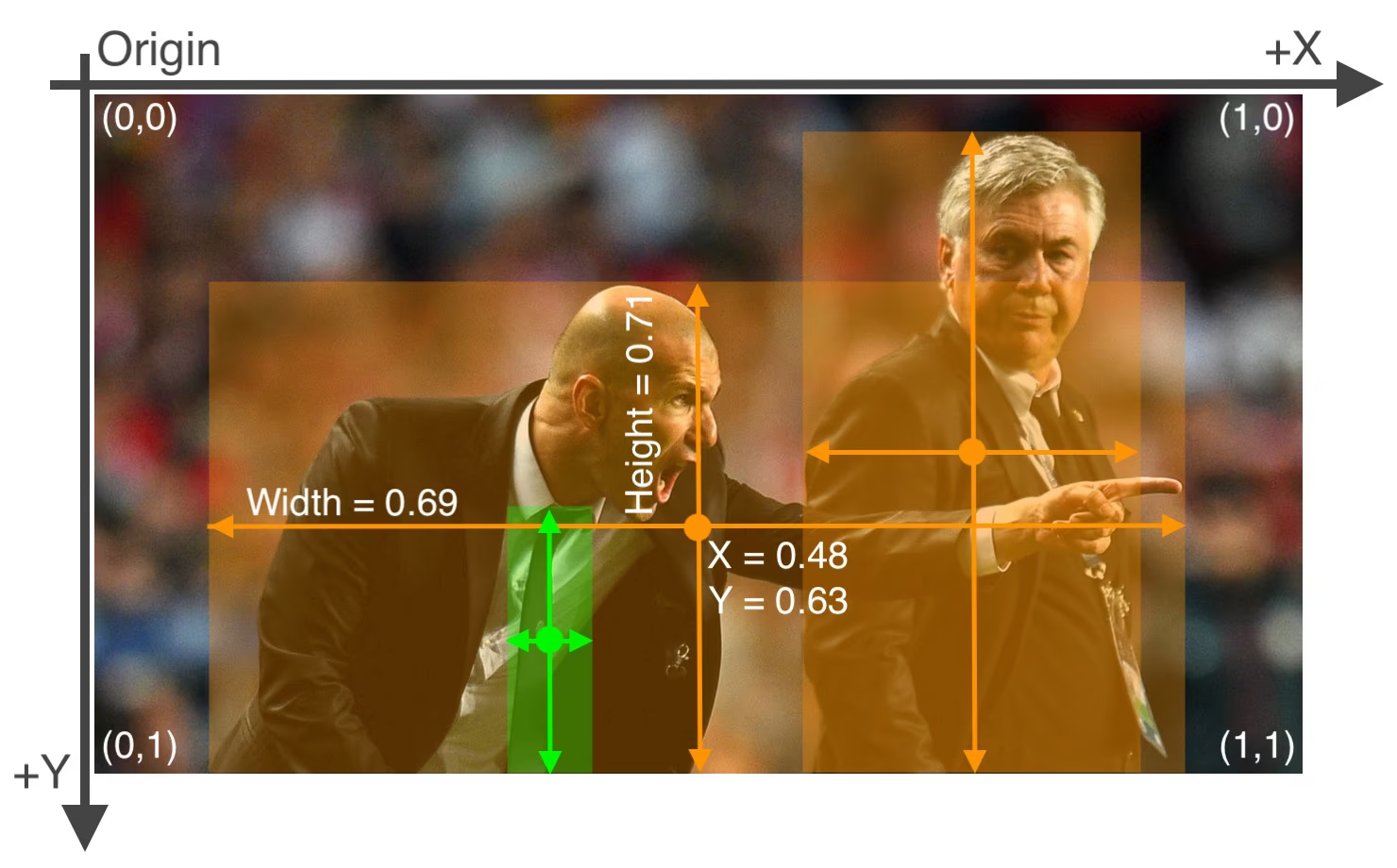
Tệp nhãn tương ứng với ảnh trên chứa 2 người (class 0) và một chiếc cà vạt (class 27):
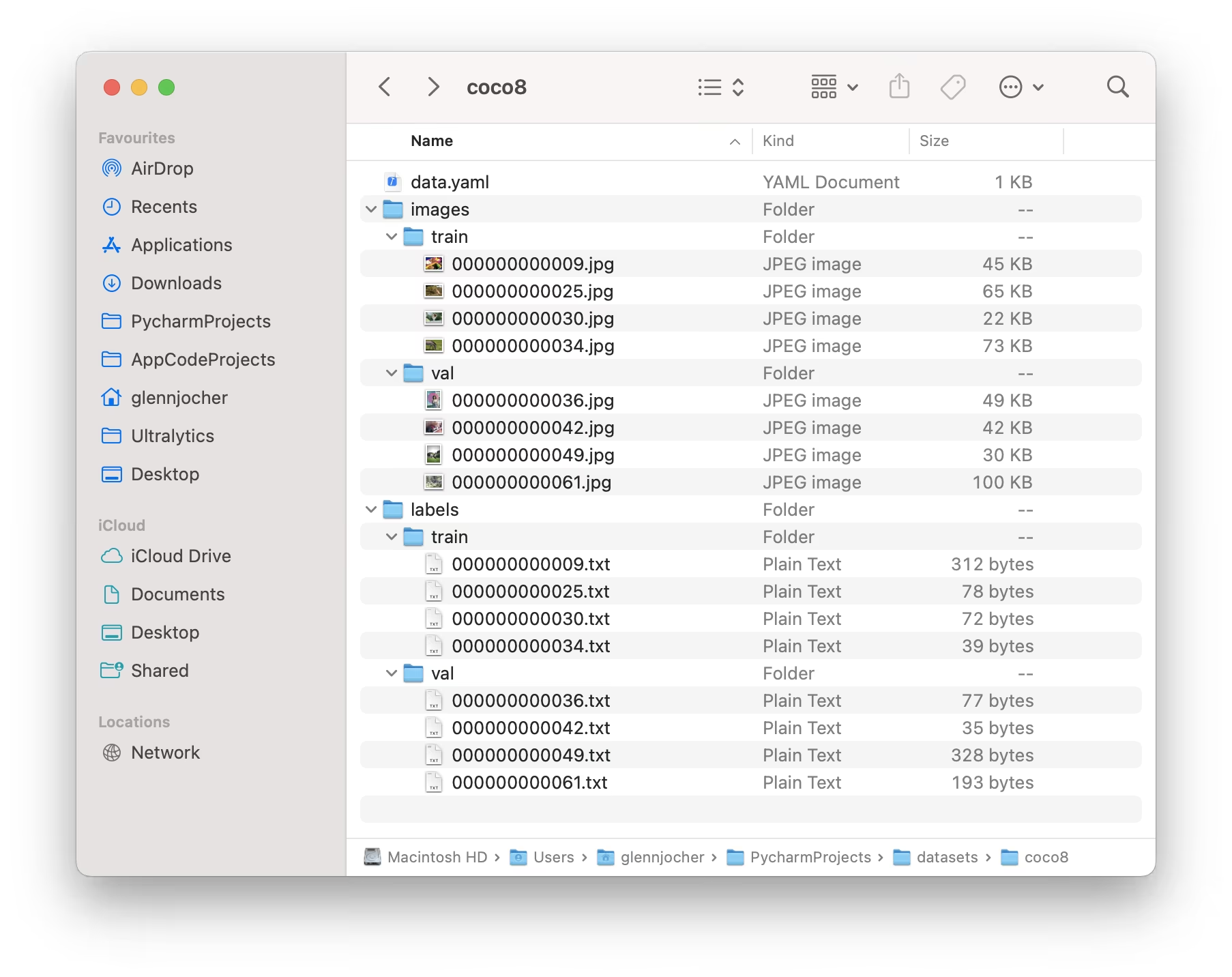
Khi sử dụng định dạng Ultralytics YOLO, hãy sắp xếp ảnh và nhãn huấn luyện, validation như trong ví dụ dataset COCO8 bên dưới.
Ví dụ sử dụng#
Sau đây là cách sử dụng dataset định dạng YOLO để huấn luyện model:
from ultralytics import YOLO

# Tải model
model = YOLO("yolo26n.pt")  # tải model đã huấn luyện trước (được khuyến nghị khi huấn luyện)

# Huấn luyện model
results = model.train(data="coco8.yaml", epochs=100, imgsz=640)
Định dạng Ultralytics NDJSON#
Định dạng NDJSON (JSON phân tách bằng dòng mới) là một cách khác để định nghĩa dataset cho các model Ultralytics YOLO. Định dạng này lưu metadata và nhãn của dataset trong một tệp duy nhất, mỗi dòng chứa một đối tượng JSON riêng.
Tệp dataset NDJSON bao gồm:
- Bản ghi dataset (dòng đầu tiên): Chứa metadata của dataset, bao gồm loại tác vụ, tên class và thông tin tổng quan
- Bản ghi ảnh (các dòng tiếp theo): Chứa dữ liệu của từng ảnh, bao gồm kích thước, nhãn và đường dẫn tệp
{
    "type": "dataset",
    "task": "detect",
    "name": "Example",
    "description": "COCO NDJSON example dataset",
    "url": "https://platform.ultralytics.com/user/datasets/example",
    "class_names": { "0": "person", "1": "bicycle", "2": "car" },
    "bytes": 426342,
    "version": 0,
    "created_at": "2024-01-01T00:00:00Z",
    "updated_at": "2025-01-01T00:00:00Z"
}
Metadata ảnh tùy chỉnh#
Mỗi bản ghi ảnh có thể bao gồm một đối tượng JSON metadata để lưu ngữ cảnh dành riêng cho ứng dụng, chẳng hạn như điều kiện chụp, mã định danh thiết bị hoặc trạng thái đánh giá. Có hỗ trợ các giá trị lồng nhau. Khi được nhập vào Ultralytics Platform, metadata sẽ được lưu cùng ảnh đó và có thể xem hoặc chỉnh sửa trong bảng thông tin toàn màn hình.
{
    "type": "image",
    "file": "airbus-wing.jpg",
    "url": "https://example.com/airbus-wing.jpg",
    "split": "train",
    "metadata": {
        "aircraft": { "family": "A350", "section": "wing" },
        "inspectionStatus": "reviewed"
    }
}
Platform giới hạn khóa metadata cấp cao nhất ở 128 ký tự, đối tượng metadata đã tuần tự hóa của mỗi ảnh ở 500.000 ký tự và tổng metadata hiệu lực trong một lần nhập NDJSON ở 500.000 ký tự.
Ví dụ sử dụng#
Để sử dụng dataset NDJSON với YOLO26, chỉ cần chỉ định đường dẫn đến tệp .ndjson:
from ultralytics import YOLO

# Tải model
model = YOLO("yolo26n.pt")

# Huấn luyện bằng dataset NDJSON
results = model.train(data="path/to/dataset.ndjson", epochs=100, imgsz=640)
Ưu điểm của định dạng NDJSON#
- Một tệp duy nhất: Toàn bộ thông tin dataset được lưu trong một tệp
- Xử lý luồng: Có thể xử lý dataset lớn từng dòng mà không cần tải toàn bộ vào bộ nhớ
- Tích hợp đám mây: Hỗ trợ URL ảnh từ xa để huấn luyện trên đám mây
- Có thể mở rộng: Dễ dàng thêm các trường metadata tùy chỉnh
- Kiểm soát phiên bản: Định dạng một tệp hoạt động hiệu quả với git và các hệ thống kiểm soát phiên bản
Dataset được hỗ trợ#
Sau đây là danh sách các dataset được hỗ trợ cùng mô tả ngắn cho từng dataset. Hầu hết các dataset này cũng được lưu trữ trên Ultralytics Platform, nơi bạn có thể duyệt ảnh và nhãn, xem thống kê dataset và nhân bản dataset để huấn luyện trên đám mây.
- African-wildlife: Bộ dữ liệu gồm hình ảnh động vật hoang dã châu Phi, bao gồm trâu, voi, tê giác và ngựa vằn.
- Argoverse: Dataset phát hiện 2D Argoverse-HD gồm 54.446 ảnh đô thị phục vụ lái xe tự hành, với 8 class đối tượng trên đường.
- Khối u não: Dataset dùng để phát hiện khối u trong ảnh MRI não, được gán nhãn bằng bounding box của khối u trong một class duy nhất.
- COCO: Common Objects in Context (COCO) là dataset quy mô lớn về phát hiện, phân đoạn và tạo chú thích cho vật thể, với 80 danh mục vật thể.
- COCO8: Tập con nhỏ gồm 8 ảnh đầu tiên của COCO train2017, trong đó 4 ảnh dùng để huấn luyện và 4 ảnh để xác thực, phù hợp cho các bài kiểm tra nhanh.
- COCO8-Grayscale: Phiên bản ảnh thang độ xám của COCO8, được tạo bằng cách chuyển RGB sang thang độ xám, hữu ích để đánh giá model một kênh.
- COCO8-Multispectral: Phiên bản đa phổ 10 kênh của COCO8, được tạo bằng cách nội suy các bước sóng RGB, hữu ích để đánh giá model có nhận biết phổ.
- COCO12-Formats: Dataset kiểm thử gồm 12 ảnh thuộc 12 định dạng ảnh được hỗ trợ (AVIF, BMP, DNG, HEIC, JP2, JPEG, JPG, MPO, PNG, TIF, TIFF, WebP), dùng để kiểm tra các pipeline tải ảnh.
- COCO16: Tập con gồm 16 ảnh đầu tiên từ COCO train2017 (8 train + 8 val), phù hợp cho các bài kiểm thử nhanh.
- COCO32: Tập con gồm 32 ảnh đầu tiên từ COCO train2017 (16 train + 16 val), phù hợp cho các bài kiểm thử nhanh.
- COCO64: Tập con gồm 64 ảnh đầu tiên từ COCO train2017 (32 train + 32 val), phù hợp cho các bài kiểm thử nhanh.
- COCO128: Tập con nhỏ gồm 128 ảnh đầu tiên của COCO train2017, phù hợp cho kiểm thử.
- Construction-PPE: Dataset gồm công nhân tại công trường, được gán nhãn trang bị bảo hộ như mũ bảo hiểm, áo vest, găng tay, ủng và kính bảo hộ; đồng thời có các nhãn thiếu trang bị như no_helmet, no_goggle để giám sát tuân thủ trong thực tế.
- Global Wheat 2020: Dataset gồm hình ảnh bông lúa mì dành cho Global Wheat Challenge 2020.
- HomeObjects-3K: Dataset về đồ dùng trong nhà, bao gồm giường, ghế, TV và nhiều vật dụng khác—phù hợp cho các ứng dụng tự động hóa nhà thông minh, robot, thực tế tăng cường và phân tích bố cục phòng.
- KITTI: Dataset gồm các cảnh lái xe thực tế với dữ liệu stereo, LiDAR và GPS/IMU, được sử dụng ở đây cho các tác vụ phát hiện đối tượng 2D như nhận diện ô tô, người đi bộ và người đi xe đạp trong môi trường đô thị, nông thôn và đường cao tốc.
- LVIS: Dataset quy mô lớn về phát hiện và phân đoạn đối tượng, với 1.203 danh mục vật thể.
- Medical-pills: Bộ dữ liệu gồm hình ảnh thuốc viên, được gán nhãn cho các ứng dụng như đảm bảo chất lượng dược phẩm, phân loại thuốc viên và tuân thủ quy định.
- Objects365: Dataset chất lượng cao, quy mô lớn dành cho phát hiện đối tượng, với 365 danh mục đối tượng và hơn 1,7 triệu ảnh huấn luyện.
- OpenImagesV7: Dataset toàn diện của Google với 1,7 triệu ảnh huấn luyện và 42 nghìn ảnh xác thực.
- Roboflow 100: Một benchmark phát hiện đối tượng đa dạng với 100 dataset thuộc bảy miền hình ảnh, phục vụ đánh giá model toàn diện.
- Signature: Dataset gồm hình ảnh nhiều loại tài liệu với chữ ký được chú thích, hỗ trợ nghiên cứu xác minh tài liệu và phát hiện gian lận.
- SKU-110K: Dataset phục vụ phát hiện vật thể dày đặc trong môi trường bán lẻ, gồm hơn 11 nghìn ảnh và 1,7 triệu bounding box.
- TT100K: Bộ dữ liệu biển báo giao thông Tsinghua-Tencent 100K (TT100K), gồm 16.817 hình ảnh góc nhìn đường phố thuộc 221 danh mục biển báo, phục vụ phát hiện và phân loại.
- Ultralytics Benchmark: Bộ benchmark chính thức gồm 37 tập dữ liệu phát hiện được tuyển chọn trong các lĩnh vực y tế, hàng không, công nghiệp, bán lẻ và các lĩnh vực khác, với quy trình cố định để đo lường khả năng tổng quát hóa của model trong thực tế.
- VisDrone: Dataset chứa dữ liệu phát hiện vật thể và theo dõi nhiều vật thể từ hình ảnh do drone ghi lại, với hơn 10 nghìn ảnh và chuỗi video.
- VOC: Dataset Các lớp đối tượng trực quan Pascal (VOC) dành cho phát hiện và phân đoạn đối tượng, gồm 20 lớp đối tượng và hơn 11K hình ảnh.
- xView: Dataset phát hiện vật thể trong ảnh chụp từ trên cao, với 60 danh mục vật thể và hơn 1 triệu vật thể được chú thích.
Thêm dataset của riêng bạn#
Nếu bạn có dataset riêng và muốn dùng dataset đó để huấn luyện model phát hiện theo định dạng Ultralytics YOLO, hãy đảm bảo dataset tuân theo định dạng được nêu ở trên trong mục "Định dạng Ultralytics YOLO". Chuyển đổi annotation sang định dạng bắt buộc và khai báo đường dẫn, số lượng lớp cùng tên lớp trong tệp cấu hình YAML.
Chuyển đổi hoặc chuyển đổi định dạng nhãn#
Chuyển định dạng dataset COCO sang định dạng YOLO#
Bạn có thể chuyển đổi nhãn từ định dạng bộ dữ liệu COCO phổ biến sang định dạng YOLO bằng đoạn mã sau:
from ultralytics.data.converter import convert_coco

convert_coco(labels_dir="path/to/coco/annotations/")
Công cụ chuyển đổi này có thể dùng để chuyển dataset COCO hoặc bất kỳ dataset nào ở định dạng COCO sang định dạng Ultralytics YOLO. Quy trình này chuyển đổi annotation COCO dựa trên JSON sang định dạng YOLO dạng văn bản đơn giản hơn, giúp tương thích với model Ultralytics YOLO. Để xem toàn bộ quy trình — bao gồm ánh xạ ID lớp, bố cục thư mục và annotation phân đoạn hoặc tư thế — hãy xem Chuyển đổi annotation COCO sang YOLO.
Hãy nhớ kiểm tra kỹ xem dataset bạn muốn sử dụng có tương thích với model và tuân theo các quy ước định dạng cần thiết hay không. Dataset được định dạng đúng là yếu tố then chốt để huấn luyện model phát hiện đối tượng hiệu quả.
Tiếp theo là gì#
Sau khi định dạng dataset, bắt đầu huấn luyện model. Bạn chưa biết nên bắt đầu với model pretrained nào? So sánh các lựa chọn trong họ model YOLO26.
Câu hỏi thường gặp#
Định dạng Ultralytics YOLO là cấu hình có cấu trúc để xác định dataset trong các dự án huấn luyện. Định dạng này yêu cầu thiết lập đường dẫn đến hình ảnh huấn luyện, validation và kiểm thử cùng các nhãn tương ứng. Ví dụ:
# Ultralytics 🚀 AGPL-3.0 License - https://ultralytics.com/license

# COCO8 dataset (first 8 images from COCO train2017) by Ultralytics
# Documentation: https://docs.ultralytics.com/datasets/detect/coco8
# Example usage: yolo train data=coco8.yaml
# parent
# ├── ultralytics
# └── datasets
#     └── coco8 ← downloads here (1 MB)

# Train/val/test sets as 1) dir: path/to/imgs, 2) file: path/to/imgs.txt, or 3) list: [path/to/imgs1, path/to/imgs2, ..]
path: coco8 # dataset root dir
train: images/train # train images (relative to 'path') 4 images
val: images/val # val images (relative to 'path') 4 images
test: # test images (optional)

# Classes
names:
  0: person
  1: bicycle
  2: car
  3: motorcycle
  4: airplane
  5: bus
  6: train
  7: truck
  8: boat
  9: traffic light
  10: fire hydrant
  11: stop sign
  12: parking meter
  13: bench
  14: bird
  15: cat
  16: dog
  17: horse
  18: sheep
  19: cow
  20: elephant
  21: bear
  22: zebra
  23: giraffe
  24: backpack
  25: umbrella
  26: handbag
  27: tie
  28: suitcase
  29: frisbee
  30: skis
  31: snowboard
  32: sports ball
  33: kite
  34: baseball bat
  35: baseball glove
  36: skateboard
  37: surfboard
  38: tennis racket
  39: bottle
  40: wine glass
  41: cup
  42: fork
  43: knife
  44: spoon
  45: bowl
  46: banana
  47: apple
  48: sandwich
  49: orange
  50: broccoli
  51: carrot
  52: hot dog
  53: pizza
  54: donut
  55: cake
  56: chair
  57: couch
  58: potted plant
  59: bed
  60: dining table
  61: toilet
  62: tv
  63: laptop
  64: mouse
  65: remote
  66: keyboard
  67: cell phone
  68: microwave
  69: oven
  70: toaster
  71: sink
  72: refrigerator
  73: book
  74: clock
  75: vase
  76: scissors
  77: teddy bear
  78: hair drier
  79: toothbrush

# Download script/URL (optional)
download: https://github.com/ultralytics/assets/releases/download/v0.0.0/coco8.zip
Nhãn được lưu trong các tệp
*.txt, mỗi hình ảnh có một tệp, theo định dạngclass x_center y_center width heightvới tọa độ đã chuẩn hóa. Xem ví dụ dataset COCO8 để biết hướng dẫn chi tiết.Bạn có thể chuyển dataset COCO sang định dạng YOLO bằng các công cụ chuyển đổi của Ultralytics. Sau đây là phương pháp nhanh:
from ultralytics.data.converter import convert_coco

convert_coco(labels_dir="path/to/coco/annotations/")
Đoạn code này chuyển đổi annotation COCO sang định dạng YOLO để bạn có thể huấn luyện model Ultralytics YOLO trên các annotation đó.
Ultralytics YOLO hỗ trợ nhiều dataset, bao gồm:
Trang của mỗi dataset cung cấp thông tin chi tiết về cấu trúc và cách sử dụng được thiết kế để huấn luyện YOLO26 hiệu quả. Xem danh sách đầy đủ trong mục Dataset được hỗ trợ.
Để bắt đầu huấn luyện model YOLO26, hãy đảm bảo dataset được định dạng chính xác và các đường dẫn được khai báo trong tệp YAML. Dùng script sau để bắt đầu huấn luyện:
Ví dụfrom ultralytics import YOLO model = YOLO("yolo26n.pt") # Tải model pretrained results = model.train(data="path/to/your_dataset.yaml", epochs=100, imgsz=640)Ultralytics cung cấp nhiều ví dụ và hướng dẫn thực tiễn về cách sử dụng YOLO trong các ứng dụng đa dạng. Truy cập Blog Ultralytics để xem nghiên cứu tình huống, hướng dẫn chi tiết và câu chuyện cộng đồng về phát hiện đối tượng, phân đoạn và nhiều chủ đề khác. Để xem các ví dụ cụ thể, hãy tham khảo trang Chế độ Predict trong tài liệu.


Bình luận54
Đặt câu hỏi, chia sẻ kết quả hoặc giúp đỡ người khác.
zcoolster11
Python Head Bop
 Paula DerrengerUltralytics
@zcoolster11, could you clarify what you mean by “Python Head Bop” and what you’d like to do with Ultralytics YOLO? Feel free to drop your dataset or Python questions here in the discussion so the Ultralytics team can help.
 Murat Raimbekov
hey @orz-serein, short answer: no, you don't need empty label files for background images - just leave the
.txtout.i verified this empirically on the current main branch. setup: 5 images, 2 with real labels, 1 with an empty
.txtfile, 2 without any.txtfile at all. building aYOLODatasetover them gives:Scanning /tmp/bgtest_full/labels... 3 images, 3 backgrounds, 0 corrupt: 100% 5/5all 5 images are kept. the 3 without labels (the empty-
.txtone and the two with no.txtat all) all end up with the same(0, 5)labels array - they are treated identically as background images.so both options work:
- no
.txtfile: counted as "missing" (nm=1), no labels -> background - empty
.txtfile: counted as "empty" (ne=1), no labels -> background
both end up in the same
backgrounds = nm + nebucket inultralytics/data/dataset.py.this is also stated in the detection dataset docs:
If there are no objects in an image, no
*.txtfile is required.how many background images: the yolov5 training tips recommend 0-10% of the dataset as background images to reduce false positives (coco has about 1% background).
hope this helps!
- no
 serein
Hello, I would like to ask a question. During the stage of preparing the training dataset, if some images do not have the target to be detected, do I need to add corresponding empty label files in the label folder?
Fatima-khanjar
Hello, I hope this message finds you well.
I have a question regarding fine-tuning a pre-trained YOLO model (e.g., trained on the COCO dataset) on my custom dataset. My dataset includes both new classes (not present in COCO) and the same existing classes (e.g., toothbrush, car), but with different layouts. Specifically, I would like to add my new classes starting from index 80, while still leveraging the pre-trained weights for the common classes, which are the same but with different layouts.
Is it possible to use the pre-trained weights for the common classes and only train the model on the new classes, while ensuring that the pre-trained knowledge for the common classes is preserved? If so, could you please guide me on how to proceed?
Thank you for your time and assistance. best regards,
bimal-gajera
Hello, I'm working on multiple dataset formats for object detection. For the YOLO dataset format, is there any way I can rename the labels directory and put it in yaml file? Something like this:
path: path_to_root_directory
train: train\images
val: val\images
test: test\images

labels_dir: yolo

nc: 1
names: ['object']
yolo directory has yolo annotations (*.txt files), and it's inside respective train, val and test directory.
 Glenn JocherUltralytics(đã chỉnh sửa)
@bimal-gajera currently, the
labels_dirkey is not supported in the YAML file. Ultralytics finds label files by replacing the last/images/directory in each image path with/labels/, so each split needs siblingimages/andlabels/directories (for exampletrain/imagesandtrain/labels). For more details, refer to the Object Detection Datasets Overview.1
nitya-pandey-astro
Hello Team, I am using YOLO for detecting trails of slow-moving astronomical objects in my images. While the model detects the trails, the bounding boxes predicted around the objects are not tight enough. The boxes tend to be too loose or not well-shaped to fit the elongated, irregular trails, resulting in inaccurate object localization. I suspect, YOLO's standard rectangular bounding box not being well-suited for the elongated, curving shapes of the trails. Could you provide guidance on how to improve bounding box accuracy for this specific use case?
- Glenn JocherUltralytics(đã chỉnh sửa)
@astronitya thank you for your question! For detecting elongated or irregular trails, consider using Oriented Bounding Boxes (OBB), which may better fit your objects' shapes compared to standard rectangular boxes. You can format your dataset in the YOLO OBB format and train a YOLO26 OBB model. Please refer to the Oriented Bounding Box (OBB) Datasets Overview for details on dataset formatting and training. Let me know if you need further clarification!
@glenn-jocher Thankyou very much for the prompt response. I am going to work on your suggestions.
Yuxuan1998
Hi team, I am a little bit confused with the dataset folder structure. For most dataset I used, it strunctured in the way that each of
train/andval/folders containsimages/andlabels/folders. However, the COCO8 dataset example shows the opposite way, each ofimages/andlabels/folder containstest/andval/folders. Does the folder structure matter here? Thanks in advance- Glenn JocherUltralytics(đã chỉnh sửa)
@Yuxuan1998 both layouts work, as long as each image has a sibling
labelsdirectory: Ultralytics finds the label for an image by replacing the last/images/in its path with/labels/(sotrain/images/img.jpgusestrain/labels/img.txt, andimages/train/img.jpguseslabels/train/img.txt). Set the paths in your dataset's YAML file to the image directories. For details, refer to the Object Detection Datasets Overview. Let us know if you need further clarification!1
milanaveed
Hello, can you please fix the broken images on this page? Can't see the label file example.
wgdcxy
Hello, my label and image files are stored according to the requirements, but they are still not recognized, and the following is an error message Thank you in advance
WARNING ⚠️ imgsz=[2448] must be multiple of max stride 32, updating to [2464] train: Scanning D:\Textile_testing\ultralytics-seg\cs\labels\ttb... 0 images, 30 backgrounds, 0 corrupt: 100%|██████████| 30/30 [00:00<00:00, 1138.41it/s] train: WARNING ⚠️ No labels found in D:\Textile_testing\ultralytics-seg\cs\labels\ttb.cache. See https://docs.ultralytics.com/datasets/detect for dataset formatting guidance. train: WARNING ⚠️ Cache directory D:\Textile_testing\ultralytics-seg\cs\labels is not writeable, cache not saved. WARNING ⚠️ No labels found in D:\Textile_testing\ultralytics-seg\cs\labels\ttb.cache, training may not work correctly. See https://docs.ultralytics.com/datasets/detect for dataset formatting guidance. val: Scanning D:\Textile_testing\ultralytics-seg\cs\labels\ttj... 0 images, 30 backgrounds, 0 corrupt: 100%|██████████| 30/30 [00:00<00:00, 1617.94it/s] val: WARNING ⚠️ No labels found in D:\Textile_testing\ultralytics-seg\cs\labels\ttj.cache. See https://docs.ultralytics.com/datasets/detect for dataset formatting guidance. val: WARNING ⚠️ Cache directory D:\Textile_testing\ultralytics-seg\cs\labels is not writeable, cache not saved. WARNING ⚠️ No labels found in D:\Textile_testing\ultralytics-seg\cs\labels\ttj.cache, training may not work correctly. See https://docs.ultralytics.com/datasets/detect for dataset formatting guidance. Plotting labels to runs\segment\train3\labels.jpg...
- Glenn JocherUltralytics
It seems like your dataset labels are not being recognized. Please ensure your label files are in the correct YOLO format and that the directory is writable. For detailed guidance, visit the dataset formatting section at https://docs.ultralytics.com/datasets/detect/.
Hi, but my file path is very accurate, and I checked it N times, so is there any otherreason? Thank you
- Glenn JocherUltralytics
@wgdcxy please ensure your label files are in the correct YOLO format, with one
.txtfile per image containing normalized coordinates. Also, verify that the directory permissions allow writing. For more details, refer to the dataset formatting guide linked earlier. Hello, I'm a student whose English is not particularly good, so some places may not be clear, and secondly, this is not an error but a warning.I don't know why it's the background that reads, not the images. The warnings are as follows: val: Scanning D:\Textile_testing\ultralytics-seg\cs\labels\ttj... 0 images, 30 backgrounds, 0 corrupt: 100%| 30/30 [00:00<00:00, 495.76it/s] val: WARNING ⚠️ No labels found in D:\Textile_testing\ultralytics-seg\cs\labels\ttj.cache. See https://docs.ultralytics.com/datasets/detect for dataset formatting guidance. val: WARNING ⚠️ Cache directory D:\Textile_testing\ultralytics-seg\cs\labels is not writeable, cache not saved. WARNING ⚠️ No labels found in D:\Textile_testing\ultralytics-seg\cs\labels\ttj.cache, training may not work correctly. See https://docs.ultralytics.com/datasets/detect for dataset formatting guidance. Plotting labels to runs\segment\train4\labels.jpg...
Then this warning tells me that the cache file is missing, and I don't know why I can't generate a cache file for the file I created, so I'm here to ask you guys. Below is my own yaml file: # Train/val/test sets as 1) dir: path/to/imgs, 2) file: path/to/imgs.txt, or 3) list: [path/to/imgs1, path/to/imgs2, ..] path: ../cs # dataset root dir train: images/ttb # train images (relative to 'path') 128 images val: images/ttj # val images (relative to 'path') 128 images test: # test images (optional) # Classes names : 0 : wf
Below is my label file: 0 0.6799428104575164 0.5005859375 0.6844771241830065 0.500537109375 0.6845996732026144 0.497265625 0.6802696078431373 0.497119140625 0 0.6803104575163399 0.4935546875 0.6848039215686275 0.493505859375 0.6847630718954248 0.497119140625 0.6802696078431373 0.49697265625 0 0.6802696078431373 0.49013671875 0.6849673202614379 0.490185546875 0.6849264705882353 0.49345703125 0.6803513071895425 0.493359375 0 0.6805555555555556 0.48662109375 0.6850898692810458 0.486767578125 0.6850490196078431 0.490234375 0.6803513071895425 0.490234375 0 0.6808415032679739 0.483447265625 0.6852941176470588 0.48349609375 0.6852124183006536 0.486767578125 0.6806781045751634 0.486669921875 0 0.6806372549019607 0.47998046875 0.6854166666666666 0.47998046875 0.6853349673202613 0.48349609375 0.6808415032679738 0.48359375
Finally, this yolo can be run, but I don't know why the result is 0. Here's how it works: Transferred 381/417 items from pretrained weights 195/200 8.73G 0 0 nan 0 0 2464: 100%|██████████| 8/8 [01:37<00:00, 12.13s/it] Class Images Instances Box(P R mAP50 mAP50-95) Mask(P R mAP50 mAP50-95): 100%|[00:31<00:00, 7.91s/it] all 30 0 0 0 0 0 0 0 0 0 Finally, thank you for explaining it to me
By the way, the size of my picture is 2448x2048, so the imgsz entered is 2448, and your code changed the size of my picture to 2464, is it related to this. imgsz=[2448] must be multiple of max stride 32, updating to [2464]
I apologize, I found a small mistake of mine. I wrote the file name as "labels" instead of "lables" which I intended to write.Please forgive my carelessness.After all, who doesn't make mistakes. I'll come back to you next time I have a problem. Thank you for your help.
Transferred 417/417 items from pretrained weights Freezing layer 'model.22.dfl.conv.weight' AMP: running Automatic Mixed Precision (AMP) checks with YOLOv8n... AMP: checks passed ✅ WARNING ⚠️ imgsz=[2448] must be multiple of max stride 32, updating to [2464] train: Scanning D:\Textile_testing\ultralytics-seg\cs\labels\ttb.cache... 30 images, 0 backgrounds, 0 corrupt: 100%|██████████| 30/30 [00:00<?, ?it/s] Hello, here I am again, with a new problem, how to solve this problem about image size?Ask for answers, thank you
- Glenn JocherUltralytics
@wgdcxy to address the image size issue, ensure your
imgszis a multiple of 32, as required by the model's architecture. This adjustment helps maintain compatibility with the model's stride. If you have further questions, feel free to ask! WARNING ⚠️ NMS time limit 0.900s exceeded. Hello, my teacher who has never met, what should I do with this warning?
- Glenn JocherUltralytics(đã chỉnh sửa)
@wgdcxy the "NMS time limit exceeded" warning is not controlled by an
nmsargument. It appears when too many candidate boxes need to be processed within the time limit, which is common early in training when validation uses a low confidence threshold. It usually stops as the model trains, and you can reduce it by raisingconfor loweringmax_detduring validation. If you have further questions, feel free to ask! Hello, I'm here again. The issue this time is still the same warning. I adjusted the max_time_img to 0.1 in ops. py, but I don't feel it's right. So I came to ask for your help because it still shows this warning. I hope you can tell me where to make the adjustment. Thank you again. WARNING ⚠️ NMS time limit 0.900s exceeded
How can these values be improved? We can only continue training or increase the training dataset. Epoch GPU_mem box_loss seg_loss cls_loss dfl_loss Instances Size 11/500 11G nan 6.21 nan nan 132 2464: 100%|██████████| 8/8 [01:56<00:00, 14.59s/it] Class Images Instances Box(P R mAP50 mAP50-95) Mask(P R mAP50 mAP50-95): 100%|██████████| 4/4 [00:54<00:00, 13.56s/it] all 30 664 0 0 0 0 0 0 0 0
- Glenn JocherUltralytics
To improve your model's performance, consider increasing the dataset size, enhancing data quality, or adjusting hyperparameters. If issues persist, reviewing the dataset for label accuracy and distribution might help.
WARNING ⚠️ imgsz=[2448] must be multiple of max stride 32, updating to [2464] train: Scanning D:\Textile_testing\ultralytics-seg\cs\labels\ttb... 0 images, 30 backgrounds, 0 corrupt: 100%|██████████| 30/30 [00:00<00:00, 1138.41it/s] train: WARNING ⚠️ No labels found in D:\Textile_testing\ultralytics-seg\cs\labels\ttb.cache. See https://docs.ultralytics.com/datasets/detect for dataset formatting guidance. train: WARNING ⚠️ Cache directory D:\Textile_testing\ultralytics-seg\cs\labels is not writeable, cache not saved. WARNING ⚠️ No labels found in D:\Textile_testing\ultralytics-seg\cs\labels\ttb.cache, training may not work correctly. See https://docs.ultralytics.com/datasets/detect for dataset formatting guidance. val: Scanning D:\Textile_testing\ultralytics-seg\cs\labels\ttj... 0 images, 30 backgrounds, 0 corrupt: 100%|██████████| 30/30 [00:00<00:00, 1617.94it/s] val: WARNING ⚠️ No labels found in D:\Textile_testing\ultralytics-seg\cs\labels\ttj.cache. See https://docs.ultralytics.com/datasets/detect for dataset formatting guidance. val: WARNING ⚠️ Cache directory D:\Textile_testing\ultralytics-seg\cs\labels is not writeable, cache not saved. WARNING ⚠️ No labels found in D:\Textile_testing\ultralytics-seg\cs\labels\ttj.cache, training may not work correctly. See https://docs.ultralytics.com/datasets/detect for dataset formatting guidance. Plotting labels to runs\segment\train3\labels.jpg...
这个问题该如何解决?
- Glenn JocherUltralytics
It looks like your dataset labels are missing or not formatted correctly. Please ensure your labels are in the YOLO format and check the directory permissions. For detailed guidance, visit the dataset formatting section at https://docs.ultralytics.com/datasets/detect/.