Dog-Pose 数据集
简介#
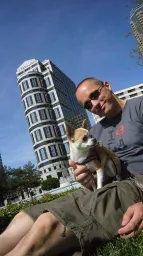
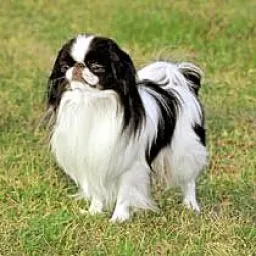
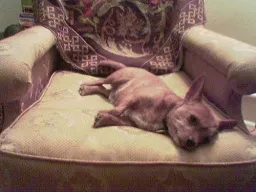
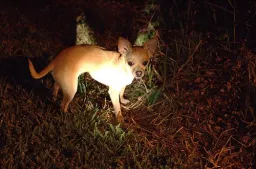
Ultralytics Dog-Pose 数据集是一个专为狗关键点估计整理的姿态估计数据集,包含 6,773 张训练图像和 1,703 张验证图像。
观看: 如何在斯坦福犬类姿态估计数据集上训练 Ultralytics YOLO 模型 | 分步教程
每张带标注的图像都包含 24 个关键点,每个关键点有 3 个维度(x、y、可见性),可支持犬类姿态估计研究和应用。
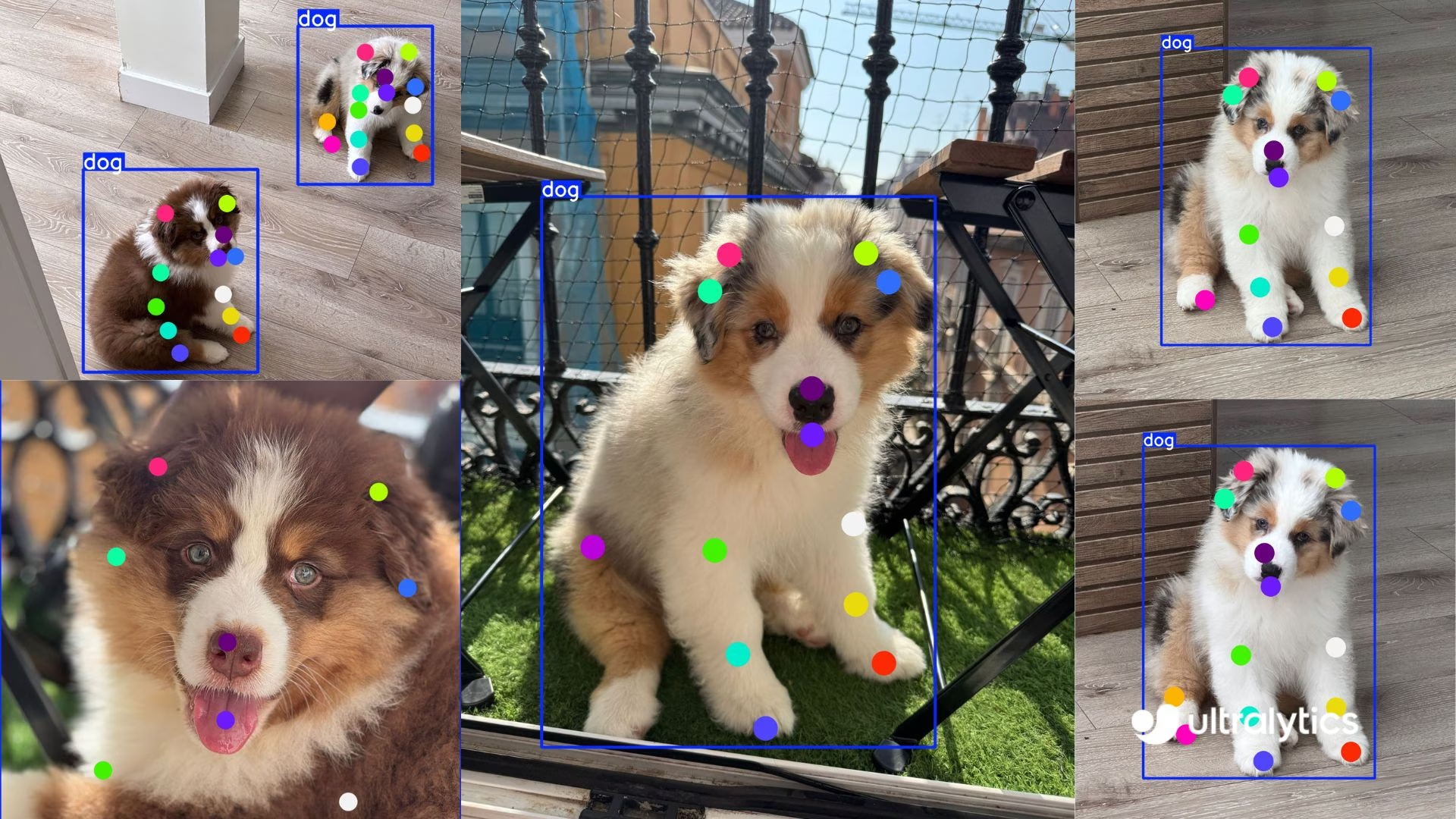
如果你需要处理特定犬种或其他动物,Ultralytics Platform 可在无需管理基础设施的情况下,处理数据上传、标注,以及基于你自己的数据训练自定义关键点模型。
数据集结构#
-
图像总数:8,476(6,773 张训练 / 1,703 张验证),并提供对应的 YOLO 格式标签文件。
-
关键点:每只狗有 24 个关键点,采用
(x, y, visibility)三元组格式。 -
下载大小:约 ~337 MB。
-
目录布局:
datasets/dog-pose/
├── images/{train,val}
└── labels/{train,val}
数据集 YAML#
使用 YAML 文件定义数据集配置,其中包含路径、关键点详情和其他相关信息。对于 Dog-Pose 数据集,dog-pose.yaml 文件位于 https://github.com/ultralytics/ultralytics/blob/main/ultralytics/cfg/datasets/dog-pose.yaml。
# Ultralytics 🚀 AGPL-3.0 License - https://ultralytics.com/license

# Dogs dataset http://vision.stanford.edu/aditya86/ImageNetDogs/ by Stanford
# Documentation: https://docs.ultralytics.com/datasets/pose/dog-pose
# Example usage: yolo train data=dog-pose.yaml
# parent
# ├── ultralytics
# └── datasets
#     └── dog-pose ← downloads here (337 MB)

# Train/val/test sets as 1) dir: path/to/imgs, 2) file: path/to/imgs.txt, or 3) list: [path/to/imgs1, path/to/imgs2, ..]
path: dog-pose # dataset root dir
train: images/train # train images (relative to 'path') 6773 images
val: images/val # val images (relative to 'path') 1703 images

# Keypoints
kpt_shape: [24, 3] # number of keypoints, number of dims (2 for x,y or 3 for x,y,visible)

# Classes
names:
  0: dog

# Keypoint names per class
kpt_names:
  0:
    - front_left_paw
    - front_left_knee
    - front_left_elbow
    - rear_left_paw
    - rear_left_knee
    - rear_left_elbow
    - front_right_paw
    - front_right_knee
    - front_right_elbow
    - rear_right_paw
    - rear_right_knee
    - rear_right_elbow
    - tail_start
    - tail_end
    - left_ear_base
    - right_ear_base
    - nose
    - chin
    - left_ear_tip
    - right_ear_tip
    - left_eye
    - right_eye
    - withers
    - throat

# Download script/URL (optional)
download: https://github.com/ultralytics/assets/releases/download/v0.0.0/dog-pose.zip用法#
要在 Dog-Pose 数据集上以 640 的图像尺寸训练YOLO26n-pose模型 100 个周期,可以使用以下代码片段。
from ultralytics import YOLO

# 加载模型
model = YOLO("yolo26n-pose.pt")  # 加载预训练模型(推荐用于训练)

# 训练模型
results = model.train(data="dog-pose.yaml", epochs=100, imgsz=640)示例图像和标注#
以下是 Dog-Pose 数据集中的一些图像示例及其对应的标注:
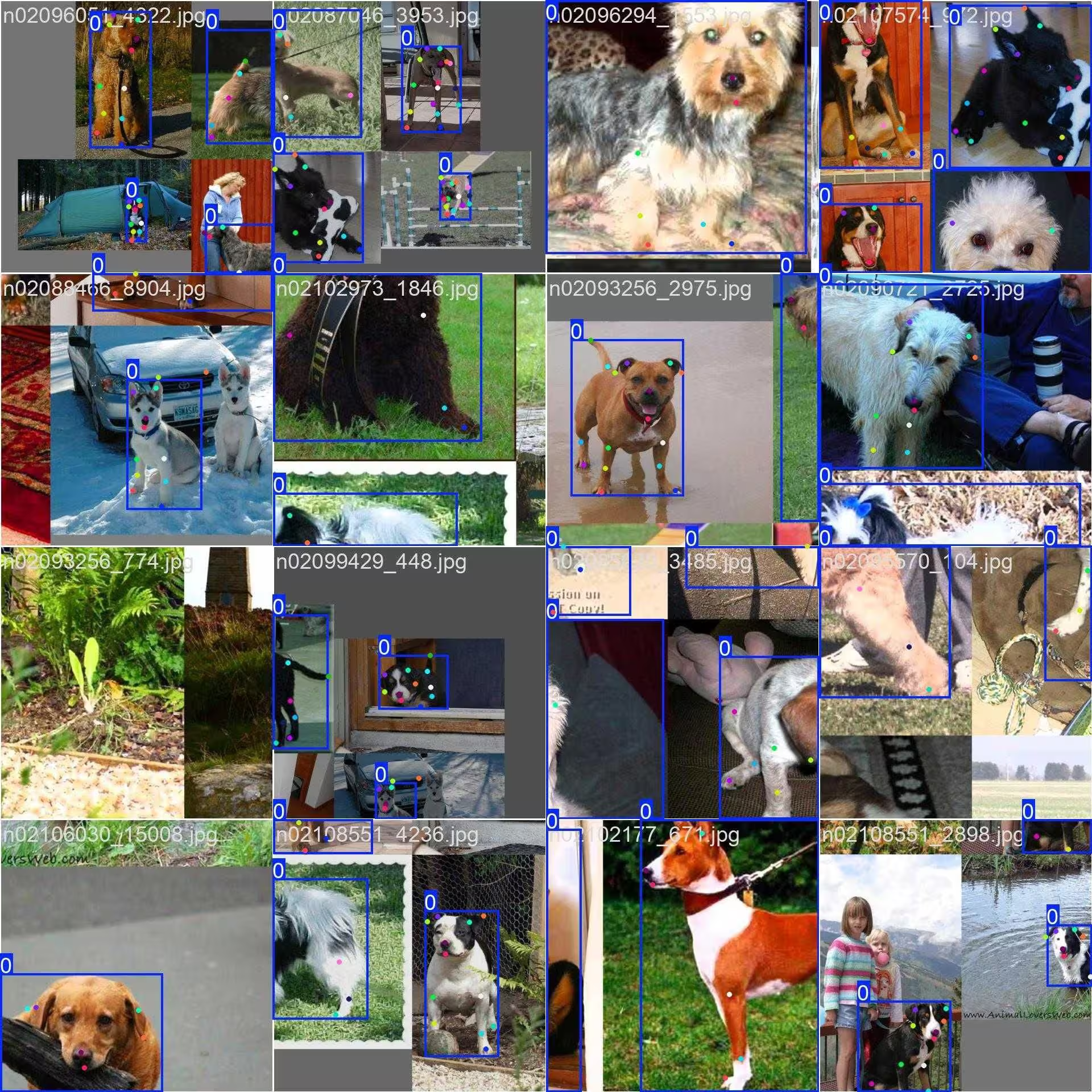
- 马赛克图像:此图像展示了由数据集马赛克图像组成的训练批次。马赛克是一种训练时使用的技术,它将多张图像合并为一张图像,从而增加每个训练批次中目标和场景的多样性。这有助于提升模型对不同目标尺寸、长宽比和上下文的泛化能力。
该示例展示了 Dog-Pose 数据集中图像的多样性和复杂性,以及在训练过程中使用马赛克增强的优势。
引用与致谢#
如果你在研究或开发工作中使用 Dog-Pose 数据集,请引用以下论文:
@inproceedings{khosla2011fgvc,
  title={Novel dataset for Fine-Grained Image Categorization},
  author={Aditya Khosla and Nityananda Jayadevaprakash and Bangpeng Yao and Li Fei-Fei},
  booktitle={First Workshop on Fine-Grained Visual Categorization (FGVC), IEEE Conference on Computer Vision and Pattern Recognition (CVPR)},
  year={2011}
}
@inproceedings{deng2009imagenet,
  title={ImageNet: A Large-Scale Hierarchical Image Database},
  author={Jia Deng and Wei Dong and Richard Socher and Li-Jia Li and Kai Li and Li Fei-Fei},
  booktitle={IEEE Computer Vision and Pattern Recognition (CVPR)},
  year={2009}
}我们感谢斯坦福大学团队创建并维护这一对计算机视觉社区有价值的资源。若要详细了解 Dog-Pose 数据集及其创建者,请访问 Stanford Dogs 数据集网站。
常见问题#
Dog-Pose 数据集包含 6,773 张训练图像和 1,703 张验证图像,每张图像标注了 24 个关键点,用于狗姿态估计。该数据集专为使用 Ultralytics YOLO26 训练和验证模型而设计,可支持动物行为分析、宠物监测和兽医研究等应用。其详细标注非常适合开发精准的犬类姿态估计模型。
Dog-Pose 数据集共包含 8,476 张图像(6,773 张训练图像 / 1,703 张验证图像),涵盖多种犬种和姿势;每个标注包含 3 维(x、y、可见性)的 24 个关键点,为模型提供了真实场景覆盖能力,满足宠物监控和行为分析等应用的需求。
马赛克增强会将多张 Dog-Pose 图像合并为一张训练图像,增加模型在每个训练步骤中接触到的狗姿势、尺寸和背景的多样性,从而提升模型对新场景和不同尺度的泛化能力,同时减少过拟合。示例图像请参阅示例图像和标注部分。
Dog-Pose 数据集 YAML 文件位于 https://github.com/ultralytics/ultralytics/blob/main/ultralytics/cfg/datasets/dog-pose.yaml。该文件定义数据集配置,包括路径、类别、关键点详情和其他相关信息。YAML 文件指定了 24 个关键点,每个关键点有 3 个维度,适用于精细的姿态估计任务。
要在 YOLO26 训练脚本中使用此文件,请按照用法部分所示,在训练命令中引用它。首次使用时,数据集会自动下载,因此设置过程十分简单。
有关关键点模型的更多信息,请参阅姿态估计任务文档。


评论12
提出问题、分享结果,或帮助其他人。
legend-zhen
Hello, although YOLOv11-pose can perform both object detection and pose estimation tasks simultaneously, there seems to be little correlation between the performance of pose estimation and object detection. What could be the reason for this? As I understand, YOLOv11-pose was specifically designed for human pose estimation, so can it also be perfectly adapted for animal pose estimation, as it is for humans? Are any special settings required when performing animal pose estimation?
 Glenn JocherUltralytics(已编辑)
@legend-zhen YOLO26 and YOLO11 pose models are indeed versatile and can be adapted for animal pose estimation, such as with the Dog-Pose dataset. While the architecture is optimized for human pose estimation, adapting it to animals typically requires a dataset with accurate annotations (e.g., 24 keypoints for dogs in Dog-Pose). No special settings are mandatory beyond ensuring the dataset YAML file is properly configured. For details on Dog-Pose, check here.
Peakednesss
I can just find 20 points, 4 for ears, 1 for nose, 1 for mouth, 2 for tail, and 12 for legs, where are the other four points?
- Glenn JocherUltralytics(已编辑)
@Peakednesss the Dog-Pose dataset has 24 keypoints. Beyond the 20 you found (ears, nose, chin, tail and legs), the other four are the left eye, right eye, withers and throat. The full list is in
kpt_namesin the dataset YAML: https://github.com/ultralytics/ultralytics/blob/main/ultralytics/cfg/datasets/dog-pose.yaml. thank you very much
goodbetterbest1
do you know where are the other 4 points’ definitions? I can’t find any useful information in the yaml document. thx
chengziNaomi
When we annotate the key point data set in a picture, if the two boxes have overlapping parts, how to annotate the key points in the overlapping boxes?
- Glenn JocherUltralytics
@chengziNaomi when annotating overlapping bounding boxes in a keypoint dataset, ensure that each object's keypoints are labeled independently, even if they share overlapping regions. Annotate each keypoint based on its respective object, maintaining clear separation to avoid ambiguity during model training. For guidelines on keypoint annotation, refer to Dog-Pose Dataset Documentation.
If I have multiple objects in a picture, should I frame all the objects at once and then label the key points together, or should I frame an object, label the key points of that object, then frame an object, and then label the key points of that object?
- Glenn JocherUltralytics
@chengziNaomi when annotating a single image with multiple objects, you should annotate each object separately. Frame one object, label its keypoints completely, then move to the next object. This ensures clarity and avoids confusion during model training. Refer to Dog-Pose Dataset Documentation for more annotation insights.
Thank you very much! and how can I draw heatmap for key point detection?
- Glenn JocherUltralytics
You're welcome! To draw a heatmap for keypoint detection, you can preprocess the keypoints into Gaussian blobs on a blank image using libraries like OpenCV or NumPy, then overlay them on the original image. For detailed implementation, check external heatmap solutions or visualization tools as it currently falls outside YOLO's built-in features. Let me know if you have further questions!