Projekt für ein Sicherheitsalarmsystem mit Ultralytics YOLO26
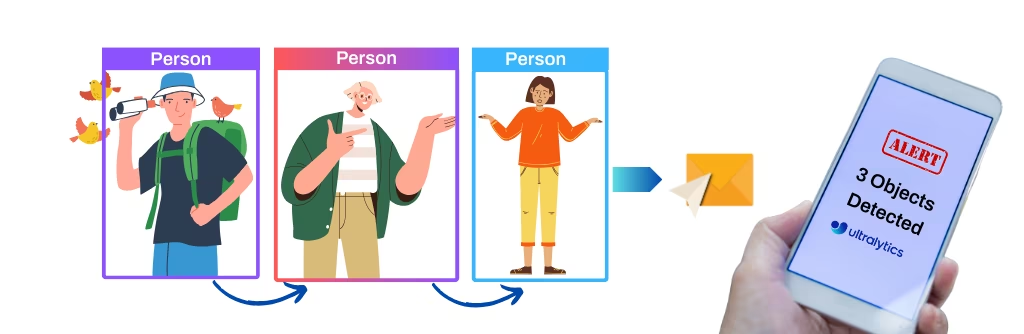
Dieses Projekt nutzt Computer Vision von Ultralytics YOLO26, um ein Sicherheitsalarmsystem zu entwickeln. YOLO26 ermöglicht Objekterkennung in Echtzeit, sodass das System potenzielle Sicherheitsbedrohungen umgehend erkennen und darauf reagieren kann. Das Projekt bietet mehrere Vorteile:
- Erkennung in Echtzeit: Dank der Effizienz von YOLO26 kann das Sicherheitsalarmsystem Sicherheitsvorfälle in Echtzeit erkennen und darauf reagieren, wodurch sich die Reaktionszeit verkürzt.
- Genauigkeit: Die genaue Objekterkennung von YOLO26 verringert die Zahl falsch positiver Ergebnisse und verbessert die Zuverlässigkeit des Sicherheitsalarmsystems.
- Integrationsmöglichkeiten: Das Projekt kann bestehende Überwachungskameras um KI-Analysen erweitern und so die aktuelle Überwachung um eine intelligente Erkennungsebene ergänzen.
Ansehen: Sicherheitsalarmsystem mit Ultralytics YOLO26 + Lösungen zur Objekterkennung
Sicherheitswarnungen mit YOLO26 versenden#
Die Lösung SecurityAlarm verfolgt Objekte in deinem Videostream und versendet eine einzelne E-Mail-Warnung mit einem angehängten Bild mit Annotationen, sobald die Anzahl der Erkennungen den Schwellenwert records erreicht. Authentifiziere ein Gmail-Konto mit einem App-Passwort und führe die Lösung dann für deine Quelle aus.
Rufe den Generator für App-Passwörter auf, gib einen App-Namen wie „security project“ an und erstelle ein 16-stelliges Passwort. Kopiere dieses Passwort und füge es in das Feld password im folgenden Code ein.
import cv2

from ultralytics import solutions

cap = cv2.VideoCapture("path/to/video.mp4")
assert cap.isOpened(), "Error reading video file"

# Video-Writer
w, h, fps = (int(cap.get(x)) for x in (cv2.CAP_PROP_FRAME_WIDTH, cv2.CAP_PROP_FRAME_HEIGHT, cv2.CAP_PROP_FPS))
video_writer = cv2.VideoWriter("security_output.avi", cv2.VideoWriter_fourcc(*"mp4v"), fps, (w, h))

from_email = "abc@gmail.com"  # die E-Mail-Adresse des Absenders
password = "---- ---- ---- ----"  # 16-stelliges App-Passwort erstellt über: https://myaccount.google.com/apppasswords
to_email = "xyz@gmail.com"  # die E-Mail-Adresse des Empfängers

# Sicherheitsalarmobjekt initialisieren
securityalarm = solutions.SecurityAlarm(
    show=True,  # # Ausgabe anzeigen
    model="yolo26n.pt",  # z. B. yolo26s.pt, yolo26m.pt
    records=1,  # Gesamtzahl der Erkennungen, ab der eine E-Mail gesendet wird
)

securityalarm.authenticate(from_email, password, to_email)  # E-Mail-Server authentifizieren

# Video verarbeiten
while cap.isOpened():
    success, im0 = cap.read()

    if not success:
        print("Video frame is empty or video processing has been successfully completed.")
        break

    results = securityalarm(im0)

    # print(results)  # auf die Ausgabe zugreifen

    video_writer.write(results.plot_im)  # das verarbeitete Bild schreiben.

cap.release()
video_writer.release()
cv2.destroyAllWindows()  # Alle geöffneten Fenster schließen
Wenn du den Code ausführst, erhältst du eine einzelne E-Mail-Benachrichtigung, falls ein Objekt erkannt wird. Die Benachrichtigung wird sofort und nicht wiederholt gesendet. Du kannst den Code an die Anforderungen deines Projekts anpassen.
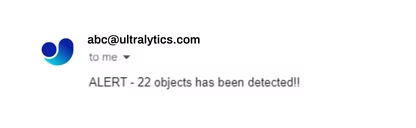
Beispiel einer empfangenen E-Mail#
Argumente für SecurityAlarm#
Hier ist eine Tabelle mit den Argumenten für SecurityAlarm:
| Argument | Typ | Standard | Beschreibung |
|---|---|---|---|
model | str | None | Pfad zu einer Ultralytics-YOLO-Modelldatei. |
records | int | 5 | Gesamtzahl der Erkennungen, ab der eine E-Mail mit einem Sicherheitsalarm ausgelöst wird. |
line_width | int | 2 | Linienstärke für die Boxen, Keypoints und Zählwerte, die von der Lösung eingezeichnet werden. |
verbose | bool | True | Aktiviert das Protokoll der Lösung für jedes Bild, das Eingabeform, Klassenanzahlen und Verarbeitungsgeschwindigkeit enthält. Der Tracking-Aufruf selbst gibt grundsätzlich keine Meldungen aus. |
Die Lösung SecurityAlarm unterstützt verschiedene Parameter für track:
| Argument | Typ | Standard | Beschreibung |
|---|---|---|---|
tracker | str | 'tracktrack.yaml' | Legt den zu verwendenden Verfolgungsalgorithmus fest. Integrierte Optionen: botsort.yaml, bytetrack.yaml, ocsort.yaml, deepocsort.yaml, fasttrack.yaml, tracktrack.yaml. |
conf | float | 0.25 | Legt den Konfidenzschwellenwert für Erkennungen fest. Niedrigere Werte ermöglichen die Verfolgung weiterer Objekte, können aber auch falsch positive Ergebnisse einschließen. |
iou | float | 0.5 | Legt den Schwellenwert für die Schnittmenge über Vereinigung (IoU) fest, um überlappende Erkennungen herauszufiltern. |
classes | list | None | Filtert die Ergebnisse nach Klassenindex. Beispielsweise verfolgt classes=[0, 2, 3] nur die angegebenen Klassen. |
device | str | None | Legt das Gerät für die Inferenz fest (z. B. cpu, cuda:0 oder 0). So kannst du für die Modellausführung zwischen CPU, einer bestimmten GPU oder anderen Rechengeräten wählen. |
imgsz | int or tuple | 640 | Zielbildgröße für die Inferenz: eine Ganzzahl für ein quadratisches Bild oder ein (height, width)-Paar. Die Formen werden an den Modellschritt angepasst. |
max_det | int | 300 | Maximale Anzahl der Erkennungen, die pro Bild vor der Verfolgung beibehalten werden. Dadurch wird die Anzahl der Objekte begrenzt, die eine Lösung in dichten Szenen verarbeitet. |
quantize | int or str | None | Inferenzpräzision: 16 (FP16) oder 32/unset (FP32) für PyTorch- und TorchScript-Modelle außerhalb der CPU; andere Formate verwenden die Präzision, die ihr Artefakt und ihre Laufzeitumgebung vorgeben. Ersetzt das veraltete Argument half. |
Außerdem sind die folgenden Visualisierungseinstellungen verfügbar:
| Argument | Typ | Standard | Beschreibung |
|---|---|---|---|
show | bool | False | Wenn True aktiviert ist, werden die annotierten Bilder oder Videos in einem Fenster angezeigt. Nützlich für unmittelbares visuelles Feedback während der Entwicklung oder beim Testen. |
show_conf | bool | True | Zeigt neben der Bezeichnung den Konfidenzwert jeder Erkennung an. Gibt Aufschluss darüber, wie sicher sich das Modell bei der jeweiligen Erkennung ist. |
show_labels | bool | True | Zeigt für jede Erkennung eine Bezeichnung in der visuellen Ausgabe an. So lassen sich erkannte Objekte sofort erkennen. |
So funktioniert es#
Das Sicherheitssystem mit Alarm nutzt Objektverfolgung, um Videostreams zu überwachen und potenzielle Sicherheitsbedrohungen zu erkennen. Sobald die Anzahl der in einem Frame erkannten Objekte den festgelegten Schwellenwert erreicht (festgelegt durch den Parameter records), sendet das System automatisch eine E-Mail-Benachrichtigung mit einem Bildanhang, auf dem die erkannten Objekte zu sehen sind.
Das System nutzt die Klasse SecurityAlarm, die folgende Methoden bereitstellt:
- Frames verarbeiten und Objekterkennungen extrahieren
- Frames mit Begrenzungsrahmen um erkannte Objekte versehen
- E-Mail-Benachrichtigungen senden, wenn Erkennungsschwellenwerte erreicht werden
Diese Implementierung eignet sich für die Haussicherheit, die Überwachung im Einzelhandel und andere Überwachungsanwendungen, bei denen eine sofortige Benachrichtigung über erkannte Objekte entscheidend ist.
Häufig gestellte Fragen#
Ultralytics YOLO26 verbessert Sicherheitsalarmsysteme durch genaue Objekterkennung in Echtzeit. Dadurch gibt es weniger falsch positive Ergebnisse, sodass das System hauptsächlich auf tatsächliche Ereignisse reagiert. Du kannst Fehlalarme weiter reduzieren, indem du die Erkennung auf relevante
classesbeschränkst, zum Beispiel nur auf Personen, den Schwellenwertconferhöhst oderrecordserhöhst.Ja. Die Lösung
SecurityAlarmverarbeitet Frames aus jeder Quelle, die OpenCV lesen kann, darunter Videodateien, Webcams und RTSP-Streams von IP-Kameras. So kannst du YOLO26-Erkennung zu einer bestehenden Kamerakonfiguration hinzufügen.Für die Ausführung von Ultralytics YOLO26 auf einem Standardsystem werden in der Regel etwa 5 GB freier Festplattenspeicher benötigt. Dazu gehört Speicherplatz für das YOLO26-Modell und weitere Abhängigkeiten. Für cloudbasierte Lösungen bietet die Ultralytics Platform eine effiziente Projektverwaltung und Datensatzverwaltung, mit denen sich der Speicherbedarf optimieren lässt. Der Pro-Tarif erhöht den Speicherplatz auf 500 GB.
Ultralytics YOLO26 ist Modellen wie Faster R-CNN oder SSD dank seiner Echtzeiterkennung und höheren Genauigkeit überlegen. Seine einstufige Architektur verarbeitet Bilder deutlich schneller, ohne die Genauigkeit zu beeinträchtigen, und eignet sich daher gut für zeitkritische Anwendungen wie Sicherheitsalarmsysteme.
Um falsch positive Ergebnisse zu reduzieren, solltest du sicherstellen, dass dein Ultralytics-YOLO26-Modell mit einem vielfältigen und sorgfältig annotierten Datensatz ausreichend trainiert wurde. Durch das Optimieren von Hyperparametern und regelmäßige Aktualisieren des Modells mit neuen Daten kannst du die Erkennungsgenauigkeit deutlich verbessern.


Kommentare153
Stell eine Frage, teile deine Ergebnisse oder hilf jemand anderem.
e9l7a5f
hi, i cant do the email setting, of Sign in with app passwords and the authentication part , it looks like google change the setting i cant find them, is there another way?
1 Glenn JocherUltralytics(bearbeitet)
Hey there! 😊 It seems like Google's app password settings have indeed evolved, and I appreciate you reaching out for assistance on this. While the current documentation may reference older interfaces, the essence of setting up app passwords for projects like the Security Alarm System with Ultralytics YOLOv8 remains relevant.
If you're experiencing difficulties locating the specific options for app passwords on Google, you might consider looking into alternative email sending services that offer API support, such as SendGrid, Mailgun, or even using a local SMTP server setup, depending on your project's complexity and scale.
For a quick fix using
smtplibwith Gmail, ensure you've enabled two-factor authentication on your account, and then create an app password here: https://myaccount.google.com/apppasswords.Here's a simplified version of how to use an app password:
import smtplib

EMAIL = "your_email@gmail.com"
APP_PASSWORD = "your_app_password"

with smtplib.SMTP("smtp.gmail.com", 587) as smtp:
    smtp.starttls()
    smtp.login(EMAIL, APP_PASSWORD)
    subject = "Security Alert"
    body = "Alert description"
    msg = f"Subject: {subject}\n\n{body}"
    smtp.sendmail(EMAIL, "receiver_email@gmail.com", msg)
Make sure to replace
"your_email@gmail.com"and"your_app_password"with your actual Gmail email and the 16-digit app password you generate, respectively.It's recommended to review the current Gmail documentation or seek updated guidance if Google's procedures have significantly changed since our last update. Hope this helps! If you have further questions or need more personalized assistance, feel free to ask.
thanks for replying, i fix it for the yolov8 as the same steps u explained, now i want to use it on yolov9 but i cant with these steps, because i am using the detect.py and i dont know how to deal with it , where to put each code, i dont have that much background in DL and python codes. the email part is working now
- Glenn JocherUltralytics(bearbeitet)
@e9l7a5f you can use YOLOv9 models the same way as you currently use YOLOv8 models; see https://docs.ultralytics.com/models/yolov9. For new projects we recommend YOLO26: https://docs.ultralytics.com/models/yolo26/.
aaurelions
% python3.11 main.py
Ultralytics Solutions: ✅ {'source': None, 'model': 'yolo11n.pt', 'classes': None, 'show_conf': True, 'show_labels': True, 'region': None, 'colormap': 21, 'show_in': True, 'show_out': True, 'up_angle': 145.0, 'down_angle': 90, 'kpts': [6, 8, 10], 'analytics_type': 'line', 'figsize': (12.8, 7.2), 'blur_ratio': 0.5, 'vision_point': (20, 20), 'crop_dir': 'cropped-detections', 'json_file': None, 'line_width': 2, 'records': 1, 'fps': 30.0, 'max_hist': 5, 'meter_per_pixel': 0.05, 'max_speed': 120, 'show': True, 'iou': 0.7, 'conf': 0.25, 'device': None, 'max_det': 300, 'half': False, 'tracker': 'botsort.yaml', 'verbose': True, 'data': 'images'}
Traceback (most recent call last):
  File "/Users/llama/Developer/sec/main.py", line 23, in <module>
    securityalarm.authenticate(from_email, password, to_email)  # authenticate the email server
    ^^^^^^^^^^^^^^^^^^^^^^^^^^^^^^^^^^^^^^^^^^^^^^^^^^^^^^^^^^
  File "/Users/llama/.venv/3.11/lib/python3.11/site-packages/ultralytics/solutions/security_alarm.py", line 68, in authenticate
    self.server = smtplib.SMTP("smtp.gmail.com: 587")
                  ^^^^^^^^^^^^^^^^^^^^^^^^^^^^^^^^^^^
  File "/opt/homebrew/Cellar/python@3.11/3.11.13/Frameworks/Python.framework/Versions/3.11/lib/python3.11/smtplib.py", line 255, in __init__
    (code, msg) = self.connect(host, port)
                  ^^^^^^^^^^^^^^^^^^^^^^^^
  File "/opt/homebrew/Cellar/python@3.11/3.11.13/Frameworks/Python.framework/Versions/3.11/lib/python3.11/smtplib.py", line 341, in connect
    self.sock = self._get_socket(host, port, self.timeout)
                ^^^^^^^^^^^^^^^^^^^^^^^^^^^^^^^^^^^^^^^^^^
  File "/opt/homebrew/Cellar/python@3.11/3.11.13/Frameworks/Python.framework/Versions/3.11/lib/python3.11/smtplib.py", line 312, in _get_socket
    return socket.create_connection((host, port), timeout,
           ^^^^^^^^^^^^^^^^^^^^^^^^^^^^^^^^^^^^^^^^^^^^^^^
  File "/opt/homebrew/Cellar/python@3.11/3.11.13/Frameworks/Python.framework/Versions/3.11/lib/python3.11/socket.py", line 863, in create_connection
    raise exceptions[0]
  File "/opt/homebrew/Cellar/python@3.11/3.11.13/Frameworks/Python.framework/Versions/3.11/lib/python3.11/socket.py", line 848, in create_connection
    sock.connect(sa)
ConnectionRefusedError: [Errno 61] Connection refused
RizwanMunawar
@aaurelions Hi, thanks for sharing it. You will need to configure the parameters first by following the docs: https://docs.ultralytics.com/guides/security-alarm-system/
1
EQUINOX391
Dear ultralytics team! First of all i really appreciate this amazing works, I'm working on my projects for detecting crime and i aalready have a trained resnet 50 model for detecting some crime as dummy, I really wonder can i integrate the Security Alarm System by Ultralytics in my projects and make it like have this functionality :
- have input of CCTV from RTSP
- when detecting people (or maybe car, bike, etc) , my resnet model will also detecting what they do, after we know what the activity is, we can send it the email
- customize the email messaging like "ALERT 2 people 2 cars detected, Activity Probability : Suspicious - Stealing"
- also send different email if the people stays too long in the frame.
- keep making new notification IF There's new people(s) inside the frame.
- notified if the people or another object is gone from the frame
- is there any pretrain model that detect something related to crime like hammer, crowbar, spraying can, grafitti, gun, etc?
- is there any pretrain model yolo have for pose estimation? i mean there's some but i don't find anything inside the documentation that said it can estimate some general pose like, squat, stand, walk, run, etc
i have so many question but i think that is the most of it! Thank you, and sorry for my bad english.
Cheikh-Ahmedand
Hi Glenn-jocher!
I am very appreciative of your help to your clients as i am one of them.
in onder to integrate security alarm system in an application, using streamlit package, how can i let the end user input their capture_index value and their email:
st. input_text ( )
from_email = "@gmail.com" # must match the email used to generate the password
st. input_text ( )
detector = ObjectDetection(capture_index=0) detector()
with examples, please!
Best regards!
- Glenn JocherUltralytics(bearbeitet)
@Cheikh-Ahmedand thank you for your support! For Streamlit integration, you can collect user inputs like this:
import cv2
import streamlit as st
from ultralytics import solutions

# User inputs
from_email = st.text_input("Sender Email")
password = st.text_input("App Password", type="password")
to_email = st.text_input("Receiver Email")
capture_source = st.text_input("Camera Index/Video Path", "0")

# Initialize SecurityAlarm with user inputs
security = solutions.SecurityAlarm(show=True, model="yolo26n.pt", records=1)
security.authenticate(from_email, password, to_email)
cap = cv2.VideoCapture(int(capture_source) if capture_source.isdigit() else capture_source)
The SecurityAlarm implementation details remain as shown in our security alarm system guide. For email setup, ensure users follow the App Password Generator instructions.
Hello there, glenn-jocher!
Thanks for your nice Help!
I would like st.input_text for end users for from_emails /to_email and detector = ObjectDetection(capture_index=0) in the below code, not for the code you gave an example on:
Securiy Alarm System
password = " " from_email = "@gmail.com" # must match the email used to generate the password to_email = "@gmail.com" # receiver email
import smtplib server = smtplib.SMTP('smtp.gmail.com: 587') server.starttls() server.login(from_email, password)
from email.mime.multipart import MIMEMultipart from email.mime.text import MIMEText from email.mime.image import MIMEImage
def send_email(to_email, from_email, image_path, object_detected=1): """Sends an email with an image attachment.""" message = MIMEMultipart() message["From"] = from_email message["To"] = to_email message["Subject"] = "Security Alert" message_body = f"ALERT - {object_detected} objects have been detected!" message.attach(MIMEText(message_body, "plain")) with open(image_path, 'rb') as img_file: img = MIMEImage(img_file.read()) message.attach(img) server.sendmail(from_email, to_email, message.as_string())
from time import time
import cv2 import torch from ultralytics import YOLO from ultralytics.utils.plotting import Annotator, colors
class ObjectDetection: def init(self, capture_index): """Initializes an ObjectDetection instance with a given camera index.""" self.capture_index = capture_index self.email_sent = False
    # model information
    self.model = YOLO("yolo11n.pt")

    # visual information
    self.annotator = None
    self.start_time = 0
    self.end_time = 0

    # device information
    self.device = "cuda" if torch.cuda.is_available() else "cpu"

def predict(self, im0):
    """Run prediction using a YOLO model for the input image `im0`."""
    results = self.model(im0, classes=[0])
    return results

def display_fps(self, im0):
    """Displays the FPS on an image `im0` by calculating and overlaying as white text on a black rectangle."""
    self.end_time = time()
    fps = 1 / round(self.end_time - self.start_time, 2)
    text = f"FPS: {int(fps)}"
    text_size = cv2.getTextSize(text, cv2.FONT_HERSHEY_SIMPLEX, 1.0, 2)[0]
    gap = 10
    cv2.rectangle(
        im0,
        (20 - gap, 70 - text_size[1] - gap),
        (20 + text_size[0] + gap, 70 + gap),
        (255, 255, 255),
        -1,
    )
    cv2.putText(im0, text, (20, 70), cv2.FONT_HERSHEY_SIMPLEX, 1.0, (0, 0, 0), 2)

def plot_bboxes(self, results, im0):
    """Plots bounding boxes on an image given detection results; returns annotated image and class IDs."""
    class_ids = []
    self.annotator = Annotator(im0, 3, results[0].names)
    boxes = results[0].boxes.xyxy.cpu()
    clss = results[0].boxes.cls.cpu().tolist()
    names = results[0].names
    for box, cls in zip(boxes, clss):
        class_ids.append(cls)
        self.annotator.box_label(box, label=names[int(cls)], color=colors(int(cls), True))
    return im0, class_ids

def __call__(self):
    """Run object detection on video frames from a camera stream, plotting and showing the results."""
    cap = cv2.VideoCapture(self.capture_index)
    assert cap.isOpened()
    cap.set(cv2.CAP_PROP_FRAME_WIDTH, 640)
    cap.set(cv2.CAP_PROP_FRAME_HEIGHT, 480)
    frame_count = 0
    while True:
        self.start_time = time()
        ret, im0 = cap.read()
        assert ret
        results = self.predict(im0)
        im0, class_ids = self.plot_bboxes(results, im0)
        if len(class_ids) > 0:
           image_path = f"detected_frame_{frame_count}.jpg"
           cv2.imwrite(image_path, im0)
           if not self.email_sent:
            send_email(to_email, from_email, image_path, len(class_ids))
            self.email_sent = True
        else:
            self.email_sent = False

        self.display_fps(im0)
        cv2.imshow("YOLO11 Detection", im0)
        frame_count += 1
        if cv2.waitKey(5) & 0xFF == 27:
            break
    cap.release()
    cv2.destroyAllWindows()
    server.quit()
detector = ObjectDetection(capture_index=0) detector()
would you please give an example of st. input_text for end users letting them write their emails and capture_index on the above code?
Sincerely Yours!
- Glenn JocherUltralytics
Thank you for your question! For Streamlit integration with user inputs in your security system, here's how to modify your code:
import streamlit as st

# User inputs
from_email = st.text_input("Sender Email")
to_email = st.text_input("Receiver Email")
password = st.text_input("App Password", type="password")
capture_index = st.text_input("Camera Index/Video Path", "0")

# Initialize detector with user inputs
detector = ObjectDetection(capture_index=int(capture_index) if capture_index.isdigit() else capture_index)
This allows users to specify their email credentials and camera source through Streamlit's interactive interface. The Security Alarm System guide shows how these inputs integrate with YOLO11's detection capabilities. For email setup requirements, please ensure users follow the App Password Generator instructions from our security alarm documentation.
boukosho
Hey glenn-jocher!
As you know, ML models need frequent check so as their data remain undriffed and their distribution remain unchanged.
To frequently monitor deployed ml models by streamlit in case it is deployed to aws ec2, Google Cloud, or streamlit community cloud or in local server, what should I do ?
Please give an example!
Thanks!
- Glenn JocherUltralytics(bearbeitet)
@boukosho for monitoring deployed YOLO11 models across cloud platforms, consider implementing a heartbeat system with performance metrics logging. Our Security Alarm System guide shows email alert integration that could be adapted for drift detection notifications. For production deployments, Ultralytics Platform provides monitoring for deployed endpoints; see the Platform monitoring documentation. A minimal implementation might track inference statistics and trigger alerts via our solutions.SecurityAlarm class when thresholds are exceeded.
Hello there glenn-jocher!
Thanks for your respectful responses!
If I want the alarm system to only notify me when it is confident of more than 0.3 % .
So how to do it, with examples, please!
 # model information

    self.model = YOLO("yolo11.pt")

    # visual information

    self.annotator = None

    self.start_t        ime = 0

    self.end_time = 0


    # device information

    self.device = "cuda" if torch.cuda.is_available() else "cpu"


def predict(self, im0):

    """Run prediction using a YOLO model for the input image `im0`."""

    results = self.model(im0, classes=[0])

     return results
Sincelrely Yours!
- Glenn JocherUltralytics(bearbeitet)
@Cheikh-Ahmedand to adjust the confidence threshold in your security alarm system, set the
confargument when initializing the solution. For example:security = solutions.SecurityAlarm(model="yolo26n.pt", conf=0.5) # only detections above 0.5 confidenceThis ensures notifications only trigger for detections exceeding your specified confidence level. For more details, refer to the Security Alarm System guide.
hey!
Thanks glenn-jocher for your respectful response.
security = solutions.SecurityAlarm(model="yolo11n.pt", conf=0.5) # Set confidence threshold >0.3 security.model.conf = 0.5 # Alternative direct method
N.B, I would like to add conf=0.5 for the below function (self.model = YOLO("yolo11n.pt"), not for the above one
class ObjectDetection:
def __init__(self, capture_index):

    """Initializes an ObjectDetection instance with a given camera index."""

    self.capture_index = capture_index

    self.email_sent = False

    # model information

    self.model = YOLO("yolo11n.pt")
visual information
    self.annotator = None

    self.start_time = 0

    self.end_time = 0

    # device information

    self.device = "cuda" if torch.cuda.is_available() else "cpu"
How to do so with examples, please!
Sincerely Yours!
- Glenn JocherUltralytics(bearbeitet)
@Cheikh-Ahmedand in your own
ObjectDetectionclass, passconfwhen you run inference rather than when loading the model:self.model = YOLO("yolo26n.pt") results = self.model.predict(im0, conf=0.5)For more details on model arguments, see the Predict mode documentation.
Hey glenn- jocher!
Thanks lots for your respectful response.
self.model = YOLO("yolo11n.pt", task="detect").set({"conf": 0.5})
When i run the above code, an error has been occured:
(AttributeError: 'DetectionModel' object has no attribute 'set')
What should i do instead? With examples, Please.
Best Regards!
- Glenn JocherUltralytics
To set the confidence threshold in your custom
ObjectDetectionclass, modify yourpredictmethod like this:def predict(self, im0): results = self.model.predict(im0, classes=[0], conf=0.5) # Add conf here return resultsThe
confparameter should be passed during inference rather than model initialization. For more details on prediction arguments, see the Predict mode documentation.
Hello there! What do you mean by the below function?
cap = cv2.VideoCapture("Path/to/video/file.mp4") assert cap.isOpened(), "Error reading video file"
Namely, I have a Webcam or the laptop camera or dvr/nvr cameras and I want to attach them to the above function. How to do so? With examples, please!! . Sincerely Yours!
- Glenn JocherUltralytics(bearbeitet)
To use your webcam or camera stream with OpenCV's
VideoCapture, replace the file path with:0for default laptop camera (e.g.,cap = cv2.VideoCapture(0))- RTSP URL for network cameras (e.g.,
cap = cv2.VideoCapture("rtsp://username:password@camera_ip:port/stream"))
For DVR/NVR cameras, use your camera's RTSP stream URL. See OpenCV VideoCapture docs for more input formats.
Hay!
Glenn-jocher I asked you questions here, you haven't answered me yet? Do you still respond kindly to questions regarding yolo security alarm system here? Or you no longer do so?
Best Regards!
- Glenn JocherUltralytics
@boukosho hi! We're happy to help with YOLO security alarm system questions. Our comprehensive Security Alarm System guide at https://docs.ultralytics.com/guides/security-alarm-system/ provides complete implementation code and documentation. For specific issues, feel free to open a GitHub Discussion with details about your implementation and we'll assist there. 😊
Hello there! What do you mean by the below function?
cap = cv2.VideoCapture("Path/to/video/file.mp4") assert cap.isOpened(), "Error reading video file"
Namely, I have a Webcam or the laptop camera or dvr/nvr cameras and I want to attach them to the above function. How to do so? With examples, please!! . Sincerely Yours!
- Glenn JocherUltralytics(bearbeitet)
To use your webcam, laptop camera, or DVR/NVR cameras with
cv2.VideoCapture, modify the source argument:-
Webcam/Laptop Camera:
cap = cv2.VideoCapture(0)(0 for default camera, 1 for secondary, etc.) -
IP/DVR/NVR Cameras:
Use RTSP/HTTP stream URLs like:
cap = cv2.VideoCapture("rtsp://username:password@camera_ip:port/stream")
The rest of the security alarm code remains unchanged. Ensure your camera feed is accessible and credentials are correctly formatted in URLs. For more details on video sources, see our Object Detection and Tracking guide.
-
Hello there! What do you mean by the below function?
cap = cv2.VideoCapture("Path/to/video/file.mp4") assert cap.isOpened(), "Error reading video file"
Namely, I have a Webcam or the laptop camera or dvr/nvr cameras and I want to attach them to the above function. How to do so? With examples, please!! . Sincerely Yours!
- Glenn JocherUltralytics(bearbeitet)
For webcam/laptop camera use
cap = cv2.VideoCapture(0)(0=default camera index). For IP cameras, use an RTSP URL likecap = cv2.VideoCapture("rtsp://username:password@camera_ip:port/path"). Theassertchecks if the video source opens successfully. You can find specific camera URL formats in your DVR/NVR documentation.
andrewjang2234
Traceback (most recent call last): File "C:\Users\User\class-iot\apps\iot07\security.py", line 17, in server.login(from_email, password) File "C:\Users\User\miniconda3\envs\class-iot061\lib\smtplib.py", line 750, in login raise last_exception File "C:\Users\User\miniconda3\envs\class-iot061\lib\smtplib.py", line 739, in login (code, resp) = self.auth( File "C:\Users\User\miniconda3\envs\class-iot061\lib\smtplib.py", line 662, in auth raise SMTPAuthenticationError(code, resp) smtplib.SMTPAuthenticationError: (534, b'5.7.9 Application-specific password required. For more information, go to\n5.7.9 https://support.google.com/mail/?p=InvalidSecondFactor 41be03b00d2f7-7fd430cec7bsm8095565a12.67 - gsmtp')
I don't know why this error is keep causing.......... what is the problem?
sorry I sovle that problem if I want to use my laptob cam what do I have to do?
- Glenn JocherUltralytics
@andrewjang2234 to use your laptop's camera, set the
capture_indexparameter in theObjectDetectionclass to0(e.g.,ObjectDetection(capture_index=0)). This should automatically access your default webcam. If issues persist, ensure your camera is not being used by another application.
I have a question. what exactly 'to_email' is? 'from_email' is my main emial, and 'password' is 'from_email's password and what is to_email?
- Glenn JocherUltralytics
@andrewjang2234 the
to_emailrefers to the recipient's email address where the alert or notification will be sent. If you have further questions about this setup, feel free to ask!