Suivi des entraînements avec Ultralytics YOLO26

Le suivi des entraînements grâce à l’estimation de pose avec Ultralytics YOLO26 améliore l’évaluation des exercices en suivant avec précision les repères et les articulations clés du corps en temps réel. Cette technologie fournit un retour instantané sur la posture, suit les routines d’entraînement et mesure les indicateurs de performance, optimisant ainsi les séances pour les utilisateurs comme pour les entraîneurs.
Regarder : Comment suivre des exercices physiques avec Ultralytics YOLO | Squats, extensions des jambes, pompes et plus encore
Avantages du suivi des entraînements#
- Performances optimisées : adapter les entraînements en fonction des données de suivi pour obtenir de meilleurs résultats.
- Atteinte des objectifs : suivre et ajuster les objectifs de remise en forme pour mesurer les progrès.
- Personnalisation : créer des programmes d’entraînement personnalisés à partir des données de chaque personne pour plus d’efficacité.
- Attention à la santé : détecter tôt les tendances pouvant indiquer des problèmes de santé ou du surentraînement.
- Décisions éclairées : prendre des décisions fondées sur les données pour ajuster les routines et fixer des objectifs réalistes.
Applications concrètes#
| Suivi des entraînements | Suivi des entraînements |
|---|---|
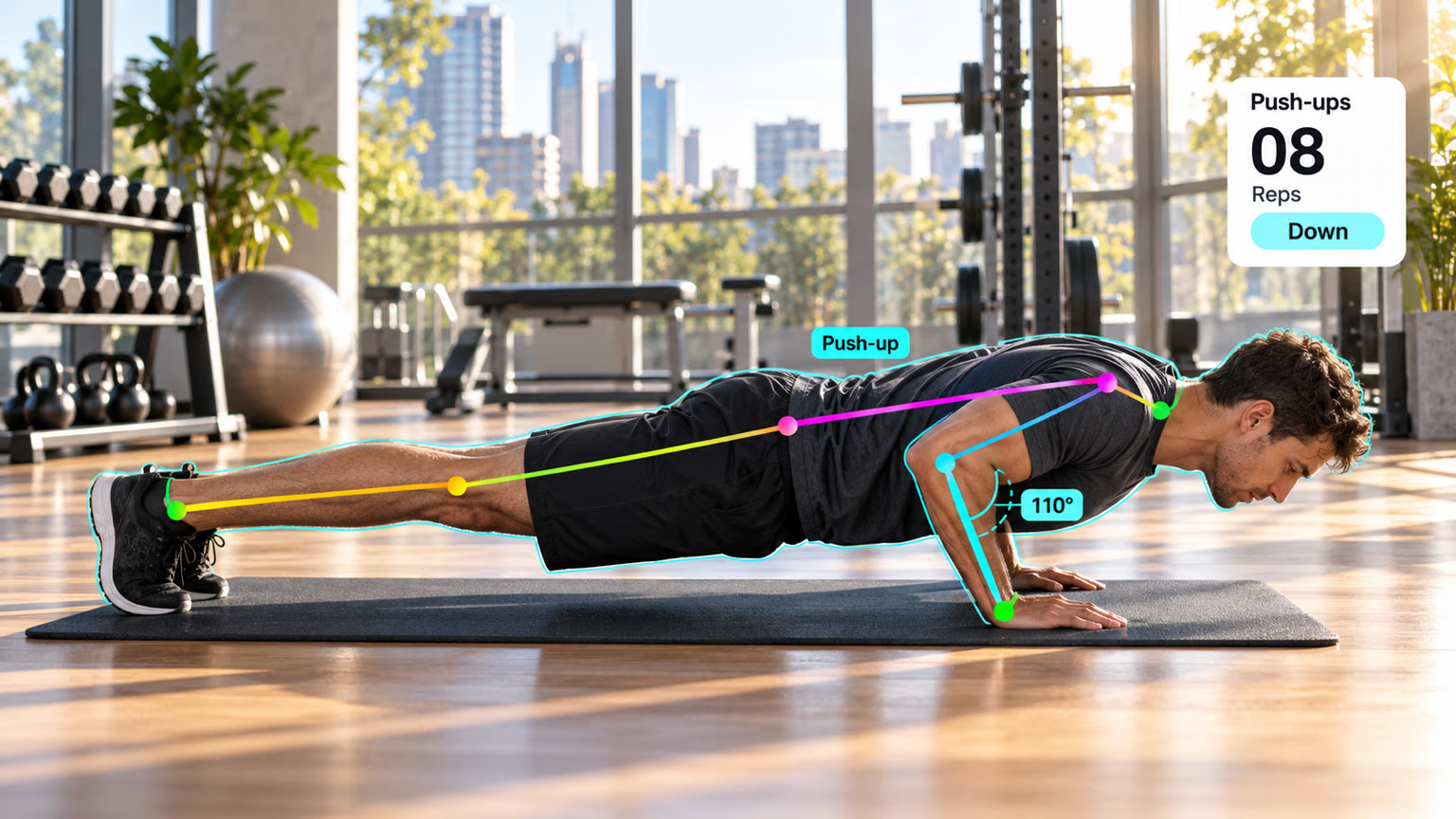 | 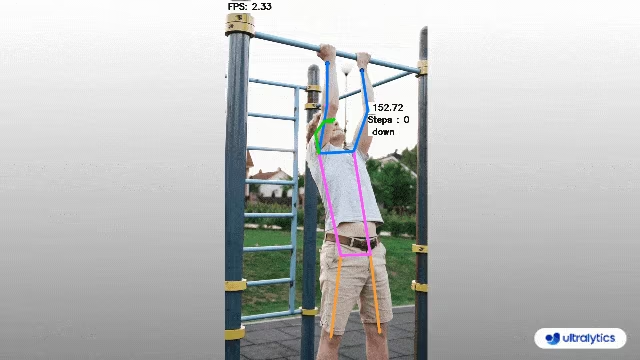 |
| Comptage des pompes | Comptage des tractions |
Suivre les entraînements avec YOLO26#
La solution AIGym exécute l’estimation de pose avec un modèle tel que YOLO26n-pose et compte les répétitions en mesurant l’angle formé par trois points clés lorsqu’un membre passe entre les seuils up_angle et down_angle. Choisis les points clés correspondant à l’exercice que tu veux suivre avec kpts, puis exécute la solution sur ta vidéo avec l’API Python ou la CLI.
# Run a workout example
yolo solutions workout show=True

# Pass a source video
yolo solutions workout source="path/to/video.mp4"

# Use keypoints for pushups
yolo solutions workout kpts="[6, 8, 10]"
Carte des points clés#
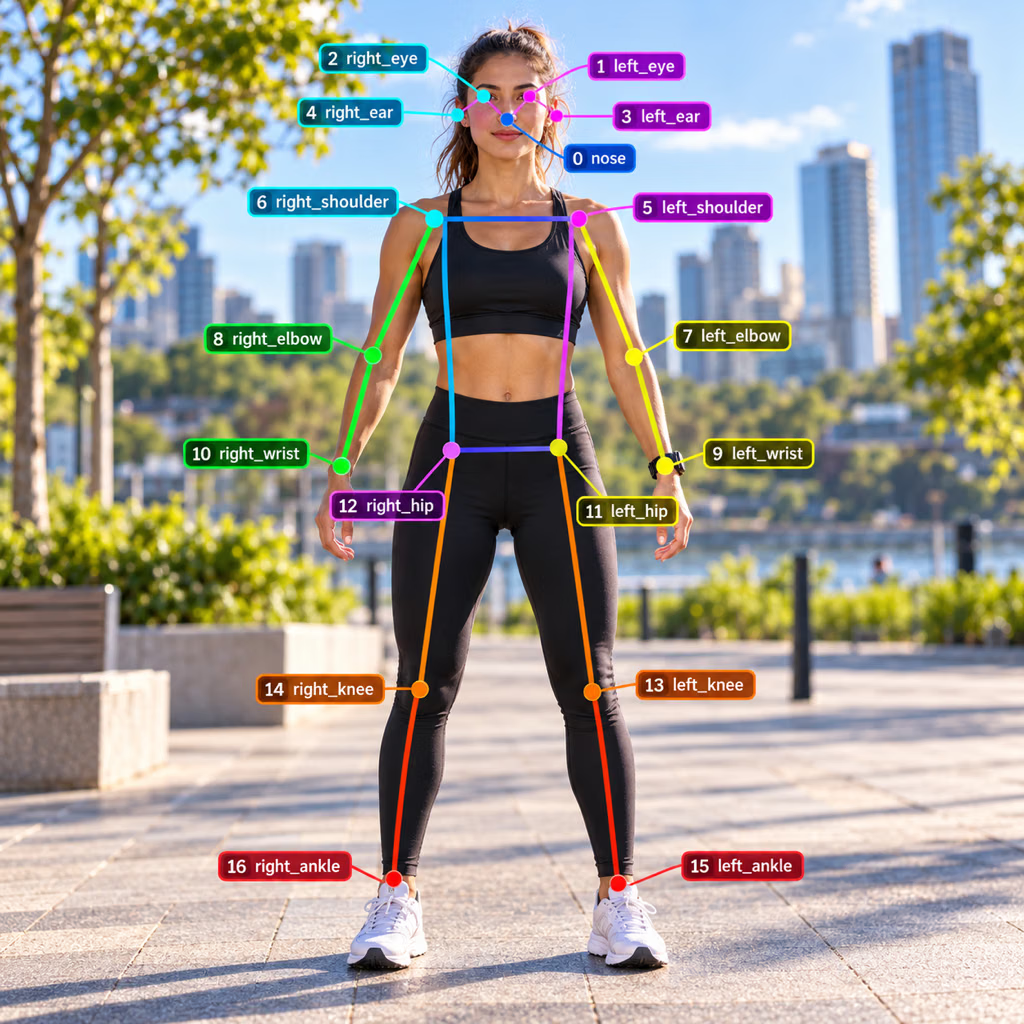
Arguments de AIGym#
Voici un tableau des arguments de AIGym :
| Argument | Type | Valeur par défaut | Description |
|---|---|---|---|
model | str | None | Chemin vers un fichier de modèle Ultralytics YOLO. |
up_angle | float | 145.0 | Seuil d'angle pour la pose « haute ». |
down_angle | float | 90.0 | Seuil d'angle pour la pose « basse ». |
kpts | list[int] | [6, 8, 10] | Liste de trois indices de points clés utilisés pour suivre les entraînements. Ces points clés correspondent à des articulations ou parties du corps, telles que les épaules, les coudes et les poignets, pour des exercices comme les pompes, les tractions, les squats et les exercices abdominaux. |
line_width | int | 2 | Épaisseur des lignes des boîtes, des points clés et des compteurs dessinés par la solution. |
verbose | bool | True | Active le journal de la solution pour chaque image, qui indique la forme de l'entrée, le nombre d'éléments par classe et la vitesse de traitement. L'appel de suivi reste toujours silencieux. |
La solution AIGym prend également en charge divers paramètres de suivi d’objets :
| Argument | Type | Valeur par défaut | Description |
|---|---|---|---|
tracker | str | 'tracktrack.yaml' | Indique l'algorithme de suivi à utiliser. Options intégrées : botsort.yaml, bytetrack.yaml, ocsort.yaml, deepocsort.yaml, fasttrack.yaml, tracktrack.yaml. |
conf | float | 0.25 | Définit le seuil de confiance des détections ; des valeurs plus faibles permettent de suivre davantage d'objets, mais peuvent inclure des faux positifs. |
iou | float | 0.5 | Définit le seuil d'intersection sur l'union (IoU) utilisé pour filtrer les détections qui se chevauchent. |
classes | list | None | Filtre les résultats selon l'indice de classe. Par exemple, classes=[0, 2, 3] ne suit que les classes spécifiées. |
device | str | None | Indique le périphérique utilisé pour l'inférence (par exemple, cpu, cuda:0 ou 0). Permet de choisir entre le CPU, un GPU spécifique ou d'autres périphériques de calcul pour l'exécution du modèle. |
imgsz | int or tuple | 640 | Taille cible de l'image pour l'inférence : un entier pour une image carrée ou une paire (height, width). Les dimensions sont ajustées au stride du modèle. |
max_det | int | 300 | Nombre maximal de détections conservées par image avant le suivi, ce qui limite le nombre d'objets qu'une solution traite dans les scènes denses. |
quantize | int or str | None | Précision d’inférence : 16 (FP16) ou 32/unset (FP32) pour les modèles PyTorch et TorchScript hors CPU ; les autres formats utilisent la précision définie par leur artefact et leur environnement d’exécution. Remplace l’argument half obsolète. |
De plus, tu peux appliquer les paramètres de visualisation suivants :
| Argument | Type | Valeur par défaut | Description |
|---|---|---|---|
show | bool | False | Si True, affiche les images ou vidéos annotées dans une fenêtre. Utile pour obtenir un retour visuel immédiat pendant le développement ou les tests. |
show_labels | bool | True | Affiche les étiquettes de chaque détection dans le résultat visuel. Permet d'identifier immédiatement les objets détectés. |
FAQ#
Pour suivre tes entraînements avec Ultralytics YOLO26, tu peux utiliser les capacités d’estimation de pose afin de suivre et d’analyser en temps réel les repères et les articulations clés du corps. Tu peux ainsi obtenir un retour instantané sur ta posture, compter les répétitions et mesurer les indicateurs de performance. Pour commencer, utilise l’exemple de code fourni pour les pompes, les tractions ou les exercices pour les abdominaux :
import cv2 from ultralytics import solutions cap = cv2.VideoCapture("path/to/video.mp4") assert cap.isOpened(), "Error reading video file" w, h, fps = (int(cap.get(x)) for x in (cv2.CAP_PROP_FRAME_WIDTH, cv2.CAP_PROP_FRAME_HEIGHT, cv2.CAP_PROP_FPS)) gym = solutions.AIGym( line_width=2, show=True, kpts=[6, 8, 10], ) while cap.isOpened(): success, im0 = cap.read() if not success: print("Video frame is empty or processing is complete.") break results = gym(im0) cap.release() cv2.destroyAllWindows()L’utilisation d’Ultralytics YOLO26 pour le suivi des entraînements offre plusieurs avantages clés :
- Performances optimisées : en adaptant tes entraînements selon les données de suivi, tu peux obtenir de meilleurs résultats.
- Atteinte des objectifs : suis et ajuste facilement tes objectifs de remise en forme pour mesurer tes progrès.
- Personnalisation : bénéficie de programmes d’entraînement personnalisés selon tes données pour une efficacité optimale.
- Attention à la santé : détecte tôt les tendances pouvant indiquer des problèmes de santé ou du surentraînement.
- Décisions éclairées : prends des décisions fondées sur les données pour ajuster tes routines et fixer des objectifs réalistes.
Tu peux regarder une vidéo de démonstration sur YouTube pour voir ces avantages en action.
Les modèles de pose Ultralytics YOLO26 suivent avec précision les repères et les articulations clés du corps en temps réel, fournissant un retour fiable sur la posture et le nombre de répétitions. En pratique, la précision dépend aussi de l’angle de caméra, de l’éclairage, des occultations et du choix de valeurs adaptées pour
kpts,up_angleetdown_anglepour chaque exercice.Oui, Ultralytics YOLO26 peut être adapté à des routines d’entraînement personnalisées. La classe
AIGymdétecte les répétitions d’exercices à l’aide des argumentsup_angle,down_angleetkpts. Tu peux spécifier des points clés et des angles pour détecter des exercices précis. Voici un exemple de configuration :from ultralytics import solutions gym = solutions.AIGym( line_width=2, show=True, kpts=[6, 8, 10], # Pour les pompes ; peut être adapté à d’autres exercices )Cette flexibilité te permet de suivre divers exercices et de personnaliser tes routines en fonction de tes objectifs de forme physique.
Pour enregistrer le résultat du suivi des entraînements, tu peux modifier le code afin d’ajouter un encodeur vidéo qui sauvegarde les images traitées. Voici un exemple :
import cv2

from ultralytics import solutions

cap = cv2.VideoCapture("path/to/video.mp4")
assert cap.isOpened(), "Error reading video file"
w, h, fps = (int(cap.get(x)) for x in (cv2.CAP_PROP_FRAME_WIDTH, cv2.CAP_PROP_FRAME_HEIGHT, cv2.CAP_PROP_FPS))

video_writer = cv2.VideoWriter("workouts.avi", cv2.VideoWriter_fourcc(*"mp4v"), fps, (w, h))

gym = solutions.AIGym(
    line_width=2,
    show=True,
    kpts=[6, 8, 10],
)

while cap.isOpened():
    success, im0 = cap.read()
    if not success:
        print("Video frame is empty or processing is complete.")
        break
    results = gym(im0)
    video_writer.write(results.plot_im)

cap.release()
video_writer.release()
cv2.destroyAllWindows()
Cette configuration enregistre la vidéo suivie dans un fichier de sortie, ce qui te permet de revoir ultérieurement tes performances ou de la partager avec des entraîneurs pour obtenir des conseils supplémentaires.


Commentaires41
Pose une question, partage tes résultats ou aide quelqu’un d’autre.
 流川疯
May I ask how to obtain the value of step and perform some logical operations, such as counting to 10 times for pop-up reminders,many thanks
1 Glenn JocherUltralytics(modifié)
@wynshiter the
AIGymsolution counts repetitions for you: callresults = gym_object(frame)and readresults.workout_count(one entry per tracked person). Add your own logic on top, for exampleif any(c >= 10 for c in results.workout_count):to trigger a pop-up reminder. For further details, please refer to the documentation on workouts monitoring.nel-mv
Thanks for your answer, Glenn. And the documentation on workouts monitoring is just this same page (https://docs.ultralytics.com/guides/workouts-monitoring) we are commenting on?
And from the comments you gave above, we know that we can get the angles from the gym object: im0, angle_data = gym_object.start_counting(im0, results)
I was expecting we could get the 'step' value similarly via a return variable.
Do you know where we could see a list of return variables that the gym object gives?
- Glenn JocherUltralytics(modifié)
The
AIGymresults provideworkout_count,workout_stageandworkout_anglefor each tracked person (results = gym_object(frame)), so repetitions are counted for you. To act on them, add your own logic in your processing loop, for example whenworkout_countreaches a target. For further details, please refer to the Workouts Monitoring documentation. DanishkhanOp
Where to get the model
- Glenn JocherUltralytics(modifié)
@DanishkhanOp the pose model (
yolo26n-pose.ptby default) is downloaded automatically the first timeAIGymis initialized, or you can download it manually from the Ultralytics YOLO26 Model Documentation. You can also specifymodel="yolo26n-pose.pt"in yourAIGym()constructor as shown in the workout monitoring examples.
AhmedMostafa3m
hello, i guess i came a little late , it ssems that start_counting method is not available any more i want to know how can i use the code above after updating. results = model.predict(frame, verbose=False) frame = gym_object.start_counting(frame, results) thanks alot
- Glenn JocherUltralytics(modifié)
@AhmedMostafa3m
start_countinghas been replaced: the solution is now called directly on the frame and runs pose tracking itself, so no separatemodel.trackcall is needed:from ultralytics import solutions gym = solutions.AIGym(model="yolo26n-pose.pt") # Initialize once results = gym(frame) frame = results.plot_imFor full implementation details, see the AIGym documentation.
Where i can get the model
- Glenn JocherUltralytics(modifié)
@DanishkhanOp the pose estimation model is used automatically when you initialize the
AIGymclass as shown in the code examples. By default it isyolo26n-pose.pt, which you can also set withmodel="yolo26n-pose.pt"in yoursolutions.AIGym()call; it will be downloaded from our servers if not already cached. For more details on pose models, visit our Keypoint Estimation Docs.
AdadAlShabab
Hi. Suppose I'm detecting the angle between [8, 6, 12] and I wanna show text something like: "The angle between Shoulder and Wrist : {detected angle}" using cv2.putText. How3 can I do that?
- Glenn JocherUltralytics
@AdadAlShabab to display the angle using
cv2.putText, you can calculate the angle between the keypoints and then overlay the text on the image. Here's a minimal example:import cv2 import numpy as np # Assuming you have the coordinates of the keypoints shoulder = np.array([x1, y1]) elbow = np.array([x2, y2]) wrist = np.array([x3, y3]) # Calculate the angle angle = np.degrees(np.arctan2(wrist[1] - elbow[1], wrist[0] - elbow[0]) - np.arctan2(shoulder[1] - elbow[1], shoulder[0] - elbow[0])) # Display the angle cv2.putText(im0, f"Angle: {angle:.2f}", (50, 50), cv2.FONT_HERSHEY_SIMPLEX, 0.5, (255, 255, 255), 2)This will show the angle between the shoulder, elbow, and wrist on your video frame. Adjust the coordinates and text position as needed.
1 Hi Glenn. Thanks for your wonderful reply. Can you please tell the about the keypoints [x1, y1]? Like : "shoulder = np.array([x1, y1]) elbow = np.array([x2, y2]) wrist = np.array([x3, y3]" What values should I put here?
- Glenn JocherUltralytics
@AdadAlShabab to determine the values for keypoints like [x1, y1], you need to extract them from the model's output. When you run the model, it provides coordinates for each keypoint. For example,
results[0].keypointswill give you the keypoints, and you can access specific ones using their indices. Adjust these based on your specific use case. This code: " if result[0].keypoints is not None: keypoints = result[0].keypoints.data.cpu().numpy() # Access the actual keypoints data
                # Debugging: Print keypoints shape to understand the issue
                print(f"Keypoints shape: {keypoints.shape}")"
Providing me results for each frame: 0: 384x640 1 person, 45.3ms Speed: 2.0ms preprocess, 45.3ms inference, 0.0ms postprocess per image at shape (1, 3, 384, 640) Keypoints shape: (1, 17, 3) Person keypoints shape: (17, 3) Keypoint 0: (x=1086.50, y=456.84), Confidence=0.97 Keypoint 1: (x=1098.32, y=446.95), Confidence=0.95 Keypoint 2: (x=1077.20, y=450.47), Confidence=0.90 Keypoint 3: (x=1121.03, y=453.73), Confidence=0.87 Keypoint 4: (x=1068.29, y=461.00), Confidence=0.64 Keypoint 5: (x=1147.66, y=499.11), Confidence=0.99 Keypoint 6: (x=1054.84, y=529.72), Confidence=0.98 Keypoint 7: (x=1192.78, y=521.58), Confidence=0.98 Keypoint 8: (x=1061.91, y=577.40), Confidence=0.90 Keypoint 9: (x=1161.27, y=528.25), Confidence=0.95 Keypoint 10: (x=1100.56, y=558.10), Confidence=0.86 Keypoint 11: (x=1189.49, y=611.80), Confidence=0.99 Keypoint 12: (x=1134.91, y=632.54), Confidence=0.98 Keypoint 13: (x=1234.99, y=644.81), Confidence=0.97 Keypoint 14: (x=1194.94, y=665.07), Confidence=0.94 Keypoint 15: (x=1295.68, y=737.43), Confidence=0.88 Keypoint 16: (x=1300.56, y=750.85), Confidence=0.85
Are these the values you were talking about?
- Glenn JocherUltralytics(modifié)
Yes, those are the keypoint values. You can use them to calculate angles between specific joints. For example, use the coordinates of keypoints 8 (elbow), 6 (shoulder), and 12 (hip) to compute the angle and display it with
cv2.putText. If you need further assistance, feel free to ask!
actionTurtle
If I wanted to count how many steps you took running. Would you just set the pose type to "running"? Or do I need to make my own model for running? Thank you
- Glenn JocherUltralytics
@actionTurtle to count steps for running, you'll need to customize the model since "running" isn't a predefined pose type like "pushup" or "pullup." You can adapt the existing model by training it with running-specific keypoints. For more details, please refer to the workouts monitoring guide.
"You can adapt the existing model by training it with running-specific keypoints."
Sorry, I still don't understand. Is there a walk though of how I would do that?
- Glenn JocherUltralytics
@actionTurtle to create a custom model for running, you'll need to train it with running-specific keypoints. Unfortunately, there's no built-in "running" pose type, so you'll need to gather a dataset of running poses and train the model accordingly. For a detailed guide on training custom models, please refer to the Ultralytics documentation.
Hi. The model is working pretty fine. But when I'm running the python file the detected angle data are shown in box. But I want to have the data stored in variable or maybe a list so that I can use them use outside or print in console. Please help.
- Glenn JocherUltralytics(modifié)
@AdadAlShabab to store the detected angle data in a list, read
workout_anglefrom the results the solution returns for each frame. Here's a basic example:import cv2 from ultralytics import solutions cap = cv2.VideoCapture("path/to/video/file.mp4") assert cap.isOpened(), "Error reading video file" gym_object = solutions.AIGym(model="yolo26n-pose.pt", kpts=[6, 8, 10], show=True) angles = [] while cap.isOpened(): success, im0 = cap.read() if not success: break results = gym_object(im0) angles.append(results.workout_angle) # one angle per tracked person cap.release() cv2.destroyAllWindows() print(angles)This will store the angle data in the
angleslist for further use.2 Hi. I want detect angle of two hands simultaneously. So I wrote the code : gym_object = solutions.AIGym( line_thickness=2, view_img=True, pose_type="pushup", kpts_to_check={[8, 6, 12,],[5, 7, 9]}, )
But it giving me error: TypeError: unhashable type: 'list'
How to solve? Please let me know. TIA
- Glenn JocherUltralytics(modifié)
kptsmust be a flat list of three keypoint indices, written with square brackets, for examplekpts=[6, 8, 10]. Curly braces raise the "unhashable type" error, and nested lists such as[[8, 6, 12], [5, 7, 9]]are not supported. To track two sets of keypoints, create oneAIGyminstance for each:gym_left = solutions.AIGym(kpts=[5, 7, 9]) gym_right = solutions.AIGym(kpts=[6, 8, 10]) Hi Glenn! Still it throwing error: im0 = gym_object.start_counting(im0, results) ^^^^^^^^^^^^^^^^^^^^^^^^^^^^^^^^^^^^^^^ File "E:\Bass fish streamlit.venv\Lib\site-packages\ultralytics\solutions\ai_gym.py", line 85, in start_counting k[int(self.kpts_to_check[0])].cpu(), ^^^^^^^^^^^^^^^^^^^^^^^^^^ TypeError: int() argument must be a string, a bytes-like object or a real number, not 'list'
- Glenn JocherUltralytics(modifié)
The error occurs because
kptsshould be a flat list of three integers, not nested lists. To track both hands, create a separateAIGyminstance for each set of keypoints and run both on every frame. If you need further assistance, please check the latest documentation or update your package to the latest version.
 sg zhou
Can we train extra classes for pose prediction?
- Glenn JocherUltralytics
@Shengguang-Zhou yes, you can train extra classes for pose prediction by customizing the
AIGymclass and specifying the keypoints and angles for the exercises you want to monitor. For more details, please refer to the Workouts Monitoring Guide.
MarserHK
Hello, I would like to ask if there are any examples of using YOLOv8 for behavior recognition in electrical power field scenarios?
- Glenn JocherUltralytics
@MarserHK currently, we don't have specific examples for behavior recognition in electrical power field scenarios. However, you can adapt the pose estimation capabilities of YOLOv8 for such tasks by training on relevant datasets. For more details on pose estimation, you can refer to the workouts monitoring guide here.
duncanwaugh
Hello, it seems like it has to be setup for a specific type of workout eg. pushups and then it would track pushups, but if you started squatting it wouldn't track your squats. I'm curious if there is a way where U can have a live video feed where lets say you do 10 pushups, then 10 pullups, it will identify how its a different exercise and count it. Thanks.
- Glenn JocherUltralytics(modifié)
Hello,
Thank you for your insightful question! You're correct that the current setup of the
AIGymsolution in Ultralytics YOLOv8 is designed to track specific types of workouts like pushups, pullups, and ab workouts individually. However, your idea of dynamically identifying and counting different exercises in a single session is quite intriguing and can be approached with some modifications.Dynamic Workout Detection and Counting
To achieve dynamic detection and counting of different exercises, you would need to implement a mechanism that can:
- Identify the type of exercise being performed: This could be done by analyzing the keypoint movements and angles to classify the exercise type.
- Switch the counting logic based on the identified exercise: Once the exercise type is identified, the corresponding counting logic can be applied.
Here's a conceptual approach to get you started:
- Exercise Classification: Use a simple heuristic or a machine learning model to classify the exercise based on keypoint movements.
- Dynamic Counting: Switch between different
AIGymconfigurations based on the classified exercise.
Example Code
Below is a basic example to illustrate this concept. Note that this is a starting point and may require further refinement based on your specific requirements.
import cv2
from ultralytics import YOLO, solutions

# Load the pose estimation model
model = YOLO("yolo26n-pose.pt")
cap = cv2.VideoCapture("path/to/video/file.mp4")
assert cap.isOpened(), "Error reading video file"
w, h, fps = (int(cap.get(x)) for x in (cv2.CAP_PROP_FRAME_WIDTH, cv2.CAP_PROP_FRAME_HEIGHT, cv2.CAP_PROP_FPS))

# Initialize video writer if needed
video_writer = cv2.VideoWriter("workouts.avi", cv2.VideoWriter_fourcc(*"mp4v"), fps, (w, h))

# Define a function to classify the exercise type
def classify_exercise(keypoints):
    # Placeholder logic for exercise classification
    # Replace with actual logic based on keypoint analysis
    if some_condition_based_on_keypoints:
        return "pushup"
    elif some_other_condition_based_on_keypoints:
        return "pullup"
    else:
        return "unknown"

# Initialize the AIGym object
gym_objects = {
    "pushup": solutions.AIGym(show=True, kpts=[6, 8, 10]),
    "pullup": solutions.AIGym(show=True, kpts=[6, 8, 10]),
    # Add other exercises as needed
}

frame_count = 0
current_exercise = "unknown"
while cap.isOpened():
    success, im0 = cap.read()
    if not success:
        print("Video frame is empty or video processing has been successfully completed.")
        break
    frame_count += 1
    results = model.track(im0, verbose=False)  # Tracking recommended

    # Classify the exercise based on keypoints
    keypoints = results[0].keypoints
    exercise_type = classify_exercise(keypoints)

    if exercise_type in gym_objects:
        gym_object = gym_objects[exercise_type]
        im0 = gym_object(im0).plot_im  # AIGym runs its own pose tracking

    video_writer.write(im0)

cv2.destroyAllWindows()
video_writer.release()
Next Steps
- Refine Exercise Classification: Develop a robust method to classify exercises based on keypoint data. This could involve machine learning models trained on labeled exercise data.
- Expand Exercise Types: Add more exercises to the
gym_objectsdictionary and their corresponding keypoint checks. - Optimize Performance: Ensure the solution runs efficiently in real-time, especially if processing live video feeds.
For more detailed guidance and advanced configurations, you can refer to our Workouts Monitoring Guide.
Feel free to experiment with this approach and let us know how it works for you! If you encounter any issues or have further questions, don't hesitate to reach out.
- Glenn JocherUltralytics(modifié)
@duncanwaugh hello,
Thank you for your insightful question! You're correct that the current setup of Ultralytics YOLOv8 for workout monitoring is designed to track specific exercises like pushups, pullups, and ab workouts individually. However, your idea of having a live video feed that can dynamically identify and count different exercises in sequence is fascinating and certainly feasible with some modifications.
Dynamic Exercise Recognition
To achieve dynamic exercise recognition, you would need to implement a mechanism that can classify the type of exercise being performed in real-time and then switch to the matching
AIGymcounter. Here's a high-level approach to how you might achieve this:-
Exercise Classification: Use a classification model to identify the type of exercise being performed. This model can be trained to recognize different exercises based on the input video frames.
-
Counter Switching: Once the exercise type is identified, switch to the
AIGyminstance (keypointskpts) for that exercise. This can be done dynamically within the video processing loop.
Example Implementation
Below is a simplified example to illustrate this concept. This example assumes you have a model for exercise classification;
AIGymruns its own pose model.import cv2 from ultralytics import YOLO, solutions # Load models classification_model = YOLO("exercise_classification_model.pt") cap = cv2.VideoCapture("path/to/video/file.mp4") assert cap.isOpened(), "Error reading video file" w, h, fps = (int(cap.get(x)) for x in (cv2.CAP_PROP_FRAME_WIDTH, cv2.CAP_PROP_FRAME_HEIGHT, cv2.CAP_PROP_FPS)) gym_objects = { "pushup": solutions.AIGym(show=True, kpts=[6, 8, 10]), "pullup": solutions.AIGym(show=True, kpts=[6, 8, 10]), "squat": solutions.AIGym(show=True, kpts=[12, 14, 16]) } current_exercise = None frame_count = 0 while cap.isOpened(): success, im0 = cap.read() if not success: print("Video frame is empty or video processing has been successfully completed.") break frame_count += 1 # Classify exercise type every few frames if frame_count % 30 == 0: # Adjust frequency as needed classification_results = classification_model.predict(im0) current_exercise = classification_model.names[classification_results[0].probs.top1] # class name of the top-1 prediction if current_exercise: gym_object = gym_objects[current_exercise] im0 = gym_object(im0).plot_im # AIGym runs its own pose tracking cv2.imshow("Workout Monitoring", im0) if cv2.waitKey(1) & 0xFF == ord("q"): break cap.release() cv2.destroyAllWindows()Key Points:
- Exercise Classification: The
classification_modelpredicts the type of exercise. - Counter Switching: Based on the predicted exercise, the corresponding
AIGymobject is used. - Dynamic Processing: This setup allows for dynamic switching between different exercises during a workout session.
This approach provides a flexible and scalable solution for monitoring multiple types of exercises in a single session. For more detailed guidance and advanced configurations, you can refer to our Workouts Monitoring Guide.
Feel free to experiment with this setup and adjust it to better fit your specific use case. If you encounter any issues or have further questions, don't hesitate to reach out!
-
awesome thanks
- Glenn JocherUltralytics(modifié)
@duncanwaugh hello,
Thank you for your enthusiasm! 😊
To address your query about dynamically identifying and counting different exercises within a single workout session, such as transitioning from pushups to pullups, you would need to implement a mechanism that can classify the type of exercise being performed in real-time and then switch to the matching
AIGymcounter.Dynamic Exercise Recognition
Here's a high-level approach to achieve this:
- Exercise Classification: Use a classification model to identify the type of exercise being performed. This model can be trained to recognize different exercises based on the input video frames.
- Counter Switching: Once the exercise type is identified, switch to the
AIGyminstance (keypointskpts) for that exercise. This can be done dynamically within the video processing loop.
Example Implementation
Below is a simplified example to illustrate this concept. This example assumes you have a model for exercise classification;
AIGymruns its own pose model.import cv2 from ultralytics import YOLO, solutions # Load models classification_model = YOLO("exercise_classification_model.pt") cap = cv2.VideoCapture("path/to/video/file.mp4") assert cap.isOpened(), "Error reading video file" w, h, fps = (int(cap.get(x)) for x in (cv2.CAP_PROP_FRAME_WIDTH, cv2.CAP_PROP_FRAME_HEIGHT, cv2.CAP_PROP_FPS)) gym_objects = { "pushup": solutions.AIGym(show=True, kpts=[6, 8, 10]), "pullup": solutions.AIGym(show=True, kpts=[6, 8, 10]), "squat": solutions.AIGym(show=True, kpts=[12, 14, 16]) } current_exercise = None frame_count = 0 while cap.isOpened(): success, im0 = cap.read() if not success: print("Video frame is empty or video processing has been successfully completed.") break frame_count += 1 # Classify exercise type every few frames if frame_count % 30 == 0: # Adjust frequency as needed classification_results = classification_model.predict(im0) current_exercise = classification_model.names[classification_results[0].probs.top1] # class name of the top-1 prediction if current_exercise: gym_object = gym_objects[current_exercise] im0 = gym_object(im0).plot_im # AIGym runs its own pose tracking cv2.imshow("Workout Monitoring", im0) if cv2.waitKey(1) & 0xFF == ord("q"): break cap.release() cv2.destroyAllWindows()Key Points:
- Exercise Classification: The
classification_modelpredicts the type of exercise. - Counter Switching: Based on the predicted exercise, the corresponding
AIGymobject is used. - Dynamic Processing: This setup allows for dynamic switching between different exercises during a workout session.
This approach provides a flexible and scalable solution for monitoring multiple types of exercises in a single session. For more detailed guidance and advanced configurations, you can refer to our Workouts Monitoring Guide.
Feel free to experiment with this setup and adjust it to better fit your specific use case. If you encounter any issues or have further questions, don't hesitate to reach out!
1
felipeca2
hello, this is possible whit CLI? thanks
 Paula DerrengerUltralytics(modifié)
Hello,
Yes, you can monitor workouts using the CLI with the
workoutsolution:yolo solutions workout source=path/to/video/file.mp4 kpts="[6, 8, 10]"The
kptsargument selects the three keypoints whose angle is counted ([6, 8, 10]is for pushups). For more detailed information, please refer to the documentation.Happy training! 💪