Ultralytics YOLO26によるキュー管理
キュー管理とは何ですか?#

Ultralytics YOLO26を使った待ち行列管理では、人や車両の列を監視して待ち時間を短縮し、効率を高めます。YOLO26は待機エリア内のすべての人を検出して追跡し、リアルタイムの待ち行列の長さを報告します。小売店、銀行、空港、医療施設などで、顧客満足度と業務運営の向上に役立ちます。
視聴: Ultralytics YOLO26 で待ち行列管理システムを構築する方法 | リアルタイムの待ち行列分析 🚀
キュー管理のメリット#
- 待ち時間の短縮: キュー管理システムは列を効率よく整理し、顧客の待ち時間を最小限に抑えます。顧客が待つ時間を減らし、製品やサービスを利用する時間を増やすことで、満足度の向上につながります。
- 効率の向上: キュー管理を導入すると、企業はリソースをより効果的に配分できます。キューデータを分析し、スタッフの配置を最適化することで、業務の効率化、コスト削減、全体的な生産性の向上を実現できます。
- リアルタイムの状況把握: YOLO26を活用したキュー管理では、列の長さや待ち時間のデータを即座に取得できるため、管理者は迅速に情報に基づいた判断を下せます。
- 顧客体験の向上: 長時間待つことによる不満を軽減し、顧客満足度とロイヤルティの向上につなげられます。
実際の用途#
| 物流 | 小売 |
|---|---|
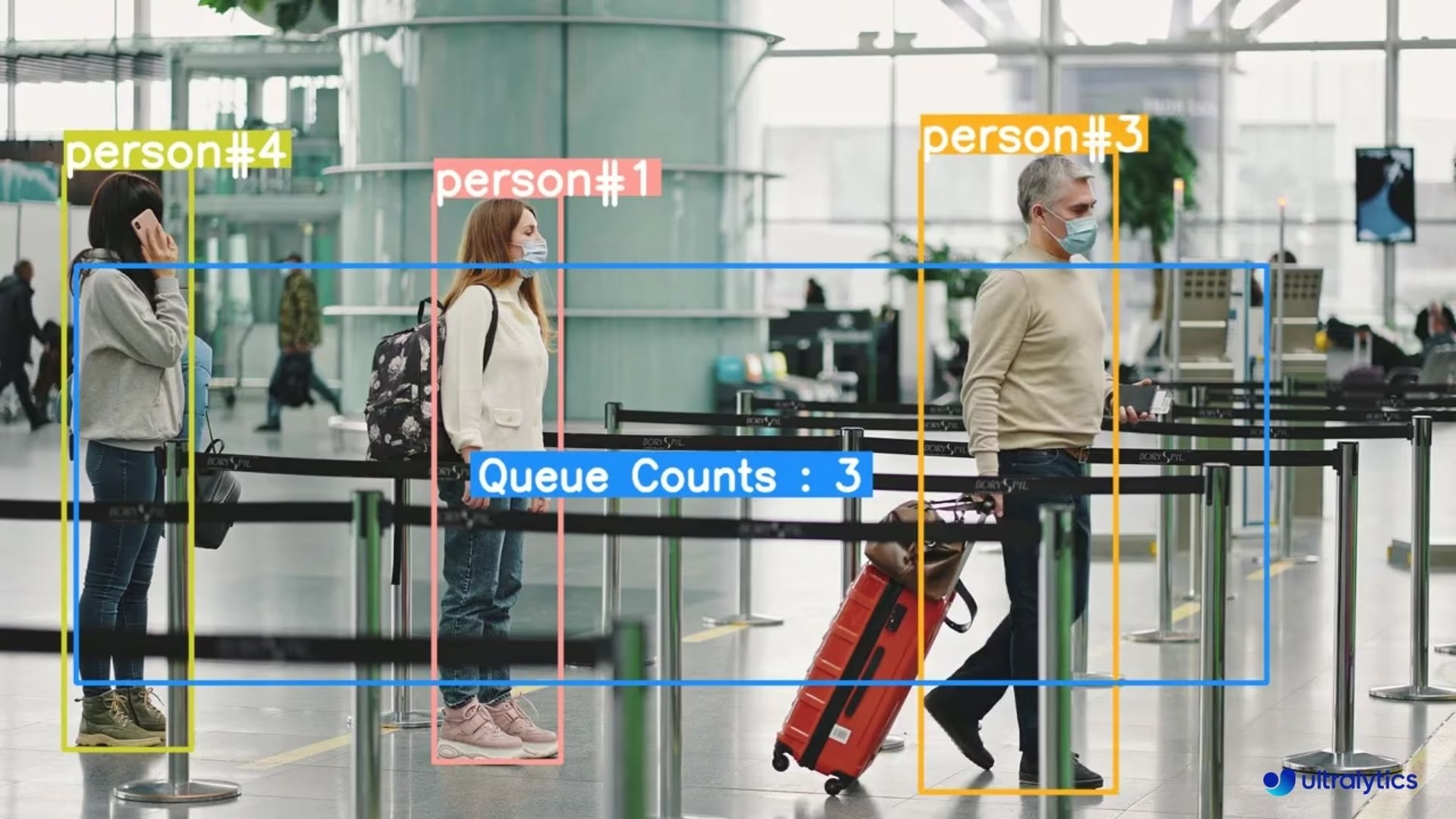 | 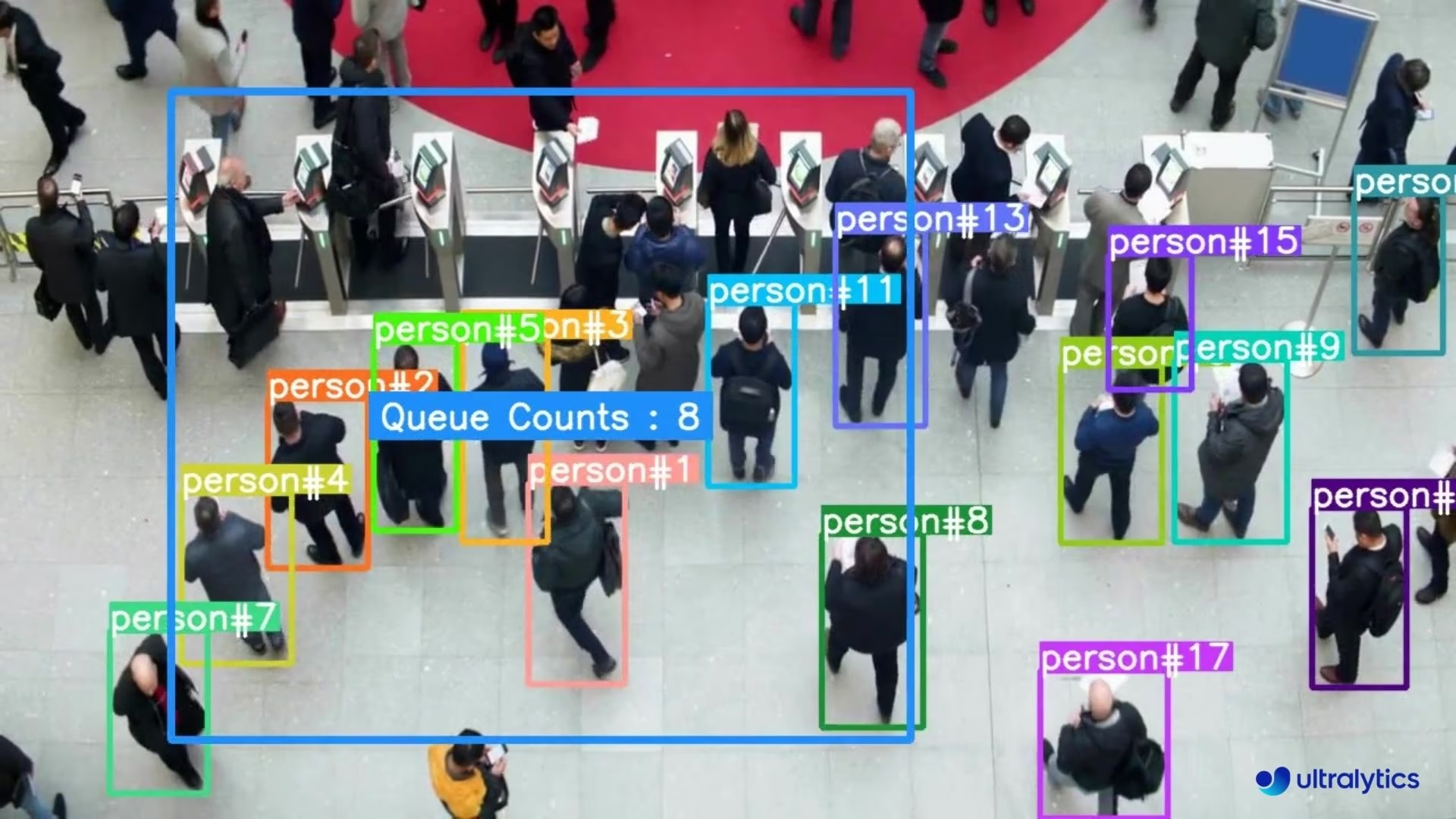 |
| Ultralytics YOLO26を使用した空港チケットカウンターでのキュー管理 | Ultralytics YOLO26による群衆のキュー監視 |
YOLO26でキューを管理#
QueueManagerソリューションは、各フレームで定義した領域内の追跡対象をカウントし、出力動画に書き込めるリアルタイムの待ち行列の長さを算出します。待機エリアを囲むポリゴン領域を指定し、Python APIまたはCLIを使って動画ソースに対して実行します。
# Run a queue example
yolo solutions queue show=True

# Pass a source video
yolo solutions queue source="path/to/video.mp4"

# Pass queue coordinates
yolo solutions queue region="[(20, 400), (1080, 400), (1080, 360), (20, 360)]"QueueManagerの引数#
QueueManagerの引数を以下の表に示します。
| 引数 | 種類 | デフォルト | 説明 |
|---|---|---|---|
model | str | None | Ultralytics YOLOモデルファイルへのパスです。 |
region | listまたはdict | None | 関心領域を定義するポイントです。(x, y)タプルのリスト、または複数領域用に領域名とポイントリストを対応付ける辞書(RegionCounterのみ)を指定します。Noneの場合、領域が必要なSolutionsでは定義済みのデフォルト値が使用されます。 |
line_width | int | 2 | Solutionが描画するボックス、キーポイント、カウント表示の線幅です。 |
verbose | bool | True | 各フレームの入力shape、クラス数、処理速度を記録するSolutionのログを有効にします。トラッキング呼び出し自体は常にログを出力しません。 |
QueueManagerソリューションは、track引数にも対応しています。
| 引数 | 種類 | デフォルト | 説明 |
|---|---|---|---|
tracker | str | 'tracktrack.yaml' | 使用するトラッキングアルゴリズムを指定します。組み込みのオプション:botsort.yaml、bytetrack.yaml、ocsort.yaml、deepocsort.yaml、fasttrack.yaml、tracktrack.yaml。 |
conf | float | 0.25 | 検出の信頼度しきい値を設定します。値を低くすると、より多くの物体を追跡できますが、誤検出が含まれる可能性があります。 |
iou | float | 0.5 | 重複する検出をフィルタリングするためのIntersection over Union(IoU)しきい値を設定します。 |
classes | list | None | クラスインデックスで結果をフィルタリングします。たとえば、classes=[0, 2, 3]を指定すると、指定したクラスのみを追跡します。 |
device | str | None | 推論に使用するデバイスを指定します(例:cpu、cuda:0、0)。モデル実行に使用するCPU、特定のGPU、その他の計算デバイスを選択できます。 |
imgsz | int or tuple | 640 | 推論時の入力画像サイズです。正方形の場合は整数、または(height, width)のペアを指定します。形状はモデルのストライドに合わせて調整されます。 |
max_det | int | 300 | トラッキング前にフレームごとに保持する検出の最大数です。混雑したシーンでソリューションが処理する物体数を制限します。 |
quantize | int or str | None | 推論精度: CPU以外で実行するPyTorchおよびTorchScriptモデルでは、16(FP16)または32/未設定(FP32)を使用します。その他の形式では、アーティファクトとランタイムによって選択される精度が使用されます。非推奨のhalf引数を置き換えます。 |
さらに、次の可視化パラメーターを使用できます。
| 引数 | 種類 | デフォルト | 説明 |
|---|---|---|---|
show | bool | False | Trueの場合、注釈付き画像または動画をウィンドウに表示します。開発やテスト中にすぐ視覚的なフィードバックを得るのに便利です。 |
show_conf | bool | True | 各検出のラベルとともに信頼度スコアを表示します。各検出に対するモデルの確信度を確認できます。 |
show_labels | bool | True | 可視化出力で各検出のラベルを表示します。検出されたオブジェクトをすぐに把握できます。 |
実装方法#
YOLO26を使用してキュー管理を実装する際は、次のベストプラクティスを検討してください。
- カメラの戦略的な設置: 障害物を避け、キュー全体を撮影できる位置にカメラを設置します。
- 適切なキュー領域の定義: 施設の物理的なレイアウトに基づいて、キューの境界を慎重に設定します。
- 検出信頼度の調整: 照明条件や群衆の密度に応じて、信頼度のしきい値を微調整します。
- 既存システムとの統合: キュー管理ソリューションをデジタルサイネージやスタッフへの通知システムに接続し、自動対応を実現します。
よくある質問#
Ultralytics YOLO26をリアルタイムのキュー管理に使用するには、次の手順に従います。
cv2.VideoCaptureを使用して動画フィードを取得します。- キュー管理の対象領域(ROI)を定義します。
yolo26n.ptなどのYOLO26モデルと領域を指定して、solutions.QueueManagerを初期化します。- フレームを処理してオブジェクトを検出し、キューを管理します。
最小限の例を次に示します。
import cv2 from ultralytics import solutions cap = cv2.VideoCapture("path/to/video.mp4") queue_region = [(20, 400), (1080, 400), (1080, 360), (20, 360)] queuemanager = solutions.QueueManager( model="yolo26n.pt", region=queue_region, line_width=3, show=True, ) while cap.isOpened(): success, im0 = cap.read() if not success: break results = queuemanager(im0) cap.release() cv2.destroyAllWindows()待ち行列管理ソリューションで使用するモデルは、Ultralytics Platformでトレーニングしてデプロイできます。
キュー管理にUltralytics YOLO26を使用すると、次のようなメリットがあります。
- 待ち時間の短縮: 待ち行列を効率的に整理し、顧客の待ち時間を短縮して満足度を高めます。
- 効率の向上: 待ち行列のデータを分析して人員配置と業務運営を最適化し、コストを削減します。
- リアルタイムの状況把握: 各フレームのキュー数をリアルタイムに表示し、列が長くなった場合に迅速な対応を可能にします。
- 拡張性: 小売店、空港、医療施設など、さまざまな環境に簡単に展開できます。
Ultralytics YOLO26には、待ち行列管理においてTensorFlowベースの検出器やDetectron2と比べて、いくつかの利点があります。
- リアルタイム性能: YOLO26はリアルタイム検出向けに設計されており、フレームを高速に処理します。
- 使いやすさ: Ultralyticsは、PythonまたはUltralytics Platformでのトレーニングからデプロイまで、ワークフロー全体をサポートします。
- 事前トレーニング済みモデル: さまざまな事前トレーニング済みモデルを利用できるため、セットアップにかかる時間を短縮できます。
- コミュニティサポート: 充実したドキュメントと活発なコミュニティサポートにより、問題を解決しやすくなります。
Ultralytics YOLOの使い始め方をご覧ください。
はい。Ultralytics YOLO26は、空港や小売環境など、さまざまな場所の待ち行列を管理できます。QueueManagerを特定の領域や設定に合わせて構成することで、さまざまな待ち行列の形状や密度に対応できます。
空港向けの例:
queue_region_airport = [(50, 600), (1200, 600), (1200, 550), (50, 550)] queue_airport = solutions.QueueManager( model="yolo26n.pt", region=queue_region_airport, line_width=3, )Ultralytics YOLO26は、キュー管理に関するさまざまな実環境のアプリケーションで使用されています。
- 小売店: レジの列を監視して待ち時間を短縮し、顧客満足度を高めます。
- 空港: チケットカウンターや保安検査場の列を管理し、乗客がスムーズに利用できるようにします。
- 医療: クリニックや病院における患者の流れを最適化します。
- 銀行: 銀行の列を効率的に管理し、顧客サービスを向上させます。
コンピュータービジョンがさまざまな業界のキュー監視をどのように変革しているかについては、実環境におけるキュー管理のブログ記事をご覧ください。


コメント18
質問したり、結果を共有したり、ほかの人をサポートしたりできます。
CharanPrasadK
Like in_counts and out_counts methods in objectCounter class, I want get Queue Count in real time to print and use on out side but the method you provided 'counts' in QueueManager class is refreshing to 0, so I made some changes in code in my local system used private variable to get the count out side in real time. How can I make it better?
 Glenn JocherUltralytics(編集済み)
@TechWolf21 to get the real-time queue count, read it from the results returned for each frame (
queue_count) instead of modifyingQueueManager:results = queue(im0) print(results.queue_count)For details, please refer to the Queue Management documentation.
Alexts166
Have a nice day. I made several queue areas, but I can't find the code to get a separate counter to count the total number of people who passed through these areas.
- Glenn JocherUltralytics(編集済み)
@Alexts166 hello!
Thank you for your question.
QueueManagercounts the people currently inside its region on each frame (results.queue_countorqueue.counts), so with several queue areas you can create oneQueueManagerper region and sum their counts:import cv2 from ultralytics import solutions cap = cv2.VideoCapture("path/to/video/file.mp4") assert cap.isOpened(), "Error reading video file" w, h, fps = (int(cap.get(x)) for x in (cv2.CAP_PROP_FRAME_WIDTH, cv2.CAP_PROP_FRAME_HEIGHT, cv2.CAP_PROP_FPS)) video_writer = cv2.VideoWriter("queue_management.avi", cv2.VideoWriter_fourcc(*"mp4v"), fps, (w, h)) # Define multiple queue regions queue_regions = [ [(20, 400), (1080, 404), (1080, 360), (20, 360)], [(30, 300), (1070, 304), (1070, 260), (30, 260)], ] # Initialize a QueueManager for each region (person class only) queues = [solutions.QueueManager(model="yolo26n.pt", region=region, classes=[0], show=False) for region in queue_regions] while cap.isOpened(): success, im0 = cap.read() if not success: print("Video frame is empty or video processing has been successfully completed.") break for queue in queues: queue(im0) # draws on im0 total_in_queues = sum(queue.counts for queue in queues) # people currently inside all queue regions print(f"People currently in the queue areas: {total_in_queues}") video_writer.write(im0) cap.release() video_writer.release() cv2.destroyAllWindows()Note this is a per-frame count of people currently in the regions, not a running total of everyone who has passed through. For cumulative in/out crossing counts, use
solutions.ObjectCounterinstead.For more details on queue management and additional examples, you can refer to our Queue Management Guide.
If you encounter any issues or have further questions, please provide a reproducible example, and ensure you are using the latest version of the packages. This will help us assist you more effectively.
Thanks for the code. I tweaked it a little to fit my needs. There is no summation of objects in queues. Maybe where is the error?
import cv2 from ultralytics import YOLO, solutions # Load the YOLOv8 model model = YOLO("best.pt") cap = cv2.VideoCapture("gf.mp4") assert cap.isOpened(), "Error reading video file" w, h, fps = (int(cap.get(x)) for x in (cv2.CAP_PROP_FRAME_WIDTH, cv2.CAP_PROP_FRAME_HEIGHT, cv2.CAP_PROP_FPS)) video_writer = cv2.VideoWriter("queue_management.avi", cv2.VideoWriter_fourcc(*"mp4v"), fps, (w, h)) # Define multiple queue regions queue_regions = [ [(20, 200), (1200, 200), (1200, 150), (20, 150)], [(20, 600), (1200, 600), (1200, 550), (20, 550)] ] # Initialize QueueManager for each region queues = [solutions.QueueManager( classes_names=model.names, reg_pts=region, line_thickness=3, fontsize=1.0, region_color=(255, 144, 31) ) for region in queue_regions] total_count = 0 while cap.isOpened(): success, im0 = cap.read() if success: tracks = model.track(im0, show=False, persist=True, verbose=False) for queue in queues: out = queue.process_queue(im0, tracks) total_count += queue.counts # Accumulate the count from each queue region color_black = (0, 0, 0) cv2.rectangle(im0, (15, 25), (250, 110), (0, 255, 255), -15) cv2.putText(im0, ('Summ - ') + str(total_count), (20, 50), cv2.FONT_HERSHEY_DUPLEX, 0.8, color_black, 2, cv2.LINE_AA) video_writer.write(im0) if cv2.waitKey(1) & 0xFF == ord("q"): break continue print("Video frame is empty or video processing has been successfully completed.") break cap.release() cv2.destroyAllWindows()- Glenn JocherUltralytics
Hi! It looks like the issue might be with how the counts are being accumulated. Ensure that
queue.countsis correctly accessed and reset after each frame. Also, make sure you're using the latest version of the packages. If the problem persists, please provide more details. Happy coding!
QuifaAbas
Despite multiple attempts, I'm still facing the same problem. The code isn't generating the expected results. Even with the provided inputs, the results aren't found. Additionally, when trying to generate a video file, the output turns out to be empty. I input a 2.3 MB video file, and it is not an empty file. The code snippet I've been using is,
Install required packages
!pip install opencv-python torch
Import necessary libraries
from ultralytics import YOLO from ultralytics.solutions import distance_calculation import cv2
Load YOLO model
model = YOLO("/content/drive/MyDrive/YOLOv8_1/Distance/yolov8s.pt") # Update the path to yolov8s.pt names = model.model.names
Load video file
video_path = "/content/drive/MyDrive/YOLOv8_1/Distance/vid2.mp4" # Update the path to your video file cap = cv2.VideoCapture(video_path) assert cap.isOpened(), "Error reading video file" w, h, fps = (int(cap.get(x)) for x in (cv2.CAP_PROP_FRAME_WIDTH, cv2.CAP_PROP_FRAME_HEIGHT, cv2.CAP_PROP_FPS))
Video writer
output_video_path = "/content/drive/MyDrive/YOLOv8_1/Distance/distance_calculation.mp4" video_writer = cv2.VideoWriter(output_video_path, cv2.VideoWriter_fourcc(*'MP4V'), # Or try 'MP4V' for .mp4 files fps, (w, h))
Init distance-calculation obj
dist_obj = distance_calculation.DistanceCalculation() dist_obj.set_args(names=names, view_img=False) # Change view_img to False
while cap.isOpened(): success, im0 = cap.read() if not success: print("End of video or read error encountered.") break
tracks = model.track(im0, persist=True, show=False)

# Check if any tracks were found
if len(tracks) > 0:  # Using len() to get the count of elements
    im0 = dist_obj.start_process(im0, tracks)

    # Debugging: Save frame only if it's not empty
    if im0 is not None and im0.any():
        cv2.imwrite('/content/drive/MyDrive/YOLOv8_1/Distance/Copy of Copy of DJI_0083.JPG', im0)  # Save a frame as an image for debugging
        video_writer.write(im0)
    else:
        print("Empty frame detected. Skipping saving to file.")
else:
    print("No tracks found. Skipping frame processing.")
Release resources
video_writer.release() cap.release()
Provide the download link for the output video
output_video_path
The specific error message I'm receiving is "Empty frame detected. Skipping saving to file. End of video or read error encountered.". Strangely, the resulting video file is only 258 bytes in size, indicating an issue with its generation.
In my pursuit to find a solution, I came across your YouTube video [YouTube Video Link: "https://www.youtube.com/watch?v=LE8am1QoVn4&ab_channel=Ultralytics", where the results showcased are exactly what I'm aiming for. Specifically, I'm keen on measuring the distance between two bounded boxes in both photos and videos.
Could you please provide a YOLOv8 Google Colab code for both video files and image files that addresses these issues and ensures error-free execution?Specifically, I would need two separate codes: one for processing video files and another for processing image files. Could you include instructions on what file paths I should replace in each code?
I've made several attempts to correct and run the code, but unfortunately, I keep encountering the same issue. It seems to persist despite my efforts. I hope you understand my actual problem and can provide a solution that resolves the issue. Could you please provide the complete code along with a detailed explanation to help me better understand and address the problem?
[ I want to attach your comment to my screenshot. How can I do that?I would like to include your comment in my screenshot for reference. Could you please provide guidance on how to attach your comment to the screenshot? ]
- Glenn JocherUltralytics(編集済み)
It looks like you're encountering a common issue with video processing where no tracks are found and your output frames are empty. Let's try a couple of things to resolve this:
-
Check Video Input: Confirm the video path and contents to ensure it's being read correctly. You have already done this, but double-check if the path is accessible and the video is not corrupted.
-
Model Loading: Verify the model path for loading the YOLO model. Ensure that
yolov8s.ptis the correct model file and path. -
Debugging Output: Try increasing the verbosity of your video processing to get more details:
tracks = model.track(im0, persist=True, show=True, verbose=True) -
Update Your Installation: Ensure your
ultralyticspackage is up to date as fixes are frequently released. Use:pip install --upgrade ultralytics -
Modify Export Code: If the issue persists, simplify the frame processing code to check if any frames are being written to the file at all:
while cap.isOpened(): ret, frame = cap.read() if not ret: break video_writer.write(frame) # write raw frames to see if writing is the issue -
Permissions and Path: Ensure that the output path for your video file is correct and your environment has write permissions for that directory.
Try these steps and see if the issue persists. If it does, you might want to check out a Colab example: Ultralytics YOLO Example Colab.
Regarding attaching a comment to a screenshot, if you're using screenshot tools like Snipping Tool or Snagit, you can usually add text directly on the image. Alternatively, you can use image editing software like Photoshop or free tools like GIMP to add text annotations.
Please let me know if these suggestions help resolve your issues or if there’s anything else I can assist you with!
-
I've attempted to run the code multiple times, but I'm consistently encountering errors. I ran the code that you provided with the suggested changes, but unfortunately, the issue persists. The code I've been using is,
Install required packages
!pip install opencv-python torch !pip install --upgrade ultralytics
Import necessary libraries
from ultralytics import YOLO from ultralytics.solutions import distance_calculation import cv2
Load YOLO model
model = YOLO("/content/drive/MyDrive/YOLOv8_1/Distance/yolov8s.pt") # Update the path to yolov8s.pt names = model.model.names
Load video file
video_path = "/content/drive/MyDrive/YOLOv8_1/Distance/vid2.mp4" # Update the path to your video file cap = cv2.VideoCapture(video_path) assert cap.isOpened(), "Error reading video file" w, h, fps = (int(cap.get(x)) for x in (cv2.CAP_PROP_FRAME_WIDTH, cv2.CAP_PROP_FRAME_HEIGHT, cv2.CAP_PROP_FPS))
Video writer
output_video_path = "/content/drive/MyDrive/YOLOv8_1/Distance/distance_calculation.mp4" video_writer = cv2.VideoWriter(output_video_path, cv2.VideoWriter_fourcc(*'MP4V'), # Or try 'MP4V' for .mp4 files fps, (w, h))
Init distance-calculation obj
dist_obj = distance_calculation.DistanceCalculation() dist_obj.set_args(names=names, view_img=False) # Change view_img to False
while cap.isOpened(): ret, frame = cap.read() if not ret: break video_writer.write(frame) # write raw frames to see if writing is the issue
tracks = model.track(im0, persist=True, show=True, verbose=True)

# Check if any tracks were found
if len(tracks) > 0:  # Using len() to get the count of elements
    im0 = dist_obj.start_process(im0, tracks)

    # Debugging: Save frame only if it's not empty
    if im0 is not None and im0.any():
        cv2.imwrite('/content/drive/MyDrive/YOLOv8_1/Distance/Copy of Copy of DJI_0083.JPG', im0)  # Save a frame as an image for debugging
        video_writer.write(im0)
    else:
        print("Empty frame detected. Skipping saving to file.")
else:
    print("No tracks found. Skipping frame processing.")
Release resources
video_writer.release() cap.release()
Provide the download link for the output video
output_video_path
and the resulting output is,
Requirement already satisfied: torchvision>=0.9.0 in /usr/local/lib/python3.10/dist-packages (from ultralytics) (0.17.1+cu121) Requirement already satisfied: tqdm>=4.64.0 in /usr/local/lib/python3.10/dist-packages (from ultralytics) (4.66.2) Requirement already satisfied: psutil in /usr/local/lib/python3.10/dist-packages (from ultralytics) (5.9.5) Requirement already satisfied: py-cpuinfo in /usr/local/lib/python3.10/dist-packages (from ultralytics) (9.0.0) Requirement already satisfied: thop>=0.1.1 in /usr/local/lib/python3.10/dist-packages (from ultralytics) (0.1.1.post2209072238) Requirement already satisfied: pandas>=1.1.4 in /usr/local/lib/python3.10/dist-packages (from ultralytics) (2.0.3) Requirement already satisfied: seaborn>=0.11.0 in /usr/local/lib/python3.10/dist-packages (from ultralytics) (0.13.1) Requirement already satisfied: contourpy>=1.0.1 in /usr/local/lib/python3.10/dist-packages (from matplotlib>=3.3.0->ultralytics) (1.2.1) Requirement already satisfied: cycler>=0.10 in /usr/local/lib/python3.10/dist-packages (from matplotlib>=3.3.0->ultralytics) (0.12.1) Requirement already satisfied: fonttools>=4.22.0 in /usr/local/lib/python3.10/dist-packages (from matplotlib>=3.3.0->ultralytics) (4.51.0) Requirement already satisfied: kiwisolver>=1.0.1 in /usr/local/lib/python3.10/dist-packages (from matplotlib>=3.3.0->ultralytics) (1.4.5) Requirement already satisfied: numpy>=1.20 in /usr/local/lib/python3.10/dist-packages (from matplotlib>=3.3.0->ultralytics) (1.25.2) Requirement already satisfied: packaging>=20.0 in /usr/local/lib/python3.10/dist-packages (from matplotlib>=3.3.0->ultralytics) (24.0) Requirement already satisfied: pyparsing>=2.3.1 in /usr/local/lib/python3.10/dist-packages (from matplotlib>=3.3.0->ultralytics) (3.1.2) Requirement already satisfied: python-dateutil>=2.7 in /usr/local/lib/python3.10/dist-packages (from matplotlib>=3.3.0->ultralytics) (2.8.2) Requirement already satisfied: pytz>=2020.1 in /usr/local/lib/python3.10/dist-packages (from pandas>=1.1.4->ultralytics) (2023.4) Requirement already satisfied: tzdata>=2022.1 in /usr/local/lib/python3.10/dist-packages (from pandas>=1.1.4->ultralytics) (2024.1) Requirement already satisfied: charset-normalizer<4,>=2 in /usr/local/lib/python3.10/dist-packages (from requests>=2.23.0->ultralytics) (3.3.2) Requirement already satisfied: idna<4,>=2.5 in /usr/local/lib/python3.10/dist-packages (from requests>=2.23.0->ultralytics) (3.7) Requirement already satisfied: urllib3<3,>=1.21.1 in /usr/local/lib/python3.10/dist-packages (from requests>=2.23.0->ultralytics) (2.0.7) Requirement already satisfied: certifi>=2017.4.17 in /usr/local/lib/python3.10/dist-packages (from requests>=2.23.0->ultralytics) (2024.2.2) Requirement already satisfied: filelock in /usr/local/lib/python3.10/dist-packages (from torch>=1.8.0->ultralytics) (3.14.0) Requirement already satisfied: typing-extensions>=4.8.0 in /usr/local/lib/python3.10/dist-packages (from torch>=1.8.0->ultralytics) (4.11.0) Requirement already satisfied: sympy in /usr/local/lib/python3.10/dist-packages (from torch>=1.8.0->ultralytics) (1.12) Requirement already satisfied: networkx in /usr/local/lib/python3.10/dist-packages (from torch>=1.8.0->ultralytics) (3.3) Requirement already satisfied: jinja2 in /usr/local/lib/python3.10/dist-packages (from torch>=1.8.0->ultralytics) (3.1.3) Requirement already satisfied: fsspec in /usr/local/lib/python3.10/dist-packages (from torch>=1.8.0->ultralytics) (2023.6.0) Requirement already satisfied: nvidia-cuda-nvrtc-cu12==12.1.105 in /usr/local/lib/python3.10/dist-packages (from torch>=1.8.0->ultralytics) (12.1.105) Requirement already satisfied: nvidia-cuda-runtime-cu12==12.1.105 in /usr/local/lib/python3.10/dist-packages (from torch>=1.8.0->ultralytics) (12.1.105) Requirement already satisfied: nvidia-cuda-cupti-cu12==12.1.105 in /usr/local/lib/python3.10/dist-packages (from torch>=1.8.0->ultralytics) (12.1.105) Requirement already satisfied: nvidia-cudnn-cu12==8.9.2.26 in /usr/local/lib/python3.10/dist-packages (from torch>=1.8.0->ultralytics) (8.9.2.26) Requirement already satisfied: nvidia-cublas-cu12==12.1.3.1 in /usr/local/lib/python3.10/dist-packages (from torch>=1.8.0->ultralytics) (12.1.3.1) Requirement already satisfied: nvidia-cufft-cu12==11.0.2.54 in /usr/local/lib/python3.10/dist-packages (from torch>=1.8.0->ultralytics) (11.0.2.54) Requirement already satisfied: nvidia-curand-cu12==10.3.2.106 in /usr/local/lib/python3.10/dist-packages (from torch>=1.8.0->ultralytics) (10.3.2.106) Requirement already satisfied: nvidia-cusolver-cu12==11.4.5.107 in /usr/local/lib/python3.10/dist-packages (from torch>=1.8.0->ultralytics) (11.4.5.107) Requirement already satisfied: nvidia-cusparse-cu12==12.1.0.106 in /usr/local/lib/python3.10/dist-packages (from torch>=1.8.0->ultralytics) (12.1.0.106) Requirement already satisfied: nvidia-nccl-cu12==2.19.3 in /usr/local/lib/python3.10/dist-packages (from torch>=1.8.0->ultralytics) (2.19.3) Requirement already satisfied: nvidia-nvtx-cu12==12.1.105 in /usr/local/lib/python3.10/dist-packages (from torch>=1.8.0->ultralytics) (12.1.105) Requirement already satisfied: triton==2.2.0 in /usr/local/lib/python3.10/dist-packages (from torch>=1.8.0->ultralytics) (2.2.0) Requirement already satisfied: nvidia-nvjitlink-cu12 in /usr/local/lib/python3.10/dist-packages (from nvidia-cusolver-cu12==11.4.5.107->torch>=1.8.0->ultralytics) (12.4.127) Requirement already satisfied: six>=1.5 in /usr/local/lib/python3.10/dist-packages (from python-dateutil>=2.7->matplotlib>=3.3.0->ultralytics) (1.16.0) Requirement already satisfied: MarkupSafe>=2.0 in /usr/local/lib/python3.10/dist-packages (from jinja2->torch>=1.8.0->ultralytics) (2.1.5) Requirement already satisfied: mpmath>=0.19 in /usr/local/lib/python3.10/dist-packages (from sympy->torch>=1.8.0->ultralytics) (1.3.0) WARNING ⚠️ Environment does not support cv2.imshow() or PIL Image.show()
NameError Traceback (most recent call last) in <cell line: 31>() 35 video_writer.write(frame) # write raw frames to see if writing is the issue 36 ---> 37 tracks = model.track(im0, persist=True, show=True, verbose=True) 38 39 # Check if any tracks were found
NameError: name 'im0' is not defined
Unfortunately, I'm unable to attach a screenshot directly. Could you please provide the complete code to resolve this issue?
I did try my older code, which is,
Install required packages
!pip install opencv-python torch
Import necessary libraries
from ultralytics import YOLO from ultralytics.solutions import distance_calculation import cv2
Load YOLO model
model = YOLO("/content/drive/MyDrive/YOLOv8_1/Distance/yolov8s.pt") # Update the path to yolov8s.pt names = model.model.names
Load video file
video_path = "/content/drive/MyDrive/YOLOv8_1/Distance/vid2.mp4" # Update the path to your video file cap = cv2.VideoCapture(video_path) assert cap.isOpened(), "Error reading video file" w, h, fps = (int(cap.get(x)) for x in (cv2.CAP_PROP_FRAME_WIDTH, cv2.CAP_PROP_FRAME_HEIGHT, cv2.CAP_PROP_FPS))
Video writer
output_video_path = "/content/drive/MyDrive/YOLOv8_1/Distance/distance_calculation.mp4" video_writer = cv2.VideoWriter(output_video_path, cv2.VideoWriter_fourcc(*'MP4V'), # Or try 'MP4V' for .mp4 files fps, (w, h))
Init distance-calculation obj
dist_obj = distance_calculation.DistanceCalculation() dist_obj.set_args(names=names, view_img=False) # Change view_img to False
while cap.isOpened(): success, im0 = cap.read() if not success: print("End of video or read error encountered.") break
tracks = model.track(im0, persist=True, show=False)

# Check if any tracks were found
if len(tracks) > 0:  # Using len() to get the count of elements
    im0 = dist_obj.start_process(im0, tracks)

    # Debugging: Save frame only if it's not empty
    if im0 is not None and im0.any():
        cv2.imwrite('/content/drive/MyDrive/YOLOv8_1/Distance/Copy of Copy of DJI_0083.JPG', im0)  # Save a frame as an image for debugging
        video_writer.write(im0)
    else:
        print("Empty frame detected. Skipping saving to file.")
else:
    print("No tracks found. Skipping frame processing.")
Release resources
video_writer.release() cap.release()
Provide the download link for the output video
output_video_path
and the resulting output was ,
Requirement already satisfied: nvidia-nccl-cu12==2.19.3 in /usr/local/lib/python3.10/dist-packages (from torch) (2.19.3) Requirement already satisfied: nvidia-nvtx-cu12==12.1.105 in /usr/local/lib/python3.10/dist-packages (from torch) (12.1.105) Requirement already satisfied: triton==2.2.0 in /usr/local/lib/python3.10/dist-packages (from torch) (2.2.0) Requirement already satisfied: nvidia-nvjitlink-cu12 in /usr/local/lib/python3.10/dist-packages (from nvidia-cusolver-cu12==11.4.5.107->torch) (12.4.127) Requirement already satisfied: MarkupSafe>=2.0 in /usr/local/lib/python3.10/dist-packages (from jinja2->torch) (2.1.5) Requirement already satisfied: mpmath>=0.19 in /usr/local/lib/python3.10/dist-packages (from sympy->torch) (1.3.0) WARNING ⚠️ Environment does not support cv2.imshow() or PIL Image.show()
requirements: Ultralytics requirement ['lapx>=0.5.2'] not found, attempting AutoUpdate... Collecting lapx>=0.5.2 Downloading lapx-0.5.8-cp310-cp310-manylinux_2_5_x86_64.manylinux1_x86_64.manylinux_2_17_x86_64.manylinux2014_x86_64.whl (1.7 MB) ━━━━━━━━━━━━━━━━━━━━━━━━━━━━━━━━━━━━━━━━ 1.7/1.7 MB 14.6 MB/s eta 0:00:00 Requirement already satisfied: Cython>=0.29.32 in /usr/local/lib/python3.10/dist-packages (from lapx>=0.5.2) (3.0.10) Requirement already satisfied: numpy>=1.21.6 in /usr/local/lib/python3.10/dist-packages (from lapx>=0.5.2) (1.25.2) Installing collected packages: lapx Successfully installed lapx-0.5.8
requirements: AutoUpdate success ✅ 8.7s, installed 1 package: ['lapx>=0.5.2'] requirements: ⚠️ Restart runtime or rerun command for updates to take effect
0: 384x640 (no detections), 566.5ms Speed: 29.6ms preprocess, 566.5ms inference, 4702.4ms postprocess per image at shape (1, 3, 384, 640) Empty frame detected. Skipping saving to file.
0: 384x640 (no detections), 436.2ms Speed: 3.1ms preprocess, 436.2ms inference, 0.9ms postprocess per image at shape (1, 3, 384, 640) Empty frame detected. Skipping saving to file.
0: 384x640 (no detections), 410.8ms Speed: 3.4ms preprocess, 410.8ms inference, 1.5ms postprocess per image at shape (1, 3, 384, 640) Empty frame detected. Skipping saving to file.
0: 384x640 1 potted plant, 412.6ms Speed: 3.1ms preprocess, 412.6ms inference, 15.0ms postprocess per image at shape (1, 3, 384, 640) Empty frame detected. Skipping saving to file.
0: 384x640 1 potted plant, 428.9ms Speed: 3.2ms preprocess, 428.9ms inference, 1.3ms postprocess per image at shape (1, 3, 384, 640) Empty frame detected. Skipping saving to file.
0: 384x640 1 potted plant, 545.6ms Speed: 3.8ms preprocess, 545.6ms inference, 1.9ms postprocess per image at shape (1, 3, 384, 640) Empty frame detected. Skipping saving to file.
0: 384x640 (no detections), 546.6ms Speed: 3.0ms preprocess, 546.6ms inference, 1.3ms postprocess per image at shape (1, 3, 384, 640) Empty frame detected. Skipping saving to file.
0: 384x640 (no detections), 626.9ms Speed: 3.6ms preprocess, 626.9ms inference, 1.2ms postprocess per image at shape (1, 3, 384, 640) Empty frame detected. Skipping saving to file.
0: 384x640 (no detections), 631.8ms Speed: 3.4ms preprocess, 631.8ms inference, 1.2ms postprocess per image at shape (1, 3, 384, 640) Empty frame detected. Skipping saving to file. End of video or read error encountered. /content/drive/MyDrive/YOLOv8_1/Distance/distance_calculation.mp4
The specific error message I'm receiving is "Empty frame detected. Skipping saving to file. End of video or read error encountered.". Strangely, the resulting video file is only 258 bytes in size, indicating an issue with its generation.
- Glenn JocherUltralytics(編集済み)
Hi there! 👋 It seems like you're encountering a persistent issue with detecting objects in your video file. Let's try a couple of adjustments:
-
Ensure Correct Model Load: Double-check if the path to your model (yolov8s.pt) is correct and the model is appropriately loaded.
-
Verify Video Content: Sometimes, if the video does not include the objects the model is trained to detect, it may not find any tracks. Confirm that the target objects are present in the video.
-
Frame Handling: Right before calling the solution (
distancecalculator(frame)), ensure thatframeis your actual frame variable fromret, frame = cap.read(). -
Debugging Output: Increase logging for each step and verify each component's output, such as the captured frames and the model's response.
Here's a simplified snippet to recheck each part:
from ultralytics import solutions

distancecalculator = solutions.DistanceCalculation(model="yolo26n.pt", show=True)  # tracking is handled internally

while cap.isOpened():
    ret, frame = cap.read()
    if not ret:
        print("Failed to read frame.")
        break

    # Debugging: Show frame dimension
    print(f"Frame dimensions: {frame.shape}")

    results = distancecalculator(frame)
    video_writer.write(results.plot_im)

# Cleanup
cap.release()
video_writer.release()
print("Released all resources.")
Adjust the debugging prints as necessary to check the outputs directly. Let me know how it goes, and if there's anything else I can help with! 🚀
-
I have zero knowledge in YOLOv8, as I'm an undergraduate student in Electrical Engineering. My final year project topic is 'Unmanned Aerial Systems (UAS) for Enhanced Vegetation Management in Electric Distribution Networks'. Initially, I aimed to detect vegetation and power lines in single frames. I successfully achieved this using YOLOv8 in Google Colab for images. However, I encountered difficulties when applying the same approach to videos, particularly in detecting power lines accurately.
To enhance the accuracy of power line detection, I plan to collect more photos using a drone. Additionally, I aim to measure the distance between vegetation and power lines. Despite my efforts, I've faced repeated challenges in implementing these tasks.
I have shared a link to my Google Drive , which contains my files. Within this folder, I've included one of the best detection images, the detected video, the final output, and my code.
I kindly request two separate complete codes—one for image tracking and another for video tracking. As I have minimal knowledge about where to make changes in the code, it would greatly assist me if you could run the code using my data and provide the necessary adjustments.
- Glenn JocherUltralytics(編集済み)
Hello! 🚀 It's great to see you using YOLOv8 for your project on unmanned aerial systems for vegetation management. Since you're encountering issues with power line detection in videos, here are a few suggestions:
-
Data Collection: Collecting more diverse images of power lines and vegetation at different times and conditions will definitely help in improving the model's accuracy.
-
Annotation Quality: Ensure that your additional images are accurately annotated to improve learning during training.
-
Model Training for Video: Although you've successfully used YOLOv8 for single frame detections, video processing can be trickier due to motion and different angles. Consider using techniques like temporal smoothing or frame-to-frame tracking to enhance accuracy.
Here's a basic outline on how you could set up your code for video processing using your own data:
import cv2
from ultralytics import YOLO

# Load your pre-trained model
model = YOLO("/path/to/your/model.pt")

# Setup the video capture
cap = cv2.VideoCapture("/path/to/your/video.mp4")
while cap.isOpened():
    ret, frame = cap.read()
    if not ret:
        break

    # Detect objects in the frame
    results = model.predict(frame)

    # Optionally, visualize the results
    annotated_frame = results[0].plot()  # frame with the detections drawn
    cv2.imshow('YOLO Detections', annotated_frame)
    if cv2.waitKey(1) & 0xFF == ord('q'):
        break

cap.release()
cv2.destroyAllWindows()
For measuring distances between detected objects like vegetation and power lines, you'd have to post-process the detection bounding boxes from YOLOv8. Calculating distances could be based on known scales or additional sensors like LiDAR data if your drone setup permits.
If you have any more questions or need further assistance with your code, feel free to ask. Best of luck with your exciting project! 🌿⚡
-
I've tried multiple times, but I haven't been successful in getting the distance calculation code to work properly.
-
Could you please ensure that the distance calculation code is implemented correctly for both my image and video files? [I have asked multiple times for you in providing separate code for processing my image and video files. However, you have only provided code for the video file. As I have zero knowledge in YOLOv8 coding, it's challenging for me to adapt the provided code for my image files. I kindly request your understanding of my situation and would greatly appreciate separate code for both image and video files.]
-
Once you've done so, Could you please provide the results for both my video and image files, which I have attached in the Google Drive folder?
-
Can you share these results with me via your Google Drive link?
I have a tight deadline to complete my project within this week, and your assistance would be immensely valuable. Thank you for understanding my situation. I am seeking results that accurately measure the distance between the vegetation bounded box and powerline bounded box in both my input image and input video. The desired outcome is to achieve results that closely resemble the accuracy and presentation demonstrated in your YouTube video (https://www.youtube.com/watch?v=LE8am1QoVn4&t=5s&ab_channel=Ultralytics).
I have clearly articulated my problem and outlined my specific requests. I kindly request your attention to my three requests and urge you to help me resolve my problem. 🥰
-
- Glenn JocherUltralytics(編集済み)
Hello! Thanks for sharing the details and your Google Drive link. It sounds like you're facing a challenge with adapting the distance calculation code specifically for images, along with your existing video processing.
For processing images separately, you can follow a similar approach as with videos but adapted for single-frame use. Here is a simplified code snippet that processes individual images:
from ultralytics import YOLO
import cv2

# Load the model
model = YOLO('path/to/your/model.pt')

# Load an image
image_path = 'path/to/your/image.jpg'
image = cv2.imread(image_path)

# Predict using the model
results = model.predict(image)

# Display detected objects with bounding boxes
results[0].show()
For the videos, if the provided code doesn't meet expectations, it helps to first manually check a few frames to understand what's missing or incorrect. This could be due to various factors such as the model's sensitivity, training data, or the quality/resolution of the video frame.
I've noticed your tight deadline and understand the importance of precise and timely responses. Please check the code above, and let's ensure it aligns with your project's requirements. If you need adjustments or further assistance, feel free to let me know! 🌟
Once again, I am encountering a problem. I have attached a screenshot of the error I'm facing, along with the image for which I want to measure the distance between the vegetation and powerline. Initially, could you please provide me with the tracked image? Subsequently, I will require the results image corresponding to the attached image. Following that, kindly provide the code necessary to achieve this task.
- Glenn JocherUltralytics(編集済み)
@QuifaAbas hello! Thanks for reaching out and sharing the details and your screenshot. It seems like you're looking to measure distances between detected objects in an image, which is a great application of YOLOv8.
For measuring distances, we would typically process the output of the detection model to obtain bounding boxes, and then calculate the distances based on these coordinates.
Here's a simplified approach to get you started with the image processing:
from ultralytics import YOLO
import cv2

# Load your pre-trained model
model = YOLO('path/to/your/model.pt')

# Load your image
image = cv2.imread('path/to/your/image.jpg')

# Perform detection
results = model.predict(image)

# Extract bounding boxes (for example, for vegetation and power lines)
result = results[0]
for box in result.boxes:
    name = result.names[int(box.cls)]
    if name == 'vegetation':  # replace with your actual class
        veg_box = box.xyxy[0].tolist()  # x1, y1, x2, y2
    elif name == 'power line':  # replace with your actual class
        pline_box = box.xyxy[0].tolist()  # x1, y1, x2, y2

# Calculate distances between objects (simplified Euclidean distance)
distance = ((veg_box[0] - pline_box[0])**2 + (veg_box[1] - pline_box[1])**2)**0.5

# Draw results on image
annotated_image = result.plot()

# Save or display the annotated image
cv2.imwrite('output.jpg', annotated_image)
cv2.imshow('Distance Detection', annotated_image)
cv2.waitKey(0)
cv2.destroyAllWindows()
For video files, you can follow a similar approach by processing each frame for detections and computing distances as outlined above.
If you need further customization or assistance, we're here to help! 🚀
Once again, I am encountering a problem. I have attached a screenshot of the error I'm facing, along with the image for which I want to measure the distance between the vegetation and powerline. My objective is to detect and measure distances between power lines and vegetation. Initially, could you please provide me with the tracked image? Subsequently, I will require the results image corresponding to the attached image. Following that, kindly provide the code necessary to achieve this task.
- Glenn JocherUltralytics(編集済み)
Hello! 🚀 It looks like you've run into some challenges with error handling and distance measurements between detected objects in your images. Let's tackle this step by step.
To help you measure the distances between detected vegetation and power lines in the image, you can utilize the coordinates of the bounding boxes provided by the YOLOv8 detections. Here's a simple code snippet to get you started:
from ultralytics import YOLO
import cv2

# Load your model
model = YOLO('path/to/your/yolov8-model.pt')

# Load your image
image = cv2.imread('path/to/your/image.jpg')

# Detect objects
results = model.predict(image)

# Draw boxes and labels on the image
results[0].show()

# Save or display the image
cv2.imwrite('tracked_image.jpg', results[0].plot())

# Extract bounding boxes for specific classes
veg_boxes = [b.xyxy[0].tolist() for b in results[0].boxes if results[0].names[int(b.cls)] == 'Vegetation']
pline_boxes = [b.xyxy[0].tolist() for b in results[0].boxes if results[0].names[int(b.cls)] == 'Power Line']

# Assuming you want the distance between the closest points, calculate Euclidean distance
from scipy.spatial import distance
if veg_boxes and pline_boxes:
    veg_point = veg_boxes[0][:2]  # Example: top-left corner of the first vegetation box
    pline_point = pline_boxes[0][:2]  # Example: top-left corner of the first powerline box
    dist = distance.euclidean(veg_point, pline_point)
    print(f"Distance between closest points: {dist} pixels")
Make sure to modify the
path/to/your/yolov8-model.ptandpath/to/your/image.jpgaccording to your files. This code will print the Euclidean distance between the top left corners of the first detected vegetation and power line boxes.I hope this helps! Start with this basic functionality and you can tune further based on your project needs. Let me know if there are specific aspects you want to adjust or if you encounter further issues! 🌿⚡