Проект системы охранной сигнализации на базе Ultralytics YOLO26
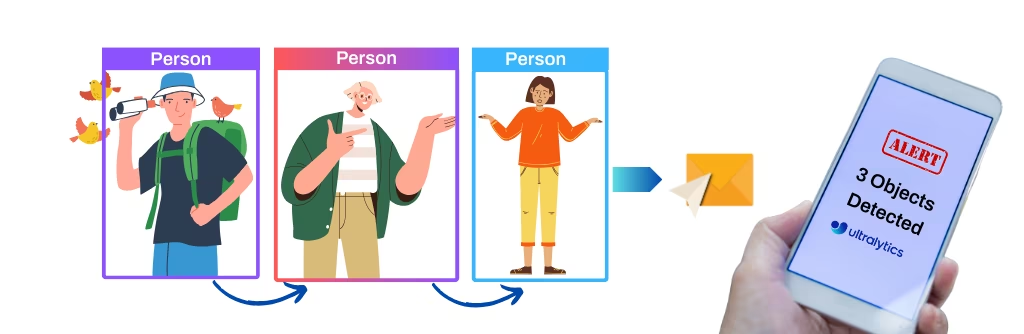
В этом проекте используется компьютерное зрение Ultralytics YOLO26 для создания системы охранной сигнализации. YOLO26 обеспечивает обнаружение объектов в реальном времени, позволяя системе оперативно выявлять потенциальные угрозы безопасности и реагировать на них. Проект обладает рядом преимуществ:
- Обнаружение в реальном времени: Благодаря эффективности YOLO26 система охранной сигнализации обнаруживает происшествия и реагирует на них в реальном времени, сводя к минимуму время реагирования.
- Точность: Точное обнаружение объектов с помощью YOLO26 сокращает число ложных срабатываний и повышает надёжность системы охранной сигнализации.
- Возможности интеграции: Проект позволяет добавить аналитику на основе ИИ к существующим камерам видеонаблюдения, дополняя имеющуюся систему наблюдения интеллектуальным уровнем обнаружения.
Смотреть: Система охранной сигнализации с Ultralytics YOLO26 + решения для обнаружения объектов
Отправляй оповещения о безопасности с YOLO26#
Решение SecurityAlarm отслеживает объекты в видеопотоке и отправляет одно оповещение по электронной почте с прикреплённым размеченным изображением, как только число обнаруженных объектов достигает порога records. Подключи аккаунт Gmail с помощью пароля приложения, а затем запусти решение для обработки источника.
Перейди в генератор паролей приложений, укажи название приложения, например "проект системы безопасности", и получи пароль из 16 символов. Скопируй пароль и вставь его в поле password в коде ниже.
import cv2

from ultralytics import solutions

cap = cv2.VideoCapture("path/to/video.mp4")
assert cap.isOpened(), "Error reading video file"

# Запись видео
w, h, fps = (int(cap.get(x)) for x in (cv2.CAP_PROP_FRAME_WIDTH, cv2.CAP_PROP_FRAME_HEIGHT, cv2.CAP_PROP_FPS))
video_writer = cv2.VideoWriter("security_output.avi", cv2.VideoWriter_fourcc(*"mp4v"), fps, (w, h))

from_email = "abc@gmail.com"  # адрес электронной почты отправителя
password = "---- ---- ---- ----"  # пароль приложения из 16 символов, созданный на странице: https://myaccount.google.com/apppasswords
to_email = "xyz@gmail.com"  # адрес электронной почты получателя

# Инициализируй объект охранной сигнализации
securityalarm = solutions.SecurityAlarm(
    show=True,  # отобразить результат
    model="yolo26n.pt",  # например, yolo26s.pt, yolo26m.pt
    records=1,  # общее число обнаружений для отправки электронного письма
)

securityalarm.authenticate(from_email, password, to_email)  # аутентифицировать почтовый сервер

# Обработка видео
while cap.isOpened():
    success, im0 = cap.read()

    if not success:
        print("Video frame is empty or video processing has been successfully completed.")
        break

    results = securityalarm(im0)

    # print(results)  # доступ к результату

    video_writer.write(results.plot_im)  # запись обработанного кадра.

cap.release()
video_writer.release()
cv2.destroyAllWindows()  # закрытие всех открытых окон
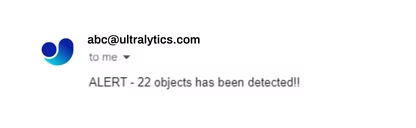
При запуске кода ты получишь одно уведомление по электронной почте, если будет обнаружен хотя бы один объект. Уведомление отправляется сразу и не повторяется. Ты можешь настроить код в соответствии с требованиями своего проекта.
Пример полученного письма#
Аргументы SecurityAlarm#
Вот таблица с аргументами SecurityAlarm:
| Аргумент | Тип | По умолчанию | Описание |
|---|---|---|---|
model | str | None | Путь к файлу модели Ultralytics YOLO. |
records | int | 5 | Общее количество обнаруженных объектов, при достижении которого отправляется электронное письмо с предупреждением системы безопасности. |
line_width | int | 2 | Толщина линий рамок, ключевых точек и счётчиков, которые рисует решение. |
verbose | bool | True | Включает журнал решения для каждого кадра с указанием формы входных данных, количества объектов по классам и скорости обработки. Сам вызов отслеживания всегда выполняется без вывода сообщений. |
Решение SecurityAlarm поддерживает различные параметры track:
| Аргумент | Тип | По умолчанию | Описание |
|---|---|---|---|
tracker | str | 'tracktrack.yaml' | Задаёт алгоритм отслеживания. Встроенные варианты: botsort.yaml, bytetrack.yaml, ocsort.yaml, deepocsort.yaml, fasttrack.yaml, tracktrack.yaml. |
conf | float | 0.25 | Задаёт порог уверенности для обнаружений: при более низких значениях можно отслеживать больше объектов, но возрастает вероятность ложноположительных срабатываний. |
iou | float | 0.5 | Задаёт порог пересечения над объединением (IoU) для фильтрации перекрывающихся обнаружений. |
classes | list | None | Фильтрует результаты по индексу класса. Например, classes=[0, 2, 3] отслеживает только указанные классы. |
device | str | None | Задаёт устройство для инференса (например, cpu, cuda:0 или 0). Позволяет выбрать CPU, определённый GPU или другое вычислительное устройство для выполнения модели. |
imgsz | int or tuple | 640 | Целевой размер изображения для инференса: целое число для квадратного изображения или пара (height, width). Размеры корректируются с учётом шага модели. |
max_det | int | 300 | Максимальное количество обнаружений, сохраняемых в каждом кадре перед отслеживанием; ограничивает число объектов, обрабатываемых решением в насыщенных сценах. |
quantize | int or str | None | Точность инференса: 16 (FP16) или 32/unset (FP32) для моделей PyTorch и TorchScript не на CPU; для других форматов точность определяется артефактом модели и средой выполнения. Заменяет устаревший аргумент half. |
Кроме того, доступны следующие настройки визуализации:
| Аргумент | Тип | По умолчанию | Описание |
|---|---|---|---|
show | bool | False | Если True, показывает аннотированные изображения или видео в окне. Полезно для мгновенной визуальной проверки во время разработки или тестирования. |
show_conf | bool | True | Показывает оценку уверенности каждой детекции рядом с меткой. Позволяет оценить уверенность модели в каждой детекции. |
show_labels | bool | True | Показывает метки каждой детекции на визуализации. Помогает сразу понять, какие объекты обнаружены. |
Как это работает#
Система охранной сигнализации использует отслеживание объектов для мониторинга видеопотоков и обнаружения потенциальных угроз безопасности. Когда число обнаруженных объектов в кадре достигает заданного порога (установленного параметром records), система автоматически отправляет уведомление по электронной почте с прикреплённым изображением обнаруженных объектов.
В системе используется класс SecurityAlarm, предоставляющий методы для:
- Обработки кадров и извлечения обнаруженных объектов
- Аннотирования кадров ограничивающими рамками вокруг обнаруженных объектов
- Отправки уведомлений по электронной почте при достижении пороговых значений обнаружения
Эта реализация подходит для домашней безопасности, видеонаблюдения в магазинах и других задач мониторинга, где важно немедленно получать уведомления об обнаруженных объектах.
Часто задаваемые вопросы#
Ultralytics YOLO26 повышает эффективность систем охранной сигнализации благодаря точному обнаружению объектов в реальном времени. Это сокращает число ложных срабатываний, поэтому система реагирует преимущественно на реальные события. Ты можешь дополнительно сократить число ложных тревог, ограничив обнаружение релевантными
classes(например, только людьми), повысив порогconfили увеличивrecords.Да. Решение
SecurityAlarmобрабатывает кадры из любого источника, который может считывать OpenCV, включая видеофайлы, веб-камеры и RTSP-потоки с IP-камер, поэтому ты можешь добавить обнаружение с помощью YOLO26 к существующей системе камер.Для запуска Ultralytics YOLO26 в стандартной конфигурации обычно требуется около 5 ГБ свободного места на диске. Оно понадобится для хранения модели YOLO26 и дополнительных зависимостей. Для облачных решений Ultralytics Platform предлагает эффективное управление проектами и наборами данных, помогая оптимизировать использование хранилища. План Pro увеличивает объём хранилища до 500 ГБ.
Ultralytics YOLO26 превосходит такие модели, как Faster R-CNN и SSD, благодаря обнаружению объектов в реальном времени и более высокой точности. Её одноэтапная архитектура обрабатывает изображения значительно быстрее без потери точности, поэтому модель хорошо подходит для задач, чувствительных ко времени, например для систем охранной сигнализации.
Чтобы сократить число ложных срабатываний, убедись, что модель Ultralytics YOLO26 достаточно обучена на разнообразном и качественно размеченном наборе данных. Настройка гиперпараметров и регулярное обновление модели на новых данных могут значительно повысить точность обнаружения.


Комментарии155
Задай вопрос, поделись результатами или помоги кому-нибудь.
e9l7a5f
hi, i cant do the email setting, of Sign in with app passwords and the authentication part , it looks like google change the setting i cant find them, is there another way?
1 Glenn JocherUltralytics(изменено)
Hey there! 😊 It seems like Google's app password settings have indeed evolved, and I appreciate you reaching out for assistance on this. While the current documentation may reference older interfaces, the essence of setting up app passwords for projects like the Security Alarm System with Ultralytics YOLOv8 remains relevant.
If you're experiencing difficulties locating the specific options for app passwords on Google, you might consider looking into alternative email sending services that offer API support, such as SendGrid, Mailgun, or even using a local SMTP server setup, depending on your project's complexity and scale.
For a quick fix using
smtplibwith Gmail, ensure you've enabled two-factor authentication on your account, and then create an app password here: https://myaccount.google.com/apppasswords.Here's a simplified version of how to use an app password:
import smtplib

EMAIL = "your_email@gmail.com"
APP_PASSWORD = "your_app_password"

with smtplib.SMTP("smtp.gmail.com", 587) as smtp:
    smtp.starttls()
    smtp.login(EMAIL, APP_PASSWORD)
    subject = "Security Alert"
    body = "Alert description"
    msg = f"Subject: {subject}\n\n{body}"
    smtp.sendmail(EMAIL, "receiver_email@gmail.com", msg)
Make sure to replace
"your_email@gmail.com"and"your_app_password"with your actual Gmail email and the 16-digit app password you generate, respectively.It's recommended to review the current Gmail documentation or seek updated guidance if Google's procedures have significantly changed since our last update. Hope this helps! If you have further questions or need more personalized assistance, feel free to ask.
thanks for replying, i fix it for the yolov8 as the same steps u explained, now i want to use it on yolov9 but i cant with these steps, because i am using the detect.py and i dont know how to deal with it , where to put each code, i dont have that much background in DL and python codes. the email part is working now
- Glenn JocherUltralytics(изменено)
@e9l7a5f you can use YOLOv9 models the same way as you currently use YOLOv8 models; see https://docs.ultralytics.com/models/yolov9. For new projects we recommend YOLO26: https://docs.ultralytics.com/models/yolo26/.
AKAfaq Karim have ultralytics model mask or gun class?
 Paula DerrengerUltralytics
@afaq-karim The
yolo26n.ptmodel in this guide uses the 80 COCO classes, which include neither face masks nor guns. To try detecting either, you can use YOLOE-26 with text prompts such asface maskorhandgun. Validate it on footage from your camera before relying on it for alerts.
aaurelions
% python3.11 main.py
Ultralytics Solutions: ✅ {'source': None, 'model': 'yolo11n.pt', 'classes': None, 'show_conf': True, 'show_labels': True, 'region': None, 'colormap': 21, 'show_in': True, 'show_out': True, 'up_angle': 145.0, 'down_angle': 90, 'kpts': [6, 8, 10], 'analytics_type': 'line', 'figsize': (12.8, 7.2), 'blur_ratio': 0.5, 'vision_point': (20, 20), 'crop_dir': 'cropped-detections', 'json_file': None, 'line_width': 2, 'records': 1, 'fps': 30.0, 'max_hist': 5, 'meter_per_pixel': 0.05, 'max_speed': 120, 'show': True, 'iou': 0.7, 'conf': 0.25, 'device': None, 'max_det': 300, 'half': False, 'tracker': 'botsort.yaml', 'verbose': True, 'data': 'images'}
Traceback (most recent call last):
  File "/Users/llama/Developer/sec/main.py", line 23, in <module>
    securityalarm.authenticate(from_email, password, to_email)  # authenticate the email server
    ^^^^^^^^^^^^^^^^^^^^^^^^^^^^^^^^^^^^^^^^^^^^^^^^^^^^^^^^^^
  File "/Users/llama/.venv/3.11/lib/python3.11/site-packages/ultralytics/solutions/security_alarm.py", line 68, in authenticate
    self.server = smtplib.SMTP("smtp.gmail.com: 587")
                  ^^^^^^^^^^^^^^^^^^^^^^^^^^^^^^^^^^^
  File "/opt/homebrew/Cellar/python@3.11/3.11.13/Frameworks/Python.framework/Versions/3.11/lib/python3.11/smtplib.py", line 255, in __init__
    (code, msg) = self.connect(host, port)
                  ^^^^^^^^^^^^^^^^^^^^^^^^
  File "/opt/homebrew/Cellar/python@3.11/3.11.13/Frameworks/Python.framework/Versions/3.11/lib/python3.11/smtplib.py", line 341, in connect
    self.sock = self._get_socket(host, port, self.timeout)
                ^^^^^^^^^^^^^^^^^^^^^^^^^^^^^^^^^^^^^^^^^^
  File "/opt/homebrew/Cellar/python@3.11/3.11.13/Frameworks/Python.framework/Versions/3.11/lib/python3.11/smtplib.py", line 312, in _get_socket
    return socket.create_connection((host, port), timeout,
           ^^^^^^^^^^^^^^^^^^^^^^^^^^^^^^^^^^^^^^^^^^^^^^^
  File "/opt/homebrew/Cellar/python@3.11/3.11.13/Frameworks/Python.framework/Versions/3.11/lib/python3.11/socket.py", line 863, in create_connection
    raise exceptions[0]
  File "/opt/homebrew/Cellar/python@3.11/3.11.13/Frameworks/Python.framework/Versions/3.11/lib/python3.11/socket.py", line 848, in create_connection
    sock.connect(sa)
ConnectionRefusedError: [Errno 61] Connection refused
RizwanMunawar
@aaurelions Hi, thanks for sharing it. You will need to configure the parameters first by following the docs: https://docs.ultralytics.com/guides/security-alarm-system/
1
EQUINOX391
Dear ultralytics team! First of all i really appreciate this amazing works, I'm working on my projects for detecting crime and i aalready have a trained resnet 50 model for detecting some crime as dummy, I really wonder can i integrate the Security Alarm System by Ultralytics in my projects and make it like have this functionality :
- have input of CCTV from RTSP
- when detecting people (or maybe car, bike, etc) , my resnet model will also detecting what they do, after we know what the activity is, we can send it the email
- customize the email messaging like "ALERT 2 people 2 cars detected, Activity Probability : Suspicious - Stealing"
- also send different email if the people stays too long in the frame.
- keep making new notification IF There's new people(s) inside the frame.
- notified if the people or another object is gone from the frame
- is there any pretrain model that detect something related to crime like hammer, crowbar, spraying can, grafitti, gun, etc?
- is there any pretrain model yolo have for pose estimation? i mean there's some but i don't find anything inside the documentation that said it can estimate some general pose like, squat, stand, walk, run, etc
i have so many question but i think that is the most of it! Thank you, and sorry for my bad english.
Cheikh-Ahmedand
Hi Glenn-jocher!
I am very appreciative of your help to your clients as i am one of them.
in onder to integrate security alarm system in an application, using streamlit package, how can i let the end user input their capture_index value and their email:
st. input_text ( )
from_email = "@gmail.com" # must match the email used to generate the password
st. input_text ( )
detector = ObjectDetection(capture_index=0) detector()
with examples, please!
Best regards!
- Glenn JocherUltralytics(изменено)
@Cheikh-Ahmedand thank you for your support! For Streamlit integration, you can collect user inputs like this:
import cv2
import streamlit as st
from ultralytics import solutions

# User inputs
from_email = st.text_input("Sender Email")
password = st.text_input("App Password", type="password")
to_email = st.text_input("Receiver Email")
capture_source = st.text_input("Camera Index/Video Path", "0")

# Initialize SecurityAlarm with user inputs
security = solutions.SecurityAlarm(show=True, model="yolo26n.pt", records=1)
security.authenticate(from_email, password, to_email)
cap = cv2.VideoCapture(int(capture_source) if capture_source.isdigit() else capture_source)
The SecurityAlarm implementation details remain as shown in our security alarm system guide. For email setup, ensure users follow the App Password Generator instructions.
Hello there, glenn-jocher!
Thanks for your nice Help!
I would like st.input_text for end users for from_emails /to_email and detector = ObjectDetection(capture_index=0) in the below code, not for the code you gave an example on:
Securiy Alarm System
password = " " from_email = "@gmail.com" # must match the email used to generate the password to_email = "@gmail.com" # receiver email
import smtplib server = smtplib.SMTP('smtp.gmail.com: 587') server.starttls() server.login(from_email, password)
from email.mime.multipart import MIMEMultipart from email.mime.text import MIMEText from email.mime.image import MIMEImage
def send_email(to_email, from_email, image_path, object_detected=1): """Sends an email with an image attachment.""" message = MIMEMultipart() message["From"] = from_email message["To"] = to_email message["Subject"] = "Security Alert" message_body = f"ALERT - {object_detected} objects have been detected!" message.attach(MIMEText(message_body, "plain")) with open(image_path, 'rb') as img_file: img = MIMEImage(img_file.read()) message.attach(img) server.sendmail(from_email, to_email, message.as_string())
from time import time
import cv2 import torch from ultralytics import YOLO from ultralytics.utils.plotting import Annotator, colors
class ObjectDetection: def init(self, capture_index): """Initializes an ObjectDetection instance with a given camera index.""" self.capture_index = capture_index self.email_sent = False
    # model information
    self.model = YOLO("yolo11n.pt")

    # visual information
    self.annotator = None
    self.start_time = 0
    self.end_time = 0

    # device information
    self.device = "cuda" if torch.cuda.is_available() else "cpu"

def predict(self, im0):
    """Run prediction using a YOLO model for the input image `im0`."""
    results = self.model(im0, classes=[0])
    return results

def display_fps(self, im0):
    """Displays the FPS on an image `im0` by calculating and overlaying as white text on a black rectangle."""
    self.end_time = time()
    fps = 1 / round(self.end_time - self.start_time, 2)
    text = f"FPS: {int(fps)}"
    text_size = cv2.getTextSize(text, cv2.FONT_HERSHEY_SIMPLEX, 1.0, 2)[0]
    gap = 10
    cv2.rectangle(
        im0,
        (20 - gap, 70 - text_size[1] - gap),
        (20 + text_size[0] + gap, 70 + gap),
        (255, 255, 255),
        -1,
    )
    cv2.putText(im0, text, (20, 70), cv2.FONT_HERSHEY_SIMPLEX, 1.0, (0, 0, 0), 2)

def plot_bboxes(self, results, im0):
    """Plots bounding boxes on an image given detection results; returns annotated image and class IDs."""
    class_ids = []
    self.annotator = Annotator(im0, 3, results[0].names)
    boxes = results[0].boxes.xyxy.cpu()
    clss = results[0].boxes.cls.cpu().tolist()
    names = results[0].names
    for box, cls in zip(boxes, clss):
        class_ids.append(cls)
        self.annotator.box_label(box, label=names[int(cls)], color=colors(int(cls), True))
    return im0, class_ids

def __call__(self):
    """Run object detection on video frames from a camera stream, plotting and showing the results."""
    cap = cv2.VideoCapture(self.capture_index)
    assert cap.isOpened()
    cap.set(cv2.CAP_PROP_FRAME_WIDTH, 640)
    cap.set(cv2.CAP_PROP_FRAME_HEIGHT, 480)
    frame_count = 0
    while True:
        self.start_time = time()
        ret, im0 = cap.read()
        assert ret
        results = self.predict(im0)
        im0, class_ids = self.plot_bboxes(results, im0)
        if len(class_ids) > 0:
           image_path = f"detected_frame_{frame_count}.jpg"
           cv2.imwrite(image_path, im0)
           if not self.email_sent:
            send_email(to_email, from_email, image_path, len(class_ids))
            self.email_sent = True
        else:
            self.email_sent = False

        self.display_fps(im0)
        cv2.imshow("YOLO11 Detection", im0)
        frame_count += 1
        if cv2.waitKey(5) & 0xFF == 27:
            break
    cap.release()
    cv2.destroyAllWindows()
    server.quit()
detector = ObjectDetection(capture_index=0) detector()
would you please give an example of st. input_text for end users letting them write their emails and capture_index on the above code?
Sincerely Yours!
- Glenn JocherUltralytics
Thank you for your question! For Streamlit integration with user inputs in your security system, here's how to modify your code:
import streamlit as st

# User inputs
from_email = st.text_input("Sender Email")
to_email = st.text_input("Receiver Email")
password = st.text_input("App Password", type="password")
capture_index = st.text_input("Camera Index/Video Path", "0")

# Initialize detector with user inputs
detector = ObjectDetection(capture_index=int(capture_index) if capture_index.isdigit() else capture_index)
This allows users to specify their email credentials and camera source through Streamlit's interactive interface. The Security Alarm System guide shows how these inputs integrate with YOLO11's detection capabilities. For email setup requirements, please ensure users follow the App Password Generator instructions from our security alarm documentation.
boukosho
Hey glenn-jocher!
As you know, ML models need frequent check so as their data remain undriffed and their distribution remain unchanged.
To frequently monitor deployed ml models by streamlit in case it is deployed to aws ec2, Google Cloud, or streamlit community cloud or in local server, what should I do ?
Please give an example!
Thanks!
- Glenn JocherUltralytics(изменено)
@boukosho for monitoring deployed YOLO11 models across cloud platforms, consider implementing a heartbeat system with performance metrics logging. Our Security Alarm System guide shows email alert integration that could be adapted for drift detection notifications. For production deployments, Ultralytics Platform provides monitoring for deployed endpoints; see the Platform monitoring documentation. A minimal implementation might track inference statistics and trigger alerts via our solutions.SecurityAlarm class when thresholds are exceeded.
Hello there glenn-jocher!
Thanks for your respectful responses!
If I want the alarm system to only notify me when it is confident of more than 0.3 % .
So how to do it, with examples, please!
 # model information

    self.model = YOLO("yolo11.pt")

    # visual information

    self.annotator = None

    self.start_t        ime = 0

    self.end_time = 0


    # device information

    self.device = "cuda" if torch.cuda.is_available() else "cpu"


def predict(self, im0):

    """Run prediction using a YOLO model for the input image `im0`."""

    results = self.model(im0, classes=[0])

     return results
Sincelrely Yours!
- Glenn JocherUltralytics(изменено)
@Cheikh-Ahmedand to adjust the confidence threshold in your security alarm system, set the
confargument when initializing the solution. For example:security = solutions.SecurityAlarm(model="yolo26n.pt", conf=0.5) # only detections above 0.5 confidenceThis ensures notifications only trigger for detections exceeding your specified confidence level. For more details, refer to the Security Alarm System guide.
hey!
Thanks glenn-jocher for your respectful response.
security = solutions.SecurityAlarm(model="yolo11n.pt", conf=0.5) # Set confidence threshold >0.3 security.model.conf = 0.5 # Alternative direct method
N.B, I would like to add conf=0.5 for the below function (self.model = YOLO("yolo11n.pt"), not for the above one
class ObjectDetection:
def __init__(self, capture_index):

    """Initializes an ObjectDetection instance with a given camera index."""

    self.capture_index = capture_index

    self.email_sent = False

    # model information

    self.model = YOLO("yolo11n.pt")
visual information
    self.annotator = None

    self.start_time = 0

    self.end_time = 0

    # device information

    self.device = "cuda" if torch.cuda.is_available() else "cpu"
How to do so with examples, please!
Sincerely Yours!
- Glenn JocherUltralytics(изменено)
@Cheikh-Ahmedand in your own
ObjectDetectionclass, passconfwhen you run inference rather than when loading the model:self.model = YOLO("yolo26n.pt") results = self.model.predict(im0, conf=0.5)For more details on model arguments, see the Predict mode documentation.
Hey glenn- jocher!
Thanks lots for your respectful response.
self.model = YOLO("yolo11n.pt", task="detect").set({"conf": 0.5})
When i run the above code, an error has been occured:
(AttributeError: 'DetectionModel' object has no attribute 'set')
What should i do instead? With examples, Please.
Best Regards!
- Glenn JocherUltralytics
To set the confidence threshold in your custom
ObjectDetectionclass, modify yourpredictmethod like this:def predict(self, im0): results = self.model.predict(im0, classes=[0], conf=0.5) # Add conf here return resultsThe
confparameter should be passed during inference rather than model initialization. For more details on prediction arguments, see the Predict mode documentation.
Hello there! What do you mean by the below function?
cap = cv2.VideoCapture("Path/to/video/file.mp4") assert cap.isOpened(), "Error reading video file"
Namely, I have a Webcam or the laptop camera or dvr/nvr cameras and I want to attach them to the above function. How to do so? With examples, please!! . Sincerely Yours!
- Glenn JocherUltralytics(изменено)
To use your webcam or camera stream with OpenCV's
VideoCapture, replace the file path with:0for default laptop camera (e.g.,cap = cv2.VideoCapture(0))- RTSP URL for network cameras (e.g.,
cap = cv2.VideoCapture("rtsp://username:password@camera_ip:port/stream"))
For DVR/NVR cameras, use your camera's RTSP stream URL. See OpenCV VideoCapture docs for more input formats.
Hay!
Glenn-jocher I asked you questions here, you haven't answered me yet? Do you still respond kindly to questions regarding yolo security alarm system here? Or you no longer do so?
Best Regards!
- Glenn JocherUltralytics
@boukosho hi! We're happy to help with YOLO security alarm system questions. Our comprehensive Security Alarm System guide at https://docs.ultralytics.com/guides/security-alarm-system/ provides complete implementation code and documentation. For specific issues, feel free to open a GitHub Discussion with details about your implementation and we'll assist there. 😊
Hello there! What do you mean by the below function?
cap = cv2.VideoCapture("Path/to/video/file.mp4") assert cap.isOpened(), "Error reading video file"
Namely, I have a Webcam or the laptop camera or dvr/nvr cameras and I want to attach them to the above function. How to do so? With examples, please!! . Sincerely Yours!
- Glenn JocherUltralytics(изменено)
To use your webcam, laptop camera, or DVR/NVR cameras with
cv2.VideoCapture, modify the source argument:-
Webcam/Laptop Camera:
cap = cv2.VideoCapture(0)(0 for default camera, 1 for secondary, etc.) -
IP/DVR/NVR Cameras:
Use RTSP/HTTP stream URLs like:
cap = cv2.VideoCapture("rtsp://username:password@camera_ip:port/stream")
The rest of the security alarm code remains unchanged. Ensure your camera feed is accessible and credentials are correctly formatted in URLs. For more details on video sources, see our Object Detection and Tracking guide.
-
Hello there! What do you mean by the below function?
cap = cv2.VideoCapture("Path/to/video/file.mp4") assert cap.isOpened(), "Error reading video file"
Namely, I have a Webcam or the laptop camera or dvr/nvr cameras and I want to attach them to the above function. How to do so? With examples, please!! . Sincerely Yours!
- Glenn JocherUltralytics(изменено)
For webcam/laptop camera use
cap = cv2.VideoCapture(0)(0=default camera index). For IP cameras, use an RTSP URL likecap = cv2.VideoCapture("rtsp://username:password@camera_ip:port/path"). Theassertchecks if the video source opens successfully. You can find specific camera URL formats in your DVR/NVR documentation.
andrewjang2234
Traceback (most recent call last): File "C:\Users\User\class-iot\apps\iot07\security.py", line 17, in server.login(from_email, password) File "C:\Users\User\miniconda3\envs\class-iot061\lib\smtplib.py", line 750, in login raise last_exception File "C:\Users\User\miniconda3\envs\class-iot061\lib\smtplib.py", line 739, in login (code, resp) = self.auth( File "C:\Users\User\miniconda3\envs\class-iot061\lib\smtplib.py", line 662, in auth raise SMTPAuthenticationError(code, resp) smtplib.SMTPAuthenticationError: (534, b'5.7.9 Application-specific password required. For more information, go to\n5.7.9 https://support.google.com/mail/?p=InvalidSecondFactor 41be03b00d2f7-7fd430cec7bsm8095565a12.67 - gsmtp')
I don't know why this error is keep causing.......... what is the problem?
sorry I sovle that problem if I want to use my laptob cam what do I have to do?
- Glenn JocherUltralytics
@andrewjang2234 to use your laptop's camera, set the
capture_indexparameter in theObjectDetectionclass to0(e.g.,ObjectDetection(capture_index=0)). This should automatically access your default webcam. If issues persist, ensure your camera is not being used by another application.