Ultralytics YOLO26 ile Güvenlik Alarm Sistemi Projesi
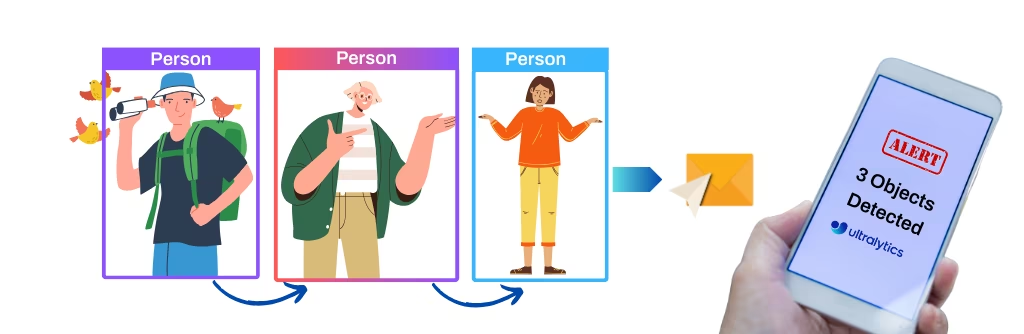
Bu proje, bir güvenlik alarm sistemi oluşturmak için Ultralytics YOLO26 bilgisayarlı görü teknolojisini kullanır. YOLO26, gerçek zamanlı nesne algılama sağlayarak sistemin olası güvenlik tehditlerini hızla belirleyip bunlara yanıt vermesine olanak tanır. Bu proje çeşitli avantajlar sunar:
- Gerçek Zamanlı Algılama: YOLO26'nın verimliliği, Güvenlik Alarm Sistemi'nin güvenlik olaylarını gerçek zamanlı algılayıp yanıtlamasını sağlayarak müdahale süresini en aza indirir.
- Doğruluk: YOLO26'nın doğru nesne algılama yeteneği, yanlış pozitifleri azaltır ve güvenlik alarm sisteminin güvenilirliğini artırır.
- Entegrasyon Yetenekleri: Proje, mevcut güvenlik kameralarına yapay zekâ analizleri ekleyebilir ve böylece mevcut gözetim sistemine akıllı bir algılama katmanı kazandırır.
İzle: Ultralytics YOLO26 ile Güvenlik Alarm Sistemi + Çözümlerle Nesne Algılama
YOLO26 ile Güvenlik Uyarıları Gönder#
SecurityAlarm çözümü, video akışındaki nesneleri takip eder ve tespit sayısı records eşiğine ulaşır ulaşmaz açıklama eklenmiş bir görselin iliştirildiği tek bir e-posta uyarısı gönderir. Bir uygulama şifresiyle Gmail hesabını doğrula, ardından çözümü kaynağında çalıştır.
Uygulama Şifresi Oluşturucu sayfasına git, "security project" gibi bir uygulama adı belirle ve 16 karakterli bir şifre al. Bu şifreyi kopyalayıp aşağıdaki koddaki password alanına yapıştır.
import cv2

from ultralytics import solutions

cap = cv2.VideoCapture("path/to/video.mp4")
assert cap.isOpened(), "Error reading video file"

# Video yazıcısı
w, h, fps = (int(cap.get(x)) for x in (cv2.CAP_PROP_FRAME_WIDTH, cv2.CAP_PROP_FRAME_HEIGHT, cv2.CAP_PROP_FPS))
video_writer = cv2.VideoWriter("security_output.avi", cv2.VideoWriter_fourcc(*"mp4v"), fps, (w, h))

from_email = "abc@gmail.com"  # gönderenin e-posta adresi
password = "---- ---- ---- ----"  # şu adresten oluşturulan 16 karakterli uygulama şifresi: https://myaccount.google.com/apppasswords
to_email = "xyz@gmail.com"  # alıcının e-posta adresi

# Güvenlik alarmı nesnesini başlat
securityalarm = solutions.SecurityAlarm(
    show=True,  # çıktıyı görüntüle
    model="yolo26n.pt",  # ör. yolo26s.pt, yolo26m.pt
    records=1,  # E-posta göndermek için toplam tespit sayısı
)

securityalarm.authenticate(from_email, password, to_email)  # E-posta sunucusunun kimliğini doğrula

# Videoyu işle
while cap.isOpened():
    success, im0 = cap.read()

    if not success:
        print("Video frame is empty or video processing has been successfully completed.")
        break

    results = securityalarm(im0)

    # print(results)  # çıktıya eriş

    video_writer.write(results.plot_im)  # işlenmiş kareyi yaz.

cap.release()
video_writer.release()
cv2.destroyAllWindows()  # açık tüm pencereleri kapat
Kodu çalıştırdığında, herhangi bir nesne tespit edilirse tek bir e-posta bildirimi alırsın. Bildirim tekrarlanmadan hemen gönderilir. Kodu projenin gereksinimlerine göre özelleştirebilirsin.
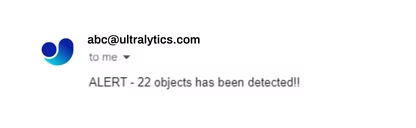
Alınan E-posta Örneği#
SecurityAlarm Bağımsız Değişkenleri#
Aşağıda SecurityAlarm bağımsız değişkenlerini içeren bir tablo bulabilirsin:
| Bağımsız değişken | Tür | Varsayılan | Açıklama |
|---|---|---|---|
model | str | None | Ultralytics YOLO model dosyasının yolu. |
records | int | 5 | Güvenlik alarm sistemiyle e-posta gönderilmesini tetikleyecek toplam tespit sayısı. |
line_width | int | 2 | Çözümün çizdiği kutular, anahtar noktalar ve sayılar için çizgi kalınlığı. |
verbose | bool | True | Çözümün her kare için girdi şekli, sınıf sayıları ve işleme hızına ilişkin günlüğünü etkinleştirir. İzleme çağrısının kendisi her zaman sessizdir. |
SecurityAlarm çözümü çeşitli track parametrelerini destekler:
| Bağımsız değişken | Tür | Varsayılan | Açıklama |
|---|---|---|---|
tracker | str | 'tracktrack.yaml' | Kullanılacak izleme algoritmasını belirtir. Yerleşik seçenekler: botsort.yaml, bytetrack.yaml, ocsort.yaml, deepocsort.yaml, fasttrack.yaml, tracktrack.yaml. |
conf | float | 0.25 | Algılamalar için güven eşiğini belirler; düşük değerler daha fazla nesnenin izlenmesine olanak tanır ancak yanlış pozitifleri de içerebilir. |
iou | float | 0.5 | Çakışan algılamaları filtrelemek için Kesişim-Birleşim Oranı (IoU) eşiğini belirler. |
classes | list | None | Sonuçları sınıf dizinine göre filtreler. Örneğin, classes=[0, 2, 3] yalnızca belirtilen sınıfları izler. |
device | str | None | Çıkarım için kullanılacak cihazı belirtir (ör. cpu, cuda:0 veya 0). Kullanıcıların model yürütme için CPU, belirli bir GPU veya başka hesaplama cihazları arasında seçim yapmasına olanak tanır. |
imgsz | int or tuple | 640 | Hedef çıkarım görüntü boyutu: kare görüntüler için bir tam sayı veya bir (height, width) çifti. Boyutlar model adım değerine göre ayarlanır. |
max_det | int | 300 | Yoğun sahnelerde bir çözümün işleyeceği nesne sayısını sınırlamak için izleme öncesinde kare başına tutulan en yüksek algılama sayısı. |
quantize | int or str | None | Çıkarım hassasiyeti: CPU dışında PyTorch ve TorchScript modelleri için 16 (FP16) veya 32/unset (FP32); diğer biçimler, model yapıtının ve çalışma zamanının seçtiği hassasiyeti kullanır. Kullanımdan kaldırılan half argümanının yerini alır. |
Ayrıca aşağıdaki görselleştirme ayarları da kullanılabilir:
| Bağımsız değişken | Tür | Varsayılan | Açıklama |
|---|---|---|---|
show | bool | False | True ise açıklama eklenmiş görüntüleri veya videoları bir pencerede gösterir. Geliştirme veya test sırasında anında görsel geri bildirim almak için kullanışlıdır. |
show_conf | bool | True | Her algılamanın güven puanını etiketinin yanında gösterir. Modelin her algılamaya ne kadar güvendiğini görmeni sağlar. |
show_labels | bool | True | Görsel çıktıda her algılama için etiketleri gösterir. Algılanan nesnelerin hemen anlaşılmasını sağlar. |
Nasıl Çalışır?#
Güvenlik Alarm Sistemi, video akışlarını izlemek ve olası güvenlik tehditlerini tespit etmek için nesne takibi kullanır. Bir karede tespit edilen nesne sayısı belirtilen eşiğe (records parametresiyle ayarlanır) ulaştığında, tespit edilen nesneleri gösteren bir görsel ekli e-posta bildirimini otomatik olarak gönderir.
Sistem, aşağıdaki yöntemleri sağlayan SecurityAlarm sınıfından yararlanır:
- Kareleri işle ve nesne tespitlerini çıkar
- Tespit edilen nesnelerin etrafına sınırlayıcı kutular çizerek karelere açıklama ekle
- Tespit eşikleri karşılandığında e-posta bildirimleri gönder
Bu uygulama, algılanan nesneler için anında bildirimlerin kritik önem taşıdığı ev güvenliği, perakende gözetimi ve diğer izleme uygulamaları için uygundur.
Sık Sorulan Sorular#
Ultralytics YOLO26, yanlış pozitifleri azaltan doğru ve gerçek zamanlı nesne algılama sunarak güvenlik alarm sistemlerini geliştirir; böylece sistem çoğunlukla gerçek olaylara yanıt verir. Yalnızca ilgili
classesöğelerini (örneğin yalnızca insanları) algılayarak,confeşiğini yükselterek veyarecordsdeğerini artırarak yanlış alarmları daha da azaltabilirsin.Evet.
SecurityAlarmçözümü; video dosyaları, web kameraları ve IP kameralardan gelen RTSP akışları dâhil olmak üzere OpenCV'nin okuyabildiği her kaynağın karelerini işler. Böylece mevcut kamera düzenine YOLO26 algılaması ekleyebilirsin.Ultralytics YOLO26'yı standart bir düzende çalıştırmak için genellikle yaklaşık 5 GB boş disk alanı gerekir. Bu alan YOLO26 modelini ve ek bağımlılıkları depolamayı kapsar. Bulut tabanlı çözümler için Ultralytics Platform, depolama gereksinimlerini optimize edebilecek verimli proje yönetimi ve veri kümesi işleme özellikleri sunar. Pro Plan, depolama alanını 500 GB'a çıkarır.
Ultralytics YOLO26, gerçek zamanlı algılama yetenekleri ve daha yüksek doğruluğuyla Faster R-CNN veya SSD gibi modellere göre avantaj sağlar. Tek aşamalı mimarisi, doğruluktan ödün vermeden görüntüleri çok daha hızlı işler ve bu nedenle güvenlik alarm sistemleri gibi zamana duyarlı uygulamalara uygundur.
Yanlış pozitifleri azaltmak için Ultralytics YOLO26 modelini çeşitli örnekler içeren, iyi açıklama eklenmiş bir veri kümesiyle yeterince eğittiğinden emin ol. Hiperparametreleri ayarlamak ve modeli yeni verilerle düzenli olarak güncellemek algılama doğruluğunu önemli ölçüde artırabilir.


Yorumlar153
Bir soru sor, sonuçlarını paylaş veya başka birine yardım et.
e9l7a5f
hi, i cant do the email setting, of Sign in with app passwords and the authentication part , it looks like google change the setting i cant find them, is there another way?
1 Glenn JocherUltralytics(düzenlendi)
Hey there! 😊 It seems like Google's app password settings have indeed evolved, and I appreciate you reaching out for assistance on this. While the current documentation may reference older interfaces, the essence of setting up app passwords for projects like the Security Alarm System with Ultralytics YOLOv8 remains relevant.
If you're experiencing difficulties locating the specific options for app passwords on Google, you might consider looking into alternative email sending services that offer API support, such as SendGrid, Mailgun, or even using a local SMTP server setup, depending on your project's complexity and scale.
For a quick fix using
smtplibwith Gmail, ensure you've enabled two-factor authentication on your account, and then create an app password here: https://myaccount.google.com/apppasswords.Here's a simplified version of how to use an app password:
import smtplib

EMAIL = "your_email@gmail.com"
APP_PASSWORD = "your_app_password"

with smtplib.SMTP("smtp.gmail.com", 587) as smtp:
    smtp.starttls()
    smtp.login(EMAIL, APP_PASSWORD)
    subject = "Security Alert"
    body = "Alert description"
    msg = f"Subject: {subject}\n\n{body}"
    smtp.sendmail(EMAIL, "receiver_email@gmail.com", msg)
Make sure to replace
"your_email@gmail.com"and"your_app_password"with your actual Gmail email and the 16-digit app password you generate, respectively.It's recommended to review the current Gmail documentation or seek updated guidance if Google's procedures have significantly changed since our last update. Hope this helps! If you have further questions or need more personalized assistance, feel free to ask.
thanks for replying, i fix it for the yolov8 as the same steps u explained, now i want to use it on yolov9 but i cant with these steps, because i am using the detect.py and i dont know how to deal with it , where to put each code, i dont have that much background in DL and python codes. the email part is working now
- Glenn JocherUltralytics(düzenlendi)
@e9l7a5f you can use YOLOv9 models the same way as you currently use YOLOv8 models; see https://docs.ultralytics.com/models/yolov9. For new projects we recommend YOLO26: https://docs.ultralytics.com/models/yolo26/.
aaurelions
% python3.11 main.py
Ultralytics Solutions: ✅ {'source': None, 'model': 'yolo11n.pt', 'classes': None, 'show_conf': True, 'show_labels': True, 'region': None, 'colormap': 21, 'show_in': True, 'show_out': True, 'up_angle': 145.0, 'down_angle': 90, 'kpts': [6, 8, 10], 'analytics_type': 'line', 'figsize': (12.8, 7.2), 'blur_ratio': 0.5, 'vision_point': (20, 20), 'crop_dir': 'cropped-detections', 'json_file': None, 'line_width': 2, 'records': 1, 'fps': 30.0, 'max_hist': 5, 'meter_per_pixel': 0.05, 'max_speed': 120, 'show': True, 'iou': 0.7, 'conf': 0.25, 'device': None, 'max_det': 300, 'half': False, 'tracker': 'botsort.yaml', 'verbose': True, 'data': 'images'}
Traceback (most recent call last):
  File "/Users/llama/Developer/sec/main.py", line 23, in <module>
    securityalarm.authenticate(from_email, password, to_email)  # authenticate the email server
    ^^^^^^^^^^^^^^^^^^^^^^^^^^^^^^^^^^^^^^^^^^^^^^^^^^^^^^^^^^
  File "/Users/llama/.venv/3.11/lib/python3.11/site-packages/ultralytics/solutions/security_alarm.py", line 68, in authenticate
    self.server = smtplib.SMTP("smtp.gmail.com: 587")
                  ^^^^^^^^^^^^^^^^^^^^^^^^^^^^^^^^^^^
  File "/opt/homebrew/Cellar/python@3.11/3.11.13/Frameworks/Python.framework/Versions/3.11/lib/python3.11/smtplib.py", line 255, in __init__
    (code, msg) = self.connect(host, port)
                  ^^^^^^^^^^^^^^^^^^^^^^^^
  File "/opt/homebrew/Cellar/python@3.11/3.11.13/Frameworks/Python.framework/Versions/3.11/lib/python3.11/smtplib.py", line 341, in connect
    self.sock = self._get_socket(host, port, self.timeout)
                ^^^^^^^^^^^^^^^^^^^^^^^^^^^^^^^^^^^^^^^^^^
  File "/opt/homebrew/Cellar/python@3.11/3.11.13/Frameworks/Python.framework/Versions/3.11/lib/python3.11/smtplib.py", line 312, in _get_socket
    return socket.create_connection((host, port), timeout,
           ^^^^^^^^^^^^^^^^^^^^^^^^^^^^^^^^^^^^^^^^^^^^^^^
  File "/opt/homebrew/Cellar/python@3.11/3.11.13/Frameworks/Python.framework/Versions/3.11/lib/python3.11/socket.py", line 863, in create_connection
    raise exceptions[0]
  File "/opt/homebrew/Cellar/python@3.11/3.11.13/Frameworks/Python.framework/Versions/3.11/lib/python3.11/socket.py", line 848, in create_connection
    sock.connect(sa)
ConnectionRefusedError: [Errno 61] Connection refused
RizwanMunawar
@aaurelions Hi, thanks for sharing it. You will need to configure the parameters first by following the docs: https://docs.ultralytics.com/guides/security-alarm-system/
1
EQUINOX391
Dear ultralytics team! First of all i really appreciate this amazing works, I'm working on my projects for detecting crime and i aalready have a trained resnet 50 model for detecting some crime as dummy, I really wonder can i integrate the Security Alarm System by Ultralytics in my projects and make it like have this functionality :
- have input of CCTV from RTSP
- when detecting people (or maybe car, bike, etc) , my resnet model will also detecting what they do, after we know what the activity is, we can send it the email
- customize the email messaging like "ALERT 2 people 2 cars detected, Activity Probability : Suspicious - Stealing"
- also send different email if the people stays too long in the frame.
- keep making new notification IF There's new people(s) inside the frame.
- notified if the people or another object is gone from the frame
- is there any pretrain model that detect something related to crime like hammer, crowbar, spraying can, grafitti, gun, etc?
- is there any pretrain model yolo have for pose estimation? i mean there's some but i don't find anything inside the documentation that said it can estimate some general pose like, squat, stand, walk, run, etc
i have so many question but i think that is the most of it! Thank you, and sorry for my bad english.
Cheikh-Ahmedand
Hi Glenn-jocher!
I am very appreciative of your help to your clients as i am one of them.
in onder to integrate security alarm system in an application, using streamlit package, how can i let the end user input their capture_index value and their email:
st. input_text ( )
from_email = "@gmail.com" # must match the email used to generate the password
st. input_text ( )
detector = ObjectDetection(capture_index=0) detector()
with examples, please!
Best regards!
- Glenn JocherUltralytics(düzenlendi)
@Cheikh-Ahmedand thank you for your support! For Streamlit integration, you can collect user inputs like this:
import cv2
import streamlit as st
from ultralytics import solutions

# User inputs
from_email = st.text_input("Sender Email")
password = st.text_input("App Password", type="password")
to_email = st.text_input("Receiver Email")
capture_source = st.text_input("Camera Index/Video Path", "0")

# Initialize SecurityAlarm with user inputs
security = solutions.SecurityAlarm(show=True, model="yolo26n.pt", records=1)
security.authenticate(from_email, password, to_email)
cap = cv2.VideoCapture(int(capture_source) if capture_source.isdigit() else capture_source)
The SecurityAlarm implementation details remain as shown in our security alarm system guide. For email setup, ensure users follow the App Password Generator instructions.
Hello there, glenn-jocher!
Thanks for your nice Help!
I would like st.input_text for end users for from_emails /to_email and detector = ObjectDetection(capture_index=0) in the below code, not for the code you gave an example on:
Securiy Alarm System
password = " " from_email = "@gmail.com" # must match the email used to generate the password to_email = "@gmail.com" # receiver email
import smtplib server = smtplib.SMTP('smtp.gmail.com: 587') server.starttls() server.login(from_email, password)
from email.mime.multipart import MIMEMultipart from email.mime.text import MIMEText from email.mime.image import MIMEImage
def send_email(to_email, from_email, image_path, object_detected=1): """Sends an email with an image attachment.""" message = MIMEMultipart() message["From"] = from_email message["To"] = to_email message["Subject"] = "Security Alert" message_body = f"ALERT - {object_detected} objects have been detected!" message.attach(MIMEText(message_body, "plain")) with open(image_path, 'rb') as img_file: img = MIMEImage(img_file.read()) message.attach(img) server.sendmail(from_email, to_email, message.as_string())
from time import time
import cv2 import torch from ultralytics import YOLO from ultralytics.utils.plotting import Annotator, colors
class ObjectDetection: def init(self, capture_index): """Initializes an ObjectDetection instance with a given camera index.""" self.capture_index = capture_index self.email_sent = False
    # model information
    self.model = YOLO("yolo11n.pt")

    # visual information
    self.annotator = None
    self.start_time = 0
    self.end_time = 0

    # device information
    self.device = "cuda" if torch.cuda.is_available() else "cpu"

def predict(self, im0):
    """Run prediction using a YOLO model for the input image `im0`."""
    results = self.model(im0, classes=[0])
    return results

def display_fps(self, im0):
    """Displays the FPS on an image `im0` by calculating and overlaying as white text on a black rectangle."""
    self.end_time = time()
    fps = 1 / round(self.end_time - self.start_time, 2)
    text = f"FPS: {int(fps)}"
    text_size = cv2.getTextSize(text, cv2.FONT_HERSHEY_SIMPLEX, 1.0, 2)[0]
    gap = 10
    cv2.rectangle(
        im0,
        (20 - gap, 70 - text_size[1] - gap),
        (20 + text_size[0] + gap, 70 + gap),
        (255, 255, 255),
        -1,
    )
    cv2.putText(im0, text, (20, 70), cv2.FONT_HERSHEY_SIMPLEX, 1.0, (0, 0, 0), 2)

def plot_bboxes(self, results, im0):
    """Plots bounding boxes on an image given detection results; returns annotated image and class IDs."""
    class_ids = []
    self.annotator = Annotator(im0, 3, results[0].names)
    boxes = results[0].boxes.xyxy.cpu()
    clss = results[0].boxes.cls.cpu().tolist()
    names = results[0].names
    for box, cls in zip(boxes, clss):
        class_ids.append(cls)
        self.annotator.box_label(box, label=names[int(cls)], color=colors(int(cls), True))
    return im0, class_ids

def __call__(self):
    """Run object detection on video frames from a camera stream, plotting and showing the results."""
    cap = cv2.VideoCapture(self.capture_index)
    assert cap.isOpened()
    cap.set(cv2.CAP_PROP_FRAME_WIDTH, 640)
    cap.set(cv2.CAP_PROP_FRAME_HEIGHT, 480)
    frame_count = 0
    while True:
        self.start_time = time()
        ret, im0 = cap.read()
        assert ret
        results = self.predict(im0)
        im0, class_ids = self.plot_bboxes(results, im0)
        if len(class_ids) > 0:
           image_path = f"detected_frame_{frame_count}.jpg"
           cv2.imwrite(image_path, im0)
           if not self.email_sent:
            send_email(to_email, from_email, image_path, len(class_ids))
            self.email_sent = True
        else:
            self.email_sent = False

        self.display_fps(im0)
        cv2.imshow("YOLO11 Detection", im0)
        frame_count += 1
        if cv2.waitKey(5) & 0xFF == 27:
            break
    cap.release()
    cv2.destroyAllWindows()
    server.quit()
detector = ObjectDetection(capture_index=0) detector()
would you please give an example of st. input_text for end users letting them write their emails and capture_index on the above code?
Sincerely Yours!
- Glenn JocherUltralytics
Thank you for your question! For Streamlit integration with user inputs in your security system, here's how to modify your code:
import streamlit as st

# User inputs
from_email = st.text_input("Sender Email")
to_email = st.text_input("Receiver Email")
password = st.text_input("App Password", type="password")
capture_index = st.text_input("Camera Index/Video Path", "0")

# Initialize detector with user inputs
detector = ObjectDetection(capture_index=int(capture_index) if capture_index.isdigit() else capture_index)
This allows users to specify their email credentials and camera source through Streamlit's interactive interface. The Security Alarm System guide shows how these inputs integrate with YOLO11's detection capabilities. For email setup requirements, please ensure users follow the App Password Generator instructions from our security alarm documentation.
boukosho
Hey glenn-jocher!
As you know, ML models need frequent check so as their data remain undriffed and their distribution remain unchanged.
To frequently monitor deployed ml models by streamlit in case it is deployed to aws ec2, Google Cloud, or streamlit community cloud or in local server, what should I do ?
Please give an example!
Thanks!
- Glenn JocherUltralytics(düzenlendi)
@boukosho for monitoring deployed YOLO11 models across cloud platforms, consider implementing a heartbeat system with performance metrics logging. Our Security Alarm System guide shows email alert integration that could be adapted for drift detection notifications. For production deployments, Ultralytics Platform provides monitoring for deployed endpoints; see the Platform monitoring documentation. A minimal implementation might track inference statistics and trigger alerts via our solutions.SecurityAlarm class when thresholds are exceeded.
Hello there glenn-jocher!
Thanks for your respectful responses!
If I want the alarm system to only notify me when it is confident of more than 0.3 % .
So how to do it, with examples, please!
 # model information

    self.model = YOLO("yolo11.pt")

    # visual information

    self.annotator = None

    self.start_t        ime = 0

    self.end_time = 0


    # device information

    self.device = "cuda" if torch.cuda.is_available() else "cpu"


def predict(self, im0):

    """Run prediction using a YOLO model for the input image `im0`."""

    results = self.model(im0, classes=[0])

     return results
Sincelrely Yours!
- Glenn JocherUltralytics(düzenlendi)
@Cheikh-Ahmedand to adjust the confidence threshold in your security alarm system, set the
confargument when initializing the solution. For example:security = solutions.SecurityAlarm(model="yolo26n.pt", conf=0.5) # only detections above 0.5 confidenceThis ensures notifications only trigger for detections exceeding your specified confidence level. For more details, refer to the Security Alarm System guide.
hey!
Thanks glenn-jocher for your respectful response.
security = solutions.SecurityAlarm(model="yolo11n.pt", conf=0.5) # Set confidence threshold >0.3 security.model.conf = 0.5 # Alternative direct method
N.B, I would like to add conf=0.5 for the below function (self.model = YOLO("yolo11n.pt"), not for the above one
class ObjectDetection:
def __init__(self, capture_index):

    """Initializes an ObjectDetection instance with a given camera index."""

    self.capture_index = capture_index

    self.email_sent = False

    # model information

    self.model = YOLO("yolo11n.pt")
visual information
    self.annotator = None

    self.start_time = 0

    self.end_time = 0

    # device information

    self.device = "cuda" if torch.cuda.is_available() else "cpu"
How to do so with examples, please!
Sincerely Yours!
- Glenn JocherUltralytics(düzenlendi)
@Cheikh-Ahmedand in your own
ObjectDetectionclass, passconfwhen you run inference rather than when loading the model:self.model = YOLO("yolo26n.pt") results = self.model.predict(im0, conf=0.5)For more details on model arguments, see the Predict mode documentation.
Hey glenn- jocher!
Thanks lots for your respectful response.
self.model = YOLO("yolo11n.pt", task="detect").set({"conf": 0.5})
When i run the above code, an error has been occured:
(AttributeError: 'DetectionModel' object has no attribute 'set')
What should i do instead? With examples, Please.
Best Regards!
- Glenn JocherUltralytics
To set the confidence threshold in your custom
ObjectDetectionclass, modify yourpredictmethod like this:def predict(self, im0): results = self.model.predict(im0, classes=[0], conf=0.5) # Add conf here return resultsThe
confparameter should be passed during inference rather than model initialization. For more details on prediction arguments, see the Predict mode documentation.
Hello there! What do you mean by the below function?
cap = cv2.VideoCapture("Path/to/video/file.mp4") assert cap.isOpened(), "Error reading video file"
Namely, I have a Webcam or the laptop camera or dvr/nvr cameras and I want to attach them to the above function. How to do so? With examples, please!! . Sincerely Yours!
- Glenn JocherUltralytics(düzenlendi)
To use your webcam or camera stream with OpenCV's
VideoCapture, replace the file path with:0for default laptop camera (e.g.,cap = cv2.VideoCapture(0))- RTSP URL for network cameras (e.g.,
cap = cv2.VideoCapture("rtsp://username:password@camera_ip:port/stream"))
For DVR/NVR cameras, use your camera's RTSP stream URL. See OpenCV VideoCapture docs for more input formats.
Hay!
Glenn-jocher I asked you questions here, you haven't answered me yet? Do you still respond kindly to questions regarding yolo security alarm system here? Or you no longer do so?
Best Regards!
- Glenn JocherUltralytics
@boukosho hi! We're happy to help with YOLO security alarm system questions. Our comprehensive Security Alarm System guide at https://docs.ultralytics.com/guides/security-alarm-system/ provides complete implementation code and documentation. For specific issues, feel free to open a GitHub Discussion with details about your implementation and we'll assist there. 😊
Hello there! What do you mean by the below function?
cap = cv2.VideoCapture("Path/to/video/file.mp4") assert cap.isOpened(), "Error reading video file"
Namely, I have a Webcam or the laptop camera or dvr/nvr cameras and I want to attach them to the above function. How to do so? With examples, please!! . Sincerely Yours!
- Glenn JocherUltralytics(düzenlendi)
To use your webcam, laptop camera, or DVR/NVR cameras with
cv2.VideoCapture, modify the source argument:-
Webcam/Laptop Camera:
cap = cv2.VideoCapture(0)(0 for default camera, 1 for secondary, etc.) -
IP/DVR/NVR Cameras:
Use RTSP/HTTP stream URLs like:
cap = cv2.VideoCapture("rtsp://username:password@camera_ip:port/stream")
The rest of the security alarm code remains unchanged. Ensure your camera feed is accessible and credentials are correctly formatted in URLs. For more details on video sources, see our Object Detection and Tracking guide.
-
Hello there! What do you mean by the below function?
cap = cv2.VideoCapture("Path/to/video/file.mp4") assert cap.isOpened(), "Error reading video file"
Namely, I have a Webcam or the laptop camera or dvr/nvr cameras and I want to attach them to the above function. How to do so? With examples, please!! . Sincerely Yours!
- Glenn JocherUltralytics(düzenlendi)
For webcam/laptop camera use
cap = cv2.VideoCapture(0)(0=default camera index). For IP cameras, use an RTSP URL likecap = cv2.VideoCapture("rtsp://username:password@camera_ip:port/path"). Theassertchecks if the video source opens successfully. You can find specific camera URL formats in your DVR/NVR documentation.
andrewjang2234
Traceback (most recent call last): File "C:\Users\User\class-iot\apps\iot07\security.py", line 17, in server.login(from_email, password) File "C:\Users\User\miniconda3\envs\class-iot061\lib\smtplib.py", line 750, in login raise last_exception File "C:\Users\User\miniconda3\envs\class-iot061\lib\smtplib.py", line 739, in login (code, resp) = self.auth( File "C:\Users\User\miniconda3\envs\class-iot061\lib\smtplib.py", line 662, in auth raise SMTPAuthenticationError(code, resp) smtplib.SMTPAuthenticationError: (534, b'5.7.9 Application-specific password required. For more information, go to\n5.7.9 https://support.google.com/mail/?p=InvalidSecondFactor 41be03b00d2f7-7fd430cec7bsm8095565a12.67 - gsmtp')
I don't know why this error is keep causing.......... what is the problem?
sorry I sovle that problem if I want to use my laptob cam what do I have to do?
- Glenn JocherUltralytics
@andrewjang2234 to use your laptop's camera, set the
capture_indexparameter in theObjectDetectionclass to0(e.g.,ObjectDetection(capture_index=0)). This should automatically access your default webcam. If issues persist, ensure your camera is not being used by another application.
I have a question. what exactly 'to_email' is? 'from_email' is my main emial, and 'password' is 'from_email's password and what is to_email?
- Glenn JocherUltralytics
@andrewjang2234 the
to_emailrefers to the recipient's email address where the alert or notification will be sent. If you have further questions about this setup, feel free to ask!