Inferência ao vivo com um aplicativo Streamlit usando Ultralytics YOLO26
Introdução#
O Streamlit facilita a criação e a implantação de aplicações web interativas. Combiná-lo com o Ultralytics YOLO26 permite realizar detecção de objetos e análise em tempo real diretamente no navegador. A velocidade e a precisão do YOLO26 tornam-no adequado para fluxos de vídeo ao vivo em aplicações como segurança e varejo.
Assista: Como criar um aplicativo de inferência ao vivo com Ultralytics YOLO26 e Streamlit | Detecção e segmentação 🚀
| Aquacultura | Criação de animais |
|---|---|
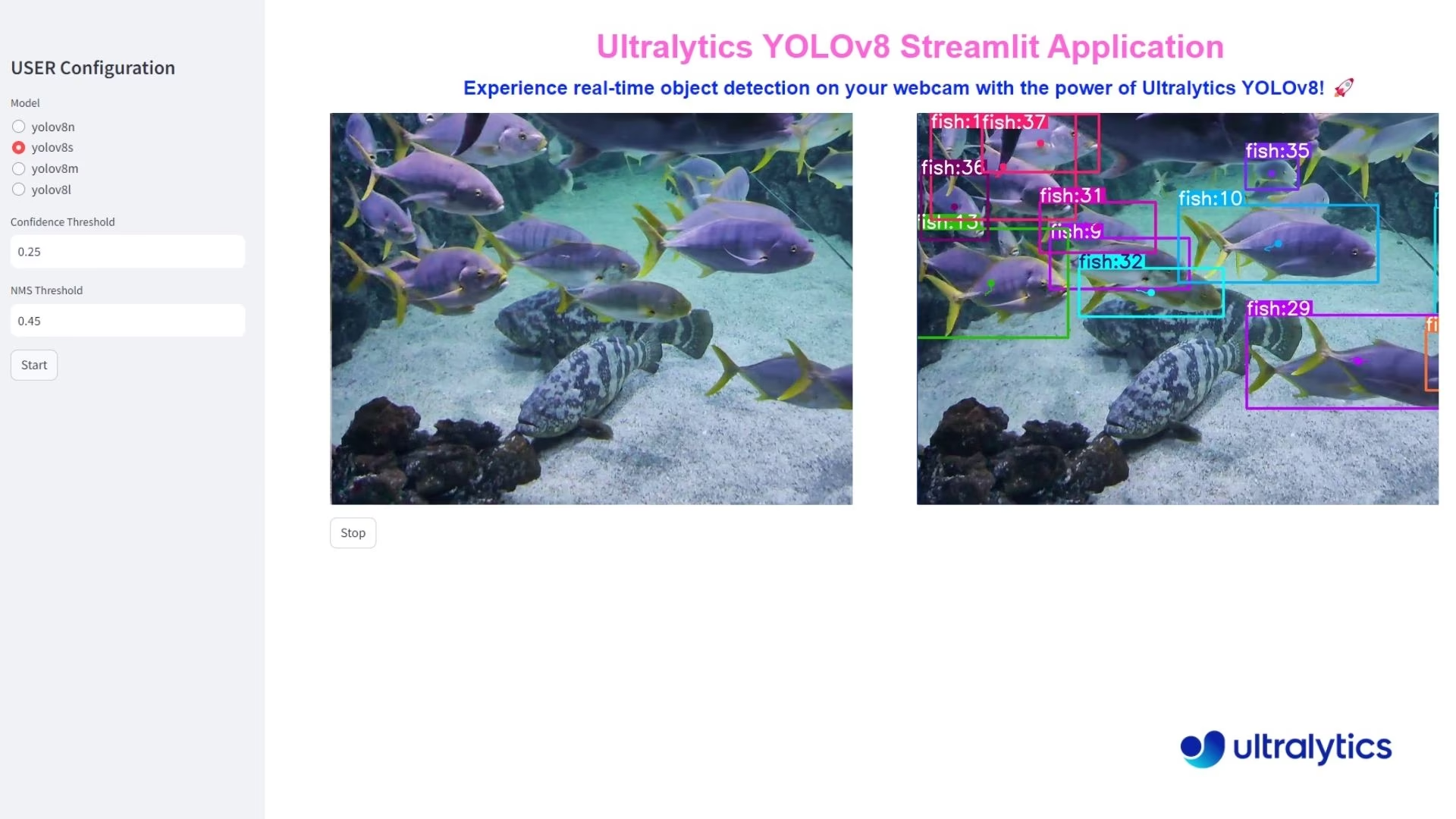 | 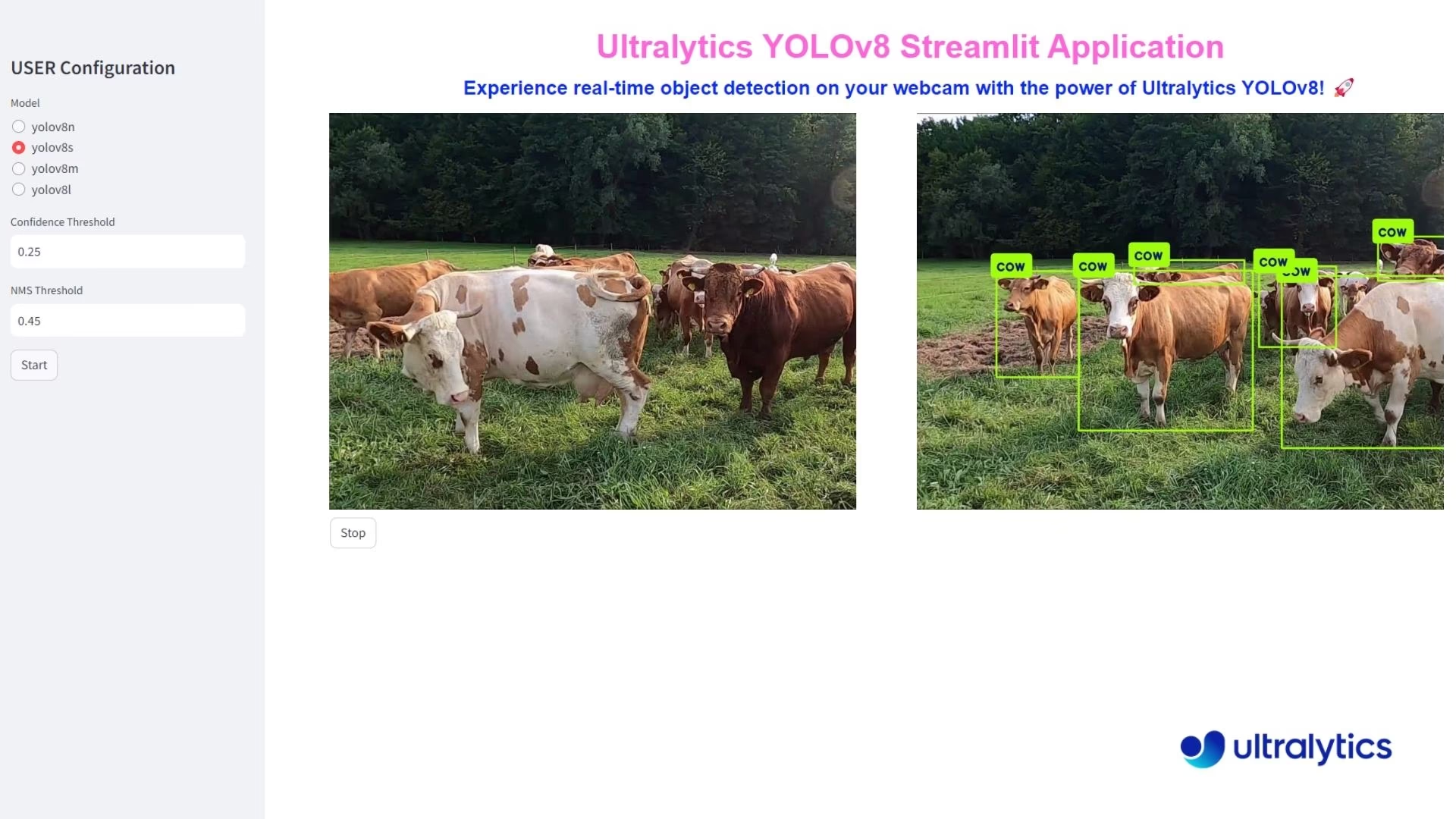 |
| Detecção de peixes usando Ultralytics YOLO26 | Detecção de animais usando Ultralytics YOLO26 |
Vantagens da inferência ao vivo#
- Detecção de objetos em tempo real: a combinação do Streamlit com o YOLO26 permite detectar objetos em tempo real diretamente da transmissão da webcam. Isso possibilita análises e insights imediatos, sendo ideal para aplicações que exigem resposta instantânea.
- Implantação fácil de usar: a interface interativa do Streamlit facilita a implantação e o uso da aplicação sem exigir conhecimentos técnicos avançados. Os usuários podem iniciar a inferência ao vivo com um simples clique, ampliando a acessibilidade e a facilidade de uso.
- Uso eficiente de recursos: os algoritmos otimizados do YOLO26 garantem processamento em alta velocidade com recursos computacionais mínimos. Essa eficiência permite inferência fluida e confiável com a webcam mesmo em hardware padrão, tornando a visão computacional avançada acessível a um público mais amplo.
Código da aplicação Streamlit#
Antes de começar a criar a aplicação, certifica-te de que tens o pacote Ultralytics Python instalado.
pip install ultralyticsyolo solutions inference
yolo solutions inference model="path/to/model.pt"
yolo solutions help # list the available solution commands and argumentsEstes comandos iniciam a interface padrão do Streamlit incluída no Ultralytics.
Isto inicia a aplicação Streamlit no teu navegador predefinido. Verás o título principal, o subtítulo e a barra lateral com opções de configuração. Seleciona o modelo YOLO26 pretendido, define os limiares de NMS e clica no botão "Start" para iniciar a deteção de objetos em tempo real.
Como funciona#
Nos bastidores, a aplicação Streamlit usa o módulo de soluções do Ultralytics para criar uma interface interativa. Quando inicias a inferência, a aplicação:
- Captura fotogramas da webcam, de um ficheiro de vídeo carregado ou de imagens carregadas
- Processa cada fotograma com o modelo YOLO26
- Aplica a deteção de objetos com os limiares de confiança e IoU especificados
- Exibe os quadros originais e os quadros anotados em tempo real
- Opcionalmente, ativa o rastreamento de objetos se essa opção estiver selecionada
A aplicação oferece uma interface simples e fácil de usar, com controlos para ajustar os parâmetros do modelo e iniciar/parar a inferência a qualquer momento.
Conclusão#
Seguindo este guia, você criou uma aplicação de detecção de objetos em tempo real usando Streamlit e Ultralytics YOLO26. A aplicação executa o YOLO26 na entrada da webcam, de um vídeo ou de uma imagem por meio de uma interface simples, e você pode interromper a transmissão a qualquer momento.
Para melhorar ainda mais a aplicação, podes explorar a adição de funcionalidades como gravar a transmissão de vídeo, guardar os fotogramas anotados ou integrar outras bibliotecas de visão computacional.
Perguntas frequentes#
Configurar uma aplicação de deteção de objetos em tempo real com Streamlit e Ultralytics YOLO26 é simples. Primeiro, certifica-te de que tens o pacote Ultralytics Python instalado usando:
pip install ultralyticsEm seguida, podes criar uma aplicação Streamlit básica para executar inferência em direto:
Aplicação Streamlitfrom ultralytics import solutions inf = solutions.Inference( model="yolo26n.pt", # podes usar qualquer modelo compatível com Ultralytics, por exemplo, YOLO26, ou um modelo treinado de forma personalizada ) inf.inference() # Certifica-te de que executas o ficheiro com o comando `streamlit run path/to/file.py`Para mais detalhes sobre a configuração prática, consulta a secção Código da aplicação Streamlit da documentação.
Usar Ultralytics YOLO26 com Streamlit para deteção de objetos em tempo real oferece várias vantagens:
- Detecção em tempo real: obtenha detecção de objetos de alta precisão em tempo real diretamente de transmissões de webcam.
- Interface fácil de usar: a interface intuitiva do Streamlit facilita a utilização e a implementação, sem exigir conhecimentos técnicos aprofundados.
- Eficiência de recursos: os algoritmos otimizados do YOLO26 garantem processamento de alta velocidade com o mínimo de recursos computacionais.
Sabe mais sobre estas vantagens na secção Vantagens da inferência em direto.
Depois de programares a aplicação Streamlit que integra Ultralytics YOLO26, podes implementá-la executando:
streamlit run path/to/file.pyEste comando iniciará o aplicativo no navegador padrão, permitindo selecionar modelos YOLO26, definir limites de confiança e IoU e iniciar a detecção de objetos em tempo real com um simples clique.
A deteção de objetos em tempo real com Streamlit e Ultralytics YOLO26 pode ser aplicada em vários setores:
- Segurança: monitorização em tempo real para detetar acessos não autorizados e sistemas de alarme de segurança.
- Retalho: contagem de clientes, gestão de prateleiras e rastreio de inventário.
- Vida selvagem e agricultura: monitorização de animais e das condições das culturas para iniciativas de conservação.
Para veres casos de utilização e exemplos mais detalhados, explora as soluções do Ultralytics.
O Ultralytics YOLO26 oferece várias melhorias em relação a modelos anteriores, como YOLOv5 e detectores da família R-CNN:
- Maior velocidade e precisão: desempenho melhorado para aplicações em tempo real.
- Facilidade de utilização: interfaces e implementação simplificadas.
- Eficiência de recursos: otimizado para maior velocidade com requisitos computacionais mínimos.


Comentários26
Faz uma pergunta, partilha os teus resultados ou ajuda alguém.
j3dd4h
the manual execution using rknn model (yolo predict model='./best_rknn_model' source='ppe.jpg') is working but got an error when running under Streamlit.
TypeError: model='best_rknn_model/best-rk3588.rknn' is not a supported model format. Ultralytics supports: ('PyTorch', 'TorchScript', 'ONNX', 'OpenVINO', 'TensorRT', 'CoreML', 'TensorFlow SavedModel', 'TensorFlow GraphDef', 'TensorFlow Lite', 'TensorFlow Edge TPU', 'TensorFlow.js', 'PaddlePaddle', 'MNN', 'NCNN', 'IMX', 'RKNN') See https://docs.ultralytics.com/modes/predict for help.
1RizwanMunawar
@j3dd4h Hi, thanks for sharing the details. We currently don't support the rknn model, but you can adjust this check in code to make the application work for rknn models. We will add support for this soon.
Ok, got it
@j3dd4h opened the Pull request here: https://github.com/ultralytics/ultralytics/pull/22212
NNQHuong
AttributeError: module 'torch' has no attribute '__version__' Traceback: File "C:\Users\myname\AppData\Local\Packages\PythonSoftwareFoundation.Python.3.11_qbz5n2kfra8p0\LocalCache\local-packages\Python311\site-packages\streamlit\runtime\scriptrunner\exec_code.py", line 88, in exec_func_with_error_handling result = func() ^^^^^^ File "C:\Users\myname\AppData\Local\Packages\PythonSoftwareFoundation.Python.3.11_qbz5n2kfra8p0\LocalCache\local-packages\Python311\site-packages\streamlit\runtime\scriptrunner\script_runner.py", line 579, in code_to_exec exec(code, module.__dict__) File "C:\WasteSegregation\app.py", line 1, in <module> from ultralytics import solutions File "C:\Users\myname\AppData\Local\Packages\PythonSoftwareFoundation.Python.3.11_qbz5n2kfra8p0\LocalCache\local-packages\Python311\site-packages\ultralytics\__init__.py", line 11, in <module> from ultralytics.models import NAS, RTDETR, SAM, YOLO, FastSAM, YOLOWorld File "C:\Users\myname\AppData\Local\Packages\PythonSoftwareFoundation.Python.3.11_qbz5n2kfra8p0\LocalCache\local-packages\Python311\site-packages\ultralytics\models\__init__.py", line 3, in <module> from .fastsam import FastSAM File "C:\Users\myname\AppData\Local\Packages\PythonSoftwareFoundation.Python.3.11_qbz5n2kfra8p0\LocalCache\local-packages\Python311\site-packages\ultralytics\models\fastsam\__init__.py", line 3, in <module> from .model import FastSAM File "C:\Users\myname\AppData\Local\Packages\PythonSoftwareFoundation.Python.3.11_qbz5n2kfra8p0\LocalCache\local-packages\Python311\site-packages\ultralytics\models\fastsam\model.py", line 5, in <module> from ultralytics.engine.model import Model File "C:\Users\myname\AppData\Local\Packages\PythonSoftwareFoundation.Python.3.11_qbz5n2kfra8p0\LocalCache\local-packages\Python311\site-packages\ultralytics\engine\model.py", line 11, in <module> from ultralytics.cfg import TASK2DATA, get_cfg, get_save_dir File "C:\Users\myname\AppData\Local\Packages\PythonSoftwareFoundation.Python.3.11_qbz5n2kfra8p0\LocalCache\local-packages\Python311\site-packages\ultralytics\cfg\__init__.py", line 12, in <module> from ultralytics.utils import ( File "C:\Users\myname\AppData\Local\Packages\PythonSoftwareFoundation.Python.3.11_qbz5n2kfra8p0\LocalCache\local-packages\Python311\site-packages\ultralytics\utils\__init__.py", line 51, in <module> TORCH_VERSION = torch.__version__ ^^^^^^^^^^^^^^^^^This is the error I encountered when usingfrom ultralytics import solutionssolutions.inference(model =r'C:path\to\my\model.pt')method (VSCode), can you please explain it to me? For further information, I've tried using the method for CLI and it works, but not with VSCode. I wonder if there's any method for CLI that allows me to use my custom trained model? It's YOLO11n-cls version. Thank you for reading this!1 Glenn JocherUltralytics
@NNQHuong the error you're encountering suggests a possible issue with your PyTorch installation. Please verify that PyTorch is properly installed and compatible with your Python version by running:
import torch
print(torch.__version__)
If the error persists, ensure you're using the latest version of PyTorch and Ultralytics with:
pip install --upgrade torch ultralyticsRegarding your CLI query, you can use your custom-trained YOLO11 model by specifying the model path directly, like so:
yolo predict model=path/to/your/model.pt source=your_inputFor detailed examples, check the documentation here. Let me know if additional assistance is required!
2Hi @NNQHuong, thank you for sharing the error log! It appears that the issue might be related to your PyTorch version. You may need to upgrade or downgrade it to ensure everything works correctly.
However, if this still doesn't resolve the issue, please share your code here for further testing.
Thanks, Ultralytics Team!
1Thanks for your infomative reply, it worked smoothly! I'm kind of new to this field anyway, about 6 months , I bet you can see it in my words haha, so thanks for your patience too!
1
Tech-Watt
Is it posible to use different camera index ?. It picks up the default computer webcam and there's no means of changing it.
- Glenn JocherUltralytics(editado)
The
Inferenceclass has nosourceargument: selecting "webcam" in the sidebar always opens camera index0(self.vid_file_name = 0inultralytics/solutions/streamlit_inference.py). To use a different camera, make it your system's default camera or change that index in the file:inf = solutions.Inference(model="yolo26n.pt") inf.inference()Run it with
streamlit run <file-name.py>.
Vectorvin
streamlit 这个解决方案可以使用tensorRT格式或者onnx格式吗?似乎程序被写死了
- Glenn JocherUltralytics(editado)
@Vectorvin 您好!Streamlit 方案现在也支持导出的模型格式:除了
.pt,还可以把.onnx、.torchscript、.mlpackage、.engine(TensorRT)、OpenVINO 或 RKNN 模型路径传给solutions.Inference(model="yolo26n.engine")。导出步骤请参考导出文档。需要企业级部署支持请访问ultralytics.com/license。
sathyanarayanaRP
how does the streamlit gets is input , is it possible to push frames or is it possible to integrate machine vision cameras that does not support RTSP protocals. i need comprehensive knowledge how does it work as a streaming device
- Glenn JocherUltralytics
@sathyanarayanaRP streamlit can receive input directly from a webcam or video file. For cameras that don't support RTSP, you can use USB or other compatible connections. The Streamlit app processes frames in real-time, allowing for seamless integration with various camera types. For more details, please refer to the Streamlit documentation.
Cheikh-Ahmedand
hey!
Once I run the app my Laptop camera turns on, instead of My webcam. How to use my external webcam instead of my LAPTOP camera?
Best Regards!
- Glenn JocherUltralytics(editado)
@Cheikh-Ahmedand the Streamlit app has no
sourceargument: choosing "webcam" in the sidebar always opens camera index0(self.vid_file_name = 0inultralytics/solutions/streamlit_inference.py). To use your external webcam, make it the system's default camera, or change that index to1(or the index of your webcam) in the file.Run the app with
yolo solutions inference, or withstreamlit run <file-name.py>for your own script. Hey ! Thanks lot for your response, but the code couldn't work with streamlit code. I pasted the following code on my Laptop anconda PowerShell Prompt:
yolo streamlit-predict solutions.inference(source=1)
Still, my Webcam can't run, but my Laptop 's Camera.
Also, I tried the below code in jupyter notebook, but the problem still persists.
from ultralytics import solutions
solutions.inference() solutions.inference(source=1)
Make sure to run the file using command
streamlit run <file-name.py>Any help either from the Respectful Staff or others would be appreciated!!!
- Glenn JocherUltralytics(editado)
@Cheikh-Ahmedand the Streamlit app has no
sourceargument: choosing "webcam" in the sidebar always opens camera index0(self.vid_file_name = 0inultralytics/solutions/streamlit_inference.py). To use an external webcam, set it as your system's default camera or change that index in the file. Run the app withyolo solutions inference, orstreamlit run <file-name.py>for your own script. If issues persist, please check your system's camera settings.
AdadAlShabab
Can you please provide the stramlit .py file that we need to run?
- Glenn JocherUltralytics(editado)
@AdadAlShabab you can use the following code to run the Streamlit application for live inference:
from ultralytics import solutions

inf = solutions.Inference(model="yolo26n.pt")
inf.inference()
Run the file with the command
streamlit run <file-name.py>. For more details, please refer to the Streamlit Live Inference Guide.
ghost
Thank you for your quick and kind response and the problem is sorted. But there is another issue while switching model to different task like pose,seg or cls and getting error of open cv not having func()
- Glenn JocherUltralytics
@Charan2128 i'm glad to hear the initial issue is resolved. Regarding the error with OpenCV when switching tasks (pose, seg, cls), please ensure you have the latest versions of both the Ultralytics package and OpenCV. You can update them using:
pip install --upgrade ultralytics opencv-pythonIf the issue persists, please provide more details about the error message and the specific function that is causing the problem. This will help us diagnose and address the issue more effectively. For further guidance, you can also refer to our Streamlit Live Inference Guide.
That was a Quick Replay and Quick fix ,Thanks for your kind support on my issues. The problem is fixed now.
- Glenn JocherUltralytics
@Charan2128 i'm glad to hear the initial issue is resolved. For the new issue with switching tasks and encountering OpenCV errors, please ensure you have the latest versions of both the Ultralytics package and OpenCV installed. You can update them using
pip install --upgrade ultralytics opencv-python. If the problem persists, please provide the specific error message and function causing the issue so we can assist you further. For more detailed guidance, you can refer to our Streamlit Live Inference Guide.
AttributeError: module 'ultralytics.solutions' has no attribute 'inference' Traceback: File "C:\Users\DELL\AppData\Local\Programs\Python\Python312\Lib\site-packages\streamlit\runtime\scriptrunner\exec_code.py", line 75, in exec_func_with_error_handling result = func() ^^^^^^ File "C:\Users\DELL\AppData\Local\Programs\Python\Python312\Lib\site-packages\streamlit\runtime\scriptrunner\script_runner.py", line 574, in code_to_exec exec(code, module.dict) File "D:\YOLO\infer.py", line 3, in solutions.inference() ^^^^^^^^^^^^^^^^^^^ This is the error im getting while running this and i have installed necessary packages.
 Paula DerrengerUltralytics(editado)
@Charan2128 it looks like you're encountering an
AttributeErrorbecausesolutions.inferenceis not an attribute of theultralytics.solutionsmodule. Please ensure you are using the latest version of the Ultralytics package by runningpip install --upgrade ultralytics. Then launch the Streamlit app directly from the CLI withyolo solutions inference, or from Python withsolutions.Inference(model="yolo26n.pt").inference()run viastreamlit run <file-name.py>. For more details, you can refer to our Streamlit Live Inference Guide.