使用 Ultralytics YOLO26 进行速度估算
什么是速度估算?#
速度估计是指在特定场景中计算对象的运动速率,常用于计算机视觉应用。借助 Ultralytics YOLO26,你可以结合目标跟踪、距离和时间数据计算对象速度,这对于交通监控和监视等任务很有用。
观看: 使用 Ultralytics YOLO26 进行速度估计
速度估算的优势#
- 高效交通管控:准确估算速度有助于管理交通流、提高安全性并减少道路拥堵。
- 精准自主导航:在自动驾驶汽车等自主系统中,可靠的速度估算可确保车辆安全、准确地导航。
- 提升安防监控能力:在监控分析中,速度估算有助于识别异常行为或潜在威胁,从而提高安防措施的有效性。
实际应用#
| 交通运输 | 交通运输 |
|---|---|
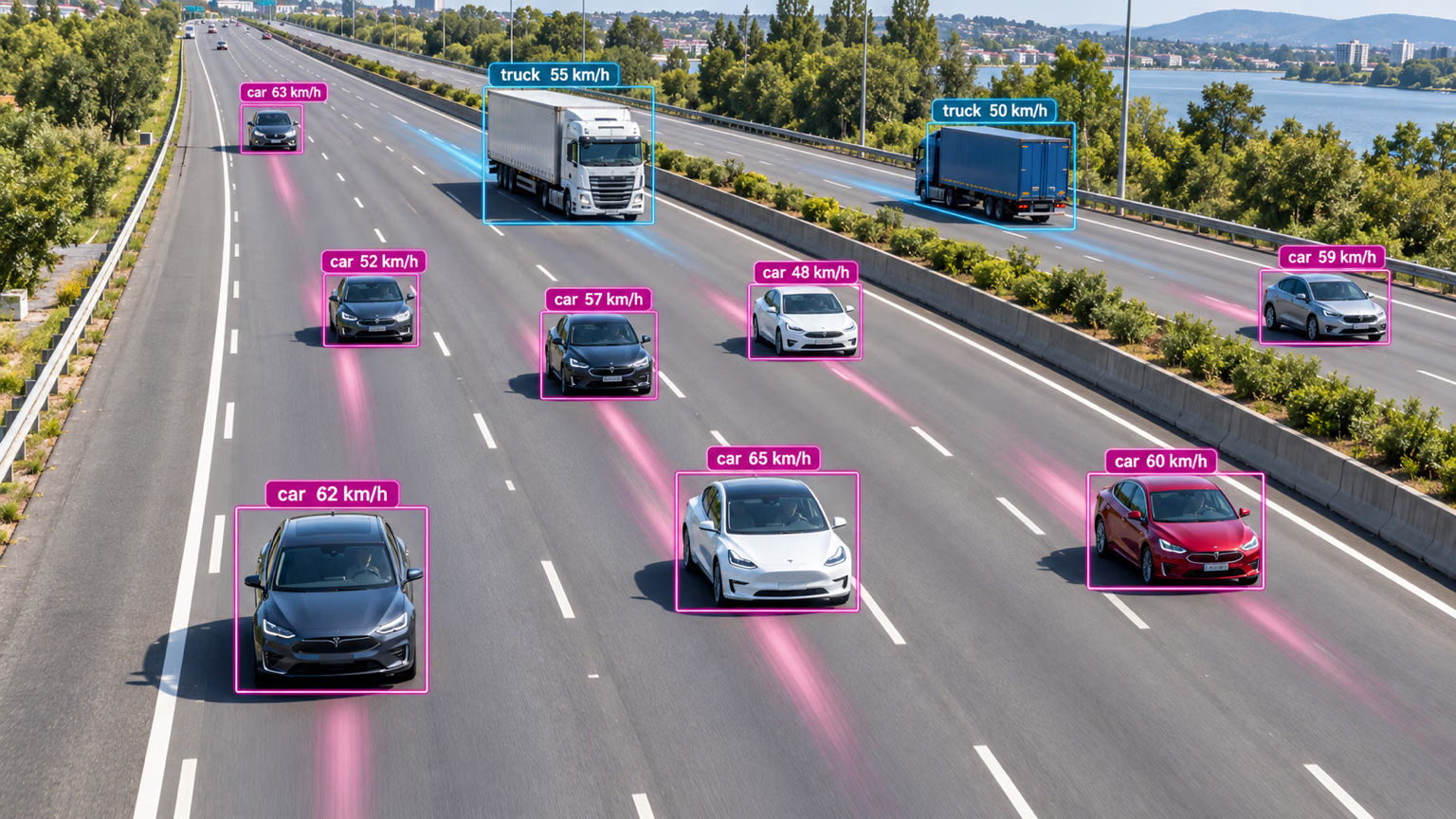 | 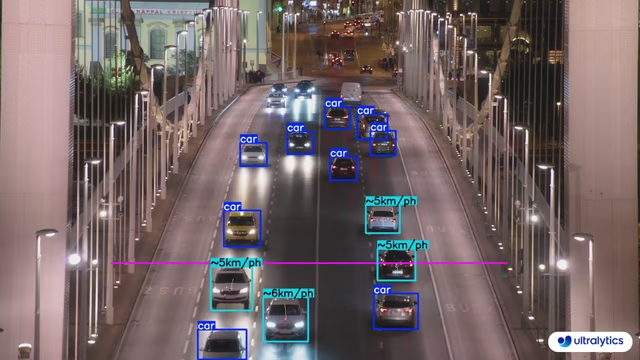 |
| 使用 Ultralytics YOLO26 在道路上进行速度估算 | 使用 Ultralytics YOLO26 在桥梁上进行速度估算 |
速度只是估算值
速度是估算值,可能并不完全准确。结果还会受到摄像头规格及相关因素的影响。
使用 YOLO26 估算速度#
SpeedEstimator 解决方案会跨帧跟踪每个物体,并利用视频帧率(fps)和现实世界比例(meter_per_pixel),将像素位移转换为速度。根据你的摄像头设置调整 meter_per_pixel,并使用 max_speed 剔除噪声跟踪结果中的异常值。
# Run a speed example
yolo solutions speed show=True

# Pass a source video
yolo solutions speed source="path/to/video.mp4"

# Adjust meter per pixel value based on camera configuration
yolo solutions speed meter_per_pixel=0.05
SpeedEstimator 参数#
下面是 SpeedEstimator 参数表:
| 参数 | 类型 | 默认值 | 说明 |
|---|---|---|---|
model | str | None | Ultralytics YOLO 模型文件的路径。 |
fps | float | 30.0 | 用于速度计算的每秒帧数。 |
max_hist | int | 5 | 每个对象用于速度/方向计算的最大历史跟踪点数。 |
meter_per_pixel | float | 0.05 | 用于将像素距离转换为实际单位的缩放系数。 |
max_speed | int | 120 | 最高速度(km/h);估算速度超过此值时将按此值封顶。 |
line_width | int | 2 | 解决方案绘制的框、关键点和计数的线条粗细。 |
verbose | bool | True | 启用逐帧日志,记录输入形状、类别计数和处理速度。跟踪调用本身始终不会输出日志。 |
SpeedEstimator 解决方案支持使用 track 参数:
| 参数 | 类型 | 默认值 | 说明 |
|---|---|---|---|
tracker | str | 'tracktrack.yaml' | 指定要使用的跟踪算法。内置选项:botsort.yaml、bytetrack.yaml、ocsort.yaml、deepocsort.yaml、fasttrack.yaml、tracktrack.yaml。 |
conf | float | 0.25 | 设置检测的置信度阈值;较低的值允许跟踪更多物体,但可能会包含误检。 |
iou | float | 0.5 | 设置用于筛除重叠检测结果的交并比 (IoU) 阈值。 |
classes | list | None | 按类别索引筛选结果。例如,classes=[0, 2, 3] 只跟踪指定类别。 |
device | str | None | 指定推理设备(例如 cpu、cuda:0 或 0)。用户可以选择 CPU、特定 GPU 或其他计算设备来运行模型。 |
imgsz | int or tuple | 640 | 目标推理图像尺寸:正方形图像使用整数,或使用 (height, width) 对。图像尺寸会调整为模型步幅的整数倍。 |
max_det | int | 300 | 跟踪前每帧保留的最大检测数量,用于限制解决方案在密集场景中处理的物体数量。 |
quantize | int or str | None | 推理精度:对于非 CPU 上运行的 PyTorch 和 TorchScript 模型,使用 16 (FP16) 或 32/unset (FP32) 进行选择;其他格式使用其模型文件和运行时所选的精度。此参数替代已弃用的 half 参数。 |
此外,还支持以下可视化选项:
| 参数 | 类型 | 默认值 | 说明 |
|---|---|---|---|
show | bool | False | 如果 True,则在窗口中显示带标注的图像或视频。适用于在开发或测试期间即时查看结果。 |
show_labels | bool | True | 在可视化输出中显示每个检测结果的标签,便于立即了解检测到的对象。 |
常见问题#
使用 Ultralytics YOLO26 进行速度估算的准确度取决于多种因素,包括目标跟踪质量、视频分辨率和帧率,以及环境变量。速度估算器能提供可靠的估算结果,但由于帧处理速度变化和物体遮挡,结果可能无法达到 100% 准确。
注意:请始终考虑误差范围,并尽可能使用真实标注数据验证估算结果。


评论109
提出问题、分享结果,或帮助其他人。
zwxdlut
For estimating the speed of passing through a region, I set the "region" parameter while initializing the speed estimator , as follow:
region_points = [(20, int(h / 2)), (w - 20, int(h / 2))]                      # line points
# Initialize speed estimation object
speedestimator = solutions.SpeedEstimator(
    show=True,  # display the output
    model="runs/detect/train/weights/best.pt",  # path to the model file
    fps=fps,  # adjust speed based on frame per second
    # max_speed=120,  # cap speed to a max value (km/h) to avoid outliers
    # max_hist=5,  # minimum frames object tracked before computing speed
    # meter_per_pixel=0.05,  # highly depends on the camera configuration
    classes=[3, 4, 5],  # estimate speed of specific classes.
    # line_width=2,  # adjust the line width for bounding boxes
    region=region_points,
)
```python

The model was customized trained with the VisDrone dataset.
The speed estimator estimates each object speed whether it is within the region or not. The parameter "region" doesn't take effect at all.

Has the function "estimating speed in regions" not been implemented yet?
t47352
I keep getting this error, whether I use reg_pts or line_pts to define the crossing line:
"ValueError: reg_pts is not a valid solution argument"
I was initially using Yolo11 with the code in the "Speed Estimation using Ultralytics YOLO" section on this webpage. Then I noticed that the Youtube video on the webpage was with Yolo8, so I changed the model to yolov8m.pt. Everything works with either model as long as I don't add "reg_points" or "line_pts".
So I tried to use "region=[(200,0), (200,720)]" instead but that didn't seem to do anything. My goal here is to only record speeds of people moving through a certain area/region of the video, not the speed of everyone in the frame. Could this be achieved?
(FYI, I do not know how to code at all... I've just been copy/pasting things together and then getting Gemini to help me fix stuff where it can.) Thank you!
 Glenn JocherUltralytics
@t47352
reg_pts/line_ptsaren’t valid for YOLO11’ssolutions.SpeedEstimator; use the documented args (model,fps,meter_per_pixel, etc.) and call it directly, then read per-ID speeds fromspeed.spdas shown in the guide and API reference.import cv2, numpy as np from ultralytics import solutions cap = cv2.VideoCapture("video.mp4") fps = cap.get(cv2.CAP_PROP_FPS) speed = solutions.SpeedEstimator(model="yolo11n.pt", fps=fps, meter_per_pixel=0.05, show=True) # Optional ROI filter (only keep speeds for boxes whose centroid is inside this polygon) roi = np.array([(200,0),(200,720),(400,720),(400,0)], dtype=np.int32) while cap.isOpened(): ok, im0 = cap.read() if not ok: break res = speed(im0) # processes and annotates frame speeds_in_roi = {} for box, tid in zip(speed.boxes, speed.track_ids): # xyxy and track ids from last frame x1,y1,x2,y2 = map(float, box) cx, cy = (x1+x2)/2, (y1+y2)/2 if cv2.pointPolygonTest(roi, (cx, cy), False) >= 0 and tid in speed.spd: speeds_in_roi[tid] = speed.spd[tid] # km/h for objects in your area- CLI (no ROI filtering):
yolo solutions speed source="video.mp4" model=yolo11n.pt meter_per_pixel=0.05 show=TrueFor supported arguments and examples see the Speed Estimation guide and the SpeedEstimator API reference: Speed Estimation using Ultralytics YOLO11 and SpeedEstimator class reference. If an error persists, please share the exact command and the output of
yolo checks.
greviewer-edt
Buen día, podrias compartir por favor los link de los videos que estan en este articulo porfa
NawzH
If I were to provide a live video feed from a moving vehicle, with the camera facing out the front window, could the speed estimator track the speeds of vehicles approaching and receding?
I understand this is possible with a stationary setup, but I am curious if the system can handle the added complexity of movement from the capturing vehicle itself?
- Glenn JocherUltralytics
@NawzH the current Ultralytics YOLO11 Speed Estimator assumes a stationary camera setup for accurate speed estimation. For a moving vehicle, additional considerations such as compensating for the camera's motion using GPS or IMU data would be required. This functionality is not natively supported in our implementation but could potentially be developed with custom modifications.
Hello Glenn, thank you for your response. I plan to use an OBD reader to capture the speed of the recording vehicle and am also now considering incorporating GPS data to aid in the estimation process.
Since I am exploring the route of custom modifications, could you kindly point me to any guidance or documentation that might assist with integrating GPS and OBD data into the YOLO speed estimator? Any advice or resources would be greatly appreciated!
- Glenn JocherUltralytics
Thank you for your interest! While we don't have direct documentation on integrating GPS and OBD data into the YOLO speed estimator, a possible approach would involve synchronizing GPS/OBD speed data with object tracking outputs to adjust for the capturing vehicle's motion. You may start by modifying the
SpeedEstimatorclass inultralytics/solutions/speed_estimation.pyto incorporate this additional data.
SourceOfNootmite
Hi how can I use this for other objects of interest like people, trains, animals, etc. Thanks.
- Glenn JocherUltralytics
@SourceOfNootmite to use speed estimation for other objects like people, trains, or animals, you can specify the desired object classes by setting the
classesargument in theSpeedEstimator. For example,classes=[0]for people orclasses=[1, 2]for specific vehicles. Refer to Speed Estimation Documentation for detailed examples. Let me know if you need further clarification!
1024-Zhang
Hello, I want to get the speed of each vehicle detected in the speed estimation method and write the vehicle ID and corresponding speed into a csv file. The speed written in the code below is not the speed of each vehicle detected, but the time taken to reason without a frame in the video. I'm using version 8.1.0 of YOLO.
speeds = [] tracks = model.track(im0, persist=True, show=False) for track in tracks: speed = speed_obj.estimate_speed(im0, track) if speed is not None: speeds.append(track.speed) im0 = speed_obj.estimate_speed(im0, tracks) video_writer.write(im0)
- Glenn JocherUltralytics(已编辑)
@1024-Zhang to write the detected vehicle ID and speed into a CSV file, use the speeds returned by the current
SpeedEstimatorinresults.speed_dict({track_id: km/h}) after each frame:import csv import time with open("speeds.csv", "w", newline="") as f: writer = csv.writer(f) writer.writerow(["timestamp", "id", "speed_kmh"]) # inside your frame loop results = speed_obj(im0) for track_id, speed in results.speed_dict.items(): writer.writerow([time.time(), track_id, speed])See the Speed Estimation guide for the full setup. Let me know if you need further clarification!
samkitshah18
I believe for the code provided in the guide, we get object speed once it enters the region which is not updated further. For my use case, I have a video of a road with cars and for all the cars in the video I want to continuously track/detect speed throughout the video. Is this feasible using solutions.SpeedEstimator ? If yes, can you provide the code snippet/idea behind this ?
- Glenn JocherUltralytics(已编辑)
@samkitshah18 the current
solutions.SpeedEstimatorcomputes each tracked object's speed once it has been tracked formax_histframes, then keeps that speed for the object's ID rather than updating it continuously. If you need continuously updated speeds, you can modify theSpeedEstimatorsource (ultralytics/solutions/speed_estimation.py) to not lock IDs, or compute speeds yourself from the track history. Keeppersist=Truetracking so IDs stay consistent. See the Speed Estimation guide for the current arguments. Let us know if you need further clarification! Thank you for your response ! I tried to implement it.
My code:
from ultralytics.solutions import speed_estimation import cv2 model = YOLO("yolo11n.pt") video_path = 'Path' cap = cv2.VideoCapture(video_path) assert cap.isOpened(), "Error opening video file" fps = int(cap.get(cv2.CAP_PROP_FPS)) w, h = (int(cap.get(cv2.CAP_PROP_FRAME_WIDTH)), int(cap.get(cv2.CAP_PROP_FRAME_HEIGHT))) video_writer = cv2.VideoWriter("speed_estimation8.mp4", cv2.VideoWriter_fourcc(*"mp4v"), fps, (w, h)) speed_obj = speed_estimation.SpeedEstimator( region=[(0, 0), (w, 0), (w, h), (0, h)], names=model.names, show=True, ) object_speeds = {} while cap.isOpened(): success, img = cap.read() if not success: break tracks = model.track(img, persist=True, show=True, tracker="bytetrack.yaml") if tracks is not None: updated_tracks = [] for track in tracks: obj_id = track.id if hasattr(track, 'id') else None if obj_id is not None: if obj_id not in object_speeds: object_speeds[obj_id] = [] if hasattr(track, 'speed'): object_speeds[obj_id].append(track.speed) updated_tracks.append(track) img = speed_obj.estimate_speed(img) video_writer.write(img) cap.release() video_writer.release() cv2.destroyAllWindows()``` Now it detects 0 speed for all the cars even though it tracks and detects cars. After Speed Detection: https://streamable.com/67n3f4 Can you please point me what am I missing here ?- Glenn JocherUltralytics(已编辑)
The current
SpeedEstimatorno longer has areg_ptsargument or a speed region: it estimates the speed of every tracked object across the whole frame, so you don't need to define one. If speeds look wrong, checkfps,meter_per_pixelandmax_histagainst the Speed Estimation guide, and make sure tracking IDs are consistent. Let me know how it goes! Thank you ! In my use case, I've several videos from varied camera angles so defining the
reg_ptsis not feasible and I want to track the objects in the entire video and not just a region. Even when I try to narrow down the region, using thepersist=Truein the above code does not update the speed of vehicles in the above code. Can you please provide any suggestions on how to resolve this ?- Glenn JocherUltralytics(已编辑)
@samkitshah18 the current
SpeedEstimatoralready tracks speeds across the entire frame without a region, andreg_ptsis no longer an argument, so there is nothing to disable. If the speed doesn't update, note that each object's speed is calculated after it has been tracked formax_histframes and then kept for that ID. Verify that frame-to-frame object IDs are consistent, and tunemeter_per_pixelandfpsfor your video. Let us know if you have further issues!
moshiour
Hi,
I would like to write speed using label box. However, the above script for speed estimation does not work. Even, I have already updated yolo11. Please check the above script in examples and here in discussion not same at all.
In the example above no tracking : speed_obj = solutions.SpeedEstimator( region=[(0, 360), (1280, 360)], model="yolo11n.pt", show=True, )
while cap.isOpened(): success, im0 = cap.read() if not success: break im0 = speed_obj.estimate_speed(im0) video_writer.write(im0)
And in the discussion:
Init speed-estimation obj
speed_obj = solutions.SpeedEstimator( reg_pts=line_pts, names=names, view_img=True, )
while cap.isOpened(): success, im0 = cap.read() if not success: print("Video frame is empty or video processing has been successfully completed.") break
tracks = model.track(im0, persist=True, show=False)

im0 = speed_obj.estimate_speed(im0, tracks)
video_writer.write(im0)
==============================================
Thank you in advance!
- Glenn JocherUltralytics
@moshiour thank you for your comment. It seems there might be a discrepancy between the examples. Please ensure you're using the correct tracking setup as shown in the discussion. For detailed guidance, refer to our speed estimation documentation at https://docs.ultralytics.com/guides/speed-estimation/. If you have further questions, feel free to ask here.
@glenn-jocher Thanks for clearification!
hardslugger
Hi! I am very glad that you introduced Yolov11 speed estimation module. I am very excited to start working with it. I have a question: Can I estimate speed of the vehicle without drawing the horizontal or vertical line? I am working on speed estimation of vehicles from the images captured by a camera mounted on an autonomous vehicle. Let me know how I can work this out?
- Glenn JocherUltralytics(已编辑)
@hardslugger yes, the current
SpeedEstimatordoesn't require you to draw lines or regions:reg_ptsis no longer an argument. It estimates the speed of every tracked object in the frame, so just setfpsand ameter_per_pixelscale that fits your camera's perspective. For more details, visit our speed estimation guide.
eps1lonline(已编辑)
Hi everyone, how can i add to array the speed of the car that passed the line? here is the code
import os import cv2 import time from ultralytics import YOLO, solutions # Запуск таймера start_time = time.time() # Путь, где будет сохранятся файл current_directory = os.getcwd() print("The resulting file is saved to the path:", current_directory) # Загрузка модели YOLOv8 model = YOLO("yolov8n.pt") names = model.model.names # Открытие видеофайла videoFile = "car7.mp4" cap = cv2.VideoCapture(videoFile) assert cap.isOpened(), "Error reading video file" w, h, fps = (int(cap.get(x)) for x in ( cv2.CAP_PROP_FRAME_WIDTH, cv2.CAP_PROP_FRAME_HEIGHT, cv2.CAP_PROP_FPS)) # Инициализация видеописателя video_writer = cv2.VideoWriter( "speed_estimation.avi", cv2.VideoWriter_fourcc(*"mp4v"), fps, (w, h)) # Определение линии line_pts = [(0, int(h/2)), (int(w), int(h/2))] # Инициализация объекта оценки скорости speed_obj = solutions.SpeedEstimator(reg_pts=line_pts, names=names, view_img=True,) speeds = [] while cap.isOpened(): success, im0 = cap.read() if not success: break tracks = model.track(im0, persist=True, show=False) im0 = speed_obj.estimate_speed(im0, tracks) video_writer.write(im0) print(speed_obj.spdl) # Освобождение ресурсов cap.release() video_writer.release() cv2.destroyAllWindows() # Время работы программы end_time = time.time() execution_time = end_time - start_time print("Program running time:", int(execution_time//60), " min ", int(execution_time%60), " sec")- Glenn JocherUltralytics(已编辑)
@eps1lonline to add the speed of the car to an array, use the speeds returned by the current
SpeedEstimatorinresults.speed_dict({track_id: km/h}). Here's a minimal example:speeds = {} while cap.isOpened(): success, im0 = cap.read() if not success: break results = speed_obj(im0) speeds.update(results.speed_dict) # last known speed per track ID video_writer.write(results.plot_im) print(list(speeds.values()))This stores one speed per tracked car.
-1 @glenn-jocher, good day.
I wanted to know the speed of each car in km/h and put it in an array, but after looking at the code, I realized that this is not necessary, because all the speeds of cars can be obtained by accessing the Speed_obj object like this: Speed_obj.spd, we get a dictionary, where the index is the car number, and the value is the speed itself.
Now I have a couple of other questions:
-
For movement, we use the formula: U=S/t, where U is the speed of the car; S is the distance traveled by the car; t is time. My object: Speed_obj stores the coordinates along which each car moved, in order to get these coordinates, we must access the object like this: Speed_obj.trk_history. The distance itself is the Euclidean distance, i.e. we find the distance from the starting point to the next point, from this point to another point and so on until we reach the final one. So here's the question, I got that the distance = 600 pixels, how does your model convert pixels into meters, kilometers in order to calculate the speed?
-
What is Speed_obj.spdl, it stores an array of several dozens that are constantly changing (10, 10, 10, 10, 10, 10...)
Thank you for your attention!
-
- Glenn JocherUltralytics(已编辑)
@eps1lonline 1. The solution uses a calibration factor,
meter_per_pixel, to convert pixels to real-world meters. You'll need to measure a known distance in the video to set this factor accurately.speed_obj.spdlbelonged to an older version and no longer exists. In the currentSpeedEstimator, the speeds are returned inresults.speed_dict({track_id: km/h}) each time you call it on a frame. See the speed estimation guide for details.