Inférence en direct avec une application Streamlit utilisant Ultralytics YOLO26
Introduction#
Streamlit facilite la création et le déploiement d’applications web interactives. En l’associant à Ultralytics YOLO26, tu peux effectuer la détection d’objets et l’analyse en temps réel directement dans ton navigateur. La vitesse et la précision de YOLO26 le rendent adapté aux flux vidéo en direct dans des applications comme la sécurité et le commerce de détail.
Regarder : Comment créer une application d’inférence en direct avec Ultralytics YOLO26 et Streamlit | Détection et segmentation 🚀
| Aquaculture | Élevage |
|---|---|
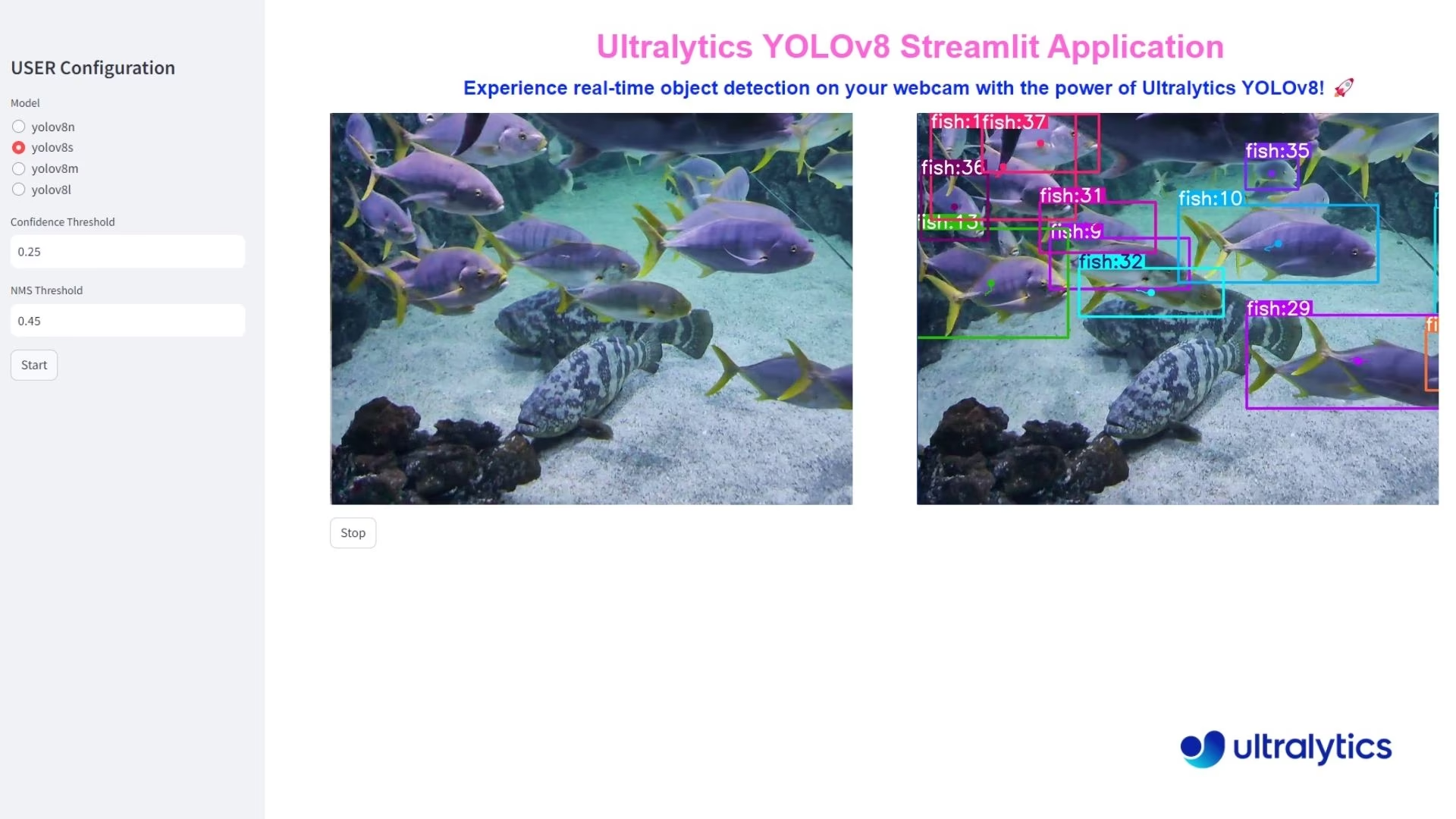 | 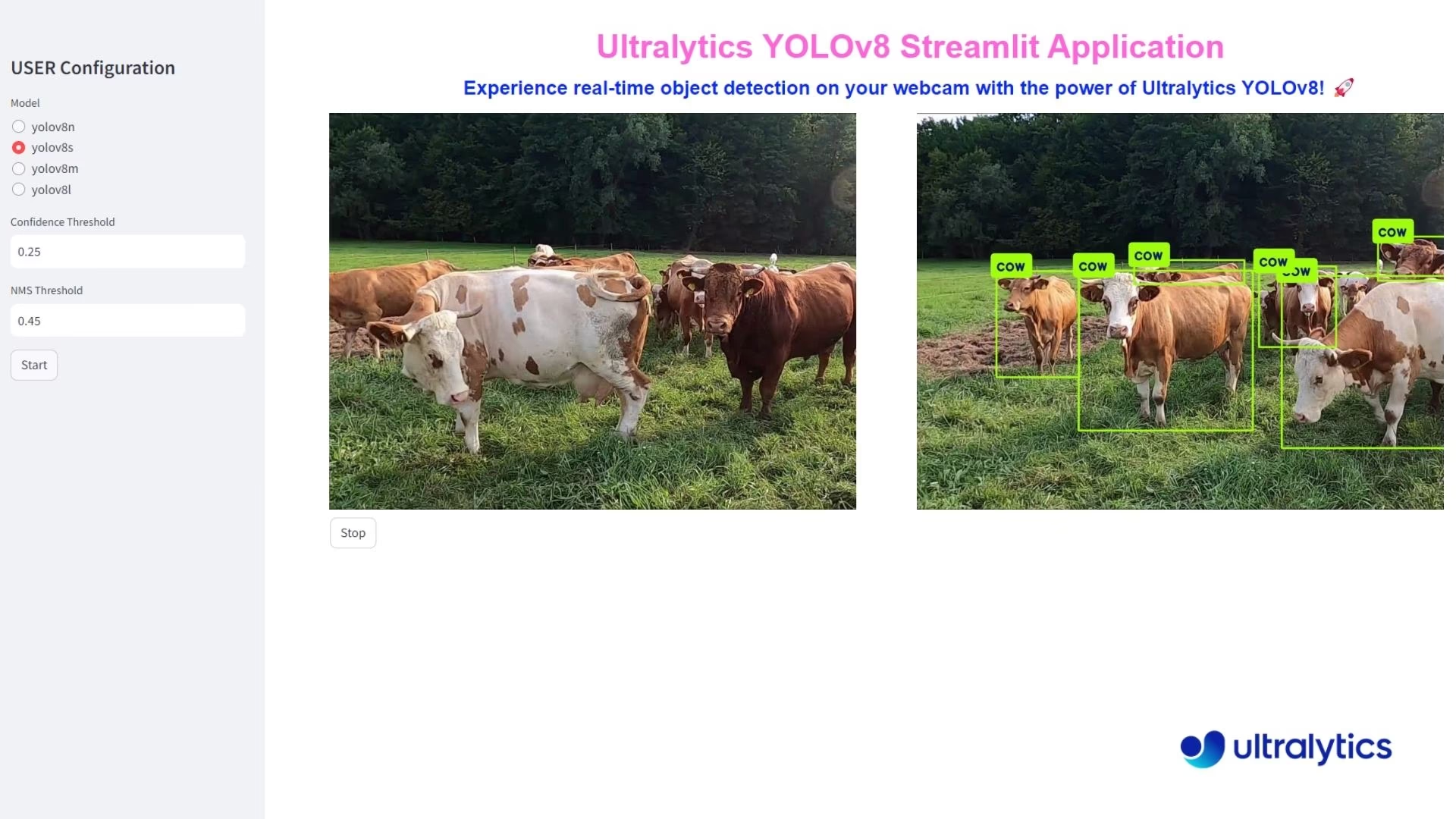 |
| Détection de poissons avec Ultralytics YOLO26 | Détection d’animaux avec Ultralytics YOLO26 |
Avantages de l’inférence en direct#
- Détection d’objets en temps réel : l’association de Streamlit et de YOLO26 permet de détecter des objets en temps réel directement à partir du flux de ta webcam. Tu peux ainsi obtenir immédiatement des analyses et des informations, ce qui est idéal pour les applications nécessitant un retour instantané.
- Déploiement convivial : l’interface interactive de Streamlit facilite le déploiement et l’utilisation de l’application sans connaissances techniques approfondies. Les utilisateurs peuvent démarrer l’inférence en direct d’un simple clic, ce qui améliore l’accessibilité et la facilité d’utilisation.
- Utilisation efficace des ressources : les algorithmes optimisés de YOLO26 garantissent un traitement à grande vitesse avec un minimum de ressources de calcul. Cette efficacité assure une inférence webcam fluide et fiable, même sur du matériel standard, et rend la vision par ordinateur avancée accessible à un public plus large.
Code de l’application Streamlit#
Avant de commencer à créer l’application, vérifie que le package Python Ultralytics est installé.
pip install ultralyticsyolo solutions inference
yolo solutions inference model="path/to/model.pt"
yolo solutions help # list the available solution commands and argumentsCes commandes lancent l’interface Streamlit par défaut fournie avec Ultralytics.
L’application Streamlit s’ouvre alors dans ton navigateur Web par défaut. Tu verras le titre principal, le sous-titre et la barre latérale avec les options de configuration. Sélectionne le modèle YOLO26 de ton choix, définis les seuils de confiance et de NMS, puis clique sur le bouton « Start » pour lancer la détection d’objets en temps réel.
Fonctionnement#
En coulisses, l’application Streamlit utilise le module de solutions Ultralytics pour créer une interface interactive. Lorsque tu démarres l’inférence, l’application :
- Capture des images depuis ta webcam, un fichier vidéo importé ou des images importées
- Traite chaque image avec le modèle YOLO26
- Applique la détection d’objets avec les seuils de confiance et d’IoU que tu as définis
- Affiche en temps réel les images originales et annotées
- Active éventuellement le suivi d’objets si tu le sélectionnes
L’application propose une interface épurée et conviviale, avec des commandes permettant de régler les paramètres du modèle et de démarrer ou d’arrêter l’inférence à tout moment.
Conclusion#
En suivant ce guide, tu as créé une application de détection d’objets en temps réel avec Streamlit et Ultralytics YOLO26. L’application exécute YOLO26 sur les images de ta webcam, de ta vidéo ou de ton image à l’aide d’une interface simple, et tu peux arrêter le flux à tout moment.
Pour aller plus loin, tu peux ajouter des fonctionnalités comme l’enregistrement du flux vidéo, la sauvegarde des images annotées ou l’intégration d’autres bibliothèques de vision par ordinateur.
FAQ#
La configuration d’une application de détection d’objets en temps réel avec Streamlit et Ultralytics YOLO26 est simple. Commence par vérifier que le package Python Ultralytics est installé à l’aide de la commande suivante :
pip install ultralyticsTu peux ensuite créer une application Streamlit simple pour exécuter l’inférence en direct :
Application Streamlitfrom ultralytics import solutions inf = solutions.Inference( model="yolo26n.pt", # tu peux utiliser n’importe quel modèle pris en charge par Ultralytics, par exemple YOLO26, ou un modèle personnalisé entraîné ) inf.inference() # Veille à exécuter le fichier avec la commande `streamlit run path/to/file.py`Pour en savoir plus sur la configuration pratique, consulte la section Code de l’application Streamlit de la documentation.
L’utilisation d’Ultralytics YOLO26 avec Streamlit pour la détection d’objets en temps réel offre plusieurs avantages :
- Détection en temps réel : réalise une détection d’objets très précise et en temps réel directement à partir des flux de ta webcam.
- Interface conviviale : l’interface intuitive de Streamlit facilite l’utilisation et le déploiement, sans nécessiter de connaissances techniques approfondies.
- Efficacité des ressources : les algorithmes optimisés de YOLO26 assurent un traitement rapide avec un minimum de ressources informatiques.
Découvre plus en détail ces avantages dans la section Avantages de l’inférence en direct.
Après avoir codé ton application Streamlit intégrant Ultralytics YOLO26, tu peux la déployer en exécutant la commande suivante :
streamlit run path/to/file.pyCette commande lance l’application dans ton navigateur Web par défaut. Tu peux alors sélectionner des modèles YOLO26, définir les seuils de confiance et d’IoU, puis démarrer la détection d’objets en temps réel d’un simple clic.
La détection d’objets en temps réel avec Streamlit et Ultralytics YOLO26 peut s’appliquer à différents secteurs :
- Sécurité : surveillance en temps réel des accès non autorisés et des systèmes d’alarme de sécurité.
- Commerce de détail : comptage des clients, gestion des rayons et suivi des stocks.
- Faune et agriculture : surveillance des animaux et de l’état des cultures pour les efforts de conservation.
Pour découvrir des cas d’usage et des exemples plus détaillés, explore les solutions Ultralytics.
Ultralytics YOLO26 apporte plusieurs améliorations par rapport aux modèles précédents comme YOLOv5 et aux détecteurs de la famille R-CNN :
- Vitesse et précision supérieures : performances améliorées pour les applications en temps réel.
- Facilité d’utilisation : interfaces et déploiement simplifiés.
- Efficacité des ressources : optimisé pour offrir une meilleure vitesse avec un minimum de ressources informatiques.


Commentaires26
Pose une question, partage tes résultats ou aide quelqu’un d’autre.
j3dd4h
the manual execution using rknn model (yolo predict model='./best_rknn_model' source='ppe.jpg') is working but got an error when running under Streamlit.
TypeError: model='best_rknn_model/best-rk3588.rknn' is not a supported model format. Ultralytics supports: ('PyTorch', 'TorchScript', 'ONNX', 'OpenVINO', 'TensorRT', 'CoreML', 'TensorFlow SavedModel', 'TensorFlow GraphDef', 'TensorFlow Lite', 'TensorFlow Edge TPU', 'TensorFlow.js', 'PaddlePaddle', 'MNN', 'NCNN', 'IMX', 'RKNN') See https://docs.ultralytics.com/modes/predict for help.
1RizwanMunawar
@j3dd4h Hi, thanks for sharing the details. We currently don't support the rknn model, but you can adjust this check in code to make the application work for rknn models. We will add support for this soon.
Ok, got it
@j3dd4h opened the Pull request here: https://github.com/ultralytics/ultralytics/pull/22212
NNQHuong
AttributeError: module 'torch' has no attribute '__version__' Traceback: File "C:\Users\myname\AppData\Local\Packages\PythonSoftwareFoundation.Python.3.11_qbz5n2kfra8p0\LocalCache\local-packages\Python311\site-packages\streamlit\runtime\scriptrunner\exec_code.py", line 88, in exec_func_with_error_handling result = func() ^^^^^^ File "C:\Users\myname\AppData\Local\Packages\PythonSoftwareFoundation.Python.3.11_qbz5n2kfra8p0\LocalCache\local-packages\Python311\site-packages\streamlit\runtime\scriptrunner\script_runner.py", line 579, in code_to_exec exec(code, module.__dict__) File "C:\WasteSegregation\app.py", line 1, in <module> from ultralytics import solutions File "C:\Users\myname\AppData\Local\Packages\PythonSoftwareFoundation.Python.3.11_qbz5n2kfra8p0\LocalCache\local-packages\Python311\site-packages\ultralytics\__init__.py", line 11, in <module> from ultralytics.models import NAS, RTDETR, SAM, YOLO, FastSAM, YOLOWorld File "C:\Users\myname\AppData\Local\Packages\PythonSoftwareFoundation.Python.3.11_qbz5n2kfra8p0\LocalCache\local-packages\Python311\site-packages\ultralytics\models\__init__.py", line 3, in <module> from .fastsam import FastSAM File "C:\Users\myname\AppData\Local\Packages\PythonSoftwareFoundation.Python.3.11_qbz5n2kfra8p0\LocalCache\local-packages\Python311\site-packages\ultralytics\models\fastsam\__init__.py", line 3, in <module> from .model import FastSAM File "C:\Users\myname\AppData\Local\Packages\PythonSoftwareFoundation.Python.3.11_qbz5n2kfra8p0\LocalCache\local-packages\Python311\site-packages\ultralytics\models\fastsam\model.py", line 5, in <module> from ultralytics.engine.model import Model File "C:\Users\myname\AppData\Local\Packages\PythonSoftwareFoundation.Python.3.11_qbz5n2kfra8p0\LocalCache\local-packages\Python311\site-packages\ultralytics\engine\model.py", line 11, in <module> from ultralytics.cfg import TASK2DATA, get_cfg, get_save_dir File "C:\Users\myname\AppData\Local\Packages\PythonSoftwareFoundation.Python.3.11_qbz5n2kfra8p0\LocalCache\local-packages\Python311\site-packages\ultralytics\cfg\__init__.py", line 12, in <module> from ultralytics.utils import ( File "C:\Users\myname\AppData\Local\Packages\PythonSoftwareFoundation.Python.3.11_qbz5n2kfra8p0\LocalCache\local-packages\Python311\site-packages\ultralytics\utils\__init__.py", line 51, in <module> TORCH_VERSION = torch.__version__ ^^^^^^^^^^^^^^^^^This is the error I encountered when usingfrom ultralytics import solutionssolutions.inference(model =r'C:path\to\my\model.pt')method (VSCode), can you please explain it to me? For further information, I've tried using the method for CLI and it works, but not with VSCode. I wonder if there's any method for CLI that allows me to use my custom trained model? It's YOLO11n-cls version. Thank you for reading this!1 Glenn JocherUltralytics
@NNQHuong the error you're encountering suggests a possible issue with your PyTorch installation. Please verify that PyTorch is properly installed and compatible with your Python version by running:
import torch
print(torch.__version__)
If the error persists, ensure you're using the latest version of PyTorch and Ultralytics with:
pip install --upgrade torch ultralyticsRegarding your CLI query, you can use your custom-trained YOLO11 model by specifying the model path directly, like so:
yolo predict model=path/to/your/model.pt source=your_inputFor detailed examples, check the documentation here. Let me know if additional assistance is required!
2Hi @NNQHuong, thank you for sharing the error log! It appears that the issue might be related to your PyTorch version. You may need to upgrade or downgrade it to ensure everything works correctly.
However, if this still doesn't resolve the issue, please share your code here for further testing.
Thanks, Ultralytics Team!
1Thanks for your infomative reply, it worked smoothly! I'm kind of new to this field anyway, about 6 months , I bet you can see it in my words haha, so thanks for your patience too!
1
Tech-Watt
Is it posible to use different camera index ?. It picks up the default computer webcam and there's no means of changing it.
- Glenn JocherUltralytics(modifié)
The
Inferenceclass has nosourceargument: selecting "webcam" in the sidebar always opens camera index0(self.vid_file_name = 0inultralytics/solutions/streamlit_inference.py). To use a different camera, make it your system's default camera or change that index in the file:inf = solutions.Inference(model="yolo26n.pt") inf.inference()Run it with
streamlit run <file-name.py>.
Vectorvin
streamlit 这个解决方案可以使用tensorRT格式或者onnx格式吗?似乎程序被写死了
- Glenn JocherUltralytics(modifié)
@Vectorvin 您好!Streamlit 方案现在也支持导出的模型格式:除了
.pt,还可以把.onnx、.torchscript、.mlpackage、.engine(TensorRT)、OpenVINO 或 RKNN 模型路径传给solutions.Inference(model="yolo26n.engine")。导出步骤请参考导出文档。需要企业级部署支持请访问ultralytics.com/license。
sathyanarayanaRP
how does the streamlit gets is input , is it possible to push frames or is it possible to integrate machine vision cameras that does not support RTSP protocals. i need comprehensive knowledge how does it work as a streaming device
- Glenn JocherUltralytics
@sathyanarayanaRP streamlit can receive input directly from a webcam or video file. For cameras that don't support RTSP, you can use USB or other compatible connections. The Streamlit app processes frames in real-time, allowing for seamless integration with various camera types. For more details, please refer to the Streamlit documentation.
Cheikh-Ahmedand
hey!
Once I run the app my Laptop camera turns on, instead of My webcam. How to use my external webcam instead of my LAPTOP camera?
Best Regards!
- Glenn JocherUltralytics(modifié)
@Cheikh-Ahmedand the Streamlit app has no
sourceargument: choosing "webcam" in the sidebar always opens camera index0(self.vid_file_name = 0inultralytics/solutions/streamlit_inference.py). To use your external webcam, make it the system's default camera, or change that index to1(or the index of your webcam) in the file.Run the app with
yolo solutions inference, or withstreamlit run <file-name.py>for your own script. Hey ! Thanks lot for your response, but the code couldn't work with streamlit code. I pasted the following code on my Laptop anconda PowerShell Prompt:
yolo streamlit-predict solutions.inference(source=1)
Still, my Webcam can't run, but my Laptop 's Camera.
Also, I tried the below code in jupyter notebook, but the problem still persists.
from ultralytics import solutions
solutions.inference() solutions.inference(source=1)
Make sure to run the file using command
streamlit run <file-name.py>Any help either from the Respectful Staff or others would be appreciated!!!
- Glenn JocherUltralytics(modifié)
@Cheikh-Ahmedand the Streamlit app has no
sourceargument: choosing "webcam" in the sidebar always opens camera index0(self.vid_file_name = 0inultralytics/solutions/streamlit_inference.py). To use an external webcam, set it as your system's default camera or change that index in the file. Run the app withyolo solutions inference, orstreamlit run <file-name.py>for your own script. If issues persist, please check your system's camera settings.
AdadAlShabab
Can you please provide the stramlit .py file that we need to run?
- Glenn JocherUltralytics(modifié)
@AdadAlShabab you can use the following code to run the Streamlit application for live inference:
from ultralytics import solutions

inf = solutions.Inference(model="yolo26n.pt")
inf.inference()
Run the file with the command
streamlit run <file-name.py>. For more details, please refer to the Streamlit Live Inference Guide.
ghost
Thank you for your quick and kind response and the problem is sorted. But there is another issue while switching model to different task like pose,seg or cls and getting error of open cv not having func()
- Glenn JocherUltralytics
@Charan2128 i'm glad to hear the initial issue is resolved. Regarding the error with OpenCV when switching tasks (pose, seg, cls), please ensure you have the latest versions of both the Ultralytics package and OpenCV. You can update them using:
pip install --upgrade ultralytics opencv-pythonIf the issue persists, please provide more details about the error message and the specific function that is causing the problem. This will help us diagnose and address the issue more effectively. For further guidance, you can also refer to our Streamlit Live Inference Guide.
That was a Quick Replay and Quick fix ,Thanks for your kind support on my issues. The problem is fixed now.
- Glenn JocherUltralytics
@Charan2128 i'm glad to hear the initial issue is resolved. For the new issue with switching tasks and encountering OpenCV errors, please ensure you have the latest versions of both the Ultralytics package and OpenCV installed. You can update them using
pip install --upgrade ultralytics opencv-python. If the problem persists, please provide the specific error message and function causing the issue so we can assist you further. For more detailed guidance, you can refer to our Streamlit Live Inference Guide.
AttributeError: module 'ultralytics.solutions' has no attribute 'inference' Traceback: File "C:\Users\DELL\AppData\Local\Programs\Python\Python312\Lib\site-packages\streamlit\runtime\scriptrunner\exec_code.py", line 75, in exec_func_with_error_handling result = func() ^^^^^^ File "C:\Users\DELL\AppData\Local\Programs\Python\Python312\Lib\site-packages\streamlit\runtime\scriptrunner\script_runner.py", line 574, in code_to_exec exec(code, module.dict) File "D:\YOLO\infer.py", line 3, in solutions.inference() ^^^^^^^^^^^^^^^^^^^ This is the error im getting while running this and i have installed necessary packages.
 Paula DerrengerUltralytics(modifié)
@Charan2128 it looks like you're encountering an
AttributeErrorbecausesolutions.inferenceis not an attribute of theultralytics.solutionsmodule. Please ensure you are using the latest version of the Ultralytics package by runningpip install --upgrade ultralytics. Then launch the Streamlit app directly from the CLI withyolo solutions inference, or from Python withsolutions.Inference(model="yolo26n.pt").inference()run viastreamlit run <file-name.py>. For more details, you can refer to our Streamlit Live Inference Guide.