Guida rapida: Raspberry Pi con Ultralytics YOLO26
Raspberry Pi è un computer piccolo ed economico che esegue Ultralytics YOLO26 per il rilevamento di oggetti in tempo reale all'edge, senza bisogno di una GPU. Questa guida ti accompagna nella distribuzione di YOLO26 su Raspberry Pi 4 e 5: installazione del sistema operativo, installazione di Ultralytics, esportazione in NCNN per ottenere l'inferenza più rapida su ARM ed esecuzione di predizioni su un flusso video in diretta dalla videocamera. Include anche benchmark delle prestazioni per otto formati di esportazione, così puoi scegliere il compromesso migliore tra velocità e precisione per il tuo hardware.
Vai a configurare Ultralytics, esportare in NCNN ed eseguire l'inferenza, consultare i benchmark o eseguire l'inferenza dalla videocamera.
Guarda: Aggiornamenti e miglioramenti per Raspberry Pi 5.
Questa guida è stata testata con Raspberry Pi 4 e Raspberry Pi 5 con l'ultima versione di Raspberry Pi OS Bookworm (Debian 12). La guida dovrebbe funzionare anche sui dispositivi Raspberry Pi meno recenti, come Raspberry Pi 3, purché sia installata la stessa versione di Raspberry Pi OS Bookworm.
Che cos'è Raspberry Pi?#
Raspberry Pi è un computer a scheda singola, piccolo ed economico. È diventato popolare per una vasta gamma di progetti e applicazioni, dalla domotica amatoriale agli usi industriali. Le schede Raspberry Pi possono eseguire diversi sistemi operativi e offrono pin GPIO (ingresso/uscita per uso generale) che consentono una facile integrazione con sensori, attuatori e altri componenti hardware. Sono disponibili in diversi modelli con specifiche differenti, ma condividono tutti la stessa filosofia progettuale di base: essere economici, compatti e versatili.
Confronto tra le serie Raspberry Pi#
| Raspberry Pi 3 | Raspberry Pi 4 | Raspberry Pi 5 | |
|---|---|---|---|
| CPU | SoC Broadcom BCM2837, Cortex-A53 a 64 bit | SoC Broadcom BCM2711, Cortex-A72 a 64 bit | SoC Broadcom BCM2712, Cortex-A76 a 64 bit |
| Frequenza massima della CPU | 1.4GHz | 1.8GHz | 2.4GHz |
| GPU | VideoCore IV | VideoCore VI | VideoCore VII |
| Frequenza massima della GPU | 400MHz | 500MHz | 800MHz |
| Memoria | 1GB LPDDR2 SDRAM | 1GB, 2GB, 4GB, 8GB LPDDR4-3200 SDRAM | 2GB, 4GB, 8GB, 16GB LPDDR4X-4267 SDRAM |
| PCIe | N/D | N/D | Interfaccia PCIe 2.0 1x |
| Consumo massimo | 2.5A@5V | 3A@5V | 5A@5V (PD abilitato) |
Che cos'è Raspberry Pi OS?#
Raspberry Pi OS (precedentemente noto come Raspbian) è un sistema operativo simile a Unix basato sulla distribuzione GNU/Linux Debian per la famiglia Raspberry Pi di computer compatti a scheda singola distribuiti dalla Raspberry Pi Foundation. Raspberry Pi OS è altamente ottimizzato per Raspberry Pi con CPU ARM e utilizza un ambiente desktop leggero che, per impostazione predefinita, gira su Wayland su Raspberry Pi 4 e 5. Raspberry Pi OS è in costante sviluppo, con l'obiettivo di migliorare la stabilità e le prestazioni del maggior numero possibile di pacchetti Debian su Raspberry Pi.
Installa Raspberry Pi OS su Raspberry Pi#
La prima cosa da fare dopo aver acquistato un Raspberry Pi è eseguire il flashing di una scheda micro-SD con Raspberry Pi OS, inserirla nel dispositivo e avviare il sistema operativo. Segui la documentazione introduttiva di Raspberry Pi per preparare il dispositivo al primo utilizzo.
Configura Ultralytics#
Puoi configurare il pacchetto Ultralytics su Raspberry Pi in due modi per il tuo prossimo progetto di visione artificiale:
Inizia con Docker#
Il modo più rapido per iniziare a usare Ultralytics YOLO26 su Raspberry Pi è eseguire un'immagine Docker precompilata per Raspberry Pi.
Esegui il comando seguente per scaricare il container Docker ed eseguirlo su Raspberry Pi. Si basa sull'immagine ufficiale di Python 3.13-slim, che esegue Python 3.13 sull'ultima versione di Debian.
t=ultralytics/ultralytics:latest-arm64
sudo docker pull $t && sudo docker run -it --ipc=host $t
L'immagine Docker include già Ultralytics, quindi puoi passare direttamente all'esportazione del tuo modello in NCNN.
Inizia senza Docker#
Installa il pacchetto Ultralytics#
Qui installeremo il pacchetto Ultralytics su Raspberry Pi. Le dipendenze di esportazione per formati come NCNN vengono installate automaticamente la prima volta che esporti un modello PyTorch, quindi qui è sufficiente il pacchetto di base.
-
Aggiorna l'elenco dei pacchetti, installa pip e aggiorna pip all'ultima versione
sudo apt update sudo apt install python3-pip -y pip install -U pip -
Installa il pacchetto pip
ultralyticspip install ultralytics -
Riavvia il dispositivo
sudo reboot
Usa NCNN su Raspberry Pi#
Tra tutti i formati di esportazione dei modelli supportati da Ultralytics, NCNN offre le migliori prestazioni di inferenza sui dispositivi Raspberry Pi perché è altamente ottimizzato per piattaforme mobili ed embedded come ARM. Converti il tuo modello YOLO26n PyTorch in NCNN, quindi esegui l'inferenza con il modello esportato:
from ultralytics import YOLO

# Carica un modello YOLO26n PyTorch
model = YOLO("yolo26n.pt")

# Esporta il modello nel formato NCNN
model.export(format="ncnn")  # creates 'yolo26n_ncnn_model'

# Carica il modello esportato in NCNN
ncnn_model = YOLO("yolo26n_ncnn_model")

# Esegui l'inferenza
results = ncnn_model("https://ultralytics.com/images/bus.jpg")Per maggiori dettagli sulle opzioni di esportazione supportate, consulta la guida alle opzioni di distribuzione dei modelli.
Miglioramenti delle prestazioni di YOLO26 rispetto a YOLO11#
YOLO26 è progettato appositamente per funzionare su dispositivi con risorse hardware limitate, come Raspberry Pi 5. Rispetto a YOLO11n, YOLO26n offre un aumento di ~15% degli FPS (6.79 → 7.79) e una mAP superiore (40.1 contro 39.5), con dimensione di input 640 e modelli esportati in ONNX su Raspberry Pi 5. La tabella e il grafico seguenti illustrano il confronto.
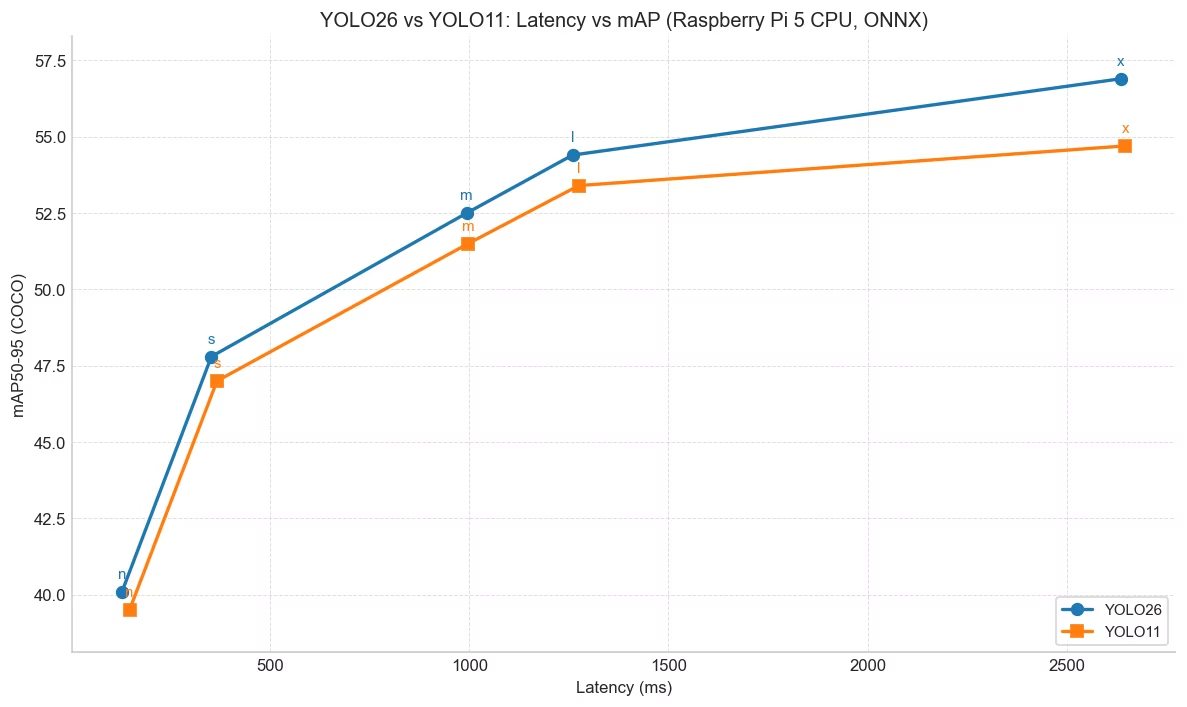
| Modello | mAP50-95(B) | Tempo di inferenza (ms/im) |
|---|---|---|
| YOLO26n | 40.1 | 128.42 |
| YOLO26s | 47.8 | 352.84 |
| YOLO26m | 52.5 | 993.78 |
| YOLO26l | 54.4 | 1259.46 |
| YOLO26x | 56.9 | 2636.26 |
Test eseguiti con Ultralytics 8.4.14.
Benchmark di YOLO26 su Raspberry Pi 5#
Il team Ultralytics ha eseguito i benchmark di YOLO26 su otto formati di modello diversi, misurando velocità e precisione: PyTorch, TorchScript, ONNX, OpenVINO, LiteRT, MNN, NCNN, ExecuTorch. I benchmark sono stati eseguiti su Raspberry Pi 5 a precisione FP32 e con la dimensione predefinita dell'immagine di input pari a 640.
Grafico di confronto#
Sono inclusi solo YOLO26n e YOLO26s, perché i modelli più grandi sono troppo lenti per essere utilizzati concretamente su Raspberry Pi.
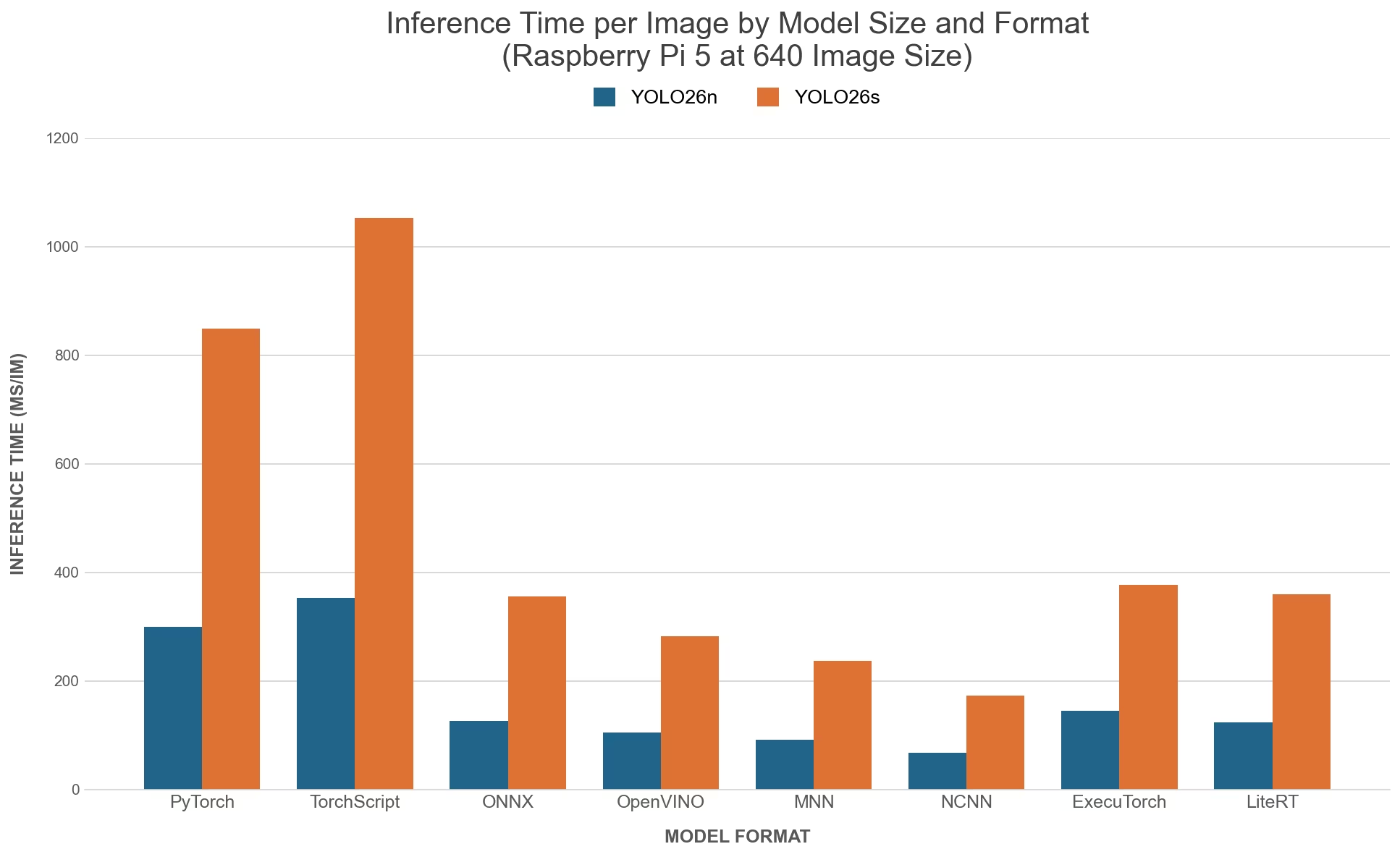
Tabella di confronto dettagliata#
La tabella seguente mostra i risultati dei benchmark per due diversi modelli (YOLO26n, YOLO26s) in otto formati diversi (PyTorch, TorchScript, ONNX, OpenVINO, LiteRT, MNN, NCNN, ExecuTorch), eseguiti su Raspberry Pi 5, indicando lo stato, le dimensioni, la metrica mAP50-95(B) e il tempo di inferenza per ogni combinazione.
| Formato | Stato | Dimensioni su disco (MB) | mAP50-95(B) | Tempo di inferenza (ms/im) |
|---|---|---|---|---|
| PyTorch | ✅ | 5.3 | 0.4760 | 299.09 |
| TorchScript | ✅ | 9.8 | 0.4734 | 353.20 |
| ONNX | ✅ | 9.5 | 0.4734 | 125.99 |
| OpenVINO | ✅ | 9.6 | 0.4734 | 104.55 |
| LiteRT | ✅ | 9.8 | 0.4730 | 123.30 |
| MNN | ✅ | 9.4 | 0.4749 | 91.87 |
| NCNN | ✅ | 9.4 | 0.4784 | 67.03 |
| ExecuTorch | ✅ | 9.4 | 0.4772 | 144.83 |
Test eseguiti con Ultralytics 8.4.108
Il tempo di inferenza non include la pre/post-elaborazione.
Riproduci i nostri risultati#
Per riprodurre i benchmark Ultralytics precedenti in tutti i formati di esportazione, esegui questo codice:
from ultralytics import YOLO

# Carica un modello YOLO26n PyTorch
model = YOLO("yolo26n.pt")

# Esegui il benchmark di velocità e accuratezza di YOLO26n sul dataset COCO128 per tutti i formati di esportazione
results = model.benchmark(data="coco128.yaml", imgsz=640)
I risultati dei benchmark possono variare in base alla configurazione hardware e software esatta del sistema e al carico di lavoro del sistema al momento dell'esecuzione dei benchmark. Per ottenere risultati più affidabili, usa un dataset con un numero elevato di immagini, ad es. data='coco.yaml' (5000 immagini di convalida).
L'esportazione format=litert (tramite litert-torch) è supportata solo su Linux x86_64 e macOS, non direttamente su Raspberry Pi. Esporta il modello .tflite su un computer Linux x86_64 o un Mac, copialo su Raspberry Pi e usa il Pi per l'inferenza.
Usa la fotocamera Raspberry Pi#
I progetti di visione artificiale su Raspberry Pi richiedono spesso flussi video in tempo reale per l'inferenza. Il connettore MIPI CSI integrato di Raspberry Pi permette di collegare i moduli videocamera ufficiali Raspberry Pi. In questa guida abbiamo usato un Raspberry Pi Camera Module 3 per acquisire i flussi video ed eseguire l'inferenza con i modelli YOLO26.
Raspberry Pi 5 usa connettori CSI più piccoli rispetto a Raspberry Pi 4 (22 pin contro 15), quindi per collegare una fotocamera Raspberry Pi ti serve un cavo adattatore da 15 a 22 pin.
Verifica la fotocamera#
Dopo aver collegato la videocamera a Raspberry Pi, esegui il comando rpicam-hello seguente. Dovresti vedere il flusso video in diretta della videocamera per circa 5 secondi.
rpicam-helloInferenza con la fotocamera#
Esistono due metodi per usare la fotocamera Raspberry Pi ed eseguire l'inferenza sui modelli YOLO26.
Usa picamera2, preinstallato con Raspberry Pi OS, per accedere alla videocamera ed eseguire l'inferenza con i modelli YOLO26.
import cv2
from picamera2 import Picamera2

from ultralytics import YOLO

# Inizializza Picamera2
picam2 = Picamera2()
picam2.preview_configuration.main.size = (1280, 720)
picam2.preview_configuration.main.format = "RGB888"
picam2.preview_configuration.align()
picam2.configure("preview")
picam2.start()

# Carica il modello YOLO26
model = YOLO("yolo26n.pt")

while True:
    # Acquisisci fotogramma per fotogramma
    frame = picam2.capture_array()

    # Esegui l'inferenza YOLO26 sul fotogramma
    results = model(frame)

    # Visualizza i risultati sul fotogramma
    annotated_frame = results[0].plot()

    # Visualizza il fotogramma risultante
    cv2.imshow("Camera", annotated_frame)

    # Interrompi il ciclo se viene premuto 'q'
    if cv2.waitKey(1) == ord("q"):
        break

# Rilascia le risorse e chiudi le finestre
cv2.destroyAllWindows()
Procedure consigliate per l'uso di Raspberry Pi#
Segui queste best practice per ottenere le massime prestazioni da YOLO26 su Raspberry Pi.
-
Usa un SSD
Per il funzionamento continuo 24/7, usa un SSD per il sistema, perché una scheda SD può usurarsi o guastarsi a causa delle scritture continue. Grazie al connettore PCIe integrato in Raspberry Pi 5, puoi collegare SSD usando un adattatore come NVMe Base for Raspberry Pi 5.
-
Installa senza interfaccia grafica
Quando installi Raspberry Pi OS, puoi scegliere di non installare l'ambiente desktop (Raspberry Pi OS Lite), risparmiando così un po' di RAM sul dispositivo e lasciando più risorse per l'elaborazione della visione artificiale.
-
Overclock di Raspberry Pi
Se vuoi migliorare leggermente le prestazioni durante l'esecuzione dei modelli Ultralytics YOLO26 su Raspberry Pi 5, puoi aumentare la frequenza della CPU dai 2.4GHz di base a 3.0GHz e quella della GPU da 800MHz a 1GHz. Se il sistema diventa instabile o si blocca, riduci i valori di overclock con incrementi di 100MHz. Assicurati che il raffreddamento sia adeguato, poiché l'overclock aumenta il calore generato e può causare thermal throttling.
a. Aggiorna il software
sudo apt update && sudo apt dist-upgradeb. Apri il file di configurazione per modificarlo
sudo nano /boot/firmware/config.txtc. Aggiungi le righe seguenti in fondo
arm_freq=3000
gpu_freq=1000
force_turbo=1
d. Salva ed esci premendo CTRL + X, poi Y e infine INVIO
e. Riavvia Raspberry Pi
Prossimi passaggi#
Hai configurato correttamente YOLO26 su Raspberry Pi. Per approfondire, esplora la modalità Predict per altre opzioni di inferenza, la modalità Export per ulteriori formati di distribuzione oppure la guida a NVIDIA Jetson se hai bisogno di maggiore potenza di calcolo edge. Per consultare la documentazione completa, visita la documentazione di Ultralytics YOLO26.
Ringraziamenti e citazioni#
Questa guida è stata creata inizialmente da Daan Eeltink per Kashmir World Foundation, un'organizzazione impegnata nell'uso di YOLO per la conservazione delle specie in via di estinzione. Riconosciamo il loro lavoro pionieristico e il loro impegno educativo nel campo delle tecnologie di rilevamento degli oggetti.
Per maggiori informazioni sulle attività di Kashmir World Foundation, puoi visitare il loro sito web.
Domande frequenti#
Per configurare Ultralytics YOLO26 su Raspberry Pi senza Docker, segui questi passaggi:
- Aggiorna l'elenco dei pacchetti e installa
pip:sudo apt update sudo apt install python3-pip -y pip install -U pip - Installa il pacchetto Ultralytics:
pip install ultralytics - Riavvia il dispositivo per applicare le modifiche:
sudo reboot
Per istruzioni dettagliate, consulta la sezione Inizia senza Docker.
- Aggiorna l'elenco dei pacchetti e installa
NCNN è altamente ottimizzato per piattaforme mobili e integrate, il che lo rende un'ottima scelta per eseguire YOLO26 sui dispositivi Raspberry Pi. I suoi kernel ottimizzati per ARM garantiscono sul Pi un'inferenza più rapida rispetto agli altri formati di esportazione nei benchmark qui sopra.
Puoi convertire un modello PyTorch YOLO26 nel formato NCNN usando Python o i comandi CLI:
Esempiofrom ultralytics import YOLO # Carica un modello YOLO26n PyTorch model = YOLO("yolo26n.pt") # Esporta il modello nel formato NCNN model.export(format="ncnn") # creates 'yolo26n_ncnn_model' # Carica il modello esportato in NCNN ncnn_model = YOLO("yolo26n_ncnn_model") # Esegui l'inferenza results = ncnn_model("https://ultralytics.com/images/bus.jpg")Per maggiori dettagli, consulta la sezione Usa NCNN su Raspberry Pi.
Le differenze principali includono:
- CPU: Raspberry Pi 4 usa il SoC Broadcom BCM2711 Cortex-A72 a 64 bit, mentre Raspberry Pi 5 usa il SoC Broadcom BCM2712 Cortex-A76 a 64 bit.
- Frequenza massima della CPU: Raspberry Pi 4 ha una frequenza massima di 1.8GHz, mentre Raspberry Pi 5 raggiunge 2.4GHz.
- Memoria: Raspberry Pi 4 offre fino a 8 GB di SDRAM LPDDR4-3200, mentre Raspberry Pi 5 dispone di SDRAM LPDDR4X-4267, disponibile nei tagli da 2 GB, 4 GB, 8 GB e 16 GB.
Questi miglioramenti contribuiscono a ottenere benchmark prestazionali migliori per i modelli YOLO26 su Raspberry Pi 5 rispetto a Raspberry Pi 4. Consulta la tabella Confronto tra le serie Raspberry Pi per maggiori dettagli.
Esistono due metodi per configurare una fotocamera Raspberry Pi per l'inferenza con YOLO26:
-
Usando
picamera2:import cv2 from picamera2 import Picamera2 from ultralytics import YOLO picam2 = Picamera2() picam2.preview_configuration.main.size = (1280, 720) picam2.preview_configuration.main.format = "RGB888" picam2.preview_configuration.align() picam2.configure("preview") picam2.start() model = YOLO("yolo26n.pt") while True: frame = picam2.capture_array() results = model(frame) annotated_frame = results[0].plot() cv2.imshow("Camera", annotated_frame) if cv2.waitKey(1) == ord("q"): break cv2.destroyAllWindows() -
Usando uno stream TCP:
rpicam-vid -n -t 0 --inline --listen -o tcp://127.0.0.1:8888from ultralytics import YOLO model = YOLO("yolo26n.pt") results = model("tcp://127.0.0.1:8888")
Per istruzioni dettagliate sulla configurazione, visita la sezione Inferenza con fotocamera.
-


Commenti134
Fai una domanda, condividi i tuoi risultati o aiuta qualcun altro.
smhty
Works great on Raspberry Pi 5. A tutorial for the AI kit that comes with Raspberry Pi 5 would be great as well: https://www.raspberrypi.com/products/ai-kit/
1 Glenn JocherUltralytics(modificato)
Hi there!
Thank you for your feedback and for sharing your positive experience on the Raspberry Pi 5! 😊
Creating a tutorial for the AI kit that comes with the Raspberry Pi 5 is a fantastic idea. In the meantime, you can refer to our comprehensive Quick Start Guide for Raspberry Pi with Ultralytics YOLO26, which provides detailed instructions on setting up and running YOLO on Raspberry Pi devices, including performance benchmarks.
For those interested in using the AI kit, the setup process should be quite similar. Here’s a quick overview to get you started:
-
Flash Raspberry Pi OS: Ensure you have the latest Raspberry Pi OS Bookworm (Debian 12) installed. Follow the Getting Started Documentation by Raspberry Pi to prepare your device.
-
Set Up Ultralytics:
- With Docker:
t=ultralytics/ultralytics:latest-arm64 && sudo docker pull $t && sudo docker run -it --ipc=host $t - Without Docker:
sudo apt update sudo apt install python3-pip -y pip install -U pip pip install ultralytics[export] sudo reboot
- With Docker:
-
Use NCNN for Best Performance: Convert your YOLO26 model to NCNN format for optimal performance on Raspberry Pi:
from ultralytics import YOLO # Load a YOLO26n PyTorch model model = YOLO("yolo26n.pt") # Export the model to NCNN format model.export(format="ncnn") # creates 'yolo26n_ncnn_model' # Load the exported NCNN model ncnn_model = YOLO("yolo26n_ncnn_model") # Run inference results = ncnn_model("https://ultralytics.com/images/bus.jpg") -
Using the Raspberry Pi Camera: For real-time video feeds, you can use the
picamera2library or set up a TCP stream:-
Using
picamera2:import cv2 from picamera2 import Picamera2 from ultralytics import YOLO picam2 = Picamera2() picam2.preview_configuration.main.size = (1280, 720) picam2.preview_configuration.main.format = "RGB888" picam2.preview_configuration.align() picam2.configure("preview") picam2.start() model = YOLO("yolo26n.pt") while True: frame = picam2.capture_array() results = model(frame) annotated_frame = results[0].plot() cv2.imshow("Camera", annotated_frame) if cv2.waitKey(1) == ord("q"): break cv2.destroyAllWindows() -
Using TCP Stream:
rpicam-vid -n -t 0 --inline --listen -o tcp://127.0.0.1:8888from ultralytics import YOLO model = YOLO("yolo26n.pt") results = model("tcp://127.0.0.1:8888")
-
We hope this helps you get started with the AI kit on your Raspberry Pi 5. For more detailed instructions and additional resources, please visit our Raspberry Pi Guide.
Happy coding! 🚀
-
wnelis
Today I've installed module ultralytics on a Raspberry Pi 4 with 4 [GiB] memory running Trixie. Some remarks about what I've learned: . Use the 64-bit variant of Raspberry OS; . Use an microSD card of at least 32 [GiB]; . Disable /tmp becoming a file system in memory (tmpfs):
sudo systemctl mask tmp.mount; . OpenCV is installed using apt, module ultralytics is installed in a virtual Python environment: 'python -m venv --system-site-packages `.It is found that YOLO runs into a hardware error: "Illegal instruction". This can be reproduced by using the Python script shown above to export the model in NCNN format. The output is:
Downloading https://github.com/ultralyti…: 100% ━━━━━━━━━━━━ 5.3MB 1.4MB/s 3.8s Ultralytics 8.4.191 🚀 Python-3.13.5 torch-2.14.1+cu130 CPU (aarch64) Illegal instruction
How can this issue be solved?
 Paula DerrengerUltralytics
@wnelis the most likely cause is a native PyTorch binary using instructions unsupported by the Pi 4’s CPU, rather than faulty hardware; similar crashes are documented in Ultralytics #19091 and upstream PyTorch, although your exact version is not confirmed affected. (github.com) Your log shows a CUDA build (
+cu130); first replace it with the matching official CPU-only packages inside your activated virtual environment, then retry the export: (pytorch.org)python -m pip install --force-reinstall torch==2.14.1 torchvision==0.29.1 --index-url https://download.pytorch.org/whl/cpuIf it still crashes, please share the text output of
yolo checksandpython -m pip show torch torchvisionfrom that same environment so we can identify package/path conflicts.
hm-zeroone(modificato)
"We haven’t validated Orbit OS yet, but if it supports tflite or onnx runtimes you should be able to deploy an exported Ultralytics YOLO26 model there using Export mode and the deployment options guide; if you try it, please share the exact device, export format, and any text error logs here in Discussions so the Ultralytics team can take a look."
Hi @glenn-jocher,
I added a new feature to my Orbit OS app to test YOLO models directly on edge devices, in this case a Raspberry Pi. The app now allows adding new models, and by default includes YOLO v8, v11 and v26.
We also introduced a benchmark mode, where you can select an image and run all models to compare performance and results.
In the example shown in the image, YOLOv8 achieved the highest number of correct object detections by time.
This demo video shows the remote deployment, no SSH, no Docker, of the app in action on Raspberry Pi 5 vs Arduino UNO Q and a comparison (“VS”) between the RPi 5 and UNO Q running YOLO v8. https://youtu.be/aiFJmosYVAI?si=v3Jo_TbswU3n-sZU
- Glenn JocherUltralytics
Thanks for sharing the Orbit OS benchmark; for a fair cross-model comparison please include the exact export/runtime backend,
imgsz, confidence/IoU thresholds, and per-image latency/FPS, since on Raspberry Pi CPU deployments NCNN is usually the best baseline for YOLO26. Hey! Thanks for the feedback. All models were tested under the same conditions — TFlite runtime, same image, same thresholds (conf=0.50, IoU=0.45), same imgsz 640×640 with letterbox preprocessing.
Everything runs through the OrbitOS SDK which currently has TFLite and ONNX embedded. NCNN is something we'll look into adding in a future release.
Quick question — for RPi deployments, would you recommend INT8 or float16 as the default export format?
Orbit OS SDK 26.0.1 Inference example.
Orbit OS is multi-language — For now only Go SDK is available, Python, Java and C++ SDKs are coming soon.
model, _ := device.AIManager.UploadAndLoadModel( "yolo8n", "models/yolo26n_float16.tflite", aiv26.ModelBackend_TFLITE, aiv26.ExecutionMode_EXEC_HIGH_THREADS, ) resp, _ := model.Infer(ctx, tensor.Data, tensor.Shape, tensor.Dtype) fmt.Println(resp.GetOutputShape()) // [1 84 8400] fmt.Println(resp.GetLatencyUs()) // e.g. 528000- Glenn JocherUltralytics(modificato)
For plain Raspberry Pi CPU deployment with
LiteRT(.tflite), I’d usually default toINT8for the best speed and memory savings, and usefloat16only if quantization hurts accuracy too much or your runtime performs better with FP kernels; if you benchmark both, the LiteRT export guide is the right reference, while our Raspberry Pi guide showsNCNNas the strongest baseline once you add that backend.1
safdarhamid64-cpu
when i write in raspberry pi terminal : from ultralytics import yolo error msg illegal instruction pops up , i have trained model and even i have first created environment and installed pip install ultralytics but still i am not able to run model yolo11n on my Raspberry Pi 4 , Guide me plzz
- Glenn JocherUltralytics
That
Illegal instructionon Raspberry Pi usually means an incompatible binary wheel (most oftentorch/numpypulled for the wrong arch/OS), and also note the correct import isfrom ultralytics import YOLO(capitalized), notyolo; please paste the text output ofyolo checksplus the full traceback here in this discussion, and confirmuname -m+ whether you’re on Raspberry Pi OS Bookworm 64-bit as in the Raspberry Pi YOLO26 guide; as a quick way to rule out env issues you can also try our ARM64 Docker flow from that guide:```bash t=ultralytics/ultralytics:latest-arm64 sudo docker pull $t && sudo docker run -it --ipc=host $t python -c "from ultralytics import YOLO; YOLO('yolo11n.pt')"
inuropix
Hi.. I get an error when implement botsort with reid is True and the model is ncnn(exported from yolo26n-cls.pt)
Here’s the full traceback from the error:
    self.tracks = self.model.track(
                  ^^^^^^^^^^^^^^^^^
 File "/home/sbr/people_counting/lib/python3.11/site-packages/ultralytics/engine/model.py", line 579, in track
    return self.predict(source=source, stream=stream, **kwargs)
           ^^^^^^^^^^^^^^^^^^^^^^^^^^^^^^^^^^^^^^^^^^^^^^^^^^^^
  File "/home/sbr/people_counting/lib/python3.11/site-packages/ultralytics/engine/model.py", line 536, in predict
    return self.predictor.predict_cli(source=source) if is_cli else self.predictor(source=source, stream=stream)
                                                                    ^^^^^^^^^^^^^^^^^^^^^^^^^^^^^^^^^^^^^^^^^^^^
  File "/home/sbr/people_counting/lib/python3.11/site-packages/ultralytics/engine/predictor.py", line 225, in __call__
    return list(self.stream_inference(source, model, *args, **kwargs))  # merge list of Results into one
           ^^^^^^^^^^^^^^^^^^^^^^^^^^^^^^^^^^^^^^^^^^^^^^^^^^^^^^^^^^^
  File "/home/sbr/people_counting/lib/python3.11/site-packages/torch/utils/_contextlib.py", line 40, in generator_context
    response = gen.send(None)
               ^^^^^^^^^^^^^^
  File "/home/sbr/people_counting/lib/python3.11/site-packages/ultralytics/engine/predictor.py", line 338, in stream_inference
    self.run_callbacks("on_predict_postprocess_end")
  File "/home/sbr/people_counting/lib/python3.11/site-packages/ultralytics/engine/predictor.py", line 509, in run_callbacks
    callback(self)
  File "/home/sbr/people_counting/lib/python3.11/site-packages/ultralytics/trackers/track.py", line 93, in on_predict_postprocess_end
    tracks = tracker.update(det, result.orig_img, getattr(result, "feats", None))
             ^^^^^^^^^^^^^^^^^^^^^^^^^^^^^^^^^^^^^^^^^^^^^^^^^^^^^^^^^^^^^^^^^^^^
  File "/home/sbr/people_counting/lib/python3.11/site-packages/ultralytics/trackers/byte_tracker.py", line 361, in update
    dists = self.get_dists(unconfirmed, detections)
            ^^^^^^^^^^^^^^^^^^^^^^^^^^^^^^^^^^^^^^^
  File "/home/sbr/people_counting/lib/python3.11/site-packages/ultralytics/trackers/bot_sort.py", line 220, in get_dists
    emb_dists = matching.embedding_distance(tracks, detections) / 2.0
                ^^^^^^^^^^^^^^^^^^^^^^^^^^^^^^^^^^^^^^^^^^^^^^^
  File "/home/sbr/people_counting/lib/python3.11/site-packages/ultralytics/trackers/utils/matching.py", line 128, in embedding_distance
    cost_matrix = np.maximum(0.0, cdist(track_features, det_features, metric))  # Normalized features
                                  ^^^^^^^^^^^^^^^^^^^^^^^^^^^^^^^^^^^^^^^^^^^
  File "/home/sbr/people_counting/lib/python3.11/site-packages/scipy/spatial/distance.py", line 2903, in cdist
    raise ValueError('XA must be a 2-dimensional array.')
ValueError: XA must be a 2-dimensional array.
Any idea?
- Glenn JocherUltralytics
That traceback usually means BoT-SORT didn’t get valid (2D) ReID embeddings; also note that
.track()should run with a Detect/Seg/Pose model, whileyolo26n-clsis only meant to be the ReID feature extractor configured insidebotsort.yaml(viawith_reid/model). (docs.ultralytics.com)yolo track model=yolo26n.pt source=path/to/video.mp4 tracker="botsort.yaml"# in a copy of botsort.yaml with_reid: True model: yolo26n-cls.pt # first confirm this works before swapping to an exported backendIf you just need stable tracking on Raspberry Pi, try
tracker="bytetrack.yaml"(no ReID); if you still hit this, please paste yourbotsort.yamland the output ofyolo checksso we can reproduce from the same environment. (docs.ultralytics.com)
hananabuzainab
I can't install ultralytics on rasspbery pi 5...with python 3.11 version,why??
I used: pip install ultralytics
How can i fix this problem ??
- Glenn JocherUltralytics
Can you paste the full
pip install ultralyticserror text (as text, not a screenshot) and the output ofpython3 -Vhere so we can pinpoint what’s failing? On Raspberry Pi 5 this is most often a Python/pip mismatch or non-Bookworm/32-bit setup—please also confirm you’re on Raspberry Pi OS Bookworm 64-bit as in the Raspberry Pi with Ultralytics YOLO26 guide.python3 -V python3 -m pip install -U pip setuptools wheel python3 -m venv .venv source .venv/bin/activate python -m pip install -U pip python -m pip install ultralytics
avasanjesh
Hi,
I want to use python version of raspberry pi 32 bit OS. can you please tell me if i can export yolo detection model in 32 bit raspberry pi?
Edward-YS
Hello,I'm wondering if there is Benchmarking Results of Two Different Models (YOLO8n, YOLO8s) Across Ten Formats: PyTorch, TF, ONNX, OpenVINO, TF SavedModel, TF GraphDef, TF Lite, PaddlePaddle, MNN, NCNN.
zyt2011
Installing a single Hailo-5 is sufficient.
发件人: Beautifulboy111 @.> 发送时间: 2025年4月22日 14:24 收件人: ultralytics/ultralytics @.> 抄送: zyt2011 @.>; Mention @.> 主题: Re: [ultralytics/ultralytics] zh/guides/raspberry-pi/ (Discussion #19489)
Why does my Raspberry Pi 5 have a high inference latency of 150ms when using NCNN for video recognition, even after overclocking? How can I reduce the inference time?
― Reply to this email directly, view it on GitHubhttps://github.com/orgs/ultralytics/discussions/19489#discussioncomment-12906311, or unsubscribehttps://github.com/notifications/unsubscribe-auth/BJ7DFR53TAD7QVJNO3TTXJL22XOAJAVCNFSM6AAAAABYEEJCHCVHI2DSMVQWIX3LMV43URDJONRXK43TNFXW4Q3PNVWWK3TUHMYTEOJQGYZTCMI. You are receiving this because you were mentioned.Message ID: @.***>
- Glenn JocherUltralytics(modificato)
@Beautifulboy111 150ms inference latency with NCNN on Raspberry Pi 5 is higher than expected. Here are some steps to reduce it:
-
Use a smaller YOLO26 model - our benchmarks show YOLO26n is significantly faster than YOLO26s with NCNN on Pi 5 (67ms vs 173ms)
-
Reduce input resolution - try 320x320 instead of 640x640, which can cut inference time by up to 70%
-
Optimize memory allocation by running without GUI (Raspberry Pi OS Lite)
-
Ensure you're using proper cooling for sustained performance when overclocked
-
Consider processing at lower FPS if your application allows it
Regarding @zyt2011's suggestion, while accelerators like Hailo can boost performance, they're a separate investment. I'd recommend optimizing your current setup first using the techniques in our Raspberry Pi guide.
What's your specific use case? This would help us provide more targeted optimization advice.
-
Beautifulboy111
Why does my Raspberry Pi 5 have a high inference latency of 150ms when using NCNN for video recognition, even after overclocking? How can I reduce the inference time?