Ultralytics YOLO26による距離計算
距離計算とは?#
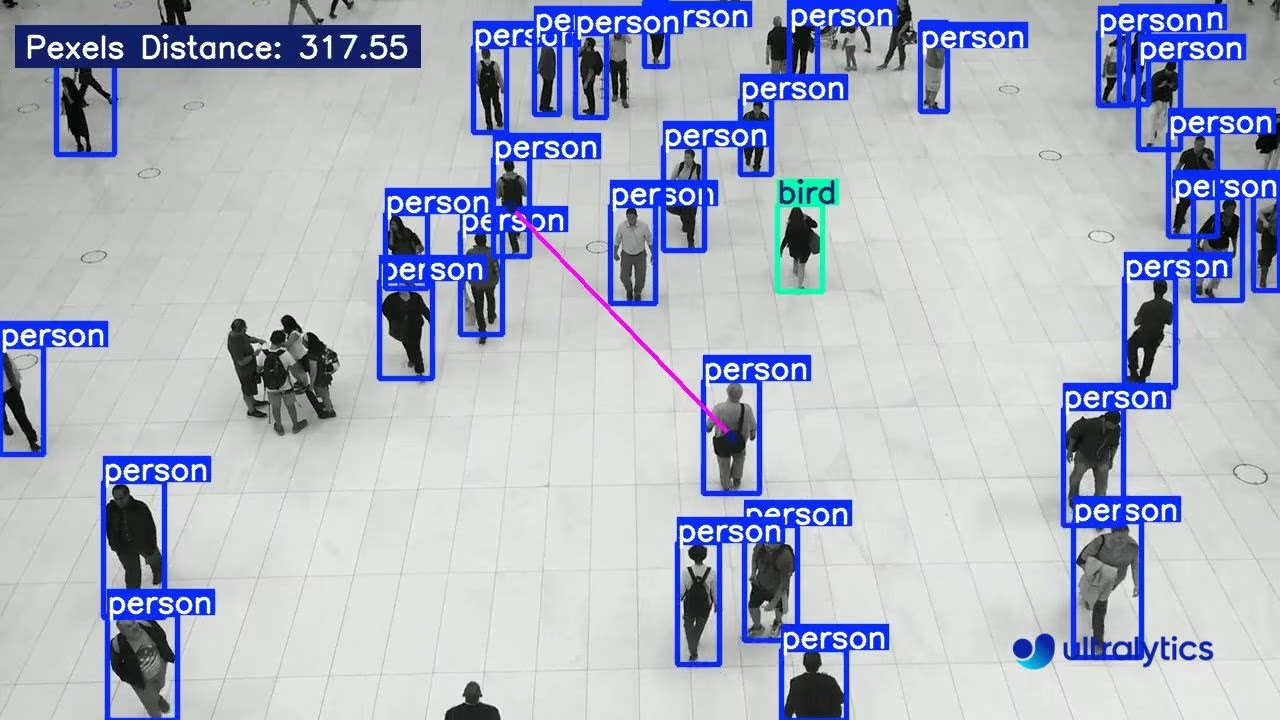
距離計算とは、画像または動画フレーム内で検出された2つの物体間の距離を測定する処理です。Ultralytics YOLO26のソリューションでは、ユーザーが選択した2つのバウンディングボックスの重心間の距離を測定します。
視聴: Ultralytics YOLO を使って検出された物体間の距離をピクセル単位で推定する方法 🚀
ビジュアル#
| Ultralytics YOLO26による距離計算 |
|---|
 |
距離計算のメリット#
- 位置特定の精度: コンピュータービジョンタスクにおける空間位置の正確な特定を強化します。
- サイズ推定: コンテキストをより適切に把握するために、物体のサイズを推定できます。
- シーン理解: 自動運転車や監視システムなどのアプリケーションで、より適切な意思決定を実現するために、3Dシーンの理解を向上させます。
- 衝突回避: 移動する物体間の距離を監視することで、システムが潜在的な衝突を検出できるようにします。
- 空間分析: 監視対象の環境内における物体の関係や相互作用の分析を容易にします。
距離計算
- マウスの左ボタンで任意の2つのバウンディングボックスをクリックすると、距離を計算できます。
- マウスの右ボタンを使用すると、描画したすべての点を削除できます。
距離は推定値です
距離は2Dデータを使って計算されるため、奥行き情報がなく、推定値が完全に正確でない場合があります。ピクセル単位の奥行きを求めるには、深度推定モデルを使用してください。
YOLO26で距離を計算する#
DistanceCalculationソリューションはフレーム間で物体を追跡し、マウスで選択した任意の2つのバウンディングボックスの重心間のユークリッド距離をピクセル単位で測定します。以下の例を実行し、2つの物体を左クリックすると、それらを結ぶ線が描画されて距離が表示されます。右クリックすると選択が解除されます。
import cv2

from ultralytics import solutions

cap = cv2.VideoCapture("path/to/video.mp4")
assert cap.isOpened(), "Error reading video file"

# 動画ライター
w, h, fps = (int(cap.get(x)) for x in (cv2.CAP_PROP_FRAME_WIDTH, cv2.CAP_PROP_FRAME_HEIGHT, cv2.CAP_PROP_FPS))
video_writer = cv2.VideoWriter("distance_output.avi", cv2.VideoWriter_fourcc(*"mp4v"), fps, (w, h))

# 距離計算オブジェクトを初期化します
distancecalculator = solutions.DistanceCalculation(
    model="yolo26n.pt",  # YOLO26モデルファイルへのパス。
    show=True,  # 出力を表示する
)

# 動画を処理
while cap.isOpened():
    success, im0 = cap.read()

    if not success:
        print("Video frame is empty or processing is complete.")
        break

    results = distancecalculator(im0)

    print(results)  # 出力にアクセスします

    video_writer.write(results.plot_im)  # 処理済みフレームを書き込みます。

cap.release()
video_writer.release()
cv2.destroyAllWindows() # 開いているすべてのウィンドウを破棄DistanceCalculation()の引数#
DistanceCalculationの引数を以下の表に示します。
| 引数 | 種類 | デフォルト | 説明 |
|---|---|---|---|
model | str | None | Ultralytics YOLOモデルファイルへのパスです。 |
line_width | int | 2 | Solutionが描画するボックス、キーポイント、カウント表示の線幅です。 |
verbose | bool | True | 各フレームの入力shape、クラス数、処理速度を記録するSolutionのログを有効にします。トラッキング呼び出し自体は常にログを出力しません。 |
DistanceCalculationソリューションでは、trackの引数も使用できます。
| 引数 | 種類 | デフォルト | 説明 |
|---|---|---|---|
tracker | str | 'tracktrack.yaml' | 使用するトラッキングアルゴリズムを指定します。組み込みのオプション:botsort.yaml、bytetrack.yaml、ocsort.yaml、deepocsort.yaml、fasttrack.yaml、tracktrack.yaml。 |
conf | float | 0.25 | 検出の信頼度しきい値を設定します。値を低くすると、より多くの物体を追跡できますが、誤検出が含まれる可能性があります。 |
iou | float | 0.5 | 重複する検出をフィルタリングするためのIntersection over Union(IoU)しきい値を設定します。 |
classes | list | None | クラスインデックスで結果をフィルタリングします。たとえば、classes=[0, 2, 3]を指定すると、指定したクラスのみを追跡します。 |
device | str | None | 推論に使用するデバイスを指定します(例:cpu、cuda:0、0)。モデル実行に使用するCPU、特定のGPU、その他の計算デバイスを選択できます。 |
imgsz | int or tuple | 640 | 推論時の入力画像サイズです。正方形の場合は整数、または(height, width)のペアを指定します。形状はモデルのストライドに合わせて調整されます。 |
max_det | int | 300 | トラッキング前にフレームごとに保持する検出の最大数です。混雑したシーンでソリューションが処理する物体数を制限します。 |
quantize | int or str | None | 推論精度: CPU以外で実行するPyTorchおよびTorchScriptモデルでは、16(FP16)または32/未設定(FP32)を使用します。その他の形式では、アーティファクトとランタイムによって選択される精度が使用されます。非推奨のhalf引数を置き換えます。 |
さらに、以下の可視化引数を使用できます。
| 引数 | 種類 | デフォルト | 説明 |
|---|---|---|---|
show | bool | False | Trueの場合、注釈付き画像または動画をウィンドウに表示します。開発やテスト中にすぐ視覚的なフィードバックを得るのに便利です。 |
show_conf | bool | True | 各検出のラベルとともに信頼度スコアを表示します。各検出に対するモデルの確信度を確認できます。 |
show_labels | bool | True | 可視化出力で各検出のラベルを表示します。検出されたオブジェクトをすぐに把握できます。 |
実装の詳細#
DistanceCalculationクラスは、ビデオフレーム間で物体を追跡し、選択されたバウンディングボックスの重心間のユークリッド距離を計算します。2つの物体をクリックすると、ソリューションは次の処理を行います。
- 選択したバウンディングボックスの重心(中心点)を抽出します
- これらの重心間のユークリッド距離をピクセル単位で計算します
- 物体間を結ぶ線とともに、フレーム上に距離を表示します
実装ではmouse_event_for_distanceメソッドを使用してマウス操作を処理し、ユーザーが必要に応じて物体を選択したり選択を解除したりできるようにします。processメソッドは、フレームごとの処理、物体の追跡、距離の計算を行います。
用途#
YOLO26による距離計算には、さまざまな実用的な用途があります。
- 小売分析: 顧客と商品との距離を測定し、店舗レイアウトの有効性を分析します
- 産業安全: 作業員と機械の間の安全な距離を監視します
- 交通管理: 車両間隔を分析し、車間距離不保持を検出します
- スポーツ分析: 選手、ボール、フィールド上の重要な位置の間の距離を計算します
- ヘルスケア: 待合エリアで適切な距離を確保し、患者の移動を監視します
- ロボティクス: ロボットが障害物や人との適切な距離を保てるようにします
よくある質問#
Ultralytics YOLO26を使用して物体間の距離を計算するには、検出された物体のバウンディングボックスの重心を特定する必要があります。この処理では、Ultralyticsの
solutionsモジュールからDistanceCalculationクラスを初期化し、モデルのトラッキング出力を使って距離を計算します。はい、Ultralytics YOLO26を使用して、リアルタイムのビデオストリームで距離を計算できます。この処理では、OpenCVでビデオフレームをキャプチャし、YOLO26で物体検出を実行してから、
DistanceCalculationクラスを使用して連続するフレーム内の物体間の距離を計算します。実装の詳細については、ビデオストリームの例をご覧ください。Ultralytics YOLO26による距離計算中に描画した点を削除するには、マウスを右クリックします。この操作ですべての描画点が消去されます。詳細については、距離計算の例の注記セクションをご覧ください。
Ultralytics YOLO26で
DistanceCalculationクラスを初期化する際の主な引数は次のとおりです。model: YOLO26モデルファイルへのパスです。tracker: 使用するトラッキングアルゴリズムです(ソリューションのデフォルトはtracktrack.yamlです)。conf: 検出の信頼度しきい値です。show: 出力を表示するためのフラグです。
すべての引数とデフォルト値については、DistanceCalculationの引数をご覧ください。


コメント195
質問したり、結果を共有したり、ほかの人をサポートしたりできます。
muhammadwildangoni
hallo, I am processing a men's 100 meter sprint video using YOLO and SpeedEstimator (Ultralytics) to detect runners, estimate their speed, and track their progress. However, the output statistics are incorrect. My code detects 16 runners, while there should only be 8 (those on the track), and the maximum speed reported is 0.00 m/s, which is clearly not correct for a sprint race. The furthest distance covered is about 96.7 meters, which seems off.
import cv2 import math import numpy as np from ultralytics import YOLO from ultralytics.solutions import speed_estimation
--- SETTINGS ---
video_path = "WHAT A RACE! _ Men s 100m Final! _ #Paris2024 highlights (online-video-cutter.com).mp4" # Change to your video path model_path = "yolo11n.pt" # Path to your YOLO model (could be yolov11n.pt if available) output_path = "output_sprint.avi" # Output video file name
meter_per_pixel = 0.05 # Calibration result for track (e.g., 0.05 for a 100m lane) center_point = (0, 720) # Track start point (adjust to your video height)
--- INITIALIZATION ---
cap = cv2.VideoCapture(video_path) assert cap.isOpened(), "Error reading video file"
w, h, fps = (int(cap.get(x)) for x in (cv2.CAP_PROP_FRAME_WIDTH, cv2.CAP_PROP_FRAME_HEIGHT, cv2.CAP_PROP_FPS)) out = cv2.VideoWriter(output_path, cv2.VideoWriter_fourcc(*"MJPG"), fps, (w, h))
model = YOLO(model_path) names = model.model.names if hasattr(model.model, "names") else ["person"]
speed_obj = speed_estimation.SpeedEstimator( names=names, reg_pts=[(0, int(h/2)), (w, int(h/2))], # Speed estimation line (across track, adjust as needed) view_img=False, meter_per_pixel=meter_per_pixel # Convert pixel to meters )
frame_count = 0 speed_over_time, distance_over_time = {}, {}
while cap.isOpened(): success, frame = cap.read() if not success: break frame_count += 1
# Detect and track runners on each frame
tracks = model.track(frame, persist=True, show=False)

# Estimate runners' speed and update visualization on frame
frame = speed_obj.estimate_speed(frame)

# Extract runner IDs, position, speed, and distance
# Make sure .boxes.id/cls property exists:
if tracks and hasattr(tracks[0], "boxes") and tracks[0].boxes.id is not None:
    boxes = tracks[0].boxes.xyxy.cpu()
    track_ids = tracks[0].boxes.id.int().cpu().tolist()
    clss = tracks[0].boxes.cls.cpu().tolist()
    for box, track_id, cls in zip(boxes, track_ids, clss):
        if cls == 0:  # 'person' class (runners)
            # Calculate runner's distance from start
            x1, y1 = int((box[0] + box[2]) // 2), int((box[1] + box[3]) // 2)
            distance = (math.sqrt((x1 - center_point[0]) ** 2 + (y1 - center_point[1]) ** 2)) * meter_per_pixel

            # Store statistics in dictionary
            if track_id not in distance_over_time:
                distance_over_time[track_id] = [0] * (frame_count - 1)
            distance_over_time[track_id].append(distance)

            speed = speed_obj.speeds.get(track_id, 0) if hasattr(speed_obj, "speeds") else 0
            if track_id not in speed_over_time:
                speed_over_time[track_id] = [0] * (frame_count - 1)
            speed_over_time[track_id].append(speed)

            # Overlay runner's speed and distance information directly on video frame
            text_speed = f"Speed: {speed:.2f} m/s"
            text_dist = f"Distance: {distance:.2f} m"
            cv2.putText(frame, f"ID:{track_id} {text_speed}, {text_dist}", (x1, y1 - 10),
                        cv2.FONT_HERSHEY_SIMPLEX, 0.8, (0,255,0), 2)

# Save frame to output video
out.write(frame)

# Display real-time video preview
cv2.imshow("Sprint Runner Detection Preview", frame)
if cv2.waitKey(1) & 0xFF == ord("q"):
    break
cap.release() out.release() cv2.destroyAllWindows()
--- Final statistics: print results to terminal ---
best_speed = max((max(speeds) for speeds in speed_over_time.values()), default=0) best_distance = max((max(distances) for distances in distance_over_time.values()), default=0) total_runners = len(distance_over_time)
print(f"Total runners detected: {total_runners}") print(f"Highest speed: {best_speed:.2f} m/s") print(f"Furthest distance covered: {best_distance:.2f} meters")
maribalke(編集済み)
Hi! I have tried to do a test on the distance calculation on a single image, but I keep getting the attribute error: 'DistanceCalculation' object has no attribute 'start_process'. I have basis in the YOLO11n-model, further trained on images from a different dataset.
model_path = "../runs/detect/train2/weights/best.pt" model = YOLO(model_path) dist_obj = distance_calculation.DistanceCalculation() frame = cv2.imread("../images/s73/raw_images/10.jpg") # Detect objects results = model(frame) # Run object tracking tracks = model.track(frame, persist=True, show = False) # process the image image_with_distances = dist_obj.start_process(frame, tracks) # Display the frame cv2.imshow('Distance Calculation', image_with_distances) cv2.waitKey(0) cv2.destroyAllWindows() Glenn JocherUltralytics(編集済み)
@maribalke thanks for reaching out!
start_process()has been removed.DistanceCalculationis now called directly on the frame and returns a results object with the annotated image inplot_im. It also runs tracking itself, so no separatemodel.track()call is needed. Here's the minimal fix for your single-image case:dist_obj = solutions.DistanceCalculation(model=model_path, show=False) results = dist_obj(frame) cv2.imshow("Distance Calculation", results.plot_im)Note that the distance is measured between two objects you select by clicking them in a display window, so a single static image only shows a distance once two boxes have been selected. For full implementation details, see our Distance Calculation Guide. Let us know if you encounter any other issues!
dgnovo
Is it possible to know the distance from an object and another object without using mouse?
- Glenn JocherUltralytics
@dgnovo yes, it's possible. You can calculate distances programmatically by using bounding box centroids from YOLO11 detections and computing the Euclidean distance between them without relying on mouse clicks. Refer to the
DistanceCalculationimplementation to customize the process for your needs: https://docs.ultralytics.com/guides/distance-calculation/.1
Muhammad-237
How can we find the distance of in the bounding box like from one point to another point in the bounding box to measure the size of object
- Glenn JocherUltralytics
@Muhammad-237 to measure the size of an object within a bounding box using Ultralytics YOLO11, you can calculate the distance between two points (e.g., edges or centroid) within that bounding box. This can be achieved using the
DistanceCalculationclass, which allows you to click on specific points to measure distances. Keep in mind, these calculations are approximations as they rely on 2D data without depth information. For more details, refer to the Distance Calculation Docs.
gg120wolf
Hi, I am using the example code of Distance Calculation using YOLO11 Example, but there is a problem of File "f:\fyp yolo\ultralytics-main\distance test1.py", line 13, in distance = solutions.DistanceCalculation() ^^^^^^^^^^^^^^^^^^^^^^^^^^^^^^^ TypeError: DistanceCalculation.init() missing 1 required positional argument: 'names' So what is this names should i set?
RizwanMunawar
@gg120wolf Hi, the correct way to use the Ultralytics distance calculation module is mentioned below.
import cv2

from ultralytics import solutions

cap = cv2.VideoCapture("Path/to/video/file.mp4")
assert cap.isOpened(), "Error reading video file"
w, h, fps = (int(cap.get(x)) for x in (cv2.CAP_PROP_FRAME_WIDTH, cv2.CAP_PROP_FRAME_HEIGHT, cv2.CAP_PROP_FPS))

# Video writer
video_writer = cv2.VideoWriter("distance_calculation.avi", cv2.VideoWriter_fourcc(*"mp4v"), fps, (w, h))

# Init distance-calculation obj
distance = solutions.DistanceCalculation(model="yolo11n.pt", show=True)

# Process video
while cap.isOpened():
    success, im0 = cap.read()
    if not success:
        print("Video frame is empty or video processing has been successfully completed.")
        break
    im0 = distance.calculate(im0)
    video_writer.write(im0)

cap.release()
video_writer.release()
cv2.destroyAllWindows()
Thanks :) The Ultralytics Team!
tylerfrisinger01
Hey there, I have a model that is trained for object detection not tracking. We are detecting two animals that are inside a cage. What we want to do is import a mp4 video then calculate the distance between the two objects while also showing the bounding boxes. However when i use the VideoStream code snippet from above, the popup window is larger then my screen. How could i adjust that code to make it a different window size so that I am able to track them in real time.
Also after this is done and the distances are calculated is there anyway to save the whole video with the bounding boxes and the distance calculations that were done in real time? Or would I have to save the video by doing the results = model.predict(save=true) and also do the VideoStream code snippet from above at the same time? and not have the distances shown in the saved video?
Get back to me as soon as possible as this is for a project for school! Thank You!!
I am also using YOLOv11, i'm not sure if that will change anything or not. And i have tried creating my own window using cv2 but that didnt work when i attempted it.
- Glenn JocherUltralytics
@tylerfrisinger01 to adjust the window size in OpenCV, you can use
cv2.namedWindow()andcv2.resizeWindow()to set a custom size. For saving the video with bounding boxes and distances, you can modify the code to include distance annotations and usecv2.VideoWriterto save the processed frames. Here's a quick example on resizing the window:cv2.namedWindow('Video', cv2.WINDOW_NORMAL) cv2.resizeWindow('Video', 800, 600) # Adjust the dimensions as neededRegarding saving the video with distances, you can overlay the distance on the frames before writing them out with
cv2.VideoWriter. If you need further assistance, feel free to ask! @glenn-jocher when I do this, it still pops open its own window that I am assuming is built into the solutions.DistanceCalculator function (since that is the name of the window) So then it does not work. Any workaround for this?
- Glenn JocherUltralytics(編集済み)
@tylerfrisinger01 to prevent the
DistanceCalculationfunction from opening its own window, you can set theshowparameter toFalsewhen initializing it, like so:distance = solutions.DistanceCalculation(model="yolo26n.pt", show=False). This should stop the automatic display window. For saving the video, continue usingcv2.VideoWriter. Let me know if you need further assistance!
Abtinz
Hello everyone, I want to deploy an yolov8-application on the edge device and estimate the distance through the user's camera without having to click on the detected object, how can I find the distance of the objects to the camera without need to click?
- Glenn JocherUltralytics
@Abtinz to estimate object distances without clicking, you'll need to use depth estimation techniques, as YOLOv8 primarily provides 2D bounding boxes. Consider integrating depth sensors or stereo cameras to obtain depth information. For more details, you can refer to the distance calculation guide.
gaodaren47297
Hi,Is there a method to calculate the distance between the camera and the objects?
- Glenn JocherUltralytics(編集済み)
@gaodaren47297 the
DistanceCalculationsolution measures the pixel distance between the centroids of two objects you select in the frame; it does not estimate the distance between the camera and an object. A 2D bounding box has no depth information, so camera-to-object distance needs extra information such as a depth sensor or stereo camera, or a calibration using an object of known size. For measuring between objects, see the distance calculation documentation on our website. If you have further questions, feel free to ask here.
Dmitrii-Smirnov
Hi Guys, Guys, I have a video with multiple objects(people) on the video. I need to calculate distance between each detected person on the each frame and to save results to csv file. Can you help me with that task? It will be really cool if you will share documentation=) As I understood relevant method for my task is DistanceCalculation(names=names[0], view_img=True).calculate_distance(obj1, obj2), am I correct?
- Glenn JocherUltralytics(編集済み)
@Dmitrii-Smirnov there is no
calculate_distance(obj1, obj2)method onDistanceCalculationin current versions. The solution is called on each frame (results = dist_obj(im0)), you left-click two tracked objects, and it reports the pixel distance inresults.pixels_distance. For distances between every pair of people on each frame and a CSV export, compute the centroid distances from the tracking boxes yourself. For details, see our documentation: https://docs.ultralytics.com/guides/distance-calculation/. Thank you!
- Glenn JocherUltralytics(編集済み)
@Dmitrii-Smirnov to calculate distances between all detected people in each frame and save the results to a CSV file, compute the centroid distances from the tracking results. The
DistanceCalculationsolution only measures between two objects you click, so for all pairs here's a basic implementation:import csv import math from itertools import combinations import cv2 from ultralytics import YOLO model = YOLO("yolo26n.pt") cap = cv2.VideoCapture("path/to/video/file.mp4") assert cap.isOpened(), "Error reading video file" with open("distances.csv", mode="w", newline="") as file: writer = csv.writer(file) writer.writerow(["Frame", "Object1", "Object2", "Distance"]) frame_count = 0 while cap.isOpened(): success, im0 = cap.read() if not success: break results = model.track(im0, persist=True, show=False, classes=[0]) # class 0 = person boxes = results[0].boxes if boxes.id is not None: centroids = dict(zip(boxes.id.int().tolist(), boxes.xywh[:, :2].tolist())) for (id1, c1), (id2, c2) in combinations(centroids.items(), 2): writer.writerow([frame_count, id1, id2, math.dist(c1, c2)]) frame_count += 1 cap.release()This script captures video frames, calculates pixel distances between detected people, and writes the results to a CSV file. For more details, refer to our documentation: https://docs.ultralytics.com/guides/distance-calculation/.
zgr1446741194
Hello author, I would like to propose a scenario similar to this: using monocular distance measurement to calculate the distance from the distant water level line (similar to the shoreline) in the video stream obtained by the camera to my camera (a kind of early warning of the water level), how can I use the solution? At present, the difficulty can be determined that we need to complete distance conversion similar to 3D to 2D, because of perspective space, instead of using fixed linear distance conversion similar to visionEye (from pixels to realistic distance). Another difficulty is that we do not know the true physical properties of the observed water line, which means that we cannot use the traditional method of monocular distance measurement to deduce the distance from the true length or height of the observed object. If you have any viable solutions, thank you very much for adding the code demo in your reply.
- Glenn JocherUltralytics
For calculating distances to a waterline using monocular vision, consider using depth estimation techniques or stereo vision for more accurate results. YOLO models can assist in object detection, but for precise distance measurement, integrating additional sensors or methods might be necessary. For more details, please refer to our distance calculation guide.