Đếm đối tượng bằng Ultralytics YOLO26
Đếm đối tượng là gì?#

Đếm đối tượng bằng Ultralytics YOLO26 là xác định và đếm các đối tượng cụ thể trong video và luồng camera. Vì YOLO26 thực hiện phát hiện bằng deep learning và theo dõi theo thời gian thực, model này phù hợp với các tình huống đếm như phân tích đám đông và mật độ hiện diện cũng như giám sát.
Xem: Cách đếm đối tượng theo thời gian thực bằng Ultralytics YOLO26 🚀
Ưu điểm của việc đếm đối tượng#
- Tối ưu hóa tài nguyên: Đếm đối tượng hỗ trợ quản lý tài nguyên hiệu quả bằng cách cung cấp số lượng chính xác, tối ưu hóa việc phân bổ tài nguyên trong các ứng dụng như quản lý hàng tồn kho.
- Tăng cường bảo mật: Đếm đối tượng tăng cường bảo mật và giám sát bằng cách theo dõi và đếm chính xác các thực thể, hỗ trợ phát hiện mối đe dọa chủ động.
- Ra quyết định dựa trên thông tin: Đếm đối tượng cung cấp thông tin chuyên sâu có giá trị để ra quyết định, tối ưu hóa quy trình trong lĩnh vực bán lẻ, quản lý giao thông và nhiều lĩnh vực khác.
Ứng dụng thực tế#
| Logistics | Nuôi trồng thủy sản |
|---|---|
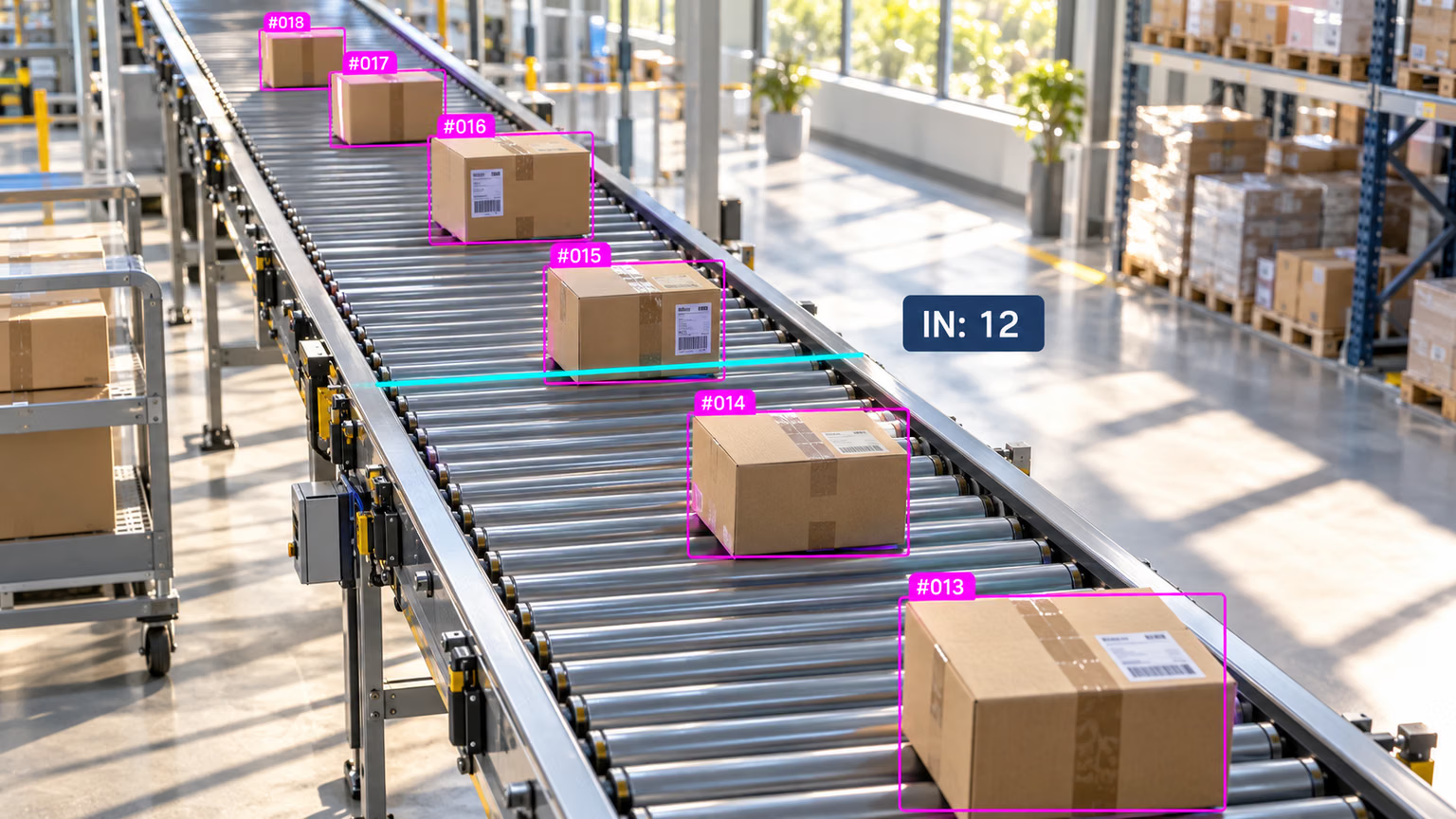 | 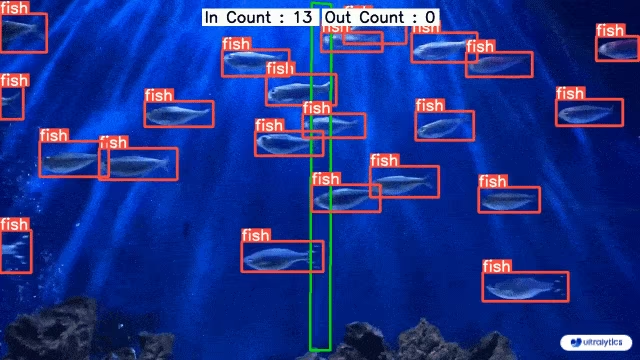 |
| Đếm gói hàng trên băng chuyền bằng Ultralytics YOLO26 | Đếm cá dưới biển bằng Ultralytics YOLO26 |
Đếm đối tượng bằng YOLO26#
Xác định một region để đếm — hai điểm cho một đường thẳng hoặc từ ba điểm trở lên cho một đa giác — rồi truyền vào giải pháp ObjectCounter. Bộ đếm theo dõi từng đối tượng qua các khung hình và tính tổng số lượt VÀO/RA khi đối tượng được theo dõi cắt qua đường thẳng hoặc đi qua vùng, sau đó trả về khung hình đã chú thích để bạn có thể ghi vào video đầu ra.
# Run a counting example
yolo solutions count show=True

# Pass a source video
yolo solutions count source="path/to/video.mp4"

# Pass region coordinates
yolo solutions count region="[(20, 400), (1080, 400), (1080, 360), (20, 360)]"
Đối số region chấp nhận hai điểm (cho đường thẳng) hoặc một đa giác có từ ba điểm trở lên. Xác định tọa độ theo thứ tự cần nối để bộ đếm biết chính xác vị trí các điểm vào và ra.
Các đối số của ObjectCounter#
Dưới đây là bảng các đối số của ObjectCounter:
| Đối số | Kiểu | Mặc định | Mô tả |
|---|---|---|---|
model | str | None | Đường dẫn đến tệp model Ultralytics YOLO. |
show_in | bool | True | Flag điều khiển việc hiển thị số lượt đi vào trên luồng video. |
show_out | bool | True | Flag điều khiển việc hiển thị số lượt đi ra trên luồng video. |
region | list hoặc dict | None | Các điểm xác định vùng quan tâm, dưới dạng danh sách tuple (x, y) hoặc từ điển ánh xạ tên vùng với danh sách điểm cho nhiều vùng (chỉ dùng RegionCounter). Khi là None, các giải pháp cần vùng sẽ dùng vùng mặc định được xác định trước. |
line_width | int | 2 | Độ dày đường viền của box, keypoint và số đếm mà giải pháp vẽ. |
verbose | bool | True | Bật nhật ký theo từng frame của giải pháp, gồm shape đầu vào, số lượng class và tốc độ xử lý. Bản thân lệnh gọi tracking luôn không ghi nhật ký. |
Giải pháp ObjectCounter cho phép sử dụng một số đối số track:
| Đối số | Kiểu | Mặc định | Mô tả |
|---|---|---|---|
tracker | str | 'tracktrack.yaml' | Chỉ định thuật toán theo dõi cần sử dụng. Các tùy chọn tích hợp sẵn: botsort.yaml, bytetrack.yaml, ocsort.yaml, deepocsort.yaml, fasttrack.yaml, tracktrack.yaml. |
conf | float | 0.25 | Đặt ngưỡng confidence cho các đối tượng được phát hiện; giá trị thấp hơn cho phép theo dõi nhiều đối tượng hơn nhưng có thể bao gồm cả kết quả dương tính giả. |
iou | float | 0.5 | Đặt ngưỡng Intersection over Union (IoU) để lọc các đối tượng phát hiện bị chồng lấn. |
classes | list | None | Lọc kết quả theo chỉ mục class. Ví dụ: classes=[0, 2, 3] chỉ theo dõi các class được chỉ định. |
device | str | None | Chỉ định thiết bị dùng để suy luận (ví dụ: cpu, cuda:0 hoặc 0). Cho phép người dùng chọn CPU, một GPU cụ thể hoặc thiết bị tính toán khác để chạy model. |
imgsz | int or tuple | 640 | Kích thước ảnh suy luận mục tiêu: số nguyên cho ảnh vuông hoặc cặp (height, width). Kích thước sẽ được điều chỉnh theo stride của model. |
max_det | int | 300 | Số lượng đối tượng phát hiện tối đa được giữ lại trong mỗi khung hình trước khi theo dõi, giới hạn số đối tượng mà một giải pháp xử lý trong các cảnh dày đặc. |
quantize | int or str | None | Độ chính xác suy luận: 16 (FP16) hoặc 32/unset (FP32) cho model PyTorch và TorchScript khi chạy ngoài CPU; các định dạng khác sử dụng độ chính xác do artifact và runtime của chúng lựa chọn. Thay thế đối số half đã lỗi thời. |
Ngoài ra, các đối số trực quan hóa được liệt kê bên dưới cũng được hỗ trợ:
| Đối số | Kiểu | Mặc định | Mô tả |
|---|---|---|---|
show | bool | False | Nếu True, hiển thị ảnh hoặc video đã được chú thích trong một cửa sổ. Hữu ích để nhận phản hồi trực quan ngay lập tức trong quá trình phát triển hoặc kiểm thử. |
show_conf | bool | True | Hiển thị điểm confidence bên cạnh nhãn của mỗi detection. Cho biết mức độ chắc chắn của model đối với từng detection. |
show_labels | bool | True | Hiển thị nhãn cho mỗi detection trong đầu ra trực quan. Giúp nhận biết ngay các đối tượng được phát hiện. |
Câu hỏi thường gặp#
Để đếm đối tượng trong video bằng Ultralytics YOLO26, bạn có thể làm theo các bước sau:
- Nhập các thư viện cần thiết (
cv2,ultralytics). - Xác định vùng đếm (ví dụ: đa giác, đường thẳng, v.v.).
- Thiết lập chức năng thu video và khởi tạo bộ đếm đối tượng.
- Xử lý từng khung hình để theo dõi và đếm đối tượng trong vùng đã xác định.
Sau đây là ví dụ đơn giản về cách đếm đối tượng trong một vùng:
import cv2

from ultralytics import solutions

def count_objects_in_region(video_path, output_video_path, model_path):
    """Count objects in a specific region within a video."""
    cap = cv2.VideoCapture(video_path)
    assert cap.isOpened(), "Error reading video file"
    w, h, fps = (int(cap.get(x)) for x in (cv2.CAP_PROP_FRAME_WIDTH, cv2.CAP_PROP_FRAME_HEIGHT, cv2.CAP_PROP_FPS))
    video_writer = cv2.VideoWriter(output_video_path, cv2.VideoWriter_fourcc(*"mp4v"), fps, (w, h))

    region_points = [(20, 400), (1080, 400), (1080, 360), (20, 360)]
    counter = solutions.ObjectCounter(show=True, region=region_points, model=model_path)

    while cap.isOpened():
        success, im0 = cap.read()
        if not success:
            print("Video frame is empty or processing is complete.")
            break
        results = counter(im0)
        video_writer.write(results.plot_im)

    cap.release()
    video_writer.release()
    cv2.destroyAllWindows()

count_objects_in_region("path/to/video.mp4", "output_video.avi", "yolo26n.pt")
Để tìm hiểu cấu hình và tùy chọn nâng cao hơn, hãy xem giải pháp RegionCounter để đếm đối tượng đồng thời trong nhiều vùng.
- Nhập các thư viện cần thiết (
Sử dụng Ultralytics YOLO26 để đếm đối tượng mang lại một số ưu điểm:
- Tối ưu hóa tài nguyên: Giải pháp này hỗ trợ quản lý tài nguyên hiệu quả bằng cách cung cấp số lượng chính xác, giúp tối ưu hóa việc phân bổ tài nguyên trong các ngành như quản lý hàng tồn kho.
- Tăng cường bảo mật: Giải pháp này tăng cường bảo mật và giám sát bằng cách theo dõi và đếm chính xác các thực thể, hỗ trợ phát hiện mối đe dọa chủ động và hệ thống bảo mật.
- Ra quyết định dựa trên thông tin: Giải pháp này cung cấp thông tin chuyên sâu có giá trị để ra quyết định, tối ưu hóa quy trình trong các lĩnh vực như bán lẻ, quản lý giao thông và nhiều lĩnh vực khác.
- Xử lý thời gian thực: Kiến trúc YOLO26 hỗ trợ suy luận thời gian thực, phù hợp với luồng video trực tiếp và các ứng dụng nhạy cảm về thời gian.
Để xem ví dụ triển khai và ứng dụng thực tế, hãy khám phá giải pháp TrackZone để theo dõi đối tượng trong các vùng cụ thể.
Để đếm các lớp đối tượng cụ thể bằng Ultralytics YOLO26, bạn cần chỉ định các lớp quan tâm trong giai đoạn theo dõi. Dưới đây là ví dụ Python:
import cv2

from ultralytics import solutions

def count_specific_classes(video_path, output_video_path, model_path, classes_to_count):
    """Count specific classes of objects in a video."""
    cap = cv2.VideoCapture(video_path)
    assert cap.isOpened(), "Error reading video file"
    w, h, fps = (int(cap.get(x)) for x in (cv2.CAP_PROP_FRAME_WIDTH, cv2.CAP_PROP_FRAME_HEIGHT, cv2.CAP_PROP_FPS))
    video_writer = cv2.VideoWriter(output_video_path, cv2.VideoWriter_fourcc(*"mp4v"), fps, (w, h))

    line_points = [(20, 400), (1080, 400)]
    counter = solutions.ObjectCounter(show=True, region=line_points, model=model_path, classes=classes_to_count)

    while cap.isOpened():
        success, im0 = cap.read()
        if not success:
            print("Video frame is empty or processing is complete.")
            break
        results = counter(im0)
        video_writer.write(results.plot_im)

    cap.release()
    video_writer.release()
    cv2.destroyAllWindows()

count_specific_classes("path/to/video.mp4", "output_specific_classes.avi", "yolo26n.pt", [0, 2])
Trong ví dụ này,
classes_to_count=[0, 2]có nghĩa là đếm các đối tượng thuộc lớp0và2(ví dụ: người và ô tô trong tập dữ liệu COCO). Bạn có thể tìm thêm thông tin về chỉ số lớp trong tài liệu tập dữ liệu COCO.Ultralytics YOLO26 có một số ưu điểm so với các model phát hiện đối tượng khác như Faster R-CNN, SSD và các phiên bản YOLO trước đây:
- Tốc độ và hiệu quả: YOLO26 chạy theo thời gian thực, rất phù hợp với các ứng dụng cần suy luận tốc độ cao như giám sát và lái xe tự hành.
- Độ chính xác: Model này mang lại độ chính xác cao trong phát hiện và theo dõi, giảm dương tính giả và cải thiện độ tin cậy tổng thể của hệ thống.
- Dễ tích hợp: YOLO26 hỗ trợ xuất sang nhiều định dạng triển khai cho máy chủ, thiết bị di động và thiết bị biên.
- Tính linh hoạt: Hỗ trợ model phát hiện, phân đoạn và OBB, đồng thời có thể dùng chế độ theo dõi và cấu hình model theo yêu cầu của từng trường hợp sử dụng.
Xem Tài liệu YOLO26 của Ultralytics để tìm hiểu sâu hơn về các tính năng và so sánh hiệu năng.
Có. Ultralytics YOLO26 rất phù hợp cho phân tích đám đông và quản lý giao thông vì có thể phát hiện, theo dõi và đếm đối tượng theo thời gian thực trong môi trường biến động. Một số trường hợp sử dụng gồm:
- Phân tích đám đông: Giám sát và quản lý các đám đông lớn, đảm bảo an toàn và tối ưu hóa luồng di chuyển của đám đông bằng đếm theo vùng.
- Quản lý giao thông: Theo dõi và đếm phương tiện, phân tích tình hình giao thông và quản lý ùn tắc theo thời gian thực bằng ước tính tốc độ.
- Phân tích bán lẻ: Phân tích mô hình di chuyển của khách hàng và tương tác với sản phẩm để tối ưu hóa cách bố trí cửa hàng và cải thiện trải nghiệm khách hàng.
- Tự động hóa công nghiệp: Đếm sản phẩm trên băng chuyền và giám sát dây chuyền sản xuất để kiểm soát chất lượng và cải thiện hiệu quả.


Bình luận879
Đặt câu hỏi, chia sẻ kết quả hoặc giúp đỡ người khác.
RizwanMunawar
🎉 Big News Alert! 🚀 Ultralytics Solutions CLI is here from ultralytics>=8.3.28! Now, you can easily harness the power of advanced YOLO solutions straight from the command line. Simplify your workflow, and streamline object detection, tracking, counting, and more—all with just a few commands! Get ready to experience a whole new level of efficiency! 💥
CLI Usage Overview
yolo SOLUTIONS SOLUTION_NAME ARGS- SOLUTIONS is a mandatory keyword.
- SOLUTION_NAME (optional): Choose from ['count', 'heatmap', 'queue', 'speed', 'workout', 'analytics'].
- ARGS (optional): Use custom
arg=valuepairs, likeshow_in=True, to customize settings.
Examples
yolo solutions count show=True  # For object counting

yolo solutions source="path/to/video/file.mp4"  # Specify a video file path
Start exploring now and let Ultralytics Solutions CLI power up your projects!
5faheem-khaskheli
i have created a line, at 15 degree angle, if a person come down it should count as in, and if a person goes up it count as out.
- down = in
- up = out but model does not work like this, model count direction is reversed.
how can i solve this?
 Glenn JocherUltralytics
@faheem-khaskheli to resolve the direction issue, ensure the line's orientation is correctly defined in your code. You might need to adjust the logic that determines the direction based on the line's angle. If the model's counting direction is reversed, check the implementation of the
ObjectCounterand verify the region or line points are set correctly.@glenn-jocher is there any way i can use ultralytics solution for this problem? i have checked the code and it is only checking
dx > 0forinelseout.- Glenn JocherUltralytics
@faheem-khaskheli to address the reversed counting direction, adjust the logic in your code to correctly interpret the angle of the line. Ensure that the conditions for
dx > 0anddx < 0align with the intended "in" and "out" directions based on your line's orientation.
Boaruzhanchik
Hi,how can I use object counting with 3 lines and 3 different counters ?
line_points = [(197,164), (486,164)]Line pedestrian
line_pedestrian_1 = [(234,244),(131,218)] line_pedestrian_2 = [(490,245),(534,231)] line_pedestrian_3 = [(112,189),(154,177)] counter = object_counter.ObjectCounter() counter.set_args(view_img=False, reg_pts=line_points, classes_names=model.names, draw_tracks=False, region_thickness = 1) my code ex: im0 = counter.start_counting(frame, results) counter.extract_and_process_tracks(results) counter.in_counts counter.out_counts print(f'In counts:{counter.in_counts}') print(f'Out counts:{counter.out_counts}')
2- Glenn JocherUltralytics(đã chỉnh sửa)
Hey there! 👋 For multiple lines with separate counts, create one
ObjectCounterper line and pass each frame to every counter. Each counter keeps its own in/out counts:from ultralytics import solutions line_pedestrian_1 = [(234, 244), (131, 218)] line_pedestrian_2 = [(490, 245), (534, 231)] line_pedestrian_3 = [(112, 189), (154, 177)] counters = [ solutions.ObjectCounter(region=line, model='yolo26n.pt') for line in (line_pedestrian_1, line_pedestrian_2, line_pedestrian_3) ] # For each frame: for i, counter in enumerate(counters, 1): results = counter(frame) print(f'Counter {i} - In: {results.in_count}, Out: {results.out_count}')This way, each
ObjectCounterwill track objects crossing its respective line. Hope this helps! If you have further questions, feel free to ask. Happy coding! 😊1 Thank you for your reply! There was a problem with counting the number of custom classes, the docstring says "classes_names (dict): Classes names", I'm trying to use class_cars = { 2.0 : 'car', 5 : 'bus', 7: 'truck' } counter3.set_args(classes_names=class_cars, reg_pts=line_pedestrian_3,region_thickness = 2) but an error occurs Traceback (most recent call last): File "/home/iosif/Documents/Dev/yolo_model/yolov8_train/yolov8_tracking_car_number/tracking_5.py", line 93, in im0 = counter3.start_counting(frame, results) File "/home/iosif/.local/lib/python3.10/site-packages/ultralytics/solutions/object_counter.py", line 259, in start_counting self.extract_and_process_tracks(tracks) File "/home/iosif/.local/lib/python3.10/site-packages/ultralytics/solutions/object_counter.py", line 172, in extract_and_process_tracks self.annotator.box_label(box, label=f"{track_id}:{self.names[cls]}", color=colors(int(cls), True)) KeyError: 0.0 When trying to get a class by index, the following error occurs Traceback (most recent call last): File "/home/iosif/Documents/Dev/yolo_model/yolov8_train/yolov8_tracking_car_number/tracking_5.py", line 87, in im0 = counter1.start_counting(frame, results) File "/home/iosif/.local/lib/python3.10/site-packages/ultralytics/solutions/object_counter.py", line 259, in start_counting self.extract_and_process_tracks(tracks) File "/home/iosif/.local/lib/python3.10/site-packages/ultralytics/solutions/object_counter.py", line 172, in extract_and_process_tracks self.annotator.box_label(box, label=f"{track_id}:{self.names[cls]}", color=colors(int(cls), True)) TypeError: string indices must be integers Question: How can I select the class that I want to count?
- Glenn JocherUltralytics(đã chỉnh sửa)
Hi there! 👋 In current versions
ObjectCounterno longer takesclasses_namesorset_args(); class names come from the model, so thatKeyErrorcan't occur. To count only specific classes, pass their indices withclasses:from ultralytics import solutions counter3 = solutions.ObjectCounter(region=line_pedestrian_3, model='yolo26n.pt', classes=[2, 5, 7], line_width=2) results = counter3(im0) print(results.classwise_count) # e.g. {'car': {'IN': 1, 'OUT': 0}}This should resolve the errors you're seeing. Let me know if you need any more help! 😊
This will work to limit the total number of detectable classes, but it does not solve the problem of counting in separate areas of a single class (2 areas to count only cars and buses and 2 areas for pedestrians). An example from the code (Now I will describe why it happens) I specified a limited list of classes for tracking and when cls =17 is detected in tracking, the program crashes because this class is not specified in counter.set_args. How can I get around this limitation so that I can specify different classes for counting different areas (as I said in the example 2 only for cars, 2 only for people).
class_list_common = [0,2,5,7,17]
 all_dict_dict = { 0 : 'person', 2: 'car', 5: 'bus',7: 'truck'}
counter1.set_args(classes_names=all_dict_dict,reg_pts=line_pedestrian_1,region_thickness = 2,line_dist_thresh=8,draw_tracks=True)
results = model.track(frame,classes=class_list_common)
Traceback (most recent call last): File "/home/iosif/Documents/Dev/yolo_model/yolov8_train/yolov8_tracking_car_number/tracking_5.py", line 140, in im0 = counter1.start_counting(frame, results) File "/home/iosif/.local/lib/python3.10/site-packages/ultralytics/solutions/object_counter.py", line 259, in start_counting self.extract_and_process_tracks(tracks) File "/home/iosif/.local/lib/python3.10/site-packages/ultralytics/solutions/object_counter.py", line 172, in extract_and_process_tracks self.annotator.box_label(box, label=f"{track_id}:{self.names[cls]}", color=colors(int(cls), True)) KeyError: 17.0
- Glenn JocherUltralytics(đã chỉnh sửa)
Hey there! 👋 To count different classes in separate areas, create multiple
ObjectCounterinstances, each with its ownregionandclasseslist. Class names come from the model automatically, andclasswise_countgives the counts per class:from ultralytics import solutions counter_cars_buses = solutions.ObjectCounter(model='yolo26n.pt', region=line_cars_buses, classes=[2, 5]) counter_pedestrians = solutions.ObjectCounter(model='yolo26n.pt', region=line_pedestrians, classes=[0]) # For each frame: im0 = counter_cars_buses(frame).plot_im im0 = counter_pedestrians(frame).plot_imThis way, each counter will only count the classes it's set up for. Happy counting! 😊
syariffortask
hello there, how about if i want my line just for in count not for out count for example i have line_pedestrian_1 = [(0,244),(131,244)] ,if all people touch this line count in will increment, because what I know so far is that the line is divided into 2 parts, one for counting in and one for counting out
- Glenn JocherUltralytics(đã chỉnh sửa)
Hi there! 👋
ObjectCounterreportsin_countandout_countseparately for a line, based on the direction in which tracked objects cross it. If you only need one direction, read just that value and ignore the other:from ultralytics import solutions counter = solutions.ObjectCounter(region=line_pedestrian_1, model='yolo26n.pt') results = counter(frame) print(results.in_count) # only objects crossing in the 'in' directionHappy coding! 😊
can you gimmi example please
- Glenn JocherUltralytics(đã chỉnh sửa)
Hello! Sure, I'd be happy to provide an example for setting up object counting with Ultralytics YOLO. Let's suppose you want to count cars crossing a line. Here's how you could set this up:
import cv2

from ultralytics import solutions

# Open video file
cap = cv2.VideoCapture('path/to/your/video.mp4')
assert cap.isOpened(), 'Error loading video'

# Define the line points for counting
line_points = [(20, 400), (1080, 400)]  # Adjust these points to fit your line

# Initialize Object Counter; classes=[2] counts only cars in the COCO classes
counter = solutions.ObjectCounter(model='yolo26n.pt', region=line_points, classes=[2])

# Process video and start counting
while cap.isOpened():
    ret, frame = cap.read()
    if not ret:
        break  # End of video

    # Perform tracking and counting
    results = counter(frame)

    # Optionally view the frame with counts
    cv2.imshow('Object Counting', results.plot_im)
    if cv2.waitKey(1) & 0xFF == 27:  # press 'ESC' to exit
        break

# Release resources
cap.release()
cv2.destroyAllWindows()
💡 Important:
- Adjust
line_pointsto position your counting line in the video frame. - Use
classeswith the model's class indices to count only specific object types.
Objects crossing the line in one direction increase
results.in_countand in the opposite directionresults.out_count. For multiple counting areas, create one counter per line or region.Hope this helps get you started! Let me know if there's anything else you'd like to explore. 😄
- Adjust
why line point not show in frame?
- Glenn JocherUltralytics(đã chỉnh sửa)
@syariffortask hey! If your line is not appearing on the frame, there could be a couple of things to check. Make sure
show=Trueis set when initializing yourObjectCounter(or displayresults.plot_imyourself), and verify that theregionpoints are correctly defined and fall within the frame's dimensions. Here's a quick example:from ultralytics import solutions counter = solutions.ObjectCounter( show=True, region=[(20, 400), (1080, 400)], # Make sure these points are within your frame's dimensions model='yolo26n.pt', )Make sure your setup matches your video frame size, and adjust
regionas necessary. This adjustment should help you visualize the counting line directly on your frames! 😊 Let me know if this does the trick! glenn tell me how you can do that? are you update class ObjectCounter logic in new version ultralytics?
- Glenn JocherUltralytics(đã chỉnh sửa)
Hey! 👋 Thanks for reaching out. Yes, we're constantly working on enhancing the
ObjectCounterlogic. For counting objects crossing a specific line, here's a quick example based on your requirement:import cv2 from ultralytics import solutions # Set up your video source cap = cv2.VideoCapture('path/to/video.mp4') # Initialize Object Counter for your line line_pedestrian_1 = [(0, 244), (131, 244)] # Define as per your need counter = solutions.ObjectCounter(show=True, region=line_pedestrian_1, model='yolo26n.pt', classes=[0]) while cap.isOpened(): ret, im0 = cap.read() if not ret: break # Track objects and count crossings of your line results = counter(im0) # Display cv2.imshow('Count', results.plot_im) if cv2.waitKey(1) == ord('q'): # press q to quit break cap.release() cv2.destroyAllWindows()This sets up an object counting system for pedestrians crossing
line_pedestrian_1.ObjectCounterreportsresults.in_countandresults.out_countseparately based on the direction of crossing, so you can use only the one you need. Keep up with our GitHub releases for the latest features! 🚀 Let me know if there's anything else I can help with. Thanks for answer my question, But Can ultralytics predict and count two frame/ two vidio source ?
- Glenn JocherUltralytics(đã chỉnh sửa)
@syariffortask hey! Thanks for reaching out with your question. 😊 Yes, YOLO can definitely work with two video sources simultaneously, but it would require running two instances of the video processing loop, each in its own thread or process, due to the way the code execution works.
Here's a simplified example using Python's
threadingmodule to process two videos at the same time:from threading import Thread import cv2 from ultralytics import YOLO def process_video(video_path): model = YOLO('yolo26n.pt') cap = cv2.VideoCapture(video_path) assert cap.isOpened(), 'Error reading video file' while cap.isOpened(): success, frame = cap.read() if not success: break results = model.track(frame, persist=True) # Here you could use a solutions.ObjectCounter per video # For example: im0 = counter(frame).plot_im # And then save or display im0 cap.release() # Define your video sources video_1 = 'path/to/your/first_video.mp4' video_2 = 'path/to/your/second_video.mp4' # Start processing each video in a separate thread Thread(target=process_video, args=(video_1,)).start() Thread(target=process_video, args=(video_2,)).start()Remember, depending on your system, handling two video streams simultaneously can be resource-intensive. Adjust the frame processing rate if necessary to manage system load. Hope that helps! Let me know if you have more questions. 🚀
phoenix-JM
Hello everyone; i used the following code snippet for trained yolov8n-obb model with five classes;
import cv2
from ultralytics import solutions
cap = cv2.VideoCapture("xie_035.mp4") assert cap.isOpened(), "Error reading video file"
region_points = [(20, 400), (1080, 400)] # line counting
region_points = [(20, 400), (1080, 400), (1080, 360), (20, 360)] # rectangle region
region_points = [(20, 400), (1080, 400), (1080, 360), (20, 360), (20, 400)] # polygon region
Video writer
w, h, fps = (int(cap.get(x)) for x in (cv2.CAP_PROP_FRAME_WIDTH, cv2.CAP_PROP_FRAME_HEIGHT, cv2.CAP_PROP_FPS)) video_writer = cv2.VideoWriter("object_counting_output.avi", cv2.VideoWriter_fourcc(*"mp4v"), fps, (w, h))
Initialize object counter object
counter = solutions.ObjectCounter( show=True, # display the output region=region_points, # pass region points model="D:/TRACKING_COUNTING/yolov8n-obb_ads.pt", # model="yolo11n-obb.pt" for object counting with OBB model. # classes=[0, 2], # count specific classes i.e. person and car with COCO pretrained model. tracker="bytetrack.yaml", # choose trackers i.e "bytetrack.yaml" )
Process video
while cap.isOpened(): success, im0 = cap.read()
if not success:
    print("Video frame is empty or processing is complete.")
    break

results = counter(im0)

# print(results)  # access the output

video_writer.write(results.plot_im)  # write the processed frame.
cap.release() video_writer.release() cv2.destroyAllWindows() # destroy all opened windows
however, it generates HBB not OBB, can someone help please.
1- Glenn JocherUltralytics(đã chỉnh sửa)
@phoenix-JM thanks for reaching out!
ObjectCounterhandles OBB models natively, so you can pass an OBB model directly (e.g.model="yolo26n-obb.pt") and no special initialization is needed; please make sure you're using the latest Ultralytics version. If you need the raw OBB coordinates for custom plotting, they are available ascounter.boxesafter the call (orresults.obb.xyxyxyxywhen running a model directly). For new projects we recommend the YOLO26-OBB models as shown in our Object Counting documentation. Let us know if you need further guidance! 🚀 @phoenix-JM Hi, thanks for the question. Indeed, visualization for OBB is not supported yet. you can only plot the HBB. I will work on this feature this week. Thanks
Thank you for your reply. @glenn-jocher can you please provide me the code snippet to do so.
@muhammadrizwanmunawar Hello ! is there any update regarding object counting and tracking using OBB. ?
@phoenix-JM Hi, yes, we already added the support for OBB object counting. The code is the same, no changes. Here's the demo. If you want to take a look: https://www.linkedin.com/feed/update/urn:li:activity:7327964827048411136/
mirfan-ahmad
Can I integrate ObjectCounter Pipeline with RT-DETR?
1@mirfan-ahmad Hi, Thanks for reaching out. We currently don't support the ObjectCounting functionality for RT-DETR! At the moment we only support the Ultralytics YOLO models for Object Counting available here: https://docs.ultralytics.com/models/. Thank you!
SourceOfNootmite
Hi ultralytics team! Hope you're doing well. My knowledge of computer vision is quite limited, so apologies for dumb questions. Is it possible to train my own model based off yolov11? I attempted to do so by using a roboflow guide and their example colab notebook. I have access to the weights, one of them saying best.pt. Are weights and models completely different. Can i somehow use that and replace:
model="yolo11n.pt" with my own model.# Init ObjectCounter counter = solutions.ObjectCounter( show=True, # Display the output region=region_points, # Pass region points model="yolo11n.pt", # model="yolo11n-obb.pt" for object counting using YOLO11 OBB model. # classes=[0, 2], # If you want to count specific classes i.e person and car with COCO pretrained model. # show_in=True, # Display in counts # show_out=True, # Display out counts # line_width=2, # Adjust the line width for bounding boxes and text display )1@SourceOfNootmite Hi! Yes, you can use any supported model for object counting, including YOLOv10, Ultralytics YOLO11, and Ultralytics YOLOv8. You can also use any model we support. If you have a YOLO11 model trained on your dataset, it will work seamlessly with the Object Counting module.
However, this feature is not currently supported if you're referring to a completely new model architecture. Thanks!
Martinnemo
hi guys.
Thanks for an awesome job with all of ultralytics!
I'm having a problem where/ how to implement the conf and model.track in the code above ? Can you help ? :)
1@Martinnemo Hi, the implementation for object counting is available at: https://github.com/ultralytics/ultralytics/blob/main/ultralytics/solutions/object_counter.py
Thank you! 😊
I mean, i following code, how do i apply the confidence function:
import cv2
from ultralytics import solutions
cap = cv2.VideoCapture("path/to/video/file.mp4") assert cap.isOpened(), "Error reading video file" w, h, fps = (int(cap.get(x)) for x in (cv2.CAP_PROP_FRAME_WIDTH, cv2.CAP_PROP_FRAME_HEIGHT, cv2.CAP_PROP_FPS))
Define region points
region_points = [(20, 400), (1080, 400)] # For line counting
region_points = [(20, 400), (1080, 400), (1080, 360), (20, 360)] # For rectangle region counting
region_points = [(20, 400), (1080, 400), (1080, 360), (20, 360), (20, 400)] # For polygon region counting
Video writer
video_writer = cv2.VideoWriter("object_counting_output.avi", cv2.VideoWriter_fourcc(*"mp4v"), fps, (w, h))
Init Object Counter
counter = solutions.ObjectCounter( show=True, # Display the output region=region_points, # Pass region points model="yolo11n.pt", # model="yolo11n-obb.pt" for object counting using YOLO11 OBB model. # classes=[0, 2], # If you want to count specific classes i.e person and car with COCO pretrained model. # show_in=True, # Display in counts # show_out=True, # Display out counts # line_width=2, # Adjust the line width for bounding boxes and text display )
Process video
while cap.isOpened(): success, im0 = cap.read() if not success: print("Video frame is empty or video processing has been successfully completed.") break im0 = counter.count(im0) video_writer.write(im0)
cap.release() video_writer.release() cv2.destroyAllWindows()
- Glenn JocherUltralytics(đã chỉnh sửa)
To apply the confidence threshold (
conf) to filter detections, you can pass it as a parameter when initializing theObjectCounter. Here's an example:counter = solutions.ObjectCounter( show=True, region=region_points, model="yolo26n.pt", conf=0.5 # Adjust the confidence threshold as needed )This will only count objects with a detection confidence score above the specified threshold (
0.5in this case). Let me know if you need further clarification!
gmantova
What is the minimal code that I can use to have:
yolo (defining parameters, if any)
bytetrack (defining parameters, if any)
get the coordinates of the boxes and id of the object
then I'll define a geometric condition, let's say behind a line etc
1- Glenn JocherUltralytics(đã chỉnh sửa)
@g-i-o-r-g-i-o to achieve object tracking and counting with YOLO and ByteTrack, you can use the following minimal code setup. This will allow you to get the coordinates and IDs of detected objects and apply a geometric condition:
import cv2
from ultralytics import YOLO

# Initialize model and video capture
model = YOLO('yolo26n.pt')
cap = cv2.VideoCapture('path/to/video.mp4')

while cap.isOpened():
    success, frame = cap.read()
    if not success:
        break

    # Run detection and tracking
    results = model.track(frame, persist=True, tracker='bytetrack.yaml')

    # Process results
    for r in results:
        for box in r.boxes:
            x1, y1, x2, y2 = box.xyxy[0].tolist()
            obj_id = int(box.id) if box.id is not None else None
            # Apply geometric condition here, e.g., check if behind a line

    # Display or save results
    cv2.imshow('Frame', frame)
    if cv2.waitKey(1) & 0xFF == ord('q'):
        break

cap.release()
cv2.destroyAllWindows()
For more detailed guidance, please visit the object counting guide.
1
Hi, my results with "count in line" are totally off. It confuses in and out while there is only one direction, I've wasted hours and this is crazy.
It confuses in and out, and I don't understand why.
Maybe someone can take a look?
1- Glenn JocherUltralytics
@g-i-o-r-g-i-o i'm sorry to hear about the issues you're facing. Please ensure that the region and line points are correctly defined in your setup. For further guidance, you can refer to our object counting documentation at https://docs.ultralytics.com/guides/object-counting/. If the problem persists, consider checking the model configuration and input parameters.
GenieV19
I have a question about the total number of objects detected vs the counts displayed. I have set the polygon region to be the entire video area, but my counts 'in' and 'out' do not equal either the number of boxes drawn and manually counted or the ID number displayed against each object, which is around double the number of boxes actually shown. Could you explain why this is and how to obtain a final number of unique objects detected? Thanks!
1 Paula DerrengerUltralytics(đã chỉnh sửa)
@GenieV19 hello!
Thank you for your question and for providing detailed information. It sounds like you're experiencing a discrepancy between the number of detected objects and the counts displayed. Let's address this step-by-step:
-
Tracking IDs vs. Bounding Boxes: The IDs displayed are unique identifiers assigned to each tracked object. These IDs can appear higher than the number of visible bounding boxes due to objects entering and exiting the frame, or being temporarily occluded and then re-detected. This can lead to new IDs being assigned.
-
Counting Logic: The 'in' and 'out' counts are based on tracked objects crossing the line or entering the region, and each track ID is counted once. Ensure that your region is set correctly and that the counting logic aligns with your expectations.
-
Unique Object Counting: To get a final count of unique objects, you can collect the track IDs over the entire video. Here's a simple example:
import cv2

from ultralytics import solutions

cap = cv2.VideoCapture("path/to/video/file.mp4")
assert cap.isOpened(), "Error reading video file"
w, h, fps = (int(cap.get(x)) for x in (cv2.CAP_PROP_FRAME_WIDTH, cv2.CAP_PROP_FRAME_HEIGHT, cv2.CAP_PROP_FPS))

# Define region points
region_points = [(20, 400), (1080, 404), (1080, 360), (20, 360)]


unique_ids = set()

# Video writer
video_writer = cv2.VideoWriter("object_counting_output.avi", cv2.VideoWriter_fourcc(*"mp4v"), fps, (w, h))

# Init Object Counter
counter = solutions.ObjectCounter(
    show=True,
    region=region_points,
    model="yolo26n.pt",
)

while cap.isOpened():
    success, im0 = cap.read()
    if not success:
        print("Video frame is empty or processing is complete.")
        break

    results = counter(im0)
    unique_ids.update(counter.track_ids)  # track IDs in this frame
    video_writer.write(results.plot_im)

cap.release()
video_writer.release()
cv2.destroyAllWindows()
After the loop, print the result:
print(f"Total unique objects detected: {len(unique_ids)}")- Ensure Latest Versions: Please ensure you are using the latest versions of
torchandultralytics. You can upgrade them using:pip install --upgrade torch ultralytics
If the issue persists, please provide a minimum reproducible example as outlined here. This will help us investigate further.
Feel free to reach out if you have any more questions! 😊
-
TanrionTV
Hello,
I would like to use your program to count grey sections. However, I have two problems: - Firstly, when I use the tracker some detections disappear. That's why I can't think of anything to improve it. - and secondly, some tracking identifiers are reallocated to objects that have nothing to do with the initial one. I was thinking of modifying botrack so that it only assigns the same identifiers for 10 frames, for example, but I have no idea how to do this. Do you think this is feasible?
I have an i9 vPro and a Nvidia A2000.
Here's the program I use:
import cv2
from ultralytics import YOLO, solutions

MODEL_PATH = r'model\best.pt'
model=YOLO(MODEL_PATH)
cap = cv2.VideoCapture('test_26_50mm.avi')
assert cap.isOpened(), "Error reading video file"
w, h, fps = (int(cap.get(x)) for x in (cv2.CAP_PROP_FRAME_WIDTH, cv2.CAP_PROP_FRAME_HEIGHT, cv2.CAP_PROP_FPS))

# Define line points
# Conveyor
#line_points = [(0, 800), (2000, 800)]
# Bar line vertical
line_points = [(2000, 0), (2000, 2500)]
# Bar line horizontal
#line_points = [(0,2200), (2500, 2200)]

# Video writer
video_writer = cv2.VideoWriter('results\output_bar_counting.avi', cv2.VideoWriter_fourcc(*"mp4v"), fps, (w, h))

# Init Object Counter
counter = solutions.ObjectCounter(
    view_img=False,
    reg_pts=line_points,
    classes_names=model.names,
    draw_tracks=False,
    track_thickness=2,
    line_thickness=5,
    line_dist_thresh = 200,
    view_out_counts=False

)

while cap.isOpened():
    success, frame = cap.read()
    if not success:
        print("Video frame is empty or video processing has been successfully completed.")
        break
    tracks = model.track(frame, persist=True, show=False, tracker = 'botsort.yaml', conf = 0.6)

    frame = counter.start_counting(frame, tracks)
    video_writer.write(frame)

cap.release()
video_writer.release()
cv2.destroyAllWindows()
I would have liked to share some pictures with you, but I couldn't. If you can help me, I would appreciate it.
1maybe i can edit botsort.yaml, what do you think ?
and do you why the tracking is better when count in line than when count in region ?
- Glenn JocherUltralytics(đã chỉnh sửa)
Hello,
Thank you for reaching out! Let's address your concerns one by one.
Disappearing Detections
The issue of disappearing detections can often be attributed to the confidence threshold or the tracking algorithm's parameters. You can experiment with the
confandiouparameters (they can be passed straight toObjectCounter, which runs the tracker) to see if adjusting these values helps retain more detections. For example, lowering the confidence threshold might help:counter = solutions.ObjectCounter(region=line_points, model="best.pt", tracker="botsort.yaml", conf=0.3, iou=0.4)Reallocation of Tracking Identifiers
Reallocation of tracking IDs can indeed be problematic. Modifying the BoT-SORT algorithm to maintain the same identifiers for a fixed number of frames is a feasible approach. However, this requires a deeper dive into the BoT-SORT implementation. You can start by editing the
botsort.yamlconfiguration file to tweak parameters liketrack_high_threshandtrack_low_thresh.Editing
botsort.yamlYou can modify the
botsort.yamlfile to adjust the tracking parameters. Here’s an example of how you might adjust thetrack_high_threshto ensure that IDs are not reallocated too frequently:# botsort.yaml track_high_thresh: 0.6 # Increase this value to make the tracker more confident before reallocating IDs track_low_thresh: 0.1 # Lower this value to keep tracks alive longerExample Code
Here’s an updated version of your code with some adjustments:
import cv2

from ultralytics import solutions

cap = cv2.VideoCapture("test_26_50mm.avi")
assert cap.isOpened(), "Error reading video file"
w, h, fps = (int(cap.get(x)) for x in (cv2.CAP_PROP_FRAME_WIDTH, cv2.CAP_PROP_FRAME_HEIGHT, cv2.CAP_PROP_FPS))

# Define line points
line_points = [(2000, 0), (2000, 2500)]

# Video writer
video_writer = cv2.VideoWriter("results/output_bar_counting.avi", cv2.VideoWriter_fourcc(*"mp4v"), fps, (w, h))

# Init Object Counter
counter = solutions.ObjectCounter(
    show=False,
    region=line_points,
    model=r"model/best.pt",
    tracker="botsort.yaml",
    conf=0.3,
    iou=0.4,
    line_width=5,
    show_out=False,
)

while cap.isOpened():
    success, frame = cap.read()
    if not success:
        print("Video frame is empty or video processing has been successfully completed.")
        break

    results = counter(frame)
    video_writer.write(results.plot_im)

cap.release()
video_writer.release()
cv2.destroyAllWindows()
Further Customization
For more advanced customization, you might need to dive into the BoT-SORT source code. If you're comfortable with Python, you can clone the BoT-SORT repository, make your changes, and then use your modified version with Ultralytics YOLO.
Additional Resources
For more detailed guidance on object counting and tracking, you can refer to our Object Counting Guide. This guide provides comprehensive information on setting up and optimizing object counting with Ultralytics YOLO.
Feel free to reach out if you have any more questions or need further assistance. Happy coding! 😊
Thank you very much for your advice, I had already tried to modify the conf and iou parameters as well as the botsort.yaml file. However, it still doesn't work. I think I'm asking too much of the program, because the gray sections are very close together and the camera only records at 24fps. Thanks anyway! Or do you have other trackers to recommend?
Maybe I could do some tracking in a cropped area, what do you think about that ?
- Glenn JocherUltralytics(đã chỉnh sửa)
@TanrionTV hello,
Thank you for your thoughtful question! Cropping the area for tracking can indeed be a useful strategy, especially when dealing with closely packed objects. By focusing on a smaller region, you can potentially improve the accuracy and consistency of the tracking.
Here’s how you can implement cropping in your existing code:
- Crop the Frame: Before passing the frame to the counter, crop it to the region of interest.
- Use Cropped Coordinates:
ObjectCountertracks the image you pass it, so define its line or region in the crop's coordinates and paste the annotated crop back into the full frame if needed.
Here’s an example of how you might modify your code to include cropping:
import cv2

from ultralytics import solutions

cap = cv2.VideoCapture("test_26_50mm.avi")
assert cap.isOpened(), "Error reading video file"
w, h, fps = (int(cap.get(x)) for x in (cv2.CAP_PROP_FRAME_WIDTH, cv2.CAP_PROP_FRAME_HEIGHT, cv2.CAP_PROP_FPS))

# Define crop region (x, y, width, height)
x, y, cw, ch = (500, 500, 1000, 1000)

# Line points are given in cropped-frame coordinates (here a vertical line in the middle of the crop)
line_points = [(500, 0), (500, 1000)]

# Video writer
video_writer = cv2.VideoWriter("results/output_bar_counting.avi", cv2.VideoWriter_fourcc(*"mp4v"), fps, (w, h))

# Init Object Counter
counter = solutions.ObjectCounter(
    show=False,
    region=line_points,
    model=r"model/best.pt",
    tracker="botsort.yaml",
    conf=0.3,
    iou=0.4,
    line_width=5,
    show_out=False,
)

while cap.isOpened():
    success, frame = cap.read()
    if not success:
        print("Video frame is empty or video processing has been successfully completed.")
        break

    # Crop, count inside the crop, then paste the annotated crop back into the full frame
    results = counter(frame[y : y + ch, x : x + cw])
    frame[y : y + ch, x : x + cw] = results.plot_im
    video_writer.write(frame)

cap.release()
video_writer.release()
cv2.destroyAllWindows()
Alternative Trackers
If BoT-SORT is not meeting your needs, you might want to try ByteTrack, which is another robust tracker supported by Ultralytics. You can switch to ByteTrack by changing the
trackerparameter:counter = solutions.ObjectCounter(region=line_points, model="model/best.pt", tracker="bytetrack.yaml", conf=0.3, iou=0.4)Additional Tips
- Frame Rate: Given that your camera records at 24fps, ensure that your model and tracker can handle this frame rate efficiently. Sometimes, reducing the frame rate can help improve tracking stability.
- Experiment with Parameters: Continue experimenting with different
confandiouvalues, as well as tracker-specific parameters in the YAML files.
For more detailed guidance on object counting and tracking, you can refer to our Object Counting Guide.
Feel free to reach out if you have any more questions or need further assistance. Happy coding! 😊
thank you ! but i have this error : track.boxes.xyxy[:, [0, 2]] += x ~~~~~~~~~~~~~~~~^^^^^^^^^^^ RuntimeError: Inplace update to inference tensor outside InferenceMode is not allowed.You can make a clone to get a normal tensor before doing inplace update.See https://github.com/pytorch/rfcs/pull/17 for more details.
- Glenn JocherUltralytics(đã chỉnh sửa)
Hello,
Thank you for your detailed feedback and for sharing your code! 😊
The inplace tensor update error comes from editing the tracked boxes after inference. In current versions you don't need to:
ObjectCounterruns the tracker itself, so you pass it the cropped image with the line defined in the crop's coordinates and paste the annotated crop back. Here’s how you can modify your code:import cv2 from ultralytics import solutions cap = cv2.VideoCapture("test_26_50mm.avi") assert cap.isOpened(), "Error reading video file" w, h, fps = (int(cap.get(x)) for x in (cv2.CAP_PROP_FRAME_WIDTH, cv2.CAP_PROP_FRAME_HEIGHT, cv2.CAP_PROP_FPS)) # Define crop region (x, y, width, height) x, y, cw, ch = (500, 500, 1000, 1000) # Line points are given in cropped-frame coordinates (here a vertical line in the middle of the crop) line_points = [(500, 0), (500, 1000)] # Video writer video_writer = cv2.VideoWriter("results/output_bar_counting.avi", cv2.VideoWriter_fourcc(*"mp4v"), fps, (w, h)) # Init Object Counter counter = solutions.ObjectCounter( show=False, region=line_points, model=r"model/best.pt", tracker="botsort.yaml", conf=0.3, iou=0.4, line_width=5, show_out=False, ) while cap.isOpened(): success, frame = cap.read() if not success: print("Video frame is empty or video processing has been successfully completed.") break # Crop, count inside the crop, then paste the annotated crop back into the full frame results = counter(frame[y : y + ch, x : x + cw]) frame[y : y + ch, x : x + cw] = results.plot_im video_writer.write(frame) cap.release() video_writer.release() cv2.destroyAllWindows()Alternative Trackers
If BoT-SORT is not meeting your needs, you might want to try ByteTrack, which is another robust tracker supported by Ultralytics. You can switch to ByteTrack by changing the
trackerparameter:counter = solutions.ObjectCounter(region=line_points, model="model/best.pt", tracker="bytetrack.yaml", conf=0.3, iou=0.4)Additional Tips
- Frame Rate: Given that your camera records at 24fps, ensure that your model and tracker can handle this frame rate efficiently. Sometimes, reducing the frame rate can help improve tracking stability.
- Experiment with Parameters: Continue experimenting with different
confandiouvalues, as well as tracker-specific parameters in the YAML files.
For more detailed guidance on object counting and tracking, you can refer to our Object Counting Guide.
Feel free to reach out if you have any more questions or need further assistance. Happy coding! 😊
Thomas-CHOCHOY
Thank you for your help! Your fix gives me this error:
    track.boxes.xyxy = track.boxes.xyxy.clone() # Clone the tensor to avoid the inplace update error
    ^^^^^^^^^^^^^^^^
AttributeError : the ‘xyxy’ property of the ‘Boxes’ object has no setter
but I managed to fix it with the following patch:
    # Track the cropped image
    tracks1 = model.track(frame, persist=True, show=False, tracker = ‘bytetrack.yaml’, conf = 0.2,iou=0.4, vid_stride=1, augment=True, retina_masks=False)


    # Adjust the coordinates to the original image
    tracks = deepcopy(tracks1)
    for track in tracks :
        track.boxes.xyxy[ :, [0, 2]] += x
        track.boxes.xyxy[ :, [1, 3]] += y += y
However, even when cropping the image, the tracker reallocates the old identifiers to the new objects. I've also tried using bytetrack by adjusting the parameters but the results are even worse. I'm starting to run out of ideas. Is it possible to send you the video (20mo), maybe you'll see it more clearly than I do.
Thank you very much for your advice!
I've added you to my "bar_counting" project on github so you can see the video if you want
- Glenn JocherUltralytics(đã chỉnh sửa)
Hello,
Thank you for your detailed explanation and for sharing your code! It's great to see your dedication to solving this issue.
Regarding your current challenges with tracking and identifier reallocation, it seems like you’ve already tried several approaches, including modifying the
confandiouparameters and experimenting with different trackers. Your idea of cropping the image is a good one, and it’s excellent that you managed to fix the tensor update issue.Further Suggestions
-
Adjusting Tracker Parameters: Since you’ve already tried adjusting the
confandiouparameters, another approach could be to fine-tune other parameters in thebotsort.yamlorbytetrack.yamlconfiguration files. For example, you can try increasing thetrack_high_threshandtrack_low_threshvalues to make the tracker more conservative in reassigning IDs. -
Using a Different Tracker: If BoT-SORT and ByteTrack are not yielding satisfactory results, you might want to explore other tracking algorithms. While Ultralytics primarily supports BoT-SORT and ByteTrack, you can integrate other trackers with custom code.
-
Frame Rate and Resolution: Given that your camera records at 24fps, you might want to experiment with reducing the frame rate or resolution to see if it improves tracking stability. Sometimes, processing fewer frames can help the tracker maintain consistent IDs.
Sharing the Video
If you’re comfortable sharing the video, it would indeed help in diagnosing the issue more accurately. You can upload the video to a cloud storage service (like Google Drive or Dropbox) and share the link here. This way, we can take a closer look and provide more targeted advice.
Example Code with Cropping
In current versions
ObjectCounterruns the tracker itself, so you can pass it the cropped image directly with the line defined in the crop's coordinates, with no tensor cloning needed:import cv2 from ultralytics import solutions cap = cv2.VideoCapture("test_26_50mm.avi") assert cap.isOpened(), "Error reading video file" w, h, fps = (int(cap.get(x)) for x in (cv2.CAP_PROP_FRAME_WIDTH, cv2.CAP_PROP_FRAME_HEIGHT, cv2.CAP_PROP_FPS)) # Define crop region (x, y, width, height) x, y, cw, ch = (500, 500, 1000, 1000) # Line points are given in cropped-frame coordinates (here a vertical line in the middle of the crop) line_points = [(500, 0), (500, 1000)] # Video writer video_writer = cv2.VideoWriter("results/output_bar_counting.avi", cv2.VideoWriter_fourcc(*"mp4v"), fps, (w, h)) # Init Object Counter counter = solutions.ObjectCounter( show=False, region=line_points, model=r"model/best.pt", tracker="botsort.yaml", conf=0.3, iou=0.4, line_width=5, show_out=False, ) while cap.isOpened(): success, frame = cap.read() if not success: print("Video frame is empty or video processing has been successfully completed.") break # Crop, count inside the crop, then paste the annotated crop back into the full frame results = counter(frame[y : y + ch, x : x + cw]) frame[y : y + ch, x : x + cw] = results.plot_im video_writer.write(frame) cap.release() video_writer.release() cv2.destroyAllWindows()Additional Resources
For more detailed guidance on object counting and tracking, you can refer to our Object Counting Guide.
Feel free to share the video link or any additional details here, and we’ll do our best to assist you further. Thank you for your patience and persistence!
-
Thanks, I'll give it a try! I published on github the video, my model and some examples of programs that I tried but did not work. https://github.com/Tanrion/bar_counting
- Glenn JocherUltralytics(đã chỉnh sửa)
Hello,
Thank you for sharing the details and the GitHub link to your project! I appreciate your efforts in providing a comprehensive example. This will help us better understand the issue and provide more targeted assistance.
Next Steps
-
Reproducible Example: Please ensure that the provided code and model are using the latest versions of
torchandultralytics. You can update your packages using:pip install --upgrade torch ultralytics -
Investigate Tracking Parameters: Since you've already tried adjusting
confandiouparameters, another approach could be to fine-tune other parameters in thebotsort.yamlorbytetrack.yamlconfiguration files. For example, increasingtrack_high_threshandtrack_low_threshvalues might help in maintaining consistent IDs. -
Cropping Strategy: Cropping the frame to focus on a specific region is a good strategy. Ensure that the counting line is defined in the crop's coordinates. Note that
ObjectCounternow runs the tracker itself, so you can pass it the cropped image with the line defined in the crop's coordinates and no tensor cloning is needed. Here’s a refined version of your code:import cv2 from ultralytics import solutions cap = cv2.VideoCapture("test_26_50mm.avi") assert cap.isOpened(), "Error reading video file" w, h, fps = (int(cap.get(x)) for x in (cv2.CAP_PROP_FRAME_WIDTH, cv2.CAP_PROP_FRAME_HEIGHT, cv2.CAP_PROP_FPS)) # Define crop region (x, y, width, height) x, y, cw, ch = (500, 500, 1000, 1000) # Line points are given in cropped-frame coordinates (here a vertical line in the middle of the crop) line_points = [(500, 0), (500, 1000)] # Video writer video_writer = cv2.VideoWriter("results/output_bar_counting.avi", cv2.VideoWriter_fourcc(*"mp4v"), fps, (w, h)) # Init Object Counter counter = solutions.ObjectCounter( show=False, region=line_points, model=r"model/best.pt", tracker="botsort.yaml", conf=0.3, iou=0.4, line_width=5, show_out=False, ) while cap.isOpened(): success, frame = cap.read() if not success: print("Video frame is empty or video processing has been successfully completed.") break # Crop, count inside the crop, then paste the annotated crop back into the full frame results = counter(frame[y : y + ch, x : x + cw]) frame[y : y + ch, x : x + cw] = results.plot_im video_writer.write(frame) cap.release() video_writer.release() cv2.destroyAllWindows() -
Alternative Trackers: If BoT-SORT and ByteTrack are not yielding satisfactory results, you might want to explore other tracking algorithms. While Ultralytics primarily supports BoT-SORT and ByteTrack, you can integrate other trackers with custom code.
Additional Resources
For more detailed guidance on object counting and tracking, you can refer to our Object Counting Guide.
Feel free to share any additional details or updates here, and we’ll do our best to assist you further. Thank you for your patience and persistence! 😊
-
my github is only useful if you look at it. If you had looked at it, you would have seen that I have more programs, between "line counter", "region counter", "cropped counter" and they don't work. What's more, I've posted a video of my project on github, so maybe you'll see it more clearly. On the other hand, if you have any other trackers to suggest, I'd love to hear from you. Personally, I don't know of any others that perform as well. Thank you very much for your help!
- Glenn JocherUltralytics(đã chỉnh sửa)
Hello @Tanrion,
Thank you for sharing your GitHub repository and the video. I appreciate your detailed explanation and the effort you've put into troubleshooting the issue.
Reviewing Your Code and Video
I've reviewed the programs in your repository, including the "line counter," "region counter," and "cropped counter." It's clear that you've tried multiple approaches to solve the problem.
Tracking Identifiers Issue
Regarding the reallocation of tracking identifiers, this can be a challenging issue with object tracking. Here are a few suggestions to improve the tracking consistency:
-
Adjust Tracker Parameters:
- BoT-SORT: You can try increasing the
track_high_threshandtrack_low_threshvalues in thebotsort.yamlconfiguration file to make the tracker more conservative in reassigning IDs. - ByteTrack: Similarly, adjust the parameters in the
bytetrack.yamlfile.
- BoT-SORT: You can try increasing the
-
Alternative Trackers: While BoT-SORT and ByteTrack are among the best, you might want to explore other trackers like DeepSORT or FairMOT. These are not natively supported by Ultralytics but can be integrated with some custom coding.
-
Frame Rate and Resolution: Reducing the frame rate or resolution might help improve tracking stability. Sometimes, processing fewer frames can help the tracker maintain consistent IDs.
Cropping Strategy
Your idea of cropping the image is excellent. It helps focus on a specific region, potentially improving tracking accuracy. In current versions
ObjectCounterruns the tracker itself, so you can pass it the cropped image with the line defined in the crop's coordinates, with no tensor cloning needed:import cv2 from ultralytics import solutions cap = cv2.VideoCapture("test_26_50mm.avi") assert cap.isOpened(), "Error reading video file" w, h, fps = (int(cap.get(x)) for x in (cv2.CAP_PROP_FRAME_WIDTH, cv2.CAP_PROP_FRAME_HEIGHT, cv2.CAP_PROP_FPS)) # Define crop region (x, y, width, height) x, y, cw, ch = (500, 500, 1000, 1000) # Line points are given in cropped-frame coordinates (here a vertical line in the middle of the crop) line_points = [(500, 0), (500, 1000)] # Video writer video_writer = cv2.VideoWriter("results/output_bar_counting.avi", cv2.VideoWriter_fourcc(*"mp4v"), fps, (w, h)) # Init Object Counter counter = solutions.ObjectCounter( show=False, region=line_points, model=r"model/best.pt", tracker="botsort.yaml", conf=0.3, iou=0.4, line_width=5, show_out=False, ) while cap.isOpened(): success, frame = cap.read() if not success: print("Video frame is empty or video processing has been successfully completed.") break # Crop, count inside the crop, then paste the annotated crop back into the full frame results = counter(frame[y : y + ch, x : x + cw]) frame[y : y + ch, x : x + cw] = results.plot_im video_writer.write(frame) cap.release() video_writer.release() cv2.destroyAllWindows()Further Assistance
If you continue to face issues, please ensure you are using the latest versions of
torchandultralytics. You can update your packages using:pip install --upgrade torch ultralyticsFor more detailed guidance on object counting and tracking, you can refer to our Object Counting Guide.
Feel free to share any additional details or updates here, and we’ll do our best to assist you further. Thank you for your patience and persistence! 😊
-