تجزئة المثيلات باستخدام Ultralytics YOLO
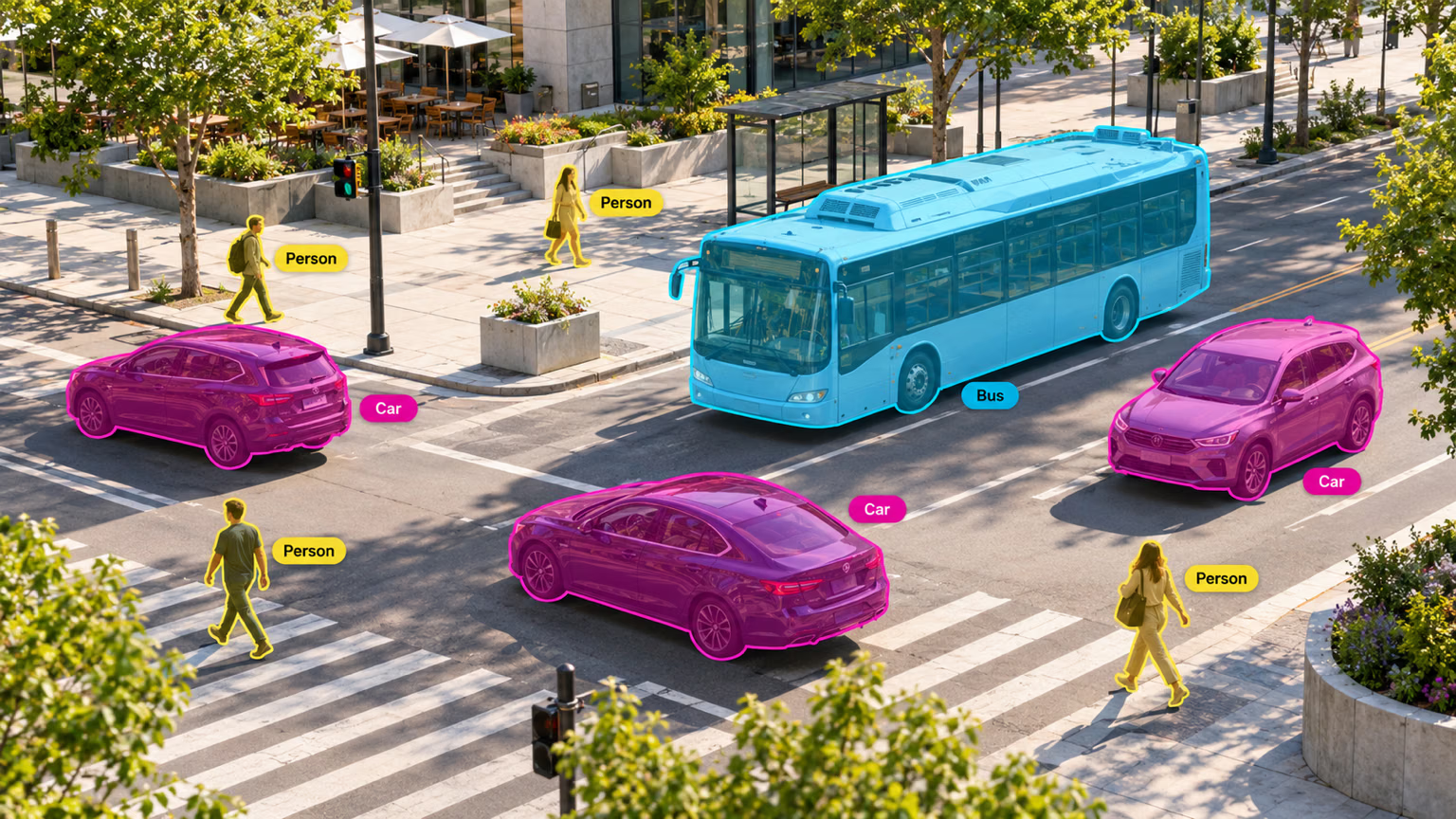
تتجاوز تجزئة المثيلات نطاق كشف الكائنات خطوةً إضافية، وتشمل تحديد الكائنات الفردية في الصورة وفصلها عن بقية الصورة.
يتكون ناتج نموذج تجزئة المثيلات من مجموعة من الأقنعة أو الحدود التي تحدد محيط كل كائن في الصورة، إلى جانب تسميات الفئات ودرجات الثقة لكل كائن. وتفيد تجزئة المثيلات عندما تحتاج إلى معرفة مواقع الكائنات في الصورة وأشكالها الدقيقة أيضًا.
شاهد: تنفيذ التقسيم باستخدام نموذج Ultralytics YOLO مُدرّب مسبقًا في Python.
تستخدم نماذج YOLO26 Segment اللاحقة -seg، مثل yolo26n-seg.pt، وهي مدرّبة مسبقًا على COCO.
النماذج#
تظهر أدناه نماذج YOLO26 Segment المدرّبة مسبقًا على مجموعة بيانات COCO.
تُنزّل النماذج تلقائيًا من أحدث إصدار من Ultralytics عند استخدامها لأول مرة.
| النموذج | الحجم (بكسل) | mAPالصندوق50-95 (e2e) | mAPالقناع50-95 (e2e) | السرعة CPU ONNX (مللي ثانية) | السرعة T4 TensorRT10 (ms) | المعاملات (M) | FLOPs (B) |
|---|---|---|---|---|---|---|---|
| YOLO26n-seg | 640 | 39.6 | 33.9 | 53.3 ± 0.5 | 2.1 ± 0.0 | 2.7 | 9.3 |
| YOLO26s-seg | 640 | 47.3 | 40.0 | 118.4 ± 0.9 | 3.3 ± 0.0 | 10.4 | 34.5 |
| YOLO26m-seg | 640 | 52.5 | 44.1 | 328.2 ± 2.4 | 6.7 ± 0.1 | 23.6 | 121.7 |
| YOLO26l-seg | 640 | 54.4 | 45.5 | 387.0 ± 3.7 | 8.0 ± 0.1 | 28.0 | 140.1 |
| YOLO26x-seg | 640 | 56.5 | 47.0 | 787.0 ± 6.8 | 16.4 ± 0.1 | 62.8 | 314.0 |
- قيم mAPval محسوبة لنموذج واحد بمقياس واحد على مجموعة بيانات COCO val2017.
أعِد إنتاج النتائج باستخدامyolo segment val data=coco.yaml device=0 nms=False - السرعة هي متوسط القياس على صور COCO val باستخدام ONNX على CPU وTensorRT10 على وحدة معالجة الرسومات NVIDIA T4.
أعِد إنتاج النتائج باستخدامyolo segment val data=coco.yaml batch=1 device=0|cpu nms=False. - قيم المعلمات وFLOPs خاصة بالنماذج المدمجة بعد طي Conv/BatchNorm وإزالة فرع الاكتشاف غير المستخدم. تحتفظ نقاط التحقق المدرّبة مسبقًا ببنية التدريب الكاملة، وقد تُظهر أعدادًا أعلى.
تجزّئ نقاط التحقق هذه فئات COCO الـ80. لتجزئة فئات خارج هذه القائمة دون إعادة التدريب، راجع YOLOE، الذي يقبل الفئات كموجّه نصي أو مثال مرئي أو مفردات مدمجة.
اطّلع على معاينة YOLO27 غير المُصدرة لمعرفة النتائج الأولية للصناديق والأقنعة على COCO.
التدريب#
درّب نموذج YOLO26n-seg على مجموعة بيانات COCO8-seg لمدة 100 حقبة وبحجم صورة 640.
from ultralytics import YOLO
# تحميل نموذج
model = YOLO("yolo26n-seg.yaml") # إنشاء نموذج جديد من YAML
model = YOLO("yolo26n-seg.pt") # تحميل نموذج مدرّب مسبقًا (موصى به للتدريب)
model = YOLO("yolo26n-seg.yaml").load("yolo26n-seg.pt") # الإنشاء من YAML ونقل الأوزان
# تدريب النموذج
results = model.train(data="coco8-seg.yaml", epochs=100, imgsz=640)اطّلع على التفاصيل الكاملة لوضع train في صفحة Train. ويمكن أيضًا تدريب نماذج التجزئة باستخدام التدريب السحابي على Ultralytics Platform.
تنسيق مجموعة البيانات#
يمكنك الاطلاع بالتفصيل على تنسيق مجموعة بيانات تجزئة YOLO في دليل مجموعة البيانات. لتحويل مجموعة بيانات COCO JSON موجودة إلى تنسيق YOLO، استخدم الدالة المدمجة convert_coco مع use_segments=True، كما هو موضح في دليل التحويل من COCO إلى YOLO. ويمكنك أيضًا إنشاء أقنعة التجزئة باستخدام التعليقات التوضيحية في Ultralytics Platform من خلال أدوات المضلعات والتعليقات التوضيحية الذكية المدعومة بـ SAM.
التحقق#
تحقّق من دقة نموذج YOLO26n-seg المدرّب، المقاسة وفق متوسط الدقة (mAP) للمربعات والأقنعة. لا حاجة إلى وسيطات، لأن model يحتفظ بإعدادات التدريب data والوسيطات بوصفها سمات للنموذج: يتحقق path/to/best.pt من مثال التدريب على COCO8-seg. تسجل الأوزان الرسمية مسار مجموعة بيانات تدريب غير موجود على جهازك، لذا تعود إلى coco8-seg.yaml الافتراضي للمهمة مع إصدار تحذير. مرّر data للتحقق من الصحة على مجموعة بيانات أخرى.
from ultralytics import YOLO
# تحميل نموذج
model = YOLO("yolo26n-seg.pt") # حمّل نموذجًا رسميًا
model = YOLO("path/to/best.pt") # تحميل نموذج مخصص
# تحقّق من النموذج
metrics = model.val() # لا حاجة إلى وسيطات؛ إذ تُحفظ مجموعة البيانات والإعدادات
metrics.box.map # map50-95(B)
metrics.box.map50 # map50(B)
metrics.box.map75 # map75(B)
metrics.box.maps # قيمة mAP50-95(B) لكل فئة؛ تحتفظ الفئات غير الموجودة في مجموعة التحقق بقيمة mAP(B) الإجمالية
metrics.box.ap_class_index # فهارس الفئات التي جرى تقييمها فعليًا
metrics.box.image_metrics # قاموس مقاييس لكل صورة للكشف، يتضمن precision وrecall وF1 وTP وFP وFN
metrics.seg.map # map50-95(M)
metrics.seg.map50 # map50(M)
metrics.seg.map75 # map75(M)
metrics.seg.maps # قيمة mAP50-95(M) لكل فئة؛ تحتفظ الفئات غير الموجودة في مجموعة التحقق بقيمة mAP(M) الإجمالية
metrics.seg.ap_class_index # فهارس الفئات التي جرى تقييمها فعليًا
metrics.seg.image_metrics # قاموس مقاييس لكل صورة للتجزئة، يتضمن precision وrecall وF1 وTP وFP وFNالتنبؤ#
استخدم نموذج YOLO26n-seg مدرّبًا لإجراء تنبؤات على الصور.
from ultralytics import YOLO
# تحميل نموذج
model = YOLO("yolo26n-seg.pt") # حمّل نموذجًا رسميًا
model = YOLO("path/to/best.pt") # تحميل نموذج مخصص
# أجرِ التنبؤ باستخدام النموذج
results = model("https://ultralytics.com/images/bus.jpg") # أجرِ التنبؤ على صورة
# الوصول إلى النتائج
for result in results:
xy = result.masks.xy # مضلعات الأقنعة بإحداثيات البكسل
xyn = result.masks.xyn # مضلعات الأقنعة المطبّعة
masks = result.masks.data # أقنعة ثنائية، شكلها (N,H,W)، ونوع بياناتها torch.uint8اطّلع على التفاصيل الكاملة لوضع predict في صفحة التنبؤ.
مخرجات النتائج#
تعيد تجزئة المثيلات في YOLO كائن Results واحدًا لكل صورة. وتخزّن كل نتيجة تنبؤات على مستوى الكائن، بحيث يكون لكل مثيل مكتشف قناعه الثنائي وفئته ودرجة ثقته وصندوقه الخاص.
| السمة | النوع | الشكل | الوصف |
|---|---|---|---|
result.masks | Masks | (N) | أقنعة المثيلات. |
result.masks.data | torch.uint8 | (N,H,W) | أقنعة ثنائية، وقيمها 0 أو 1. |
result.masks.xy | np.float32 | list[(P,2)] | مضلعات البكسل. |
result.masks.xyn | np.float32 | list[(P,2)] | مضلعات مُطبّعة. |
result.boxes | Boxes | (N) | مربعات المثيلات وفئاتها ودرجات الثقة. |
result.boxes.cls | torch.float32 | (N,) | معرّفات الفئات؛ حوّلها إلى int للحصول على الأسماء. |
للاطلاع على حقول Results الخاصة بكل مهمة، راجع قسم نتائج التنبؤ حسب المهمة.
تجزئة المثيلات مقابل التجزئة الدلالية#
تجزئة المثيلات هي تجزئة على مستوى الكائن: تنتج سيارتان قناعين وصندوقين ودرجتي ثقة. أما التجزئة الدلالية فهي تصنيف على مستوى البكسل: تتحول السيارتان نفسيهما إلى بكسلات تحمل معرّف الفئة نفسه ضمن خريطة فئات بحجم الصورة، من دون صناديق أو درجات ثقة لكل كائن أو قائمة مضلعات افتراضية. راجع المقارنة التفصيلية لكل حقل في صفحة التجزئة الدلالية.
التصدير#
صدّر نموذج YOLO26n-seg إلى تنسيق آخر مثل ONNX أو CoreML وغيرهما.
from ultralytics import YOLO
# تحميل نموذج
model = YOLO("yolo26n-seg.pt") # حمّل نموذجًا رسميًا
model = YOLO("path/to/best.pt") # تحميل نموذج مخصص
# صدّر النموذج
model.export(format="onnx")تظهر تنسيقات التصدير المتاحة لـ YOLO26-seg في الجدول أدناه. يمكنك التصدير بأي تنسيق باستخدام الوسيطة format، مثل format='onnx' أو format='engine'. ويمكنك إجراء التنبؤ أو التحقق مباشرةً باستخدام النماذج المصدّرة، مثل yolo predict model=yolo26n-seg.onnx. بعد اكتمال التصدير، تُعرض أمثلة الاستخدام الخاصة بنموذجك.
يدعم CoreML تضمين NMS (nms=True) للكشف وتجزئة المثيلات وتقدير الوضعية باستخدام أشكال ثابتة. أما عمليات تصدير التجزئة الافتراضية (nms=None) فتُسند NMS إلى التطبيق المستهلك.
| التنسيق | وسيط format | النموذج | البيانات الوصفية | الوسيطات |
|---|---|---|---|---|
| PyTorch | - | yolo26n-seg.pt | ✅ | - |
| TorchScript | torchscript | yolo26n-seg.torchscript | ✅ | imgsz, quantize, dynamic, nms, batch, device |
| ONNX | onnx | yolo26n-seg.onnx | ✅ | imgsz, quantize, dynamic, simplify, opset, nms, batch, data, fraction, device |
| OpenVINO | openvino | yolo26n-seg_openvino_model/ | ✅ | imgsz, quantize, dynamic, nms, batch, data, fraction, device |
| TensorRT | engine | yolo26n-seg.engine | ✅ | imgsz, quantize, dynamic, simplify, opset, workspace, nms, batch, data, fraction, device |
| CoreML | coreml | yolo26n-seg.mlpackage | ✅ | imgsz, dynamic, quantize, nms, batch, device |
| Apple Core AI | coreai | yolo26n-seg.aimodel | ✅ | imgsz, batch, quantize |
| TF SavedModel | saved_model | yolo26n-seg_saved_model/ | ✅ | imgsz, quantize, opset, nms, batch, data, fraction, device |
| TF GraphDef | pb | yolo26n-seg.pb | ❌ | imgsz, opset, batch, device |
| TF Edge TPU | edgetpu | yolo26n-seg_edgetpu.tflite | ✅ | imgsz, quantize, opset, data, fraction, device |
| LiteRT | litert | yolo26n-seg.tflite | ✅ | imgsz, quantize, batch, data, fraction, device |
| PaddlePaddle | paddle | yolo26n-seg_paddle_model/ | ✅ | imgsz, batch, device |
| MNN | mnn | yolo26n-seg.mnn | ✅ | imgsz, batch, dynamic, quantize, simplify, opset, nms, device |
| NCNN | ncnn | yolo26n-seg_ncnn_model/ | ✅ | imgsz, quantize, device |
| IMX500 | imx | yolo11n_imx_model/ | ✅ | imgsz, quantize, data, fraction, nms, device |
| RKNN | rknn | yolo26n-seg_rknn_model/ | ✅ | imgsz, batch, name, quantize, simplify, opset, data, fraction, device |
| ExecuTorch | executorch | yolo26n-seg_executorch_model/ | ✅ | imgsz, quantize, batch, data, fraction, device |
| Axelera | axelera | yolo26n-seg_axelera_model/ | ✅ | imgsz, batch, quantize, data, fraction, device |
| DEEPX | deepx | yolo26n-seg_deepx_model/ | ✅ | imgsz, quantize, simplify, opset, data, optimize, device |
| Qualcomm QNN | qnn | yolo26n-seg_qnn.onnx | ✅ | imgsz, batch, name, quantize, simplify, opset, data, fraction, device |
| Hailo | hailo | yolo26n-seg_hailo_model/ | ✅ | imgsz, name, quantize, data, fraction, simplify, conf, iou, device |
| Huawei Ascend | ascend | yolo26n-seg_ascend_model/ | ✅ | imgsz, batch, name, quantize, opset, simplify, nms, device |
| AMD Xilinx | xilinx | yolo26n-seg_xilinx_model/ | ✅ | imgsz, name, quantize, data, fraction, opset, simplify, device |
| NXP | nxp | yolo26n-seg_nxp.tflite | ✅ | imgsz, quantize, data, fraction, device |
| ST Edge AI | stedgeai | yolo26n-seg_stedgeai.onnx | ✅ | imgsz, quantize, data, fraction, opset, simplify, device |
يُخرج nms=None افتراضيًا مخرجات خامًا لاستخدام NMS خارجي (ويحتفظ YOLO26 برأسه الخالي من NMS على Axelera). اضبط nms=False لتحديد رأس خالٍ من NMS متاح؛ أما التنسيقات غير المدعومة فتعود إلى مسار الإخراج الأصلي الخاص بها. تحدد إدخالات nms أعلاه التنسيقات التي يمكنها تضمين NMS باستخدام nms=True.
اطّلع على التفاصيل الكاملة لـexport في صفحة التصدير.
الأسئلة الشائعة#
لـتدريب نموذج تقسيم YOLO26 على مجموعة بيانات مخصصة، عليك أولًا إعداد مجموعة البيانات بتنسيق تقسيم YOLO. يمكنك استخدام الأداة
convert_cocoالمضمّنة لتحويل مجموعات بيانات COCO بصيغة JSON. بعد تجهيز مجموعة البيانات، يمكنك تدريب النموذج باستخدام أوامر Python أو CLI:مثالfrom ultralytics import YOLO # حمّل نموذج YOLO26 segment مدرّبًا مسبقًا model = YOLO("yolo26n-seg.pt") # تدريب النموذج results = model.train(data="path/to/your_dataset.yaml", epochs=100, imgsz=640)راجع صفحة Configuration للاطلاع على مزيد من الوسيطات المتاحة.
يحدد اكتشاف الكائنات مواقع الكائنات في الصورة من خلال رسم مربعات إحاطة حولها، بينما تحدد تجزئة المثيلات مربعات الإحاطة وترسم أيضًا الحدود الدقيقة لشكل كل كائن. توفر نماذج تجزئة المثيلات في YOLO26 أقنعة أو حدودًا تحدد محيط كل كائن مكتشف، وهو ما يفيد خصوصًا في المهام التي تتطلب معرفة الشكل الدقيق للكائنات، مثل التصوير الطبي أو القيادة الذاتية.
يجمع Ultralytics YOLO26 بين الدقة العالية وسرعة الاستدلال الآني، ما يجعله مناسبًا لتجزئة المثيلات على تدفقات الفيديو والأجهزة الطرفية. تأتي نماذج YOLO26 Segment مدرّبة مسبقًا على مجموعة بيانات COCO، لذا تتمكن مباشرةً من تجزئة 80 فئة شائعة من الكائنات، وتوفر نقطة انطلاق قوية للضبط الدقيق على البيانات المخصصة. تغطي واجهة
YOLOالبرمجية نفسها التدريب والتحقق والتنبؤ والتصدير لتطبيقات الأبحاث والصناعة.إن تحميل نموذج تجزئة YOLO مدرّب مسبقًا والتحقق منه أمر مباشر. إليك طريقة تنفيذ ذلك باستخدام كل من Python وCLI:
مثالfrom ultralytics import YOLO # تحميل نموذج مدرَّب مسبقًا model = YOLO("yolo26n-seg.pt") # تحقّق من النموذج metrics = model.val() print("Mean Average Precision for boxes:", metrics.box.map) print("Mean Average Precision for masks:", metrics.seg.map)ستوفر لك هذه الخطوات مقاييس للتحقق من الصحة، مثل متوسط الدقة (mAP)، وهو المقياس القياسي لأداء التجزئة.
تصدير نموذج تجزئة YOLO إلى تنسيق ONNX سهل، ويمكن تنفيذه باستخدام Python أو أوامر CLI:
مثالfrom ultralytics import YOLO # تحميل نموذج مدرَّب مسبقًا model = YOLO("yolo26n-seg.pt") # تصدير النموذج إلى تنسيق ONNX model.export(format="onnx")لمزيد من التفاصيل حول التصدير إلى تنسيقات مختلفة، راجع صفحة Export.


التعليقات418
اطرح سؤالًا، وشارك نتائجك، أو ساعد شخصًا آخر.
hp0716
Thank you for sharing the YOLOV11-seg model. I have encountered a problem now. When using YOLOV11 to segment my ID card, there are many uneven areas on the edges of the segmentation result, which affects my fitting of the card certificate boundary. How can I obtain smooth segmentation results? Do you have any parameters that can be directly configured?
1Additionally, is there a method to fit the boundary of the ID card mask into four straight lines for locating the ID card?
 Glenn JocherUltralytics
@hp0716 for smoother segmentation results on ID cards, try using
retina_masks=Trueduring inference to get higher resolution masks:from ultralytics import YOLO model = YOLO('yolo11n-seg.pt') results = model(image, retina_masks=True)For post-processing to get smooth boundaries, you can apply morphological operations and contour approximation:
import cv2
import numpy as np

# Get mask from results
mask = results[0].masks.data[0].cpu().numpy()
mask = (mask * 255).astype(np.uint8)

# Apply morphological smoothing
kernel = cv2.getStructuringElement(cv2.MORPH_ELLIPSE, (5, 5))
mask = cv2.morphologyEx(mask, cv2.MORPH_CLOSE, kernel)
mask = cv2.morphologyEx(mask, cv2.MORPH_OPEN, kernel)

# Find contours and approximate to quadrilateral
contours, _ = cv2.findContours(mask, cv2.RETR_EXTERNAL, cv2.CHAIN_APPROX_SIMPLE)
if contours:
    largest_contour = max(contours, key=cv2.contourArea)
    epsilon = 0.02 * cv2.arcLength(largest_contour, True)
    approx = cv2.approxPolyDP(largest_contour, epsilon, True)

    # Force to 4 points for ID card corners
    if len(approx) >= 4:
        corners = approx[:4]
This approach combines higher resolution masks with geometric fitting to achieve the straight-line boundaries you need for ID card localization.
1
cyberpunk-edgerunner
Just to confirm, while auto annotating, instead of using SAM one can also use one's custom build model. right ??
1rugvedjalit
Yes, you can annotate using custom build model but please check the annotation class id after annotation.
LwpZoe
I have used yolo11x-seg.yaml to do instance segmentation on my dataset, my dataset is multiclassified medical endoscopic tissue instance segmentation task, but the metrics scores are very low, I don't know how to improve these metrics scores, can you please give me some ideas?
1The metrics score with ShuffleAttention added to the tenth layer of backbone is reduced compared to the metrics score for YOLO11x-seg.yaml alone.
Trained my dataset using YOLO11x-seg.yaml+ShuffleAttention with no other parameters changed the metrics scores are as follows:
Class Images Instances Box( P R mAP50 mAP50-95) Mask( P R mAP50 mAP50-95): all 58 332 0.583 0.504 0.519 0.238 0.551 0.456 0.468 0.195
Training my dataset using the official YOLO11x-seg.yaml alone, the metrics scores are as follows:
Class Images Instances Box( P R mAP50 mAP50-95) Mask( P R mAP50 mAP50-95): all 58 332 0.669 0.465 0.489 0.257 0.648 0.446 0.455 0.217
1- Glenn JocherUltralytics(تم التعديل)
@LwpZoe thank you for sharing these details. For medical instance segmentation with YOLO11x-seg, we recommend: 1) Verify your dataset quality and annotation consistency using the Dataset Guide, 2) Try increasing input resolution (
imgsz=1280) to capture fine tissue details, 3) Implement medical-specific augmentations like CLAHE or elastic transforms, and 4) Consider using our pretrained weights with progressive fine-tuning rather than architectural modifications initially. The segmentation documentation contains additional optimization strategies for medical imaging tasks.
Hello, here's a question: I want to use YOLO11 to train my dataset from scratch and make predictions, and don't want to use prepared pre-trained weights, so how do I write the training commands? Is this code below ok: yolo segment train data=datasets/yolo_seg/data.yaml model=yolo11n-seg.yaml epochs=300 batch=16 resume=True imgsz=640 device=0,1
1- Glenn JocherUltralytics
@LwpZoe your command is almost correct for training from scratch without pretrained weights. Ensure the
resume=Trueargument is removed, as it is only used to resume interrupted training. The corrected command would be:yolo segment train data=datasets/yolo_seg/data.yaml model=yolo11n-seg.yaml epochs=300 batch=16 imgsz=640 device=0,1This will train your YOLO11 segmentation model from scratch using your custom dataset. For more details, visit the Segment Task Documentation.
potatoandtomatowhy
how to use two camera segment with gpu?
1ZhaoHaoran0613
Same question
1 Paula DerrengerUltralytics
To use two cameras for segmentation with a GPU, you'll need to set up a multi-threaded or multi-process pipeline to handle the video streams concurrently. Each camera stream can be processed in a separate thread or process, ensuring efficient utilization of the GPU. You can use the
YOLOclass from the Ultralytics library to load your segmentation model and process the frames from each camera. For detailed steps and code examples, please refer to the Ultralytics segmentation documentation. If you encounter any issues, make sure you're using the latest version of the package.
Boaruzhanchik
Hi, can you tell me how I can get the detected car plates in separate windows (as many as I have detected and output), my code outputs only one window.
while True: ret, im0 = cap.read() if not ret: break results = model(im0,verbose=False,conf=0.4,retina_masks=True) boxes = results[0].boxes.xyxy.tolist() classes = results[0].boxes.cls.tolist() confidences = results[0].boxes.conf.tolist() masks = results[0].masks if results[0].masks is not None: clss = results[0].boxes.cls.cpu().tolist() masks = results[0].masks.xy coordinates_mask = masks[0] contour = coordinates_mask.reshape((-1, 1, 2)).astype(np.int32) epsilon = 0.04 * cv2.arcLength(contour, True) approx = cv2.approxPolyDP(contour, epsilon, True) auto_transform = four_point_transform(im0, approx.reshape(-2, 2)) cv2.imshow('automated', auto_transform)1- Paula DerrengerUltralytics
@Boaruzhanchik hey there! 👋 To display each detected car plate in separate windows, you can loop through the detected boxes and create a window for each. Here's a quick example to get you started:
for i, box in enumerate(boxes):
    x1, y1, x2, y2 = map(int, box[:4])
    plate = im0[y1:y2, x1:x2]
    cv2.imshow(f'Plate {i}', plate)
cv2.waitKey(0)
cv2.destroyAllWindows()
This code snippet extracts each detected plate based on its bounding box coordinates and displays it in a new window. Make sure to replace
im0with your frame variable if it's named differently. Hope this helps! 😊 Thanks a lot for the help, I did it this way, it seems to work too
if results[0].masks is not None: clss = results[0].boxes.cls.cpu().tolist() masks = results[0].masks.xy if len(masks) == 1: coordinates_mask = masks[0] auto_transformations_first(coordinates_mask) elif len(masks) <= 2: auto_transformations_first(coordinates_mask) coordinates_mask_2 = masks[1] auto_transformations_second_screen(coordinates_mask_2) def auto_transformations_first(coordinates_mask): contour = coordinates_mask.reshape((-1, 1, 2)).astype(np.int32) epsilon = 0.04 * cv2.arcLength(contour, True) approx = cv2.approxPolyDP(contour, epsilon, True) auto_transform = four_point_transform(im0, approx.reshape(-2, 2)) cv2.imshow('automated_first', auto_transform)- Paula DerrengerUltralytics
@Boaruzhanchik hey there! 👋 It looks like you've found a way to handle different numbers of masks with your approach. Nicely done! 🎉 Just a quick tip: you might want to ensure
coordinates_maskis defined before using it inauto_transformations_first(coordinates_mask)for theelif len(masks) <= 2:case, to avoid any potential errors. Other than that, your method seems solid. Keep up the great work, and if you have any more questions or need further assistance, feel free to ask. Happy coding! 😊
uqasha524
Hi everyone,
We have fine-tuned a YOLO model primarily for segmentation, but our dataset contains mixed annotation types—the main task is segmentation, while some classes/regions use standard bounding boxes and OBB (Oriented Bounding Boxes).
What is the recommended approach in Ultralytics for handling a dataset with mixed annotation formats in a single training pipeline, and could you explain how this is possible? Specifically, how should the data labels and model configuration be structured to handle multiple task types simultaneously?
Any guidance, workflow explanations, or examples would be greatly appreciated!
- Glenn JocherUltralytics
Ultralytics training uses one task per model (
detect,segment, orobb), so mixed label formats cannot be trained jointly in a standard pipeline. Use separate label directories/YAML files and train separate models, or convert box/OBB annotations to polygon labels so every object follows the segmentation format; note that a segmentation model returns masks and axis-aligned boxes, not native OBB predictions.1 Ultralytics YOLO does not support mixing detection, segmentation, and OBB annotations in a single training run. Each model/task expects a specific label format and corresponding loss function.
The recommended approach is to separate the annotations and train separate models for segmentation, detection, and OBB, then combine their outputs during inference if needed. A single multi-task model would require a custom architecture and training pipeline.
1- Glenn JocherUltralytics
@uqasha524, do you need masks, axis-aligned boxes, and OBBs as distinct outputs at inference, or would segmentation outputs alone meet your requirements? That distinction will help us suggest the appropriate dataset structure without introducing unnecessary custom training work.
TrieuCris
With yolo26-seg, when a small object is placed on top of a large object, I get a result where the mask of the large object is punctured right where the small object is covering it. How can I fix this?
- Glenn JocherUltralytics
That’s usually expected with standard instance segmentation:
yolo26-seglearns the visible region of each instance, so the larger object can appear “punctured” where it is occluded; if you want a filled large-object mask, you’ll need labels that include the full occluded shape or apply post-processing tor.masksafter inference, and the segmentation object isolation guide shows where to access those masks—if you share one image plus its label here, the Ultralytics team can help confirm whether it’s annotation or model behavior.
miracle101000
hello if I wanted to use your segmentation model for inference on a live camera preview, to only detect a single item at a time, how would I go about it? thank you.
- Glenn JocherUltralytics
Yes — use a
-segmodel on your webcam feed, setclasses=[...]if you only want one class, andmax_det=1if you want at most one instance per frame; if you share your use case here, the Ultralytics team can help refine it, and the Segment task docs cover the mask outputs you’ll use.from ultralytics import YOLO model = YOLO("yolo26n-seg.pt") results = model.predict(source=0, stream=True, classes=[0], max_det=1) Ok thx. I am actually trying to implement edge detection on android devices for rectangular objects. I have tried OpenCV but it's not enough. So I was thinking to use a segmentation model for my rectangular processor (overlay would only show on rectangular objects) but any time I try to implement this on android, I get serious lagging issues on the camera preview. Plus honestly new to this AI stuff.
- Glenn JocherUltralytics
If you only need a rectangle-style overlay, a segmentation model is usually heavier than necessary on Android; I’d start with a small OBB or detect model instead, export it with Export mode, and keep
imgszlow or run inference every few frames to reduce preview lag. If you share your device, export format, and current FPS here, the Ultralytics team can suggest the lightest setup.
Heyujie96
你是不是加载模型的时候没有写task=“segment”
------------------ Original ------------------ From: liyongkang2000 @.> Date: Sun,Feb 1,2026 1:12 AM To: ultralytics/ultralytics @.> Cc: Heyujie96 @.>, Comment @.> Subject: Re: [ultralytics/ultralytics] zh/tasks/segment/ (Discussion #8508)
您好我想问一下,在YOLOV8和V11测试下来,由于目标框的存在,不管如果在后处理阶段调整目标框的范围,被分割目标的上下左右边界始终会被目标框切割,导致分割结果的边缘不平滑。会出现很多直线,但是在YOLOV26上没有尝试过,YOLOV26是否优化了这个边界问题,或者说是否其他的解决方法可以解决这个分割结果的边缘不平滑问题
— Reply to this email directly, view it on GitHub, or unsubscribe. You are receiving this because you commented.Message ID: @.***>
liyongkang2000
result = model.predict(os.path.join(path,file), nms = True, )这是我的预测代码是官方提供的呀
- Glenn JocherUltralytics
你这段
predict()用法本身没问题;一般也不需要手动写task="segment",关键是确保加载的是分割权重(*-seg.pt),否则不会有result.masks输出;如果分割边缘出现“被框裁切/直线感强”的现象,可以在推理时尝试开启retina_masks=True并适当增大imgsz(NMS 默认就会做,通常不需要单独传nms=True),相关参数处理可参考 SegmentationPredictor 源码说明。from ultralytics import YOLO model = YOLO("yolo26n-seg.pt") # 确保是 -seg 权重 results = model.predict( os.path.join(path, file), retina_masks=True, imgsz=1024, conf=0.25, iou=0.7, ) 您好,您的建议是有效的,但边界还是没有那么光滑,以及大目标效果更差,有时会出现正方形,您这边还有其他的解决方案吗?期待您的回复
- Glenn JocherUltralytics
这个“边缘直线/大目标出现方块”的现象通常是分割头的掩码分辨率与“mask 会按预测框裁剪”的机制共同导致的(框越紧越容易看出裁剪痕迹,可参考这条 社区说明:inference 时 mask 是否会被 bbox 裁剪);如果你是自训练模型,想从根源提升大目标的边缘细节,建议在训练时把
mask_ratio调小(更高 mask 分辨率)并配合更大的imgsz/更大的*-seg模型,mask_ratio参数说明见 配置参数文档。from ultralytics import YOLO model = YOLO("yolo26s-seg.pt") # 也可以试试更大一点的 -seg 权重 model.train( data="path/to/your_dataset.yaml", imgsz=1024, epochs=100, mask_ratio=2, # 需要更细可再降到 1(显存占用会明显上升) )如果你只是想“导出/显示更光滑”的轮廓(不改变模型预测本身),可以按 Isolating Segmentation Objects 的方式拿到
result.masks.data后做一次轻量的blur + close再取轮廓;另外麻烦贴一张出现“正方形”的原图和对应可视化结果,并附上yolo checks的文本输出,我这边可以帮你确认主要瓶颈是分辨率、标注轮廓质量还是框裁剪造成的。