Ultralytics Explorer
Depuis ultralytics>=8.3.12, Ultralytics Explorer a été supprimé. Pour utiliser Explorer, installe pip install ultralytics==8.3.11. Des fonctionnalités similaires (et étendues) d’exploration des jeux de données sont disponibles sur Ultralytics Platform.
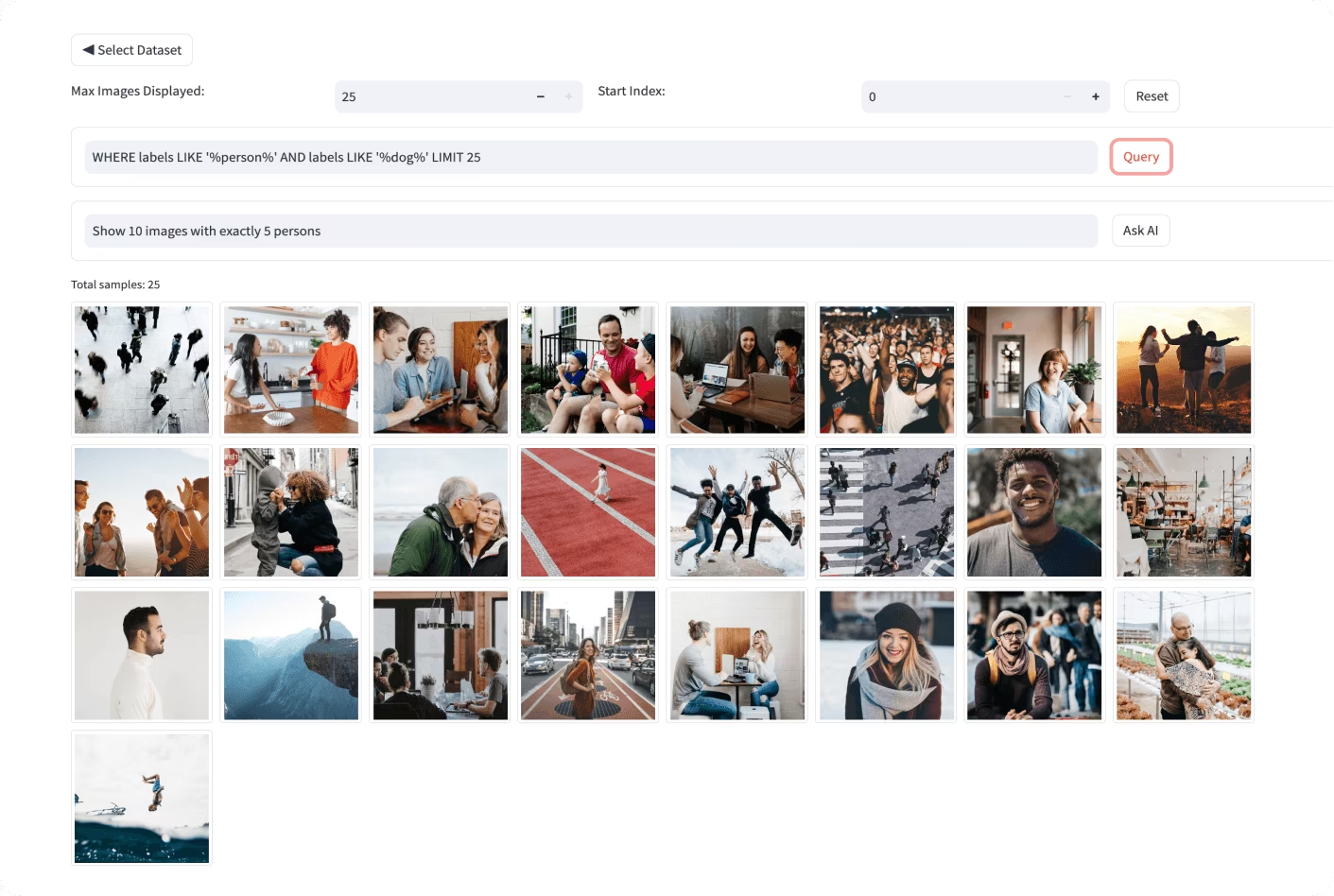
Ultralytics Explorer est un outil d’exploration de jeux de données de vision par ordinateur avec la recherche sémantique, des requêtes SQL, la recherche par similarité vectorielle et des requêtes en langage naturel. Il fournit également une API Python pour accéder aux mêmes fonctionnalités.
Regarder : Explorer API d’Ultralytics | Recherche sémantique, requêtes SQL et fonctionnalités Demander à l’IA
Installation des dépendances facultatives#
Explorer dépend de bibliothèques externes pour certaines fonctionnalités. Celles-ci sont installées automatiquement lorsque tu utilises Explorer. Pour installer ces dépendances manuellement, exécute la commande suivante :
pip install "ultralytics[explorer]==8.3.11"Explorer repose sur la recherche par plongements/recherche sémantique et les requêtes SQL, et utilise la base de données vectorielle sans serveur LanceDB. Contrairement aux bases de données traditionnelles en mémoire, elle est stockée sur disque sans perte de performances, ce qui te permet de passer localement à de grands jeux de données comme COCO sans manquer de mémoire.
API Explorer#
Il s’agit d’une API Python permettant d’explorer tes jeux de données. Elle alimente également l’interface graphique Explorer. Tu peux l’utiliser pour créer tes propres notebooks ou scripts d’exploration et obtenir des informations sur tes jeux de données.
Découvre toutes les fonctionnalités et des exemples d’utilisation dans la documentation de l’API Explorer.
Utilisation de l’interface graphique Explorer#
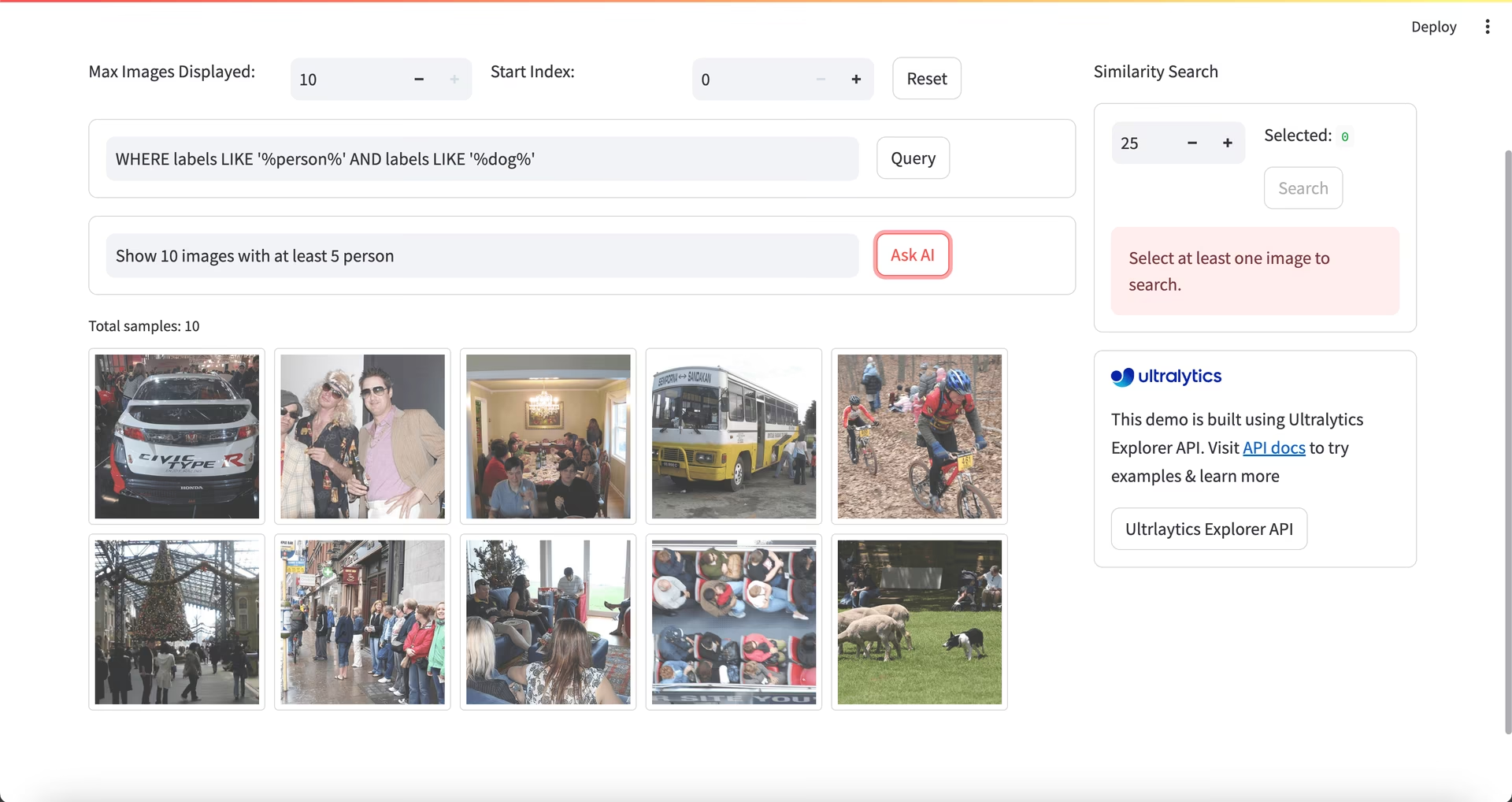
La démo de l’interface graphique s’exécute dans ton navigateur et te permet de créer des plongements pour ton jeu de données, de rechercher des images similaires, d’exécuter des requêtes SQL et d’effectuer des recherches sémantiques. Tu peux la lancer avec la commande suivante :
yolo explorerLa fonctionnalité Ask AI utilise OpenAI. La première fois que tu lances l’interface graphique, tu seras donc invité à définir la clé API OpenAI. Tu peux la définir comme ceci - yolo settings openai_api_key="..."
FAQ#
Ultralytics Explorer est un outil d’exploration de jeux de données de vision par ordinateur (CV) grâce à la recherche sémantique, aux requêtes SQL, à la recherche par similarité vectorielle et au langage naturel. Il fournit une interface graphique et une API Python. Comme il stocke les plongements sur disque avec LanceDB, il peut traiter de grands jeux de données sans consommation excessive de mémoire.
En savoir plus sur l’API Explorer.
Pour installer manuellement les dépendances facultatives nécessaires à Ultralytics Explorer, tu peux utiliser la commande
pipsuivante :pip install "ultralytics[explorer]==8.3.11"Ces dépendances sont nécessaires à la recherche sémantique et aux requêtes SQL. Elles comprennent LanceDB, qui garantit l’efficacité et l’évolutivité des opérations sur la base de données, même avec de grands jeux de données comme COCO.
La version avec interface graphique d’Ultralytics Explorer est simple à utiliser. Après avoir installé les dépendances nécessaires, tu peux lancer l’interface graphique avec la commande suivante :
yolo explorerL’interface graphique fournit une interface conviviale pour créer des plongements de jeux de données, rechercher des images similaires, exécuter des requêtes SQL et effectuer des recherches sémantiques. La fonctionnalité Ask AI, propulsée par OpenAI, te permet également d’interroger les jeux de données en langage naturel.
Pour en savoir plus sur le stockage et la capacité de mise à l’échelle, consulte nos instructions d’installation.
La fonctionnalité Ask AI d’Ultralytics Explorer permet aux utilisateurs d’interagir avec leurs jeux de données à l’aide de requêtes en langage naturel. Propulsée par OpenAI, cette fonctionnalité te permet de poser des questions sur ton jeu de données sans écrire de requêtes SQL ni de commandes similaires. Pour l’utiliser, tu dois définir ta clé API OpenAI lors du premier lancement de l’interface graphique :
yolo settings openai_api_key="YOUR_API_KEY"Pour en savoir plus sur cette fonctionnalité et son intégration, consulte la section Utilisation de l’interface graphique Explorer.
Oui. Installe la version spécifiée avec
pip install ultralytics==8.3.11dans un notebook Colab et suis l’exemple d’exploration de VOC pour créer des plongements et lancer des recherches sur les ressources cloud de Google. Consulte notre guide Google Colab pour en savoir plus.


Commentaires13
Pose une question, partage tes résultats ou aide quelqu’un d’autre.
pooya-github
Hi,
In colab code after running !pip install ultralytics[explorer] and running: from ultralytics import explorer i got the following error:
ImportError Traceback (most recent call last) in <cell line: 1>() ----> 1 from ultralytics import explorer
ImportError: cannot import name 'explorer' from 'ultralytics' (/usr/local/lib/python3.10/dist-packages/ultralytics/init.py)
how can i fix it?
 Glenn JocherUltralytics(modifié)
@pooya-github the
Ultralytics Explorerfeature has been removed as ofultralytics>=8.3.12. To access similar or enhanced functionality, we recommend using Ultralytics Platform, our platform for dataset exploration and management. Let me know if you have further questions!-2
mkutu
how can I set this up with a custom dataset? Could you direct me to any resources. Thanks!
- Glenn JocherUltralytics(modifié)
@mkutu hello!
Setting up YOLO26 with a custom dataset can be straightforward! You'd primarily need a data YAML file to describe your dataset structure and then use it in your training command. Here’s a basic guide to get you started:
-
Prepare your data: Organize your dataset into two folders (images and labels), with corresponding files named identically.
-
Create a YAML file: This file should specify the paths to your training and validation data, the number of classes, and class names. Here's an example:
# custom_data.yaml train: path/to/train/images val: path/to/val/images nc: number_of_classes names: ['class1', 'class2', 'class3'] -
Start Training: Use the following command to train your model:
yolo train data=custom_data.yaml model=yolo26n.yaml
For exploring and managing your datasets efficiently, you might consider using the Ultralytics Explorer (removed in
ultralytics>=8.3.12; useultralytics==8.3.11or Ultralytics Platform). This tool offers features like semantic search, SQL queries, and even AI-based querying to derive insights from your data.Hope this helps! If you have any more questions, feel free to ask.
-2 -
BABAFAREEDDUDEKULA
how can i run above mentioned AI using yolo v8 previously i have tried yolo v9,v8,v7,rt-detr
AloshkaD
Can you be more specific?
- Glenn JocherUltralytics(modifié)
Hey there! 🌟
It sounds like you've got a pretty wide range of experience with various YOLO versions and even RT-DETR! For running AI using YOLO26 specifically, the process is smoothly integrated into the Ultralytics framework, much like the versions you've mentioned.
To get started, make sure you have Ultralytics YOLO26 installed. If not, you can do so via pip:
pip install ultralyticsAnd then, to run your AI model with YOLO26, you can simply use:
from ultralytics import YOLO

# Load the model
model = YOLO('yolo26n.pt')  # Here 'yolo26n.pt' is an example model. Replace it with your model path.

# Run inference
results = model('path_to_your_image_or_video')
Or, if you prefer using the command line:
yolo detect predict model=yolo26n.pt source=path_to_your_image_or_videoRemember to replace 'yolo26n.pt' and 'path_to_your_image_or_video' with the actual paths to your YOLO26 model and the image or video you want to run inference on. 🚀
Since you've used various versions before, the process should feel quite familiar. If there's more specific functionality from the Ultralytics Explorer that you're interested in integrating with YOLO26, such as semantic search or SQL queries, the installation command provided in the documentation will be your first step:
pip install ultralytics[explorer]After that, you can launch the Ultralytics Explorer with:
yolo explorerAnd dive into explore mode (Explorer requires
ultralytics==8.3.11, as it was removed inultralytics>=8.3.12)! For any further details or if you've got a unique use case in mind, feel free to share more specifics. Happy to help further. Happy coding! 🎉1 Thanks a lot my brother
2- Glenn JocherUltralytics(modifié)
Note: Ultralytics Explorer was removed in
ultralytics>=8.3.12; to use it, installultralytics==8.3.11. Similar dataset exploration features are available in Ultralytics Platform.@BABAFAREEDDUDEKULA hey there! 😄
Thanks for reaching out. If you're interested in diving into the Ultralytics Explorer to explore CV datasets with semantic search, SQL queries, vector similarity search, and more, it sounds like you're on the right track!
To get started, ensure you've got the Explorer installed via:
pip install ultralytics[explorer]Once installed, you can jump straight into using the GUI by typing:
yolo explorerThis launches the GUI in your browser, where you can experiment with creating embeddings, conducting image searches, and even using SQL or natural language queries!
If you encounter any issues or have specific questions as you use the Ultralytics Explorer, feel free to drop them here. Happy exploring! 🌟
The yolo explorer command will open the explorer on the local machine. How would I set it up to work on AWS while I'm connected with my local machine using ssh?
 Paula DerrengerUltralytics(modifié)
Note: Ultralytics Explorer was removed in
ultralytics>=8.3.12; to use it, installultralytics==8.3.11. Similar dataset exploration features are available in Ultralytics Platform.To set up the Ultralytics Explorer to work on an AWS instance while you're connected via SSH from your local machine, you can use port forwarding to access the Explorer's web interface. Here's a concise step-by-step guide:
-
SSH into AWS with Port Forwarding: Use the
-Loption to forward a local port to a port on the AWS instance. Replacelocal_portwith a port on your local machine (e.g.,8080), andaws_portwith the port the Explorer runs on (usually5000).ssh -i /path/to/your/key.pem -L local_port:localhost:aws_port user @AloshkaD -
Run Explorer on AWS: Once connected, start the Explorer on the AWS instance:
yolo explorer -
Access Explorer Locally: Open a web browser on your local machine and navigate to
localhost:local_portto access the Explorer interface.
Remember to replace
/path/to/your/key.pemwith the path to your AWS key,userwith your AWS username, andaws_instance_ipwith your AWS instance's IP address. Also, ensure that the AWS security group allows inbound traffic on theaws_port.1-
Worked with a minor tweak to reference my config file. Thank you!
- Paula DerrengerUltralytics
@AloshkaD you're welcome! I'm glad to hear that you were able to get it working with your config file. If you have any more questions or need further assistance in the future, don't hesitate to reach out. Happy exploring with Ultralytics Explorer! 🚀😊
1