Ultralytics Explorer
A partire da ultralytics>=8.3.12, Ultralytics Explorer è stato rimosso. Per usare Explorer, installa pip install ultralytics==8.3.11. Funzionalità simili (e ampliate) per esplorare i dataset sono disponibili su Ultralytics Platform.
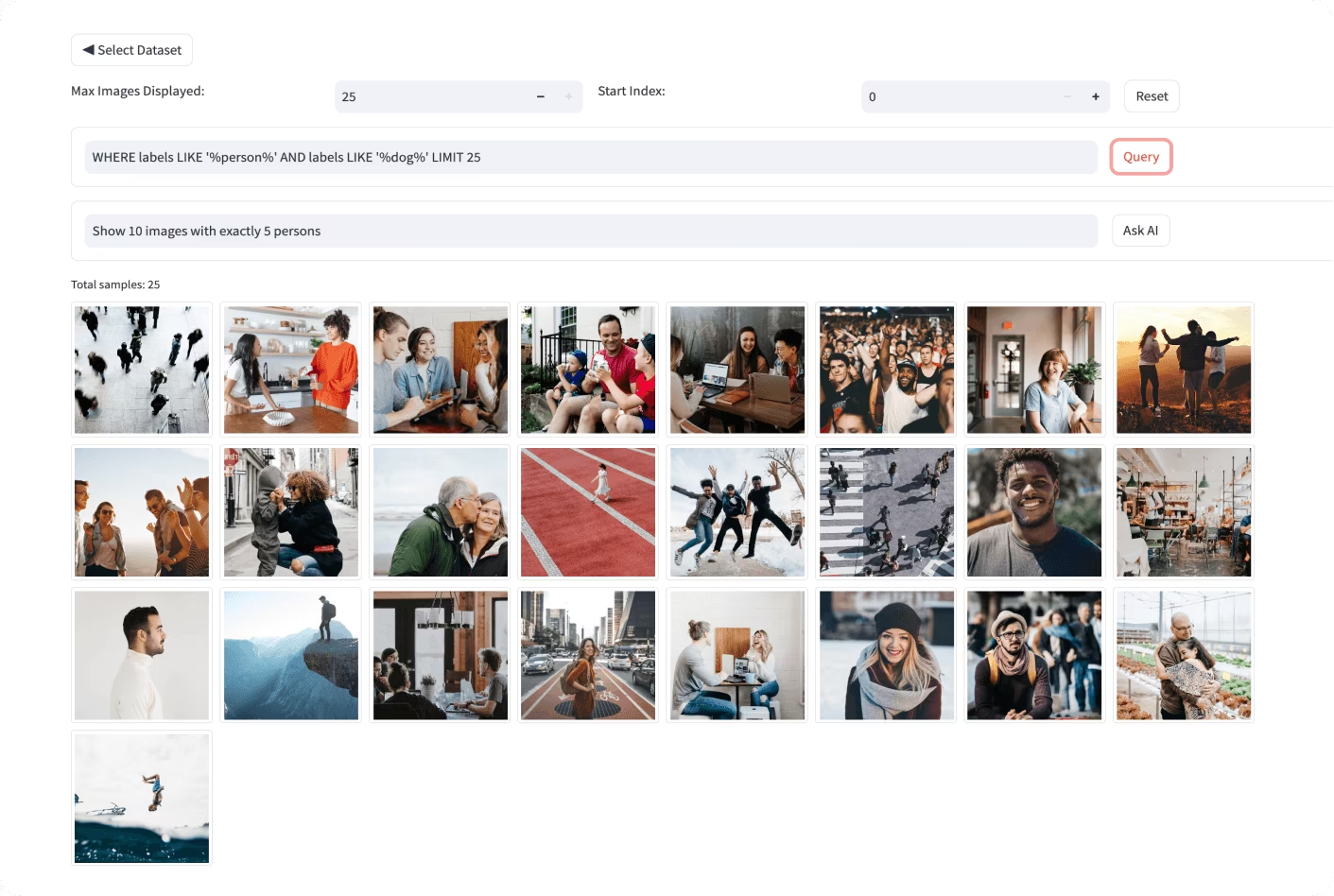
Ultralytics Explorer è uno strumento per esplorare dataset di visione artificiale tramite la ricerca semantica, query SQL, ricerca per similarità vettoriale e prompt in linguaggio naturale. Offre anche un'API Python per accedere alle stesse funzionalità.
Guarda: Explorer API di Ultralytics | Ricerca semantica, query SQL e funzionalità Chiedi all'IA
Installazione delle dipendenze facoltative#
Explorer dipende da librerie esterne per alcune delle sue funzionalità. Queste librerie vengono installate automaticamente quando usi Explorer. Per installare manualmente queste dipendenze, usa il seguente comando:
pip install "ultralytics[explorer]==8.3.11"Explorer supporta la ricerca tramite embedding e semantica, oltre alle query SQL, ed è basato sul database vettoriale serverless LanceDB. A differenza dei database tradizionali in memoria, i dati vengono salvati su disco senza sacrificare le prestazioni, così puoi scalare localmente fino a dataset di grandi dimensioni come COCO senza esaurire la memoria.
API di Explorer#
Questa è un'API Python per esplorare i tuoi dataset. È anche alla base della GUI di Explorer. Puoi usarla per creare notebook o script esplorativi personalizzati e ottenere informazioni utili sui tuoi dataset.
Scopri tutte le funzionalità e gli esempi d'uso nella documentazione dell'API di Explorer.
Uso della GUI di Explorer#
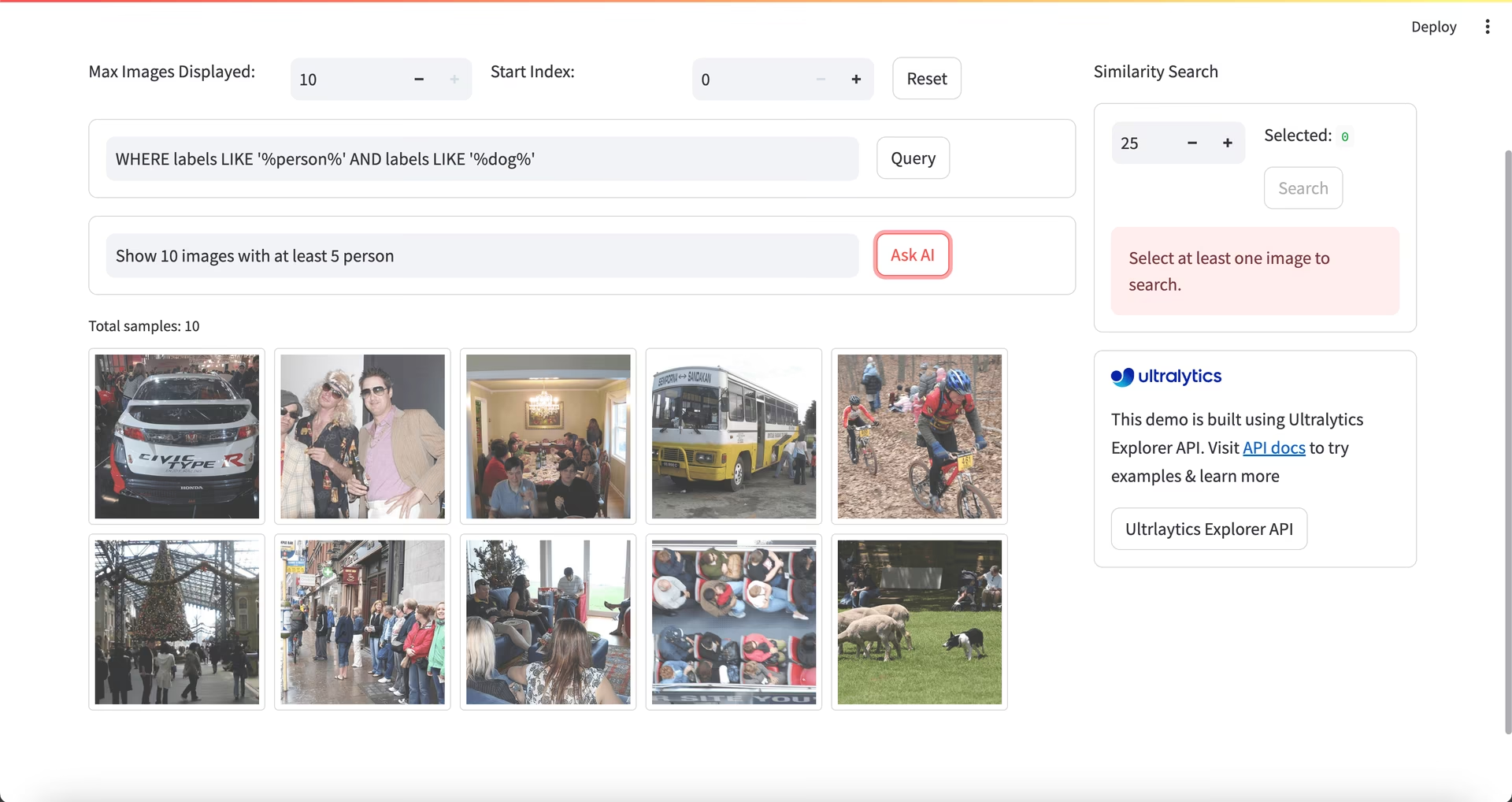
La demo della GUI viene eseguita nel browser e ti consente di creare embedding per il tuo dataset, cercare immagini simili, eseguire query SQL e svolgere ricerche semantiche. Puoi avviarla con il seguente comando:
yolo explorerLa funzionalità Ask AI usa OpenAI, quindi al primo avvio della GUI ti verrà chiesto di impostare la chiave API di OpenAI. Puoi impostarla così: yolo settings openai_api_key="..."
Domande frequenti#
Ultralytics Explorer è uno strumento per esplorare dataset di visione artificiale (CV) tramite ricerca semantica, query SQL, ricerca per similarità vettoriale e linguaggio naturale. Offre sia un'interfaccia grafica sia un'API Python. Poiché salva gli embedding su disco con LanceDB, può gestire dataset di grandi dimensioni senza un uso eccessivo della memoria.
Scopri di più sull'API di Explorer.
Per installare manualmente le dipendenze facoltative necessarie per Ultralytics Explorer, puoi usare il seguente comando
pip:pip install "ultralytics[explorer]==8.3.11"Queste dipendenze sono necessarie per la ricerca semantica e le query SQL. Includono LanceDB, che mantiene efficienti e scalabili le operazioni sul database, anche con dataset di grandi dimensioni come COCO.
Usare la versione con GUI di Ultralytics Explorer è semplice. Dopo aver installato le dipendenze necessarie, puoi avviare la GUI con il seguente comando:
yolo explorerL'interfaccia grafica offre un modo intuitivo per creare embedding dei dataset, cercare immagini simili, eseguire query SQL e svolgere ricerche semantiche. La funzione Ask AI, basata su OpenAI, consente inoltre di interrogare i dataset in linguaggio naturale.
Per informazioni sull'archiviazione e sulla scalabilità, consulta le istruzioni di installazione.
La funzione Ask AI di Ultralytics Explorer consente agli utenti di interagire con i propri dataset tramite query in linguaggio naturale. Basata su OpenAI, permette di porre domande sul dataset senza scrivere query SQL o comandi simili. Per usare questa funzione, dovrai impostare la tua chiave API OpenAI la prima volta che avvii l'interfaccia grafica:
yolo settings openai_api_key="YOUR_API_KEY"Per saperne di più su questa funzionalità e su come integrarla, consulta la sezione Uso della GUI di Explorer.
Sì. Installa la release con versione bloccata usando
pip install ultralytics==8.3.11in un notebook Colab e segui l'esempio di esplorazione di VOC per creare embedding ed eseguire ricerche sulle risorse cloud di Google. Scopri di più nella nostra guida a Google Colab.


Commenti13
Fai una domanda, condividi i tuoi risultati o aiuta qualcun altro.
pooya-github
Hi,
In colab code after running !pip install ultralytics[explorer] and running: from ultralytics import explorer i got the following error:
ImportError Traceback (most recent call last) in <cell line: 1>() ----> 1 from ultralytics import explorer
ImportError: cannot import name 'explorer' from 'ultralytics' (/usr/local/lib/python3.10/dist-packages/ultralytics/init.py)
how can i fix it?
 Glenn JocherUltralytics(modificato)
@pooya-github the
Ultralytics Explorerfeature has been removed as ofultralytics>=8.3.12. To access similar or enhanced functionality, we recommend using Ultralytics Platform, our platform for dataset exploration and management. Let me know if you have further questions!-2
mkutu
how can I set this up with a custom dataset? Could you direct me to any resources. Thanks!
- Glenn JocherUltralytics(modificato)
@mkutu hello!
Setting up YOLO26 with a custom dataset can be straightforward! You'd primarily need a data YAML file to describe your dataset structure and then use it in your training command. Here’s a basic guide to get you started:
-
Prepare your data: Organize your dataset into two folders (images and labels), with corresponding files named identically.
-
Create a YAML file: This file should specify the paths to your training and validation data, the number of classes, and class names. Here's an example:
# custom_data.yaml train: path/to/train/images val: path/to/val/images nc: number_of_classes names: ['class1', 'class2', 'class3'] -
Start Training: Use the following command to train your model:
yolo train data=custom_data.yaml model=yolo26n.yaml
For exploring and managing your datasets efficiently, you might consider using the Ultralytics Explorer (removed in
ultralytics>=8.3.12; useultralytics==8.3.11or Ultralytics Platform). This tool offers features like semantic search, SQL queries, and even AI-based querying to derive insights from your data.Hope this helps! If you have any more questions, feel free to ask.
-2 -
BABAFAREEDDUDEKULA
how can i run above mentioned AI using yolo v8 previously i have tried yolo v9,v8,v7,rt-detr
AloshkaD
Can you be more specific?
- Glenn JocherUltralytics(modificato)
Hey there! 🌟
It sounds like you've got a pretty wide range of experience with various YOLO versions and even RT-DETR! For running AI using YOLO26 specifically, the process is smoothly integrated into the Ultralytics framework, much like the versions you've mentioned.
To get started, make sure you have Ultralytics YOLO26 installed. If not, you can do so via pip:
pip install ultralyticsAnd then, to run your AI model with YOLO26, you can simply use:
from ultralytics import YOLO

# Load the model
model = YOLO('yolo26n.pt')  # Here 'yolo26n.pt' is an example model. Replace it with your model path.

# Run inference
results = model('path_to_your_image_or_video')
Or, if you prefer using the command line:
yolo detect predict model=yolo26n.pt source=path_to_your_image_or_videoRemember to replace 'yolo26n.pt' and 'path_to_your_image_or_video' with the actual paths to your YOLO26 model and the image or video you want to run inference on. 🚀
Since you've used various versions before, the process should feel quite familiar. If there's more specific functionality from the Ultralytics Explorer that you're interested in integrating with YOLO26, such as semantic search or SQL queries, the installation command provided in the documentation will be your first step:
pip install ultralytics[explorer]After that, you can launch the Ultralytics Explorer with:
yolo explorerAnd dive into explore mode (Explorer requires
ultralytics==8.3.11, as it was removed inultralytics>=8.3.12)! For any further details or if you've got a unique use case in mind, feel free to share more specifics. Happy to help further. Happy coding! 🎉1 Thanks a lot my brother
2- Glenn JocherUltralytics(modificato)
Note: Ultralytics Explorer was removed in
ultralytics>=8.3.12; to use it, installultralytics==8.3.11. Similar dataset exploration features are available in Ultralytics Platform.@BABAFAREEDDUDEKULA hey there! 😄
Thanks for reaching out. If you're interested in diving into the Ultralytics Explorer to explore CV datasets with semantic search, SQL queries, vector similarity search, and more, it sounds like you're on the right track!
To get started, ensure you've got the Explorer installed via:
pip install ultralytics[explorer]Once installed, you can jump straight into using the GUI by typing:
yolo explorerThis launches the GUI in your browser, where you can experiment with creating embeddings, conducting image searches, and even using SQL or natural language queries!
If you encounter any issues or have specific questions as you use the Ultralytics Explorer, feel free to drop them here. Happy exploring! 🌟
The yolo explorer command will open the explorer on the local machine. How would I set it up to work on AWS while I'm connected with my local machine using ssh?
 Paula DerrengerUltralytics(modificato)
Note: Ultralytics Explorer was removed in
ultralytics>=8.3.12; to use it, installultralytics==8.3.11. Similar dataset exploration features are available in Ultralytics Platform.To set up the Ultralytics Explorer to work on an AWS instance while you're connected via SSH from your local machine, you can use port forwarding to access the Explorer's web interface. Here's a concise step-by-step guide:
-
SSH into AWS with Port Forwarding: Use the
-Loption to forward a local port to a port on the AWS instance. Replacelocal_portwith a port on your local machine (e.g.,8080), andaws_portwith the port the Explorer runs on (usually5000).ssh -i /path/to/your/key.pem -L local_port:localhost:aws_port user @AloshkaD -
Run Explorer on AWS: Once connected, start the Explorer on the AWS instance:
yolo explorer -
Access Explorer Locally: Open a web browser on your local machine and navigate to
localhost:local_portto access the Explorer interface.
Remember to replace
/path/to/your/key.pemwith the path to your AWS key,userwith your AWS username, andaws_instance_ipwith your AWS instance's IP address. Also, ensure that the AWS security group allows inbound traffic on theaws_port.1-
Worked with a minor tweak to reference my config file. Thank you!
- Paula DerrengerUltralytics
@AloshkaD you're welcome! I'm glad to hear that you were able to get it working with your config file. If you have any more questions or need further assistance in the future, don't hesitate to reach out. Happy exploring with Ultralytics Explorer! 🚀😊
1