Guía de inicio rápido: NVIDIA Jetson con Ultralytics YOLO26
Esta guía explica cómo implementar Ultralytics YOLO26 en dispositivos NVIDIA Jetson e incluye pruebas de rendimiento que muestran lo que YOLO26 puede ofrecer en estos dispositivos compactos y eficientes energéticamente.
Hemos actualizado esta guía con el nuevo NVIDIA Jetson AGX Thor Developer Kit, que ofrece hasta 2070 TFLOPS FP4 de capacidad de cálculo de IA y 128 GB de memoria, con una potencia configurable entre 40 W y 130 W. Ofrece más de 7,5 veces la capacidad de cálculo de IA de NVIDIA Jetson AGX Orin, con una eficiencia energética 3,5 veces superior para ejecutar los modelos de IA más populares.
Ver: Desbloquea una inferencia más rápida con Ultralytics YOLO26 en dispositivos NVIDIA Jetson 🚀
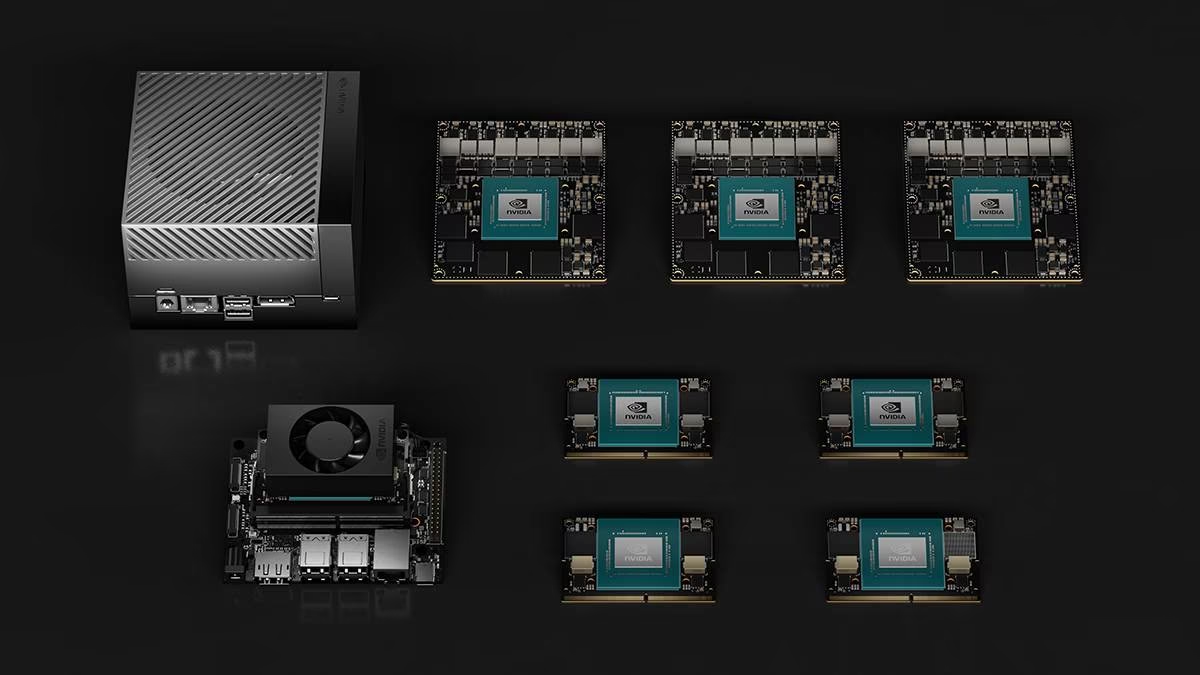
Esta guía se ha probado con NVIDIA Jetson AGX Thor Developer Kit (Jetson T5000) y NVIDIA Jetson AGX Orin Developer Kit (64GB) con la última versión estable de JetPack 7.2; con NVIDIA Jetson Orin Nano Super Developer Kit con la versión JP6.1 de JetPack; con Seeed Studio reComputer J4012, basado en NVIDIA Jetson Orin NX 16GB y con la versión JP6.0 o JP5.1.3 de JetPack; y con Seeed Studio reComputer J1020 v2, basado en NVIDIA Jetson Nano 4GB y con la versión JP4.6.1 de JetPack. Se espera que funcione en toda la gama de hardware NVIDIA Jetson, incluidos los dispositivos más recientes y los antiguos.
¿Qué es NVIDIA Jetson?#
NVIDIA Jetson es una serie de placas de computación embebida diseñadas para llevar la computación acelerada de IA (inteligencia artificial) a los dispositivos perimetrales. Estos dispositivos compactos y potentes se basan en la arquitectura de GPU de NVIDIA y pueden ejecutar algoritmos complejos de IA y modelos de aprendizaje profundo directamente en el dispositivo, sin depender de recursos de computación en la nube. Las placas Jetson se utilizan con frecuencia en robótica, vehículos autónomos, automatización industrial y otras aplicaciones en las que la inferencia de IA debe realizarse localmente con baja latencia y gran eficiencia. Además, estas placas se basan en la arquitectura ARM64 y consumen menos energía que los dispositivos tradicionales de computación con GPU.
Comparativa de la serie NVIDIA Jetson#
NVIDIA Jetson AGX Thor es la última generación de la familia NVIDIA Jetson y se basa en la arquitectura NVIDIA Blackwell, que ofrece un rendimiento de IA muy superior al de las generaciones anteriores. La tabla siguiente compara algunos de los dispositivos Jetson del ecosistema.
| Jetson AGX Thor (T5000) | Jetson AGX Orin 64GB | Jetson Orin NX 16GB | Jetson Orin Nano Super | Jetson AGX Xavier | Jetson Xavier NX | Jetson Nano | |
|---|---|---|---|---|---|---|---|
| Rendimiento de IA | 2070 TFLOPS | 275 TOPS | 100 TOPS | 67 TOPS | 32 TOPS | 21 TOPS | 472 GFLOPS |
| GPU | GPU con arquitectura NVIDIA Blackwell y 2560 núcleos, con 96 Tensor Cores | GPU con arquitectura NVIDIA Ampere y 2048 núcleos, con 64 Tensor Cores | GPU con arquitectura NVIDIA Ampere y 1024 núcleos, con 32 Tensor Cores | GPU con arquitectura NVIDIA Ampere y 1024 núcleos, con 32 Tensor Cores | GPU con arquitectura NVIDIA Volta y 512 núcleos, con 64 Tensor Cores | GPU con arquitectura NVIDIA Volta™ y 384 núcleos, con 48 Tensor Cores | GPU con arquitectura NVIDIA Maxwell™ y 128 núcleos |
| Frecuencia máxima de GPU | 1.57 GHz | 1.3 GHz | 918 MHz | 1020 MHz | 1377 MHz | 1100 MHz | 921MHz |
| CPU | CPU Arm® Neoverse®-V3AE de 64 bits y 14 núcleos; 1 MB de L2 + 16 MB de L3 | CPU NVIDIA Arm® Cortex A78AE v8.2 de 64 bits y 12 núcleos; 3 MB de L2 + 6 MB de L3 | CPU NVIDIA Arm® Cortex A78AE v8.2 de 64 bits y 8 núcleos; 2 MB de L2 + 4 MB de L3 | CPU Arm® Cortex®-A78AE v8.2 de 64 bits y 6 núcleos, 1,5 MB de caché L2 + 4 MB de caché L3 | CPU NVIDIA Carmel Arm®v8.2 de 64 bits y 8 núcleos, 8 MB de caché L2 + 4 MB de caché L3 | CPU NVIDIA Carmel Arm®v8.2 de 64 bits y 6 núcleos, 6 MB de caché L2 + 4 MB de caché L3 | Procesador Arm® Cortex®-A57 MPCore de cuatro núcleos |
| Frecuencia máxima de la CPU | 2.6 GHz | 2.2 GHz | 2.0 GHz | 1.7 GHz | 2.2 GHz | 1.9 GHz | 1.43GHz |
| Memoria | 128 GB LPDDR5X de 256 bits, 273 GB/s | 64 GB LPDDR5 de 256 bits, 204,8 GB/s | 16 GB LPDDR5 de 128 bits, 102,4 GB/s | 8 GB LPDDR5 de 128 bits, 102 GB/s | 32 GB LPDDR4x de 256 bits, 136,5 GB/s | 8 GB LPDDR4x de 128 bits, 59,7 GB/s | 4 GB LPDDR4 de 64 bits, 25,6 GB/s |
¿Qué es NVIDIA JetPack?#
NVIDIA JetPack SDK impulsa los módulos Jetson y proporciona un entorno de desarrollo completo para crear aplicaciones de IA aceleradas de extremo a extremo. JetPack incluye Jetson Linux con cargador de arranque, kernel de Linux, entorno de escritorio de Ubuntu y un conjunto completo de bibliotecas para acelerar la computación con GPU, el procesamiento multimedia, los gráficos y la visión artificial. También incluye ejemplos, documentación y herramientas para desarrolladores, tanto para el ordenador anfitrión como para el kit de desarrollo, y es compatible con SDK de nivel superior, como DeepStream para el análisis de vídeo en streaming, Isaac para robótica y Riva para IA conversacional.
Instalar JetPack en NVIDIA Jetson#
El primer paso tras conseguir un dispositivo NVIDIA Jetson es instalar NVIDIA JetPack en él. Hay varias formas de instalarlo en dispositivos NVIDIA Jetson.
- Para JetPack 7.2 en un kit de desarrollo oficial Jetson AGX Thor, AGX Orin u Orin Nano, descarga la ISO unificada de Jetson, grábala en una unidad USB y sigue la guía de inicio rápido específica del dispositivo para AGX Thor, AGX Orin u Orin Nano. A partir de JetPack 7.2, Orin Nano ya no utiliza una imagen de tarjeta SD descargable; la instalación desde la ISO en USB instala Jetson Linux en la tarjeta microSD o el SSD NVMe del dispositivo.
- Si utilizas JetPack 6 deliberadamente en un kit de desarrollo Jetson Orin Nano, sigue las instrucciones de actualización y de tarjeta SD de JetPack 6.x de NVIDIA.
- Si tienes otro kit de desarrollo NVIDIA, puedes instalar JetPack en el dispositivo con SDK Manager.
- Si tienes un dispositivo Seeed Studio reComputer J4012, puedes instalar JetPack en el SSD incluido; si tienes un dispositivo Seeed Studio reComputer J1020 v2, puedes instalar JetPack en el eMMC/ SSD.
- Si tienes otro dispositivo de terceros equipado con un módulo NVIDIA Jetson, te recomendamos seguir las instrucciones de instalación desde la línea de comandos.
Para los métodos 1, 4 y 5 anteriores, después de grabar el sistema e iniciar el dispositivo, ejecuta sudo apt update && sudo apt install nvidia-jetpack -y en el terminal del dispositivo para instalar los componentes restantes de JetPack que necesitas.
Compatibilidad de JetPack según el dispositivo Jetson#
La tabla siguiente muestra las versiones de NVIDIA JetPack compatibles con los distintos dispositivos NVIDIA Jetson.
| JetPack 4 | JetPack 5 | JetPack 6 | JetPack 7 | |
|---|---|---|---|---|
| Jetson Nano | ✅ | ❌ | ❌ | ❌ |
| Jetson TX2 | ✅ | ❌ | ❌ | ❌ |
| Jetson Xavier NX | ✅ | ✅ | ❌ | ❌ |
| Jetson AGX Xavier | ✅ | ✅ | ❌ | ❌ |
| Jetson AGX Orin | ❌ | ✅ | ✅ | ✅ |
| Jetson Orin NX | ❌ | ✅ | ✅ | ✅ |
| Jetson Orin Nano | ❌ | ✅ | ✅ | ✅ |
| Jetson AGX Thor | ❌ | ❌ | ❌ | ✅ |
Inicio rápido con Docker#
La forma más rápida de empezar a usar Ultralytics YOLO26 en NVIDIA Jetson es ejecutar las imágenes Docker prediseñadas para Jetson. Consulta la tabla anterior y elige la versión de JetPack correspondiente a tu dispositivo Jetson.
t=ultralytics/ultralytics:latest-jetson-jetpack4
sudo docker pull $t && sudo docker run -it --ipc=host --runtime=nvidia $tLa imagen latest-nvidia-arm64 utiliza NVIDIA PyTorch 26.10, incluido CUDA 13.4 y TensorRT 11.4. NVIDIA indica JetPack 7.1 para PyTorch en su tabla de compatibilidad, pero TensorRT 11 no es compatible con JetPack, incluido Thor. Utiliza esta imagen solo para cargas de trabajo de PyTorch en un host compatible. Para exportar a TensorRT en Jetson, utiliza la instalación nativa que aparece a continuación con el runtime TensorRT 10.x compatible con tu versión de JetPack. JetPack 7.2 en Thor u Orin requiere una validación independiente del contenedor. Vuelve a generar los motores para la GPU de destino y la versión de TensorRT.
Para las imágenes de JetPack 4, 5 y 6, sigue los pasos de Uso de TensorRT en NVIDIA Jetson. La imagen de JetPack 7.1 anterior es solo para cargas de trabajo de PyTorch.
Empieza con la instalación nativa#
Para realizar una instalación nativa sin Docker, sigue los pasos que se indican a continuación.
Ejecución en JetPack 7.2#
Instala el paquete Ultralytics#
Instala el paquete Ultralytics en Jetson. Las dependencias de exportación se instalan automáticamente la primera vez que exportas un modelo, así que aquí solo necesitas el paquete base. Esta guía se centra en las exportaciones a NVIDIA TensorRT, ya que TensorRT ofrece el mejor rendimiento en los dispositivos Jetson.
-
Actualiza la lista de paquetes, instala pip y actualízalo a la última versión
sudo apt update sudo apt install python3-pip -y pip install -U pip -
Instala el paquete pip
ultralyticspip install ultralytics -
Reinicia el dispositivo
sudo reboot
Instala PyTorch y Torchvision#
La instalación de ultralytics anterior instalará Torch y Torchvision. Sin embargo, estos dos paquetes instalados mediante pip no son compatibles con los dispositivos JetPack 7.2 que ejecutan CUDA 13, así que debes instalarlos manualmente.
Instala torch y torchvision según JP7.2
pip install torch torchvision --index-url https://download.pytorch.org/whl/cu130Instala onnxruntime-gpu#
Utiliza un paquete de ONNX Runtime para GPU compatible con tus versiones de JetPack, Python y CUDA. Las versiones actuales de PyPI incluyen paquetes ARM64, pero no sustituyen a los paquetes específicos del dispositivo para todas las versiones de JetPack.
Descarga e instala onnxruntime-gpu 1.24.0 con compatibilidad para Python3.12.
pip install https://github.com/ultralytics/assets/releases/download/v0.0.0/onnxruntime_gpu-1.24.0-cp312-cp312-linux_aarch64.whlEjecución en JetPack 6.1#
Instala el paquete Ultralytics#
Instala el paquete Ultralytics en Jetson. Las dependencias de exportación se instalan automáticamente la primera vez que exportas un modelo, así que aquí solo necesitas el paquete base. Esta guía se centra en las exportaciones a NVIDIA TensorRT, ya que TensorRT ofrece el mejor rendimiento en los dispositivos Jetson.
-
Actualiza la lista de paquetes, instala pip y actualízalo a la última versión
sudo apt update sudo apt install python3-pip -y pip install -U pip -
Instala el paquete pip
ultralyticspip install ultralytics -
Reinicia el dispositivo
sudo reboot
Instala PyTorch y Torchvision#
La instalación de ultralytics anterior instalará Torch y Torchvision. Sin embargo, estos dos paquetes instalados mediante pip no son compatibles con la plataforma Jetson, basada en la arquitectura ARM64, así que debes instalar manualmente una rueda pip prediseñada de PyTorch y compilar Torchvision desde el código fuente o instalarlo desde ahí.
Instala torch 2.10.0 y torchvision 0.25.0 según JP6.1
pip install https://github.com/ultralytics/assets/releases/download/v0.0.0/torch-2.10.0-cp310-cp310-linux_aarch64.whl
pip install https://github.com/ultralytics/assets/releases/download/v0.0.0/torchvision-0.25.0-cp310-cp310-linux_aarch64.whlVisita la página de PyTorch para Jetson para acceder a todas las versiones de PyTorch para las distintas versiones de JetPack. Para consultar una lista más detallada de la compatibilidad entre PyTorch y Torchvision, visita la página de compatibilidad de PyTorch y Torchvision.
Instala cuDSS para solucionar un problema de dependencias con torch 2.10.0
wget https://developer.download.nvidia.com/compute/cudss/0.7.1/local_installers/cudss-local-tegra-repo-ubuntu2204-0.7.1_0.7.1-1_arm64.deb
sudo dpkg -i cudss-local-tegra-repo-ubuntu2204-0.7.1_0.7.1-1_arm64.deb
sudo cp /var/cudss-local-tegra-repo-ubuntu2204-0.7.1/cudss-*-keyring.gpg /usr/share/keyrings/
sudo apt-get update
sudo apt-get -y install cudss
Instala onnxruntime-gpu#
Utiliza un paquete de ONNX Runtime para GPU compatible con tus versiones de JetPack, Python y CUDA. Las versiones actuales de PyPI incluyen paquetes ARM64, pero no sustituyen a los paquetes específicos del dispositivo para todas las versiones de JetPack.
Puedes encontrar todos los paquetes disponibles de onnxruntime-gpu, organizados por versión de JetPack, versión de Python y otros detalles de compatibilidad, en la matriz de compatibilidad de ONNX Runtime de Jetson Zoo.
Para JetPack 6 con compatibilidad con Python 3.10, puedes instalar onnxruntime-gpu 1.23.0:
pip install https://github.com/ultralytics/assets/releases/download/v0.0.0/onnxruntime_gpu-1.23.0-cp310-cp310-linux_aarch64.whlComo alternativa, para onnxruntime-gpu 1.20.0:
pip install https://github.com/ultralytics/assets/releases/download/v0.0.0/onnxruntime_gpu-1.20.0-cp310-cp310-linux_aarch64.whlEjecución en JetPack 5.1.2#
Instala el paquete Ultralytics#
Instala el paquete Ultralytics en Jetson. Las dependencias de exportación se instalan automáticamente la primera vez que exportas un modelo, así que aquí solo necesitas el paquete base. Esta guía se centra en las exportaciones a NVIDIA TensorRT, ya que TensorRT ofrece el mejor rendimiento en los dispositivos Jetson.
-
Actualiza la lista de paquetes, instala pip y actualízalo a la última versión
sudo apt update sudo apt install python3-pip -y pip install -U pip -
Instala el paquete pip
ultralyticspip install ultralytics -
Reinicia el dispositivo
sudo reboot
Instala PyTorch y Torchvision#
La instalación de ultralytics anterior instalará Torch y Torchvision. Sin embargo, estos dos paquetes instalados mediante pip no son compatibles con la plataforma Jetson, basada en la arquitectura ARM64, así que debes instalar manualmente una rueda pip prediseñada de PyTorch y compilar Torchvision desde el código fuente o instalarlo desde ahí.
-
Desinstala las versiones de PyTorch y Torchvision que estén instaladas
pip uninstall torch torchvision -
Instala
torch 2.1.0ytorchvision 0.16.2según JP5.1.2pip install https://github.com/ultralytics/assets/releases/download/v0.0.0/torch-2.1.0a0+41361538.nv23.06-cp38-cp38-linux_aarch64.whl pip install https://github.com/ultralytics/assets/releases/download/v0.0.0/torchvision-0.16.2+c6f3977-cp38-cp38-linux_aarch64.whl
Visita la página de PyTorch para Jetson para acceder a todas las versiones de PyTorch para las distintas versiones de JetPack. Para consultar una lista más detallada de la compatibilidad entre PyTorch y Torchvision, visita la página de compatibilidad de PyTorch y Torchvision.
Instala onnxruntime-gpu#
Utiliza un paquete de ONNX Runtime para GPU compatible con tus versiones de JetPack, Python y CUDA. Las versiones actuales de PyPI incluyen paquetes ARM64, pero no sustituyen a los paquetes específicos del dispositivo para todas las versiones de JetPack.
Encontrarás todos los paquetes disponibles de onnxruntime-gpu, organizados por versión de JetPack, versión de Python y otros detalles de compatibilidad, en la matriz de compatibilidad de ONNX Runtime de Jetson Zoo. Descarga e instala onnxruntime-gpu 1.17.0 con compatibilidad para Python3.8.
wget https://nvidia.box.com/shared/static/zostg6agm00fb6t5uisw51qi6kpcuwzd.whl -O onnxruntime_gpu-1.17.0-cp38-cp38-linux_aarch64.whl
pip install onnxruntime_gpu-1.17.0-cp38-cp38-linux_aarch64.whlonnxruntime-gpu actualiza NumPy automáticamente a la versión más reciente, así que reinstala NumPy 1.23.5 para corregir el problema resultante:
pip install numpy==1.23.5
Usa TensorRT en NVIDIA Jetson#
De todos los formatos de exportación de modelos compatibles con Ultralytics, TensorRT ofrece el mayor rendimiento de inferencia en dispositivos NVIDIA Jetson, por lo que es nuestra principal recomendación para implementaciones en Jetson. Antes de exportar, instala los bindings de Python de TensorRT proporcionados para tu versión de JetPack y compruébalos con python3 -c "import tensorrt; print(tensorrt.__version__)". Mantén el runtime TensorRT 10.x compatible en JetPack 6/7; no lo sustituyas por TensorRT 11. Para consultar las instrucciones de configuración y el uso avanzado, echa un vistazo a nuestra guía específica de integración con TensorRT.
También puedes exportar desde el navegador sin configurar el entorno de compilación local. En la pestaña Exportar modelos de Ultralytics Platform, selecciona TensorRT y el dispositivo Jetson de destino. Las opciones de Thor se validan en hardware Thor físico. Las seis opciones de Orin generan actualmente motores candidatos compilados para AGX Orin; valídalos en el modelo SKU de Orin previsto antes de implementarlos.
TensorRT crea y ajusta un motor en la GPU donde se compila. Usa una arquitectura de GPU y un entorno de ejecución TensorRT/CUDA que coincidan con los del dispositivo de destino, y valida todos los motores descargados en el dispositivo de implementación. Que los modelos Orin tengan la misma arquitectura no garantiza automáticamente su portabilidad, y la calibración INT8 debe realizarse en el dispositivo de destino para obtener los mejores resultados.
Convierte el modelo a TensorRT y ejecuta la inferencia#
El modelo YOLO26n en formato PyTorch se convierte a TensorRT para ejecutar la inferencia con el modelo exportado.
from ultralytics import YOLO

# Carga un modelo YOLO26n de PyTorch
model = YOLO("yolo26n.pt")

# Exporta el modelo a TensorRT
model.export(format="engine")  # crea 'yolo26n.engine'

# Carga el modelo exportado a TensorRT
trt_model = YOLO("yolo26n.engine")

# Ejecutar inferencia
results = trt_model("https://ultralytics.com/images/bus.jpg")
Usa NVIDIA Deep Learning Accelerator (DLA)#
NVIDIA Deep Learning Accelerator (DLA) es un componente de hardware especializado integrado en los dispositivos NVIDIA Jetson que optimiza la inferencia de aprendizaje profundo para mejorar la eficiencia energética y el rendimiento. Al descargar tareas de la GPU (y dejarla libre para procesos más exigentes), DLA permite ejecutar modelos con un menor consumo energético sin renunciar a un alto rendimiento, algo ideal para sistemas integrados y aplicaciones de IA en tiempo real.
NVIDIA indica que TensorRT 10.7 es la última versión con compatibilidad con DLA; TensorRT 11.x no es compatible con DLA. Utiliza una versión de TensorRT compatible con DLA y con tu versión de JetPack. TensorRT 11 no es compatible con JetPack, tampoco para exportaciones que solo usan la GPU.
Los siguientes dispositivos Jetson incorporan hardware DLA:
| Dispositivo Jetson | Núcleos DLA | Frecuencia máxima de DLA |
|---|---|---|
| Serie Jetson AGX Orin | 2 | 1.6 GHz |
| Jetson Orin NX 16GB | 2 | 614 MHz |
| Jetson Orin NX 8GB | 1 | 614 MHz |
| Serie Jetson AGX Xavier | 2 | 1.4 GHz |
| Serie Jetson Xavier NX | 2 | 1.1 GHz |
from ultralytics import YOLO

# Carga un modelo YOLO26n de PyTorch
model = YOLO("yolo26n.pt")

# Exporta el modelo a TensorRT con DLA habilitado (solo funciona con FP16 o INT8)
model.export(format="engine", device="dla:0", quantize=16)  # dla:0 o dla:1 corresponden a los núcleos DLA

# Carga el modelo exportado a TensorRT
trt_model = YOLO("yolo26n.engine")

# Ejecutar inferencia
results = trt_model("https://ultralytics.com/images/bus.jpg")Al exportar con DLA, es posible que algunas capas no sean compatibles con DLA y se ejecuten en la GPU. Esta alternativa puede aumentar la latencia y afectar al rendimiento general de la inferencia. Por tanto, el objetivo principal de DLA no es reducir la latencia de inferencia en comparación con TensorRT ejecutándose íntegramente en la GPU. Su objetivo principal es aumentar el rendimiento y mejorar la eficiencia energética.
Resultados de las pruebas de rendimiento de YOLO26 en NVIDIA Jetson#
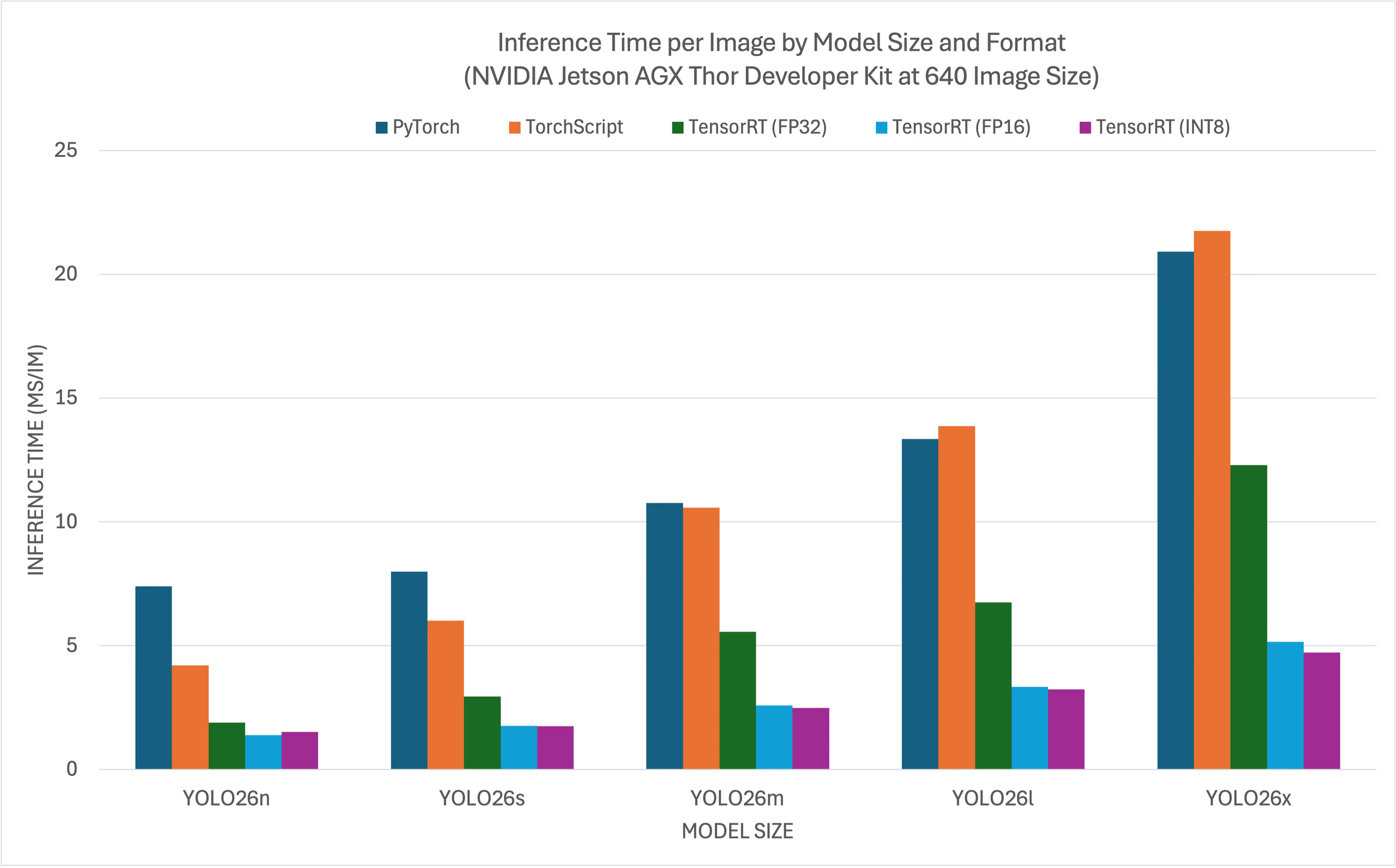
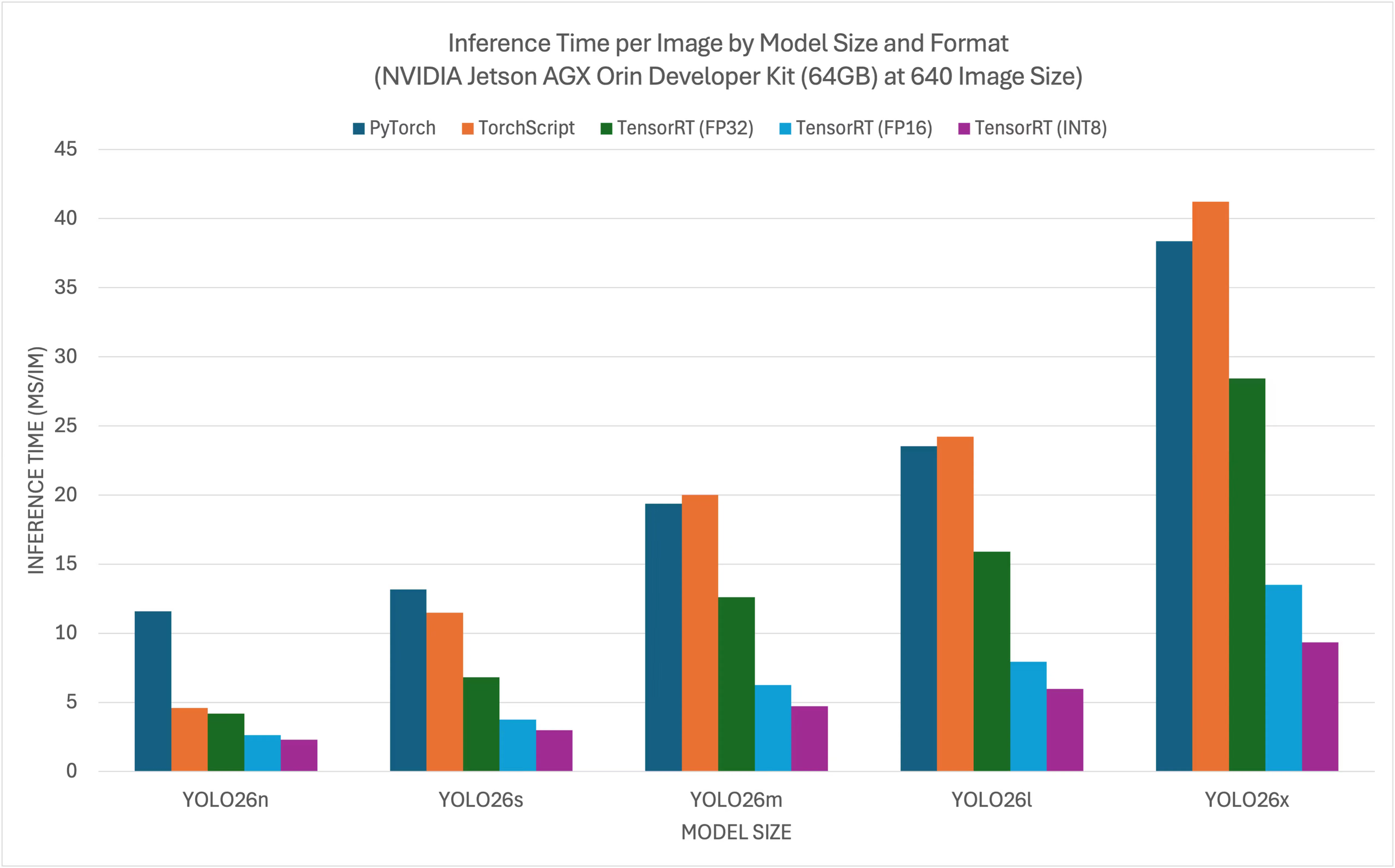
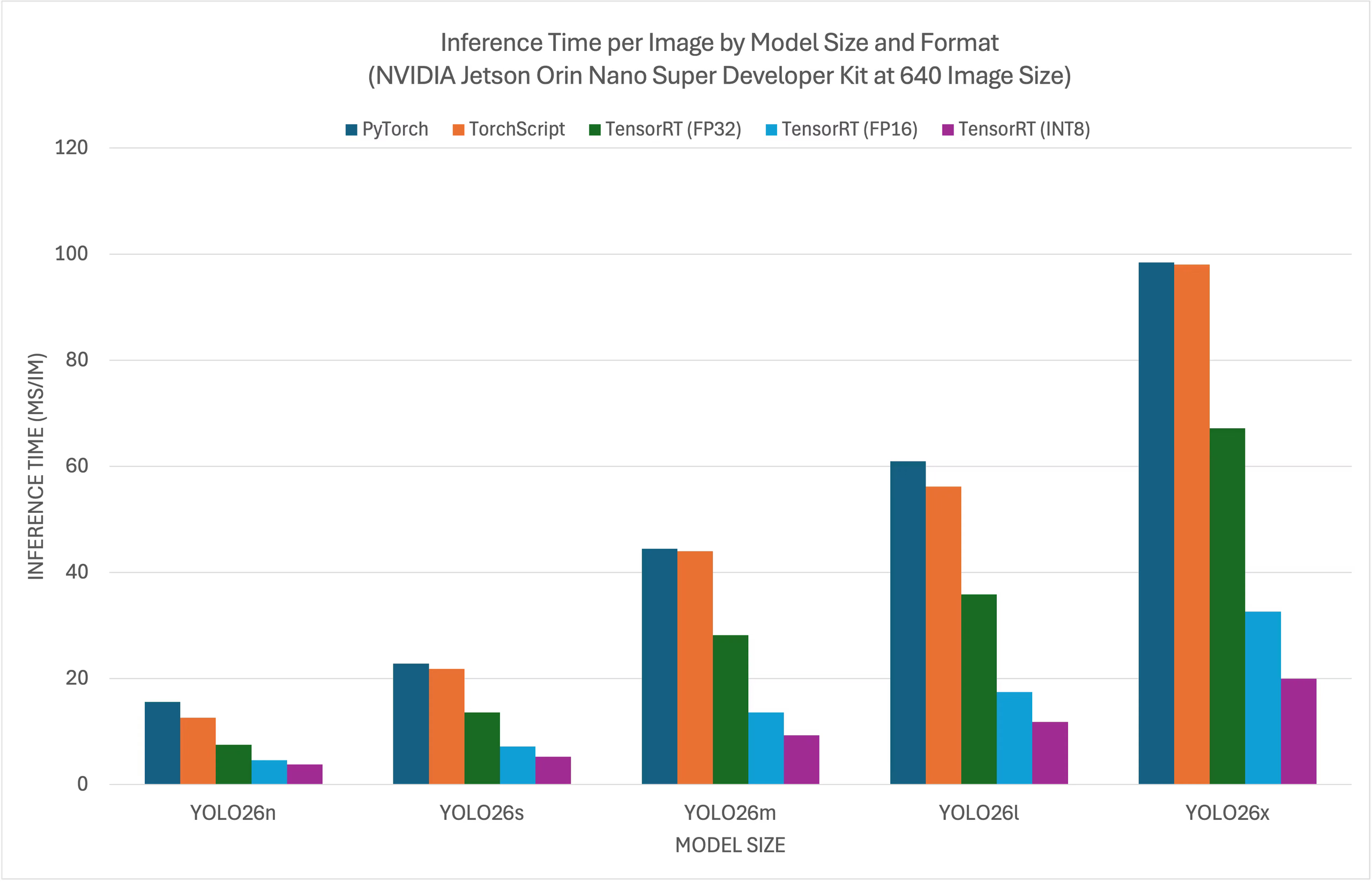
El equipo de Ultralytics realizó pruebas de rendimiento de YOLO26 en 11 formatos de modelo distintos, midiendo la velocidad y la precisión: PyTorch, TorchScript, ONNX, OpenVINO, TensorRT, TF SavedModel, TF GraphDef, TF Lite, MNN, NCNN y ExecuTorch. Las pruebas se realizaron en NVIDIA Jetson AGX Thor Developer Kit, NVIDIA Jetson AGX Orin Developer Kit (64 GB), NVIDIA Jetson Orin Nano Super Developer Kit y Seeed Studio reComputer J4012 con Jetson Orin NX de 16 GB, con precisión FP32 y un tamaño de imagen de entrada predeterminado de 640.
Gráficos comparativos#
Aunque todas las exportaciones de modelos funcionan en NVIDIA Jetson, el gráfico comparativo siguiente solo incluye PyTorch, TorchScript y TensorRT. En la sección posterior a este gráfico encontrarás benchmarks de todas las exportaciones.
Kit de desarrollo NVIDIA Jetson AGX Thor#
Kit de desarrollo NVIDIA Jetson AGX Orin (64 GB)#
Kit de desarrollo NVIDIA Jetson Orin Nano Super#
NVIDIA Jetson Orin NX 16 GB#
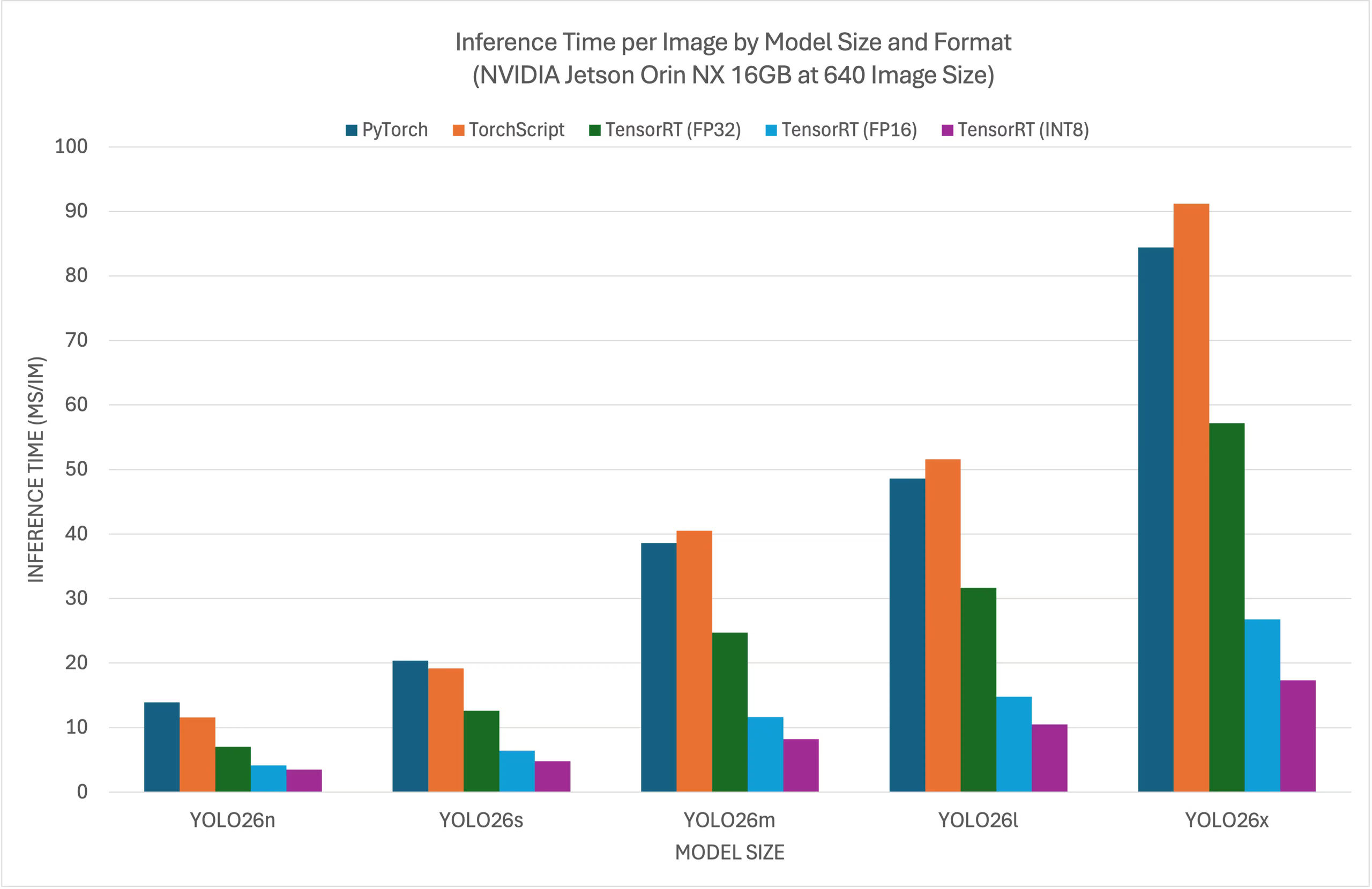
Tablas comparativas detalladas#
La tabla siguiente muestra los resultados del benchmark de cinco modelos YOLO26 distintos (YOLO26n, YOLO26s, YOLO26m, YOLO26l, YOLO26x) en 11 formatos diferentes (PyTorch, TorchScript, ONNX, OpenVINO, TensorRT, TF SavedModel, TF GraphDef, TF Lite, MNN, NCNN, ExecuTorch), e indica el estado, el tamaño, la métrica mAP50-95(B) y el tiempo de inferencia de cada combinación.
Kit de desarrollo NVIDIA Jetson AGX Thor#
| Formato | Estado | Tamaño en disco (MB) | mAP50-95(B) | Tiempo de inferencia (ms/im) |
|---|---|---|---|---|
| PyTorch | ✅ | 5.3 | 0.4798 | 7.39 |
| TorchScript | ✅ | 9.8 | 0.4789 | 4.21 |
| ONNX | ✅ | 9.5 | 0.4767 | 6.58 |
| OpenVINO | ✅ | 10.1 | 0.4794 | 17.50 |
| TensorRT (FP32) | ✅ | 13.9 | 0.4791 | 1.90 |
| TensorRT (FP16) | ✅ | 7.6 | 0.4797 | 1.39 |
| TensorRT (INT8) | ✅ | 6.5 | 0.4273 | 1.52 |
| TF SavedModel | ✅ | 25.7 | 0.4764 | 47.24 |
| TF GraphDef | ✅ | 9.5 | 0.4764 | 45.98 |
| TF Lite | ✅ | 9.9 | 0.4764 | 182.04 |
| MNN | ✅ | 9.4 | 0.4784 | 21.83 |
Pruebas de rendimiento realizadas con Ultralytics 8.4.7
El tiempo de inferencia no incluye el preprocesamiento ni el posprocesamiento.
Kit de desarrollo NVIDIA Jetson AGX Orin (64 GB)#
| Formato | Estado | Tamaño en disco (MB) | mAP50-95(B) | Tiempo de inferencia (ms/im) |
|---|---|---|---|---|
| PyTorch | ✅ | 5.3 | 0.4790 | 11.58 |
| TorchScript | ✅ | 9.8 | 0.4770 | 4.60 |
| ONNX | ✅ | 9.5 | 0.4770 | 9.87 |
| OpenVINO | ✅ | 9.6 | 0.4820 | 28.80 |
| TensorRT (FP32) | ✅ | 11.5 | 0.4770 | 4.18 |
| TensorRT (FP16) | ✅ | 7.9 | 0.4789 | 2.62 |
| TensorRT (INT8) | ✅ | 5.4 | 0.4640 | 2.30 |
| TF SavedModel | ✅ | 24.6 | 0.4760 | 71.10 |
| TF GraphDef | ✅ | 9.5 | 0.4760 | 70.02 |
| TF Lite | ✅ | 9.9 | 0.4760 | 227.94 |
| MNN | ✅ | 9.4 | 0.4760 | 32.46 |
| NCNN | ✅ | 9.3 | 0.4810 | 29.93 |
Pruebas de rendimiento realizadas con Ultralytics 8.4.32
El tiempo de inferencia no incluye el preprocesamiento ni el posprocesamiento.
Kit de desarrollo NVIDIA Jetson Orin Nano Super#
| Formato | Estado | Tamaño en disco (MB) | mAP50-95(B) | Tiempo de inferencia (ms/im) |
|---|---|---|---|---|
| PyTorch | ✅ | 5.3 | 0.4790 | 15.60 |
| TorchScript | ✅ | 9.8 | 0.4770 | 12.60 |
| ONNX | ✅ | 9.5 | 0.4760 | 15.76 |
| OpenVINO | ✅ | 9.6 | 0.4820 | 56.23 |
| TensorRT (FP32) | ✅ | 11.3 | 0.4770 | 7.53 |
| TensorRT (FP16) | ✅ | 8.1 | 0.4800 | 4.57 |
| TensorRT (INT8) | ✅ | 5.3 | 0.4490 | 3.80 |
| TF SavedModel | ✅ | 24.6 | 0.4760 | 118.33 |
| TF GraphDef | ✅ | 9.5 | 0.4760 | 116.30 |
| TF Lite | ✅ | 9.9 | 0.4760 | 286.00 |
| MNN | ✅ | 9.4 | 0.4760 | 68.77 |
| NCNN | ✅ | 9.3 | 0.4810 | 47.50 |
Pruebas de rendimiento realizadas con Ultralytics 8.4.33
El tiempo de inferencia no incluye el preprocesamiento ni el posprocesamiento.
NVIDIA Jetson Orin NX 16 GB#
| Formato | Estado | Tamaño en disco (MB) | mAP50-95(B) | Tiempo de inferencia (ms/im) |
|---|---|---|---|---|
| PyTorch | ✅ | 5.3 | 0.4799 | 13.90 |
| TorchScript | ✅ | 9.8 | 0.4787 | 11.60 |
| ONNX | ✅ | 9.5 | 0.4763 | 14.18 |
| OpenVINO | ✅ | 9.6 | 0.4819 | 40.19 |
| TensorRT (FP32) | ✅ | 11.4 | 0.4770 | 7.01 |
| TensorRT (FP16) | ✅ | 8.0 | 0.4789 | 4.13 |
| TensorRT (INT8) | ✅ | 5.5 | 0.4489 | 3.49 |
| TF SavedModel | ✅ | 24.6 | 0.4764 | 92.34 |
| TF GraphDef | ✅ | 9.5 | 0.4764 | 92.06 |
| TF Lite | ✅ | 9.9 | 0.4764 | 254.43 |
| MNN | ✅ | 9.4 | 0.4760 | 48.55 |
| NCNN | ✅ | 9.3 | 0.4805 | 34.31 |
Pruebas de rendimiento realizadas con Ultralytics 8.4.33
El tiempo de inferencia no incluye el preprocesamiento ni el posprocesamiento.
Descubre más pruebas de rendimiento de Seeed Studio ejecutadas en distintas versiones de hardware NVIDIA Jetson.
Reproduce nuestros resultados#
Para reproducir las pruebas de rendimiento anteriores de Ultralytics en todos los formatos de exportación, ejecuta este código:
from ultralytics import YOLO

# Carga un modelo YOLO26n de PyTorch
model = YOLO("yolo26n.pt")

# Prueba la velocidad y la precisión de YOLO26n en el conjunto de datos COCO128 con todos los formatos de exportación
results = model.benchmark(data="coco128.yaml", imgsz=640)
Ten en cuenta que los resultados de las pruebas de rendimiento pueden variar según la configuración exacta de hardware y software del sistema, así como la carga de trabajo del sistema en el momento de ejecutar las pruebas. Para obtener los resultados más fiables, usa un conjunto de datos con muchas imágenes, p. ej., data='coco.yaml' (5000 imágenes de validación).
Prácticas recomendadas al usar NVIDIA Jetson#
Sigue estas prácticas recomendadas para obtener el máximo rendimiento de YOLO26 en NVIDIA Jetson.
-
Activa el modo de potencia MAX
Al activar el modo de potencia MAX en Jetson, te aseguras de que todos los núcleos de CPU y GPU estén encendidos.
sudo nvpmodel -m 0 -
Activa Jetson Clocks
Al activar Jetson Clocks, te aseguras de que todos los núcleos de CPU y GPU funcionen a su frecuencia máxima.
sudo jetson_clocks -
Instala la aplicación Jetson Stats
Usa la aplicación jetson-stats para supervisar las temperaturas de los componentes del sistema, consultar el uso de CPU, GPU y RAM, cambiar los modos de potencia, establecer las frecuencias máximas y comprobar la información de JetPack.
sudo apt update
sudo pip install jetson-stats
sudo reboot
jtop
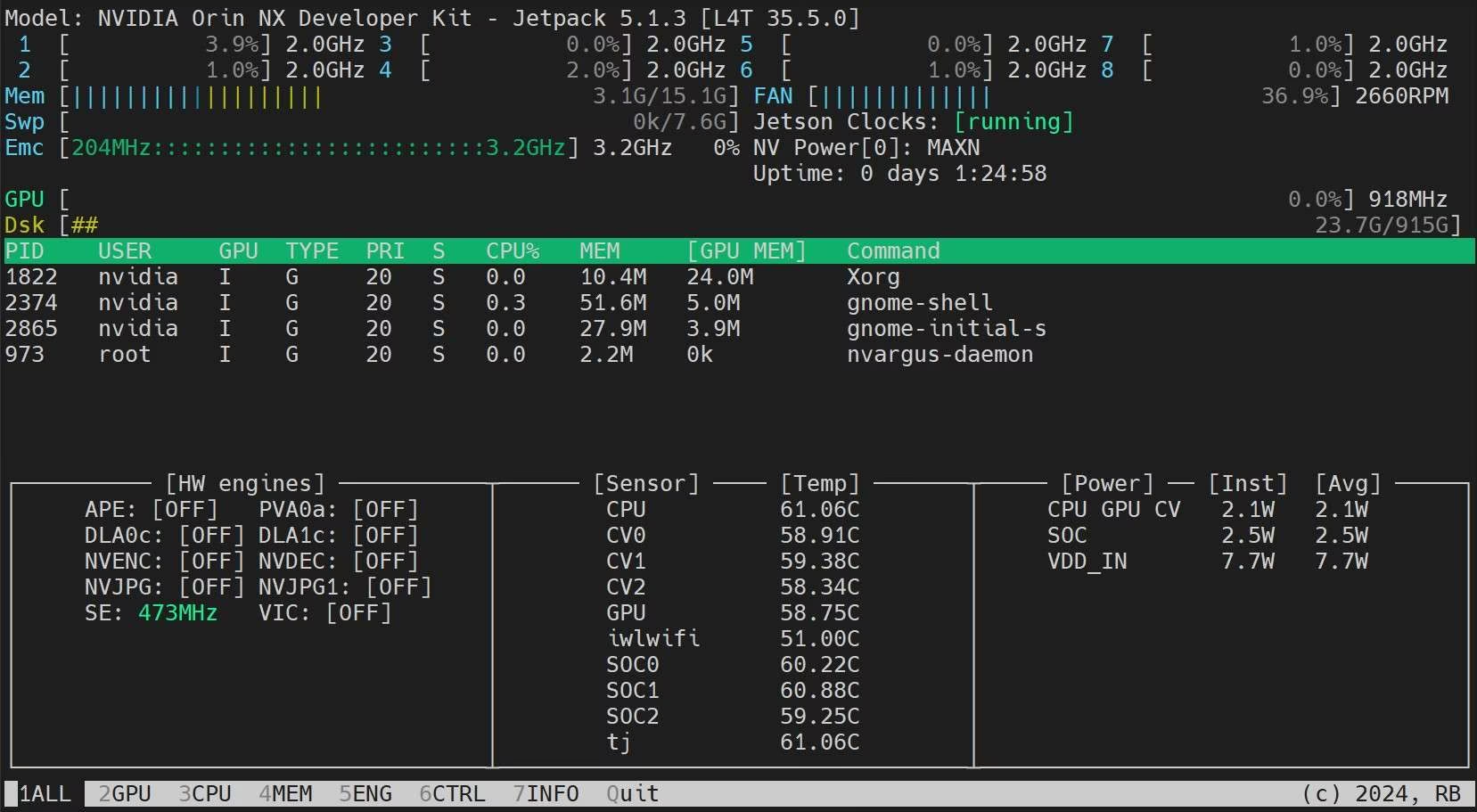
Consejos para optimizar la memoria de NVIDIA Jetson#
La memoria disponible suele ser el factor limitante en los dispositivos Jetson, sobre todo en las variantes con menos memoria, como Jetson Orin Nano (8 GB) u Orin NX 8 GB. Los consejos siguientes son cambios prácticos y de bajo riesgo que, en conjunto, pueden liberar varios cientos de megabytes y permitirte ejecutar modelos YOLO más grandes o admitir más cargas de trabajo en paralelo. Para obtener información completa, consulta el artículo de NVIDIA sobre cómo maximizar la eficiencia de la memoria en Jetson.
1. Cambia al arranque sin interfaz gráfica#
Si te conectas a Jetson por SSH o lo usas como dispositivo de producción sin una pantalla conectada, eliminar el entorno de escritorio y el servidor de pantalla puede liberar hasta 865 MB de RAM:
sudo systemctl set-default multi-user.target
sudo reboot
Para volver a activar el escritorio más adelante:
sudo systemctl set-default graphical.target
sudo reboot
2. Desactiva los servicios del sistema que no uses#
Los servicios en segundo plano no esenciales (Bluetooth, gestores de conectividad y demonios de hardware que no uses) consumen alrededor de 32 MB en total. Muestra los servicios activos y desactiva los que no necesite tu implementación:
# List running services
systemctl list-units --type=service --state=running

# Disable a service
sudo systemctl disable SERVICE_NAME
3. Analiza el uso de memoria#
Antes de optimizar, identifica qué procesos consumen realmente RAM. procrank ordena los procesos por PSS (tamaño proporcional del conjunto), que refleja la huella de memoria real de cada proceso con más precisión que RSS (tamaño del conjunto residente, las páginas de RAM física totales asignadas a un proceso, incluidas las compartidas con otros procesos):
git clone https://github.com/csimmonds/procrank_linux.git
cd procrank_linux && make
sudo ./procrank
Para consultar las asignaciones de GPU y NvMap (canalización de CUDA/vídeo) de cada proceso:
sudo cat /sys/kernel/debug/nvmap/iovmm/clients4. Ejecuta la inferencia sin pantalla en producción#
En las canalizaciones de inferencia que no necesitan una vista previa en directo, desactivar los componentes relacionados con la pantalla (Tiler, OSD, DisplaySink) puede ahorrar más de 200 MB solo en la canalización. Con Ultralytics YOLO, desactiva el visor y guarda los resultados en disco:
from ultralytics import YOLO

model = YOLO("yolo26n.engine")

# show=False evita que se abra una ventana de visualización; save=True guarda en disco los resultados anotados
results = model.predict(source="video.mp4", show=False, save=True)
Impacto acumulado#
| Optimización | Ahorro de memoria aprox. |
|---|---|
| Desactivar la interfaz gráfica de escritorio | ~865 MB |
| Desactivar los servicios del sistema que no se usan | ~32 MB |
| Canalización de inferencia sin pantalla | ~200+ MB |
| Total (mejoras sencillas) | ~1 GB+ |
Combinar estos cambios resulta especialmente útil al usar modelos TensorRT INT8 en dispositivos con memoria limitada: puede marcar la diferencia entre poder cargar en memoria una variante de modelo más grande o no.
Próximos pasos#
Para obtener más información y ayuda, consulta la documentación de Ultralytics YOLO26.
Preguntas frecuentes#
Para implementar Ultralytics YOLO26 en dispositivos NVIDIA Jetson, primero graba el NVIDIA JetPack SDK en tu dispositivo Jetson. Después, usa una imagen Docker prediseñada para una configuración rápida o instala manualmente los paquetes necesarios.
Los modelos YOLO26 se han sometido a benchmarks en los dispositivos NVIDIA Jetson AGX Thor, AGX Orin, Orin Nano Super y Orin NX, y el formato TensorRT ofrece el mejor rendimiento de inferencia. La sección Tablas comparativas detalladas incluye mAP50-95 y el tiempo de inferencia de cada modelo y formato de exportación.
Se recomienda TensorRT para implementar modelos YOLO26 en NVIDIA Jetson, ya que ofrece la inferencia más rápida de todos los formatos de exportación al optimizar el modelo para la GPU de Jetson.
Para instalar PyTorch y Torchvision en NVIDIA Jetson, primero desinstala las versiones existentes que puedan haberse instalado mediante pip. Después, instala manualmente las versiones de PyTorch y Torchvision compatibles con la arquitectura ARM64 de Jetson. Encontrarás instrucciones detalladas del proceso en la sección Instala PyTorch y Torchvision.
Para maximizar el rendimiento de YOLO26 en NVIDIA Jetson, sigue estas prácticas recomendadas:
- Activa el modo de potencia MAX para usar todos los núcleos de CPU y GPU.
- Activa Jetson Clocks para que todos los núcleos funcionen a su frecuencia máxima.
- Instala la aplicación Jetson Stats para supervisar las métricas del sistema.
Para consultar comandos y más información, ve a la sección Prácticas recomendadas al usar NVIDIA Jetson.
La RAM disponible suele ser el cuello de botella en los dispositivos Jetson con menos memoria. Tres mejoras sencillas pueden liberar en conjunto más de 1 GB:
- Cambia al arranque sin interfaz gráfica (
sudo systemctl set-default multi-user.target) para eliminar la interfaz gráfica de escritorio (ahorro de ~865 MB). - Desactiva los servicios que no uses, como Bluetooth o los gestores de conectividad (ahorro de ~32 MB).
- Ejecuta la inferencia sin pantalla estableciendo
show=Falseen la llamada de YOLOpredict, lo que evita asignar memoria a la canalización de pantalla (ahorro de ~200 MB o más).
Usa
procrankpara analizar el uso de RAM de cada proceso ysudo cat /sys/kernel/debug/nvmap/iovmm/clientspara inspeccionar las asignaciones de GPU. Consulta la sección Consejos para optimizar la memoria para obtener toda la información.- Cambia al arranque sin interfaz gráfica (
TensorRT 10.3.0, incluido en JetPack 6, tiene un problema conocido que impide compilar motores INT8 con salidas sin NMS (
nms=False) o con NMS integrado (nms=True). Cuando Ultralytics detecta esta combinación, selecciona la cabeza uno-a-muchos para las exportaciones sin NMS y detiene las exportacionesnms=Truecon un error.Para recuperar estas exportaciones INT8, actualiza TensorRT a una versión más reciente (por ejemplo, 10.7.0 o posterior):
wget https://developer.download.nvidia.com/compute/cuda/repos/ubuntu2204/arm64/cuda-keyring_1.1-1_all.deb
sudo dpkg -i cuda-keyring_1.1-1_all.deb
sudo apt-get update
sudo apt-get install -y tensorrt
Después de actualizar, vuelve a ejecutar la exportación. Para obtener más información, consulta la incidencia #23841 de GitHub y la incidencia #26655.


Comentarios194
Haz una pregunta, comparte tus resultados o ayuda a otra persona.
LG973641114
您好,如何用c++在jetson上部署YOLO26,有相关例子吗
1pknowler
Struggling with this on a new Jetson Orin Nano JP6.1. All good following the steps and installs to give torch.cuda.is_available as TRUE. The TensorRT export fails though with a number of dependency errors and I can’t re-install it with anything. Any pointers please?
1 Glenn JocherUltralytics
@pknowler it seems like the dependency errors during TensorRT export might stem from compatibility issues. Please ensure you’ve installed the required JetPack-compatible versions of PyTorch, Torchvision, and TensorRT as outlined in the Jetson Quick Start Guide. Additionally, verify that
onnxruntime-gpuandcuSPARSELtare correctly installed per the guide. If the issue persists, you can try reinstalling TensorRT using the NVIDIA SDK Manager for your JetPack version. Let me know if you need further clarification!Thank you. I will try again working through all of the steps and let you know how it goes!
I’ve tried again but this as far as I get… I have followed everything carefully.
WARNING ⚠️ TensorRT requires GPU export, automatically assigning device=0 Ultralytics 8.3.57 🚀 Python-3.10.16 torch-2.5.0a0+872d972e41.nv24.08 CUDA:0 (Orin, 7620MiB) YOLO11n summary (fused): 238 layers, 2,616,248 parameters, 0 gradients, 6.5 GFLOPs
PyTorch: starting from 'yolo11n.pt' with input shape (1, 3, 640, 640) BCHW and output shape(s) (1, 84, 8400) (5.4 MB)
ONNX: starting export with onnx 1.17.0 opset 19... ONNX: slimming with onnxslim 0.1.46... ONNX: export success ✅ 3.1s, saved as 'yolo11n.onnx' (10.2 MB) requirements: Ultralytics requirement ['tensorrt>7.0.0,!=10.1.0'] not found, attempting AutoUpdate... error: subprocess-exited-with-error
× python setup.py egg_info did not run successfully. │ exit code: 1 ╰─> [6 lines of output] Traceback (most recent call last): File "", line 2, in File "", line 34, in File "/tmp/pip-install-d0ljzl60/tensorrt-cu12_db0552ac431148489703f6f75df6764f/setup.py", line 71, in raise RuntimeError("TensorRT does not currently build wheels for Tegra systems") RuntimeError: TensorRT does not currently build wheels for Tegra systems [end of output]
note: This error originates from a subprocess, and is likely not a problem with pip. error: metadata-generation-failed
× Encountered error while generating package metadata. ╰─> See above for output.
note: This is an issue with the package mentioned above, not pip. hint: See above for details. Retry 1/2 failed: Command 'pip install --no-cache-dir "tensorrt>7.0.0,!=10.1.0" ' returned non-zero exit status 1. error: subprocess-exited-with-error
× python setup.py egg_info did not run successfully. │ exit code: 1 ╰─> [6 lines of output] Traceback (most recent call last): File "", line 2, in File "", line 34, in File "/tmp/pip-install-782zjqf9/tensorrt-cu12_44d261aea7c5489db3e9ce15cec8ee64/setup.py", line 71, in raise RuntimeError("TensorRT does not currently build wheels for Tegra systems") RuntimeError: TensorRT does not currently build wheels for Tegra systems [end of output]
note: This error originates from a subprocess, and is likely not a problem with pip. error: metadata-generation-failed
× Encountered error while generating package metadata. ╰─> See above for output.
note: This is an issue with the package mentioned above, not pip. hint: See above for details.
And I have TensorRT 10.7.0.23-1+cuda12.6
- Glenn JocherUltralytics
@pknowler it seems your TensorRT version is not compatible with the Jetson's ARM64 architecture. TensorRT does not provide pre-built Python wheels for Tegra systems. Please ensure you have TensorRT installed via the NVIDIA SDK Manager as part of the JetPack installation, and confirm compatibility with your JetPack version. The Jetson Quick Start Guide might also help clarify setup specifics. Let me know if further assistance is needed!
@glenn-jocher thank you. I have found the issue now. I am using miniconda and for some reason TensorRT Python bindings are not available in conda envs. So I can import Torch with no problem but the import TensorRT fails. I have re-installed without conda and all works as expected! 👍🏻
RasoulZardeyni
Which one reduce inference time using TensorRT or deepstream?
1 Paula DerrengerUltralytics(editado)
In terms of reducing inference time on your NVIDIA Jetson device, using TensorRT is generally recommended. TensorRT is specifically designed to provide high performance for NVIDIA hardware by optimizing deep learning models for inference. It accelerates models by fusing layers, pruning unused layers, and quantizing variables, among other optimizations. 🚀
DeepStream, on the other hand, is more focused on streaming analytics and can utilize TensorRT-optimized models. For most cases, directly using TensorRT for model optimization is your go-to for minimizing inference times.
Here's a quick example of exporting a YOLO model to TensorRT and running inference, tailored for your convenience:
from ultralytics import YOLO

# Load your YOLO model
model = YOLO('yolo26n.pt')

# Export to TensorRT format
model.export(format='engine')

# Load the TensorRT model
trt_model = YOLO('yolo26n.engine')

# Run inference using the TensorRT model
results = trt_model('your_image_or_video.jpg')
Feel free to explore more about deploying on NVIDIA Jetson with our Quick Start Guide for NVIDIA Jetson. Happy inferencing! 🌟
2Thanks!
1- Paula DerrengerUltralytics(editado)
Hey there! 😊 It looks like you're interested in speeding up your inference times. Between TensorRT and DeepStream on NVIDIA Jetson devices, TensorRT typically offers more direct optimization for reducing inference time for individual models by providing lower-level optimizations and quantization options.
DeepStream is a comprehensive framework for building end-to-end video analytics applications, which utilizes TensorRT under the hood for model inference. DeepStream excels in scenarios involving video streams, multi-stream input, and complex pipelines involving multiple AI models and analytics. If your primary goal is solely to minimize inference time for a specific model, direct optimization via TensorRT can provide more focused improvements.
A quick example of exporting a YOLO model to TensorRT:
from ultralytics import YOLO

# Load your YOLO model
model = YOLO('yolo26n.pt')

# Export to TensorRT format
model.export(format='engine')  # This creates 'yolo26n.engine'

# Done! Now you can use 'yolo26n.engine' for faster inference.
However, if your application benefits from a broader video analytics pipeline, incorporating DeepStream into your workflow can optimize and streamline these processes on top of efficiently handling inference with TensorRT optimized models. 🚀
Hope this gives you a clearer picture! If you have more questions, feel free to ask.
1
 Yufeng Wu(editado)
Hi, ultralytics team. I'm trying yolo26n-pose on Jetson orin agx 64gb and have this problem: I tried building engine with dynamic=true but failed, with the log saying ForeignNode[/model.23/Sigmoid.../model.23/Flatten] (Myelin) Skipping tactic ... Incompatible effective shapes in operation /model_23/Sub between: Unsqueeze_18_output_0 f32[1,2,33600] and Slice_output_0 f32[1,2,21504] Could not find any implementation for node {ForeignNode[/model.23/Sigmoid.../model.23/Flatten]} Is there a way to fix it?
- Glenn JocherUltralytics
This indicates a TensorRT dynamic-shape profile failure in the pose head. As a workaround, export a fixed-resolution engine, e.g.
yolo export model=yolo26n-pose.pt format=engine imgsz=640 batch=1 dynamic=False; build separate engines if multiple resolutions are required. If dynamic shapes are essential, please open a new issue with the full text log,yolo checksoutput, and JetPack/TensorRT/Ultralytics versions so we can reproduce it; see the TensorRT export guide.
 Haotian Gong(editado)
Hi, everyone,
I'd like to flag two issues with the Jetson installation guide that may need updating.
1. PyTorch 2.10.0 / Torchvision 0.25.0 doesn't work on JetPack 6.1
Following the "Start with naive installation" and "Run on JetPack 6.1" sections, I installed Pytorch 2.10.0 and Torchvision 0.25.0 as instructed.
Running my script then throws:
ImportError: libcublas.so.13: cannot open shared object file: No such file or directorySo I have to install Pytorch 2.8.0 with the guide:
https://forums.developer.nvidia.com/t/jetson-orin-nano-issues-running-yolo-ultralytics-due-to-pytorch-torchvision-compatibility-jetpack-6-x-cuda-12-6/365683/9And this version of Pytorch works. So maybe is the guide on Jetson obsolete or mistaken?
2. CSI camera requires the JetPack-bundled OpenCV, not the PyPI one
On Jetson, using a CSI camera (via
nvarguscamerasrc) requires the OpenCV that ships with JetPack, because the PyPIopencv-pythonwheel on aarch64 is built without GStreamer support.However,
pip install ultralyticspulls inopencv-pythonas a dependency, which shadows the JetPack-bundled version and silently breaks CSI camera pipelines.pip uninstall -y opencv-python opencv-python-headless sudo apt install -y python3-opencv # JetPack-bundled OpenCV with GStreamerThanks!
 Lakshantha DissanayakeUltralytics
Hi @ZephyrKeXiner Could you please double check whether you are using JetPack 6.1 system with CUDA 12.6? I have just verified on my JetPack 6.1 system with CUDA 12.6 with
torch-2.10.0andtorchvision-0.25.0as mentioned in the Ultralytics Jetson Guide and it works well.For JetPack 6.1, output of
cat /etc/nv_tegra_releaseshould look like below:(env) nvidia@ubuntu:~/yolo26/ultralytics$ cat /etc/nv_tegra_release # R36 (release), REVISION: 4.3, GCID: 38968081, BOARD: generic, EABI: aarch64, DATE: Wed Jan 8 01:49:37 UTC 2025 # KERNEL_VARIANT: oot TARGET_USERSPACE_LIB_DIR=nvidia TARGET_USERSPACE_LIB_DIR_PATH=usr/lib/aarch64-linux-gnu/nvidiaCould you also share yours please? Thanks!
cc: @raimbekovm
1- Haotian Gong
Hi @lakshanthad,
My output of
cat /etc/nv_tegra_releaseis below:$ cat /etc/nv_tegra_release # R36 (release), REVISION: 5.0, GCID: 43688277, BOARD: generic, EABI: aarch64, DATE: Fri Jan 16 03:50:45 UTC 2026 # KERNEL_VARIANT: oot TARGET_USERSPACE_LIB_DIR=nvidia TARGET_USERSPACE_LIB_DIR_PATH=usr/lib/aarch64-linux-gnu/nvidiaI notice that the revision is 5.0 not 4.3. Maybe does it cause the error?
smbunn(editado)
I would have thought the Jetson Orin Nano could do more than 5 streams, the deepstream examples with cars handles 16 streams of 1080p at what appears to be full framerate.
As a control systems engineer by training, edge devices seem a much better way to go so I prefer your jetson design. Even if one Jetson has an issue you are still processing 45 streams whereas a problem on your centralised server in option 2 takes everything down.
Are you going to set up an MQTT feed for alerts from each stream? Maybe consider secondary processing and a buffer, so the edge device detects what it thinks is an issue and a centralised server grabs 5 seconds of video of the incident and double checks.
Simon BUNN
General
From: Yash Patel @.> Sent: Friday, 22 May 2026 4:00 am To: ultralytics/ultralytics @.> Cc: Bunn, Simon @.>; Mention @.> Subject: Re: [ultralytics/ultralytics] guides/nvidia-jetson/ (Discussion #9942)
Hi, I am designing an AI-based CCTV surveillance system for a residential society with 50 RTSP camera streams. My current architecture uses multiple NVIDIA Jetson Orin Nano Super Developer Kit devices for distributed inference processing. I ZjQcmQRYFpfptBannerStart Attention The sender's identity could not be verified and someone may be impersonating the sender. L'identité de l'expéditeur n'a pas pu être vérifiée et quelqu'un pourrait se faire passer pour l'expéditeur.
ZjQcmQRYFpfptBannerEnd
Hi, I am designing an AI-based CCTV surveillance system for a residential society with 50 RTSP camera streams. My current architecture uses multiple NVIDIA Jetson Orin Nano Super Developer Kit devices for distributed inference processing. I estimate that one Jetson Orin Nano Super (8GB) can process around 5 RTSP streams at usable real-time FPS. This requires approximately 10 Jetson devices for the full deployment. Each device costs around ₹33,000 (~USD 395). The total estimated hardware cost is ₹330,000 (~USD 3,950). I want to compare this setup against a centralized Linux-based custom PC/server with NVIDIA GPU acceleration under the same budget. The comparison focuses on AI inference performance, scalability, reliability, and 24/7 operational efficiency. The workload mainly includes multi-stream YOLO/object detection inference on live RTSP feeds. I want to determine which architecture provides the best computation-to-cost ratio for this surveillance use case.
— Reply to this email directly, view it on GitHubhttps://urldefense.com/v3/__https://github.com/orgs/ultralytics/discussions/9942*discussioncomment-17006943__;Iw!!ElGdukoduuk!URiPjKkgDoMT_k2Y6pEd3XMEBGMDjhwgtQmwWXR9F4R4L7ymNloZD79NanOjYVg9YYmaARqyZGbgFv7U15KzgdcU$, or unsubscribehttps://urldefense.com/v3/__https://github.com/notifications/unsubscribe-auth/ABAAMILYUP7PPODNHDR3HC3434RYLAVCNFSM6AAAAABGAK2IGGVHI2DSMVQWIX3LMV43URDJONRXK43TNFXW4Q3PNVWWK3TUHMYTOMBQGY4TIMY__;!!ElGdukoduuk!URiPjKkgDoMT_k2Y6pEd3XMEBGMDjhwgtQmwWXR9F4R4L7ymNloZD79NanOjYVg9YYmaARqyZGbgFv7U1zjhi4YU$. Triage notifications on the go with GitHub Mobile for iOShttps://urldefense.com/v3/__https://apps.apple.com/app/apple-store/id1477376905?ct=notification-email&mt=8&pt=524675__;!!ElGdukoduuk!URiPjKkgDoMT_k2Y6pEd3XMEBGMDjhwgtQmwWXR9F4R4L7ymNloZD79NanOjYVg9YYmaARqyZGbgFv7U13gOq1qb$ or Androidhttps://urldefense.com/v3/__https://play.google.com/store/apps/details?id=com.github.android&referrer=utm_campaign*3Dnotification-email*26utm_medium*3Demail*26utm_source*3Dgithub__;JSUlJSU!!ElGdukoduuk!URiPjKkgDoMT_k2Y6pEd3XMEBGMDjhwgtQmwWXR9F4R4L7ymNloZD79NanOjYVg9YYmaARqyZGbgFv7U1zOl3XaF$. You are receiving this because you were mentioned.Message ID: @.***>
- Glenn JocherUltralytics
5streams on an Orin Nano Super is just a conservative YOLO/Python estimate; with a headless TensorRT or DeepStream pipeline, MAX power mode, andjetson_clocks, higher 1080p stream counts are definitely possible and depend heavily on the model size, input resolution, decode/encode, and any tracking or alert logic you add, so please drop your exactmodel,imgsz, FPS target, and RTSP resolution here and we can help size it more accurately using the Jetson deployment guide and DeepStream Jetson guide.
yashpatel2010
Hi, I am designing an AI-based CCTV surveillance system for a residential society with 50 RTSP camera streams. My current architecture uses multiple NVIDIA Jetson Orin Nano Super Developer Kit devices for distributed inference processing. I estimate that one Jetson Orin Nano Super (8GB) can process around 5 RTSP streams at usable real-time FPS. This requires approximately 10 Jetson devices for the full deployment. Each device costs around ₹33,000 (~USD 395). The total estimated hardware cost is ₹330,000 (~USD 3,950). I want to compare this setup against a centralized Linux-based custom PC/server with NVIDIA GPU acceleration under the same budget. The comparison focuses on AI inference performance, scalability, reliability, and 24/7 operational efficiency. The workload mainly includes multi-stream YOLO/object detection inference on live RTSP feeds. I want to determine which architecture provides the best computation-to-cost ratio for this surveillance use case.
RotatingGiraffe
Hi there, I am trying to run a fine-tuned YOLO26 based model for an OBB task on a Xavier NX running JetPack 5. I am using your container (ultralytics/ultralytics:latest-jetson-jetpack5) and trying to compile from PyTorch to TensorRT. I get the error: "mymodel.pt requires numpy>=1.26.1, however numpy==1.23.5 is installed."
Previously I have successfully the file on my host machine from PT to ONNX, copied ONNX to Jetson and then used tensorrtexec to compile to Engine. But the resulting models did not create any bounding boxes.
I wanted to ask if JetPack 5 even supports Yolo26 or if the model contains some incompatible layers? YOLO11 OBB works fine which I find extra-weird. Or is there likely an error somewhere else in my script?
- Glenn JocherUltralytics
Thanks for posting this here—JetPack 5 on Xavier NX is supported for YOLO26/TensorRT in our Jetson guide, so the
numpy>=1.26.1error points more to an environment/checkpoint mismatch than unsupported OBB layers; please paste the full text traceback andyolo checksoutput, and note that an engine built withtensorrtexeccan still produce empty OBB results if the Ultralytics export metadata/postprocessing is not preserved. Hi there, I tried to create a minimal reproducible example for you, based on what I am doing. I hope it helps with debugging.
The yolo checks you asked for is in the script output, along with the export script. I've also included the bit where I export via trtexex just for the sake of completion - it might very well be possible that I omit required metadata with this. My prefered goal would be that everything works via the Ultralytics Python API, but I had to search for workaround due to the NumPy error when compiling PT files.
I am now using the Ultralytics base image in the MRE which I hoped would be easier to debug for us. The NumPy error persists on the new image. Previously I was using something built upon l4t-ml.
Additionally, ONNX fails with an error ( `GLIBCXX_3.4.29' not found I think it was) but that is not a concern to me since I engine would be my prefered way to go. I have not installed any additional packages and kept it very vanilla (see dockerfile). The MRE also weirdly produced a new error during engine inference, but I'd say lets just focus on getting the Ultralytics native pipeline to work and then maybe all the other issues were just from my workarounds and disappear.
Execution Command
sudo docker compose up --buildDirectory Structure
obb-test-repro/
 ┣ 📂data/
 ┃ ┗ 📜mydataset.yaml
 ┣ 📂models/
 ┃ ┣ 📜my-yolo26m-model.onnx
 ┃ ┗ 📜my-yolo26m-model.pt
 ┣ 📂src/
 ┃ ┗ 📜main.py
 ┣ 📜docker-compose.yml
 ┣ 📜Dockerfile
 ┗ 📜requirements.txt
Dockerfile
FROM ultralytics/ultralytics:latest-jetson-jetpack5

WORKDIR /app

# Copy the test app
COPY src/ ./src/

# Run the test
CMD ["python3", "src/main.py"]
docker-compose.yml
version: '3.8'

services:
  obb-test-jp5:
    image: obb-test:latest
    container_name: obb_test_jp5
    build:
      context: .
      dockerfile: Dockerfile
    runtime: nvidia
    network_mode: host
    ipc: host
    restart: "no"
    volumes:
      - ./models:/app/models
      - ./data:/app/data
    environment:
      - NVIDIA_VISIBLE_DEVICES=all
      - NVIDIA_DRIVER_CAPABILITIES=all
main.py
"""
Minimal OBB model test script.

Behavior:
- Runs `yolo checks` to output environment details.
- Uses files in `/app/models` (container path mapped from `obb-test/models`).
- Expects two files (hard-coded):
  - `/app/models/my-yolo26m-model.pt` (optional) — used for Ultralytics native export
  - `/app/models/my-yolo26m-model.onnx` (optional) — used for trtexec compilation
- Runs both export methods (if files exist) and validates inference on each compiled engine using mydataset dataset.
"""

import logging
import sys
import subprocess
import os
from pathlib import Path
from ultralytics import YOLO

# Configure logging
logging.basicConfig(
    level=logging.INFO,
    format='%(asctime)s - %(levelname)s - %(message)s'
)
logger = logging.getLogger(__name__)


def run_yolo_checks():
    """Execute yolo checks via CLI to log environment details."""
    logger.info("=" * 60)
    logger.info("Environment Verification (yolo checks)")
    logger.info("=" * 60)
    try:
        res = subprocess.run(["yolo", "checks"], capture_output=True, text=True, check=True)
        logger.info("\n" + res.stdout.strip())
    except subprocess.CalledProcessError as e:
        logger.error(f"yolo checks failed:\n{e.stderr}")
    except FileNotFoundError:
        logger.error("yolo CLI command not found. Ensure ultralytics is installed in this environment.")


def test_export_to_engine():
    models_dir = Path("/app/models")
    pt_path = models_dir / "my-yolo26m-model.pt"
    onnx_path = models_dir / "my-yolo26m-model.onnx"
    dataset_yaml = "/app/data/mydataset.yaml"

    logger.info("=" * 60)
    logger.info("Minimal OBB Test - Export & Validation")
    logger.info("=" * 60)

    engines_tested = []

    # Part 1: Ultralytics native export (PT -> Engine)
    if pt_path.exists():
        try:
            logger.info(f"\nRunning Ultralytics native export for: {pt_path.name}")
            model = YOLO(str(pt_path))
            exported = model.export(format="engine", imgsz=1024, device=0, half=True)

            # Resolve the exported engine path
            native_engine = str(exported) if isinstance(exported, (str, Path)) else str(pt_path.with_suffix('.engine'))

            if os.path.exists(native_engine):
                logger.info(f"Ultralytics export successfully produced: {native_engine}")
                engines_tested.append(native_engine)
            else:
                logger.error(f"Ultralytics export completed, but engine file was not found at {native_engine}")
        except Exception as e:
            logger.error(f"Ultralytics native export failed: {e}", exc_info=True)
    else:
        logger.info(f"PT file not found ({pt_path}); skipping Ultralytics native export.")

    # Part 2: trtexec compilation (ONNX -> Engine)
    if onnx_path.exists():
        try:
            logger.info(f"\nRunning trtexec to compile ONNX: {onnx_path.name}")
            trt_engine = str(onnx_path.with_suffix('.trt.engine'))
            cmd = [
                "/usr/src/tensorrt/bin/trtexec",
                f"--onnx={onnx_path}",
                f"--saveEngine={trt_engine}",
                "--fp16",
                "--memPoolSize=workspace:768", # Prevents Out of Memory
            ]
            logger.info(f"Running command: {' '.join(cmd)}")
            res = subprocess.run(cmd, capture_output=True, text=True)

            if res.returncode != 0:
                logger.error("trtexec compilation failed.")
                logger.error(f"trtexec stderr:\n{res.stderr}")
            else:
                if os.path.exists(trt_engine):
                    logger.info(f"trtexec successfully saved engine to {trt_engine}")
                    engines_tested.append(trt_engine)
                else:
                    logger.error(f"trtexec returned success, but engine file was not found at {trt_engine}")
        except Exception as e:
            logger.error(f"trtexec execution failed: {e}", exc_info=True)
    else:
        logger.info(f"ONNX file not found ({onnx_path}); skipping trtexec compilation.")

    if not engines_tested:
        logger.error("\nNo engines are available to test. Exiting validation phase.")
        return False

    # Part 3: Inference Validation
    validation_success = True
    for eng in engines_tested:
        try:
            logger.info(f"\nValidating inference with engine: {eng}")

            model = YOLO(eng, task="obb")
            metrics = model.val(data=dataset_yaml, imgsz=1024, batch=1, verbose=False)

            logger.info(f"Validation metrics for {eng}: mAP50-95={metrics.box.map:.4f}, mAP50={metrics.box.map50:.4f}")
        except Exception as e:
            logger.error(f"Validation failed on {eng}: {e}", exc_info=True)
            validation_success = False

    logger.info("\nExecution complete.")
    return validation_success


if __name__ == "__main__":
    run_yolo_checks()

    try:
        success = test_export_to_engine()
        logger.info("\n" + "=" * 60)
        if success:
            logger.info("✓ Test passed")
        else:
            logger.info("✗ Test failed")
        logger.info("=" * 60)
        sys.exit(0 if success else 1)
    except Exception as e:
        logger.error(f"Unhandled script exception: {e}", exc_info=True)
        sys.exit(1)
Output
obb_test_jp5  | Creating new Ultralytics Settings v0.0.6 file ✅
obb_test_jp5  | View Ultralytics Settings with 'yolo settings' or at '/root/.config/Ultralytics/settings.json'
obb_test_jp5  | Update Settings with 'yolo settings key=value', i.e. 'yolo settings runs_dir=path/to/dir'. For help see https://docs.ultralytics.com/quickstart/#ultralytics-settings.
obb_test_jp5  | 2026-05-14 12:51:35,392 - INFO - ============================================================
obb_test_jp5  | 2026-05-14 12:51:35,392 - INFO - Environment Verification (yolo checks)
obb_test_jp5  | 2026-05-14 12:51:35,392 - INFO - ============================================================
obb_test_jp5  | 2026-05-14 12:51:50,554 - INFO -
obb_test_jp5  | Ultralytics 8.4.50 🚀 Python-3.8.10 torch-2.1.0a0+41361538.nv23.06 CUDA:0 (Xavier, 6833MiB)
obb_test_jp5  | Setup complete ✅ (2 CPUs, 6.7 GB RAM, 91.7/107.6 GB disk)
obb_test_jp5  |
obb_test_jp5  | OS                     Linux-5.10.216-tegra-aarch64-with-glibc2.29
obb_test_jp5  | Environment            Docker
obb_test_jp5  | Python                 3.8.10
obb_test_jp5  | Install                git
obb_test_jp5  | Path                   /ultralytics/ultralytics
obb_test_jp5  | RAM                    6.67 GB
obb_test_jp5  | Disk                   91.7/107.6 GB
obb_test_jp5  | CPU                    ARMv8 Processor rev 0 (v8l)
obb_test_jp5  | CPU count              2
obb_test_jp5  | GPU                    Xavier, 6833MiB
obb_test_jp5  | GPU count              1
obb_test_jp5  | CUDA                   11.4
obb_test_jp5  |
obb_test_jp5  | numpy                  ✅ 1.23.5>=1.23.0
obb_test_jp5  | matplotlib             ✅ 3.7.5>=3.3.0
obb_test_jp5  | opencv-python-headless ✅ 4.13.0.92>=4.6.0
obb_test_jp5  | pillow                 ✅ 10.4.0>=7.1.2
obb_test_jp5  | pyyaml                 ✅ 6.0.3>=5.3.1
obb_test_jp5  | requests               ✅ 2.32.4>=2.23.0
obb_test_jp5  | scipy                  ✅ 1.10.1>=1.4.1
obb_test_jp5  | torch                  ✅ 2.1.0a0+41361538.nv23.6>=1.8.0
obb_test_jp5  | torchvision            ✅ 0.16.2+c6f3977>=0.9.0
obb_test_jp5  | psutil                 ✅ 7.2.2>=5.8.0
obb_test_jp5  | polars                 ✅ 1.8.2>=0.20.0
obb_test_jp5  | ultralytics-thop       ✅ 2.0.19>=2.0.18
obb_test_jp5  | torch                  ✅ 2.1.0a0+41361538.nv23.6!=2.4.0,>=1.8.0; sys_platform == "win32"
obb_test_jp5  | 2026-05-14 12:51:50,562 - INFO - ============================================================
obb_test_jp5  | 2026-05-14 12:51:50,563 - INFO - Minimal OBB Test - Export & Validation
obb_test_jp5  | 2026-05-14 12:51:50,564 - INFO - ============================================================
obb_test_jp5  | 2026-05-14 12:51:50,565 - INFO -
obb_test_jp5  | Running Ultralytics native export for: my-yolo26m-model.pt
obb_test_jp5  | 2026-05-14 12:51:51,353 - ERROR - Ultralytics native export failed: ERROR ❌️ /app/models/my-yolo26m-model.pt requires numpy>=1.26.1, however numpy==1.23.5 is installed.
obb_test_jp5  | Traceback (most recent call last):
obb_test_jp5  |   File "/ultralytics/ultralytics/nn/tasks.py", line 1466, in torch_safe_load
obb_test_jp5  |     ckpt = _load()
obb_test_jp5  |   File "/ultralytics/ultralytics/nn/tasks.py", line 1463, in _load
obb_test_jp5  |     return torch_load(file, map_location="cpu")
obb_test_jp5  |   File "/ultralytics/ultralytics/utils/patches.py", line 181, in torch_load
obb_test_jp5  |     return torch.load(*args, **kwargs)
obb_test_jp5  |   File "/usr/local/lib/python3.8/dist-packages/torch/serialization.py", line 877, in load
obb_test_jp5  |     return _load(opened_zipfile, map_location, pickle_module, **pickle_load_args)
obb_test_jp5  |   File "/usr/local/lib/python3.8/dist-packages/torch/serialization.py", line 1253, in _load
obb_test_jp5  |     result = unpickler.load()
obb_test_jp5  |   File "/usr/local/lib/python3.8/dist-packages/torch/serialization.py", line 1246, in find_class
obb_test_jp5  |     return super().find_class(mod_name, name)
obb_test_jp5  | ModuleNotFoundError: No module named 'numpy._core'
obb_test_jp5  |
obb_test_jp5  | The above exception was the direct cause of the following exception:
obb_test_jp5  |
obb_test_jp5  | Traceback (most recent call last):
obb_test_jp5  |   File "src/minimal.py", line 58, in test_export_to_engine
obb_test_jp5  |     model = YOLO(str(pt_path))
obb_test_jp5  |   File "/ultralytics/ultralytics/models/yolo/model.py", line 76, in __init__
obb_test_jp5  |     super().__init__(model=model, task=task, verbose=verbose)
obb_test_jp5  |   File "/ultralytics/ultralytics/engine/model.py", line 144, in __init__
obb_test_jp5  |     self._load(model, task=task)
obb_test_jp5  |   File "/ultralytics/ultralytics/engine/model.py", line 283, in _load
obb_test_jp5  |     self.model, self.ckpt = load_checkpoint(weights)
obb_test_jp5  |   File "/ultralytics/ultralytics/nn/tasks.py", line 1537, in load_checkpoint
obb_test_jp5  |     ckpt, weight = torch_safe_load(weight)  # load ckpt
obb_test_jp5  |   File "/ultralytics/ultralytics/nn/tasks.py", line 1489, in torch_safe_load
obb_test_jp5  |     raise ModuleNotFoundError(
obb_test_jp5  | ModuleNotFoundError: ERROR ❌️ /app/models/my-yolo26m-model.pt requires numpy>=1.26.1, however numpy==1.23.5 is installed.
obb_test_jp5  | 2026-05-14 12:51:51,382 - INFO -
obb_test_jp5  | Running trtexec to compile ONNX: my-yolo26m-model.onnx
obb_test_jp5  | 2026-05-14 12:51:51,382 - INFO - Running command: /usr/src/tensorrt/bin/trtexec --onnx=/app/models/my-yolo26m-model.onnx --saveEngine=/app/models/my-yolo26m-model.trt.engine --fp16 --memPoolSize=workspace:768
obb_test_jp5  | 2026-05-14 13:21:39,214 - INFO - trtexec successfully saved engine to /app/models/my-yolo26m-model.trt.engine
obb_test_jp5  | 2026-05-14 13:21:39,217 - INFO -
obb_test_jp5  | Validating inference with engine: /app/models/my-yolo26m-model.trt.engine
obb_test_jp5  | Ultralytics 8.4.50 🚀 Python-3.8.10 torch-2.1.0a0+41361538.nv23.06 CUDA:0 (Xavier, 6833MiB)
obb_test_jp5  | Loading /app/models/my-yolo26m-model.trt.engine for TensorRT inference...
obb_test_jp5  | [05/14/2026-13:21:41] [TRT] [I] Loaded engine size: 43 MiB
obb_test_jp5  | [05/14/2026-13:21:45] [TRT] [I] [MemUsageChange] Init cuBLAS/cuBLASLt: CPU +260, GPU +306, now: CPU 648, GPU 5277 (MiB)
obb_test_jp5  | [05/14/2026-13:21:46] [TRT] [I] [MemUsageChange] Init cuDNN: CPU +82, GPU +156, now: CPU 730, GPU 5433 (MiB)
obb_test_jp5  | [05/14/2026-13:21:46] [TRT] [I] [MemUsageChange] TensorRT-managed allocation in engine deserialization: CPU +0, GPU +41, now: CPU 0, GPU 41 (MiB)
obb_test_jp5  | [05/14/2026-13:21:46] [TRT] [I] [MemUsageChange] Init cuBLAS/cuBLASLt: CPU +0, GPU +28, now: CPU 687, GPU 5422 (MiB)
obb_test_jp5  | [05/14/2026-13:21:46] [TRT] [I] [MemUsageChange] Init cuDNN: CPU +0, GPU +32, now: CPU 687, GPU 5454 (MiB)
obb_test_jp5  | [05/14/2026-13:21:46] [TRT] [I] [MemUsageChange] TensorRT-managed allocation in IExecutionContext creation: CPU +0, GPU +92, now: CPU 0, GPU 133 (MiB)
obb_test_jp5  | Setting batch=1 input of shape (1, 3, 1024, 1024)
obb_test_jp5  | 2026-05-14 13:21:54,562 - INFO - generated new fontManager
obb_test_jp5  | val: Fast image access ✅ (ping: 1.1±0.9 ms, read: 479.2±146.1 MB/s, size: 2563.4 KB)
val: Scanning /app/data/labels/rec26.cache... 2940 images, 26 backgrounds, 0 corrupt: 100% ━━━━━━━━━━━━ 2940/2940 14.4Mit/s 0.0s
obb_test_jp5  | 2026-05-14 13:22:01,033 - ERROR - Validation failed on /app/models/my-yolo26m-model.trt.engine: CUDA error: no kernel image is available for execution on the device
obb_test_jp5  | CUDA kernel errors might be asynchronously reported at some other API call, so the stacktrace below might be incorrect.
obb_test_jp5  | For debugging consider passing CUDA_LAUNCH_BLOCKING=1.
obb_test_jp5  | Compile with `TORCH_USE_CUDA_DSA` to enable device-side assertions.
obb_test_jp5  | Traceback (most recent call last):
obb_test_jp5  |   File "src/minimal.py", line 114, in test_export_to_engine
obb_test_jp5  |     metrics = model.val(data=dataset_yaml, imgsz=1024, batch=1, verbose=False)
obb_test_jp5  |   File "/ultralytics/ultralytics/engine/model.py", line 615, in val
obb_test_jp5  |     validator(model=self.model)
obb_test_jp5  |   File "/usr/local/lib/python3.8/dist-packages/torch/utils/_contextlib.py", line 115, in decorate_context
obb_test_jp5  |     return func(*args, **kwargs)
obb_test_jp5  |   File "/ultralytics/ultralytics/engine/validator.py", line 210, in __call__
obb_test_jp5  |     model.warmup(imgsz=(1 if pt else self.args.batch, self.data["channels"], imgsz, imgsz))  # warmup
obb_test_jp5  |   File "/ultralytics/ultralytics/nn/autobackend.py", line 313, in warmup
obb_test_jp5  |     non_max_suppression(warmup_boxes)  # warmup NMS
obb_test_jp5  |   File "/ultralytics/ultralytics/utils/nms.py", line 154, in non_max_suppression
obb_test_jp5  |     i = torchvision.ops.nms(boxes, scores, iou_thres)
obb_test_jp5  |   File "/usr/local/lib/python3.8/dist-packages/torchvision/ops/boxes.py", line 41, in nms
obb_test_jp5  |     return torch.ops.torchvision.nms(boxes, scores, iou_threshold)
obb_test_jp5  |   File "/usr/local/lib/python3.8/dist-packages/torch/_ops.py", line 646, in __call__
obb_test_jp5  |     return self._op(*args, **kwargs or {})
obb_test_jp5  | RuntimeError: CUDA error: no kernel image is available for execution on the device
obb_test_jp5  | CUDA kernel errors might be asynchronously reported at some other API call, so the stacktrace below might be incorrect.
obb_test_jp5  | For debugging consider passing CUDA_LAUNCH_BLOCKING=1.
obb_test_jp5  | Compile with `TORCH_USE_CUDA_DSA` to enable device-side assertions.
obb_test_jp5  |
obb_test_jp5  | 2026-05-14 13:22:01,521 - INFO -
obb_test_jp5  | Execution complete.
obb_test_jp5  | 2026-05-14 13:22:01,524 - INFO -
obb_test_jp5  | ============================================================
obb_test_jp5  | 2026-05-14 13:22:01,526 - INFO - ✗ Test failed
obb_test_jp5  | 2026-05-14 13:22:01,529 - INFO - ============================================================
obb_test_jp5 exited with code 1
Export Device
This is a bit of info on where my ONNX files come from and what my PC environment looks like where I compiled them.
Yolo Checks on the ONNX Export Device
Ultralytics 8.4.48 🚀 Python-3.13.9 torch-2.11.0+cu130 CPU (AMD Ryzen 5 5600G with Radeon Graphics)
Setup complete ✅ (12 CPUs, 15.0 GB RAM, 744.1/878.1 GB disk)

OS                     Linux-6.17.0-23-generic-x86_64-with-glibc2.39
Environment            Linux
Python                 3.13.9
Install                git
Path                   /home/myuser/projects/myproject/.venv/lib/python3.13/site-packages/ultralytics
RAM                    15.01 GB
Disk                   744.1/878.1 GB
CPU                    AMD Ryzen 5 5600G with Radeon Graphics
CPU count              12
GPU                    None
GPU count              None
CUDA                   None

numpy                  ✅ 2.4.4>=1.23.0
matplotlib             ✅ 3.10.9>=3.3.0
opencv-python          ✅ 4.13.0.92>=4.6.0
pillow                 ✅ 12.2.0>=7.1.2
pyyaml                 ✅ 6.0.3>=5.3.1
requests               ✅ 2.33.1>=2.23.0
scipy                  ✅ 1.17.1>=1.4.1
torch                  ✅ 2.11.0>=1.8.0
torch                  ✅ 2.11.0!=2.4.0,>=1.8.0; sys_platform == "win32"
torchvision            ✅ 0.26.0>=0.9.0
psutil                 ✅ 7.2.2>=5.8.0
polars                 ✅ 1.40.1>=0.20.0
ultralytics-thop       ✅ 2.0.19>=2.0.18
Export Code
from ultralytics import YOLO

# 1. Load the model weights
model_path = "my-yolo26m-model.pt"
model = YOLO(model_path)

# 2. Export the model
# Configured for OBB (Oriented Bounding Boxes) and legacy TensorRT compatibility
success = model.export(
    format="onnx",
    imgsz=1024,      # Target resolution
    opset=13,       # ONNX operator set version, also tried 12
    simplify=True,   # I hoped this would help
    task="obb",
    half=False,      # I tried this with True and False
    end2end=False    # For legacy TensorRT support...?
)

print(f"Export successful: {success}")
YOLO26m-obb summary (fused): 175 layers, 23,443,236 parameters, 0 gradients, 71.5 GFLOPs PyTorch: starting from 'my-yolo26m-model.pt' with input shape (1, 3, 1024, 1024) BCHW and output shape(s) (1, 6, 21504) (90.8 MB) ONNX: starting export with onnx 1.21.0 opset 13... ONNX: slimming with onnxslim 0.1.93... ONNX: export success ✅ 2.5s, saved as 'my-yolo26m-model.onnx' (81.3 MB) Export complete (4.3s)Old Container
Jut in case it is relevant, this is the yolo checks of my self-made container which is based on l4t-ml.
root@xaviernx-desktop:/app# yolo checks WARNING ⚠️ user config directory '/root/.config/Ultralytics' is not writable, using '/tmp/Ultralytics'. Set YOLO_CONFIG_DIR to override. Creating new Ultralytics Settings v0.0.6 file ✅ View Ultralytics Settings with 'yolo settings' or at '/tmp/Ultralytics/settings.json' Update Settings with 'yolo settings key=value', i.e. 'yolo settings runs_dir=path/to/dir'. For help see https://docs.ultralytics.com/quickstart/#ultralytics-settings. Ultralytics 8.4.49 🚀 Python-3.8.10 torch-2.0.0+nv23.05 CUDA:0 (Xavier, 6833MiB) Setup complete ✅ (2 CPUs, 6.7 GB RAM, 84.9/107.6 GB disk) OS Linux-5.10.216-tegra-aarch64-with-glibc2.29 Environment Docker Python 3.8.10 Install pip Path /usr/local/lib/python3.8/dist-packages/ultralytics RAM 6.67 GB Disk 84.9/107.6 GB CPU ARMv8 Processor rev 0 (v8l) CPU count 2 GPU Xavier, 6833MiB GPU count 1 CUDA 11.4 numpy ✅ 1.23.5>=1.23.0 matplotlib ✅ 3.7.5>=3.3.0 opencv-python ❌ (not installed)>=4.6.0 pillow ✅ 10.2.0>=7.1.2 pyyaml ✅ 5.3.1>=5.3.1 requests ✅ 2.32.4>=2.23.0 scipy ✅ 1.10.1>=1.4.1 torch ✅ 2.0.0+nv23.5>=1.8.0 torch ✅ 2.0.0+nv23.5!=2.4.0,>=1.8.0; sys_platform == "win32" torchvision ✅ 0.15.1a0+42759b1>=0.9.0 psutil ✅ 5.9.6>=5.8.0 polars ❌ (not installed)>=0.20.0 ultralytics-thop ❌ (not installed)>=2.0.18 Murat Raimbekov
Thanks for the detailed MRE. I reproduced the numpy failure end-to-end with
torch.save/torch.loadand have a verified fix. There are two independent issues here.1.
numpy._core/ "requires numpy>=1.26.1" — root cause and fixYour
.ptwas saved on your PC with numpy 2.x / Python 3.13, so the checkpoint pickle embeds the numpy-2numpy._coremodule path. JetPack 5 on Xavier NX runs Python 3.8, whose maximum numpy is 1.24.x, and Xavier cannot move to JetPack 6 (Orin-only). I verified that even numpy 1.26.x does not fully read such a checkpoint, so "upgrade numpy" is not a real option on JP5.The reliable fix is a small compatibility shim that aliases
numpy._coreto the legacynumpy.core, injected before the model is loaded. I confirmed this loads a numpy-2torch.savecheckpoint correctly under numpy 1.23.5 with the model and all fields intact. Put this at the very top of yourmain.py, beforefrom ultralytics import YOLO:import sys, numpy, numpy.core sys.modules["numpy._core"] = numpy.core for _s in ("multiarray", "numeric", "umath", "_multiarray_umath"): try: sys.modules[f"numpy._core.{_s}"] = __import__(f"numpy.core.{_s}", fromlist=[_s]) except Exception: passAlternatively, fix the checkpoint once on the PC (where numpy 2.x can read it) so the device never needs the shim — load it and re-save it after converting the auxiliary numpy fields, then copy the new
.ptto the Jetson.2. Empty boxes /
CUDA error: no kernel image is available for execution on the deviceThese are separate from numpy:
- The
trtexec-built engine produces no detections because a rawtrtexecengine carries none of the Ultralytics export metadata, so the OBB decoding/post-processing is never applied. Build the engine on the Jetson with Ultralytics directly from the.pt(after applying the shim above) so metadata is embedded:YOLO("model.pt").export(format="engine", imgsz=1024, half=True, device=0). no kernel image is availableis raised insidetorchvision.ops.nmson the GPU: the PyTorch/torchvision inultralytics/ultralytics:latest-jetson-jetpack5is built for Orin (SM 8.7), while Xavier NX is SM 7.2. That is exactly why YOLO11 OBB works in your older l4t-ml-based container (torch 2.0.0+nv23.5) but the official image fails. Recommended path: stay on the container that already works on your Xavier,pip install ultralytics opencv-python-headlessthere, and run the Ultralyticsexport(format="engine")+val()entirely on-device.
TL;DR: the numpy error is a pickle module-path mismatch from the numpy-2 export PC (fix with the shim above — verified), and the empty/CUDA errors are a raw-
trtexecmetadata loss plus a torch/torchvision build that doesn't target Xavier's SM 7.2.1- The
Hi there, thank you for the help! I just recently got around to trying out the shim and now everything works just fine, thank you for your help!
How to run deepstream for YOLO26 models in my jetson orin nano developer kit?
Is there any documentation for deepstream on jetson? I don't want any installation errors of version missmatch.
So give me any perfect guide link so that I will not miss anything while installation and run inference on live RTSP streams
githubwalt(editado)
Here you go: https://docs.ultralytics.com/guides/deepstream-nvidia-jetson/
Have a look in jtop (info) for your board compute capability (CUDA Arch BIN). If it's also 8.7, then see my posts here above to avoid problems with torch.
- Glenn JocherUltralytics
Adding one detail for
Jetson Orin Nano: keep the versions paired asJetPack 6.1+DeepStream 7.1from the Jetson quick-start and NVIDIA DeepStream getting started; for live RTSP, set theuriindeepstream_app_config.txtto your stream, and if you hit any mismatch please post the full text traceback plusyolo checksoutput here so the team can help. Thanks for your reply. Just onemore doubt to clear. docker pull nvcr.io/nvidia/deepstream:7.1-triton-multiarch
if I use above docker container for my jetpack6.1 so it there is no issue of version missmatch of deepstream right?
is it works very well with Yolo26 deepstream settings which is showing in this doc? https://docs.ultralytics.com/guides/deepstream-nvidia-jetson/
what is your recommendation to run Multiple RTSP streams with deepstream with docker containers or without docker containers manual installation?
- Glenn JocherUltralytics
Yes,
nvcr.io/nvidia/deepstream:7.1-triton-multiarchis the correct DeepStream 7.1 Jetson container forJetPack 6.1, but it still depends on the host having the JetPack BSP and NVIDIA container runtime installed, so it lowers mismatch risk rather than removing it completely; for YOLO26 + RTSP, the DeepStream multi-stream section is the right reference, and I’d suggest native setup first since that’s the install path used in the guide, then move to Docker once your pipeline is stable. (docs.ultralytics.com) Thanks. For native setup Is it good to install deepstream 7.1 while installing jetpack6.1 only?
- Glenn JocherUltralytics
Yes—on
Jetson Orin Nanonative setup,JetPack 6.1+DeepStream 7.1is the correct pairing; installJetPack 6.1first, boot and verify the system, then installDeepStream 7.1separately using the versions listed in the Jetson + YOLO26 guide and the DeepStream on Jetson guide to avoid mismatches.
Installing torch 2.11.0 from the official website pytorch.org on an AGX Orin 64Gb (dev kit) with JP6.2.2 or installing torch 2.10.0 and torchvision 0.25.0 following this page, give complaints about not being compatible with the Compute Capability (CC) of my machine which has 8.7, whatever that means. Only installing the previous versions torch 2.8.0 and torchvision 0.23.0 do work.
I understand that torch needs to be tailored specifically for the Jetson family and that is what this page is all about, so why do I have this issue if I follow the instructions given here? Is it because I am on Jetpack 6.2.2 and here it's 6.1?
I forgot the warning and error output when running a python test script:
UserWarning: Found GPU0 Orin which is of compute capability (CC) 8.7.The following list shows the CCs this version of PyTorch was built for and the hardware CCs it supports:- 8.0 which supports hardware CC >=8.0,<9.0 except {8.7}- 9.0 which supports hardware CC >=9.0,<10.0
torch.AcceleratorError CUDA error: no kernel image is available for execution on the device
- Glenn JocherUltralytics
Thanks, that traceback helps —
CC 8.7is the AGX Orin GPU architecture, andno kernel image is availablemeans the installed PyTorch wheel was built withoutsm_87support. So yes, this is most likely a JetPack/PyTorch wheel mismatch: the native steps in the JetPack 6.1 section don’t necessarily map cleanly toJP6.2.2, even though the page includesJP6.2benchmark coverage. For now I’d stick with the workingtorch 2.8.0+torchvision 0.23.0pair or use the JetPack 6 Docker setup; if you want us to check your exact environment, please postyolo checksand the full text traceback here in the discussion. Thanks, will stick to 2.8 🙂 👍 (I also posted on the guide page https://docs.ultralytics.com/guides/nvidia-jetson/#what-are-the-best-practices-for-maximizing-performance-on-nvidia-jetson-when-using-yolo26 , so you could ignore that if you like, can't delete my post there 😏 )
- Glenn JocherUltralytics
No worries — the duplicate is fine, and if you later confirm a stable
JP6.2.2+ PyTorch pairing on AGX Orin, please add it here so we can reflect it in the Jetson guide. Will do. Now trying to get the most out of the AGX. Experimenting with number of workers on a batch size of 16. So far 12 workers gave memory issues ... I chose 12 because of 12 cores, but that was a little too much. Now running with 8 workers ... so far so good. To be continued 🙂
Hi Glenn, I can confirm a stable JP6.2.2 + Pytorch (torch 2.8.0 and torchvision 0.23.0) on the AGX Orin.