SKU-110Kデータセット
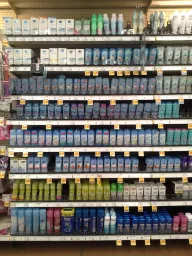

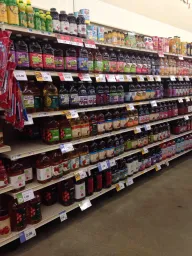

SKU-110Kデータセットは、11,743枚の小売店の棚を高密度に撮影した画像からなる単一クラスの物体検出データセットです。トレーニング画像8,219枚、検証画像588枚、テスト画像2,936枚に分割されています。各商品には単一クラスobjectの下で1つのバウンディングボックスが付与されています。この名称は、シーン全体に写る110,000を超える固有の在庫管理単位(SKUs)を指しており、110,000個の検出クラスを意味するものではありません。Eran GoldmanらがCVPR 2019の論文Precise Detection in Densely Packed Scenesのために作成したこのデータセットには、170万個を超えるアノテーション付き商品が含まれ、画像1枚あたり平均約147個にのぼります。そのため、混雑した小売環境におけるコンピュータービジョンモデルにとって、難易度の高いベンチマークとなっています。
視聴: 小売店の棚にあるすべての商品を検出するために Ultralytics YOLO26 をトレーニングする方法 | SKU-110K 🛒
主な機能#
- 単一クラス検出: すべての商品には、単一クラス
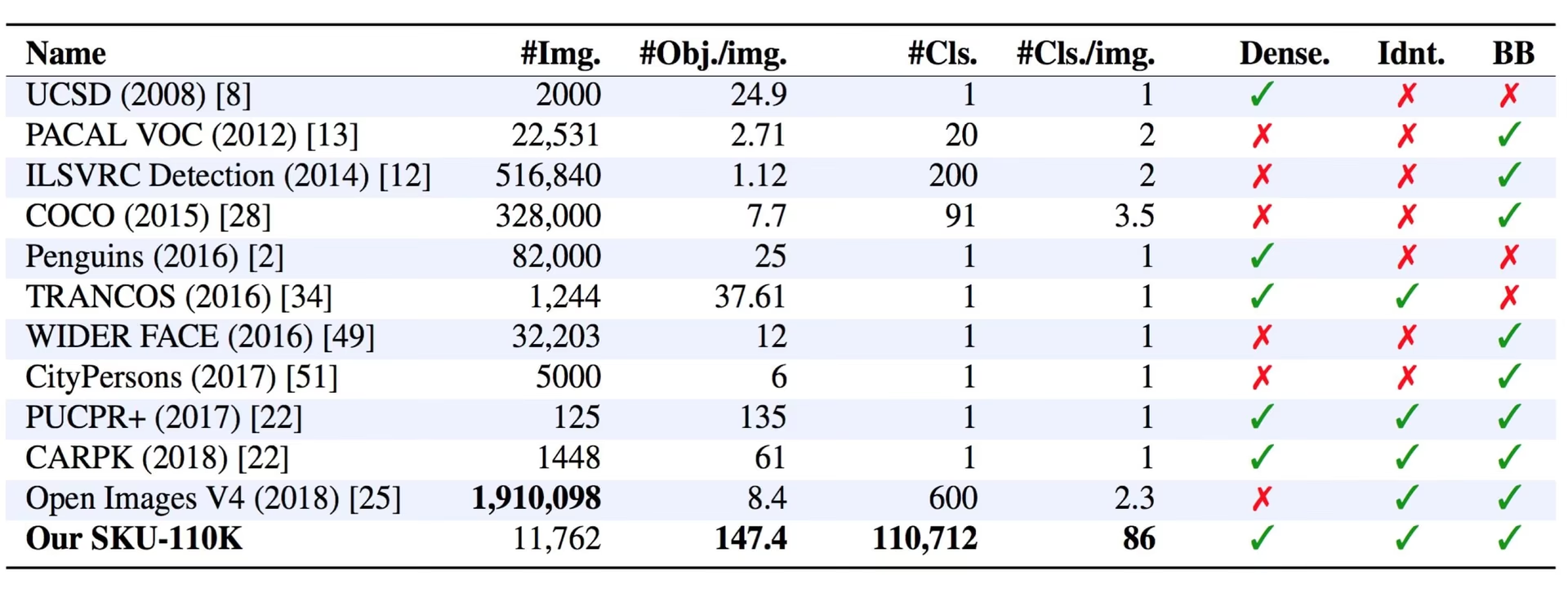
object(names: {0: object})の下で1つのバウンディングボックスが付与されています。アノテーションにはSKUごとのカテゴリラベルは含まれていません。 - 極めて高い物体密度: 世界各地の店舗の棚を写した画像には、平均して約147個の商品が密集しており、よく似た、あるいはまったく同じに見える物体が近接して配置されています。
- 大規模データ: 11,743枚の画像に含まれる110,000を超える固有のSKUと170万個を超えるアノテーション付きバウンディングボックスが、最先端の物体検出器に課題をもたらします。
データセットの構成#
SKU-110Kデータセットは3つのサブセットに分割されており、すべて単一のobjectクラスを共有しています。
| 分割 | 画像 | 説明 |
|---|---|---|
| 学習 | 8,219 | モデルのトレーニングに使用する画像とアノテーション |
| 検証 | 588 | トレーニング中の評価に使用するホールドアウト画像 |
| テスト | 2,936 | トレーニング済みモデルの最終評価に使用する画像 |
用途#
SKU-110Kデータセットは、物体検出タスク、特に小売店の棚の陳列のような高密度なシーンにおけるディープラーニングモデルのトレーニングと評価に広く使用されています。主な用途は次のとおりです。
独自の棚画像にアノテーションを付け、ブラウザー上で小売店検出データセットをトレーニングおよび管理するには、Ultralytics Platformでワークフロー全体を実行してください。
データセットYAML#
SKU-110K.yamlファイルでは、データセットのパス、クラス名、その他のメタデータなど、データセットの設定を定義します。このファイルは、https://github.com/ultralytics/ultralytics/blob/main/ultralytics/cfg/datasets/SKU-110K.yamlにあるUltralyticsリポジトリで管理されています。
# Ultralytics 🚀 AGPL-3.0 License - https://ultralytics.com/license

# SKU-110K retail items dataset https://github.com/eg4000/SKU110K_CVPR19 by Trax Retail
# Documentation: https://docs.ultralytics.com/datasets/detect/sku-110k
# Example usage: yolo train data=SKU-110K.yaml
# parent
# ├── ultralytics
# └── datasets
#     └── SKU-110K ← downloads here (13.6 GB)

# Train/val/test sets as 1) dir: path/to/imgs, 2) file: path/to/imgs.txt, or 3) list: [path/to/imgs1, path/to/imgs2, ..]
path: SKU-110K # dataset root dir
train: train.txt # train images (relative to 'path') 8219 images
val: val.txt # val images (relative to 'path') 588 images
test: test.txt # test images (optional) 2936 images

# Classes
names:
  0: object

# Download script/URL (optional) ---------------------------------------------------------------------------------------
download: |
  import shutil
  from pathlib import Path

  import numpy as np
  import polars as pl

  from ultralytics.utils import TQDM
  from ultralytics.utils.downloads import download
  from ultralytics.utils.ops import xyxy2xywh

  # Download
  dir = Path(yaml["path"])  # dataset root dir
  parent = Path(dir.parent)  # download dir
  urls = ["http://trax-geometry.s3.amazonaws.com/cvpr_challenge/SKU110K_fixed.tar.gz"]
  download(urls, dir=parent)

  # Rename directories
  if dir.exists():
      shutil.rmtree(dir)
  (parent / "SKU110K_fixed").rename(dir)  # rename dir
  (dir / "labels").mkdir(parents=True, exist_ok=True)  # create labels dir

  # Convert labels
  names = "image", "x1", "y1", "x2", "y2", "class", "image_width", "image_height"  # column names
  for d in "annotations_train.csv", "annotations_val.csv", "annotations_test.csv":
      x = pl.read_csv(dir / "annotations" / d, has_header=False, new_columns=names, infer_schema_length=None).to_numpy()  # annotations
      images, unique_images = x[:, 0], np.unique(x[:, 0])
      with open((dir / d).with_suffix(".txt").__str__().replace("annotations_", ""), "w", encoding="utf-8") as f:
          f.writelines(f"./images/{s}\n" for s in unique_images)
      for im in TQDM(unique_images, desc=f"Converting {dir / d}"):
          cls = 0  # single-class dataset
          with open((dir / "labels" / im).with_suffix(".txt"), "a", encoding="utf-8") as f:
              for r in x[images == im]:
                  w, h = r[6], r[7]  # image width, height
                  xywh = xyxy2xywh(np.array([[r[1] / w, r[2] / h, r[3] / w, r[4] / h]]))[0]  # instance
f.write(f"{cls} {xywh[0]:.5f} {xywh[1]:.5f} {xywh[2]:.5f} {xywh[3]:.5f}\n") # write label使用方法#
SKU-110Kは初回のトレーニング時に自動的にダウンロードされ、11,743枚の画像を保存するために約13.6 GBの空きディスク容量が必要です。ダウンロードスクリプトは元のアノテーションも取得してYOLO形式に変換するため、数分かかることがあります。
以下のコードスニペットを使用すると、SKU-110Kデータセットで画像サイズ640、100エポックの条件でYOLO26nモデルをトレーニングできます。
from ultralytics import YOLO

# モデルを読み込む
model = YOLO("yolo26n.pt")  # 事前トレーニング済みモデルを読み込みます(トレーニングにはこちらを推奨します)

# モデルをトレーニングする
results = model.train(data="SKU-110K.yaml", epochs=100, imgsz=640)サンプルデータとアノテーション#
SKU-110Kの画像には、実際の店舗の棚に密集して並ぶ商品が写っており、よく似た商品が何十個も隣り合っています。アノテーション付き画像の例を次に示します。
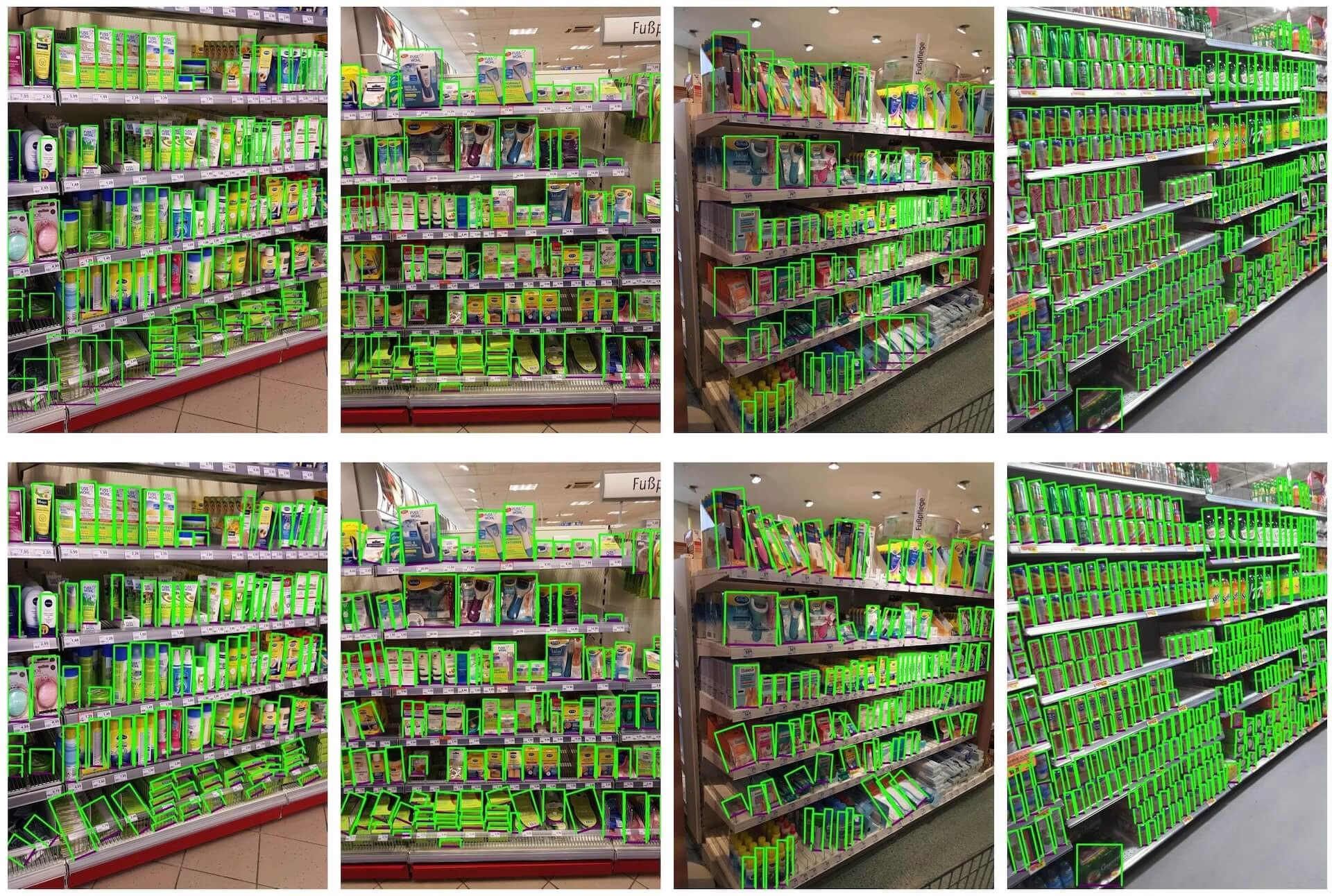
- 高密度に商品が並ぶ小売店の棚画像: この画像は、小売店の棚に物体が高密度に並ぶ例を示しています。物体には単一の
objectクラスのバウンディングボックスが付与されています。
商品が密集して配置されているため、SKU-110Kは小売業に特化した堅牢なコンピュータービジョンソリューションの開発に特に有用です。画像あたりの物体数が多いため、検出器は一般的なベンチマークを大きく上回る性能を求められます。
引用と謝辞#
研究または開発でSKU-110Kデータセットを使用する場合は、次の論文を引用してください。
@inproceedings{goldman2019dense,
  author    = {Eran Goldman and Roei Herzig and Aviv Eisenschtat and Jacob Goldberger and Tal Hassner},
  title     = {Precise Detection in Densely Packed Scenes},
  booktitle = {Proc. Conf. Comput. Vision Pattern Recognition (CVPR)},
  year      = {2019}
}
コンピュータービジョン研究コミュニティにとって貴重なリソースであるSKU-110Kデータセットを作成・維持してくださったEran Goldmanらに感謝します。SKU-110Kデータセットとその作成者について詳しくは、SKU-110KデータセットのGitHubリポジトリをご覧ください。
よくある質問#
SKU-110Kデータセットは、Eran GoldmanらがCVPR 2019論文のために作成した、商品が高密度に並ぶ小売棚の画像11,743枚からなる単一クラスの物体検出データセットです。すべての商品に
objectのバウンディングボックスが1つずつ付与され、画像には110,000種類を超える固有の在庫管理単位(SKU)が含まれています。そのため、混雑したシーンでの物体検出や小売業向けコンピュータービジョンシステム構築の優れたベンチマークとなります。いいえ。SKU-110Kは単一クラスのデータセットです。すべての商品には、クラス
object(names: {0: object})の下で1つのバウンディングボックスが付与されています。名称の「110K」は、画像全体に写る固有の在庫管理単位(SKUs)の数を指しており、検出クラスの数ではありません。SKU-110Kデータセットには画像が11,743枚含まれており、トレーニング用が8,219枚、検証用が588枚、テスト用が2,936枚です。検出クラスは
objectの1つです。詳細については、データセット構成のセクションとSKU-110K.yaml設定をご覧ください。SKU-110Kのサイズは約13.6 GBで、
data="SKU-110K.yaml"を使用した初回のトレーニング時に自動的にダウンロードされるため、手動でダウンロードする必要はありません。より小規模なデータセットについては、検出データセットの概要をご覧ください。SKU-110KデータセットでYOLO26モデルをトレーニングするのは簡単です。画像サイズ640でYOLO26nモデルを100エポックトレーニングする例を示します。
トレーニング例from ultralytics import YOLO # モデルを読み込む model = YOLO("yolo26n.pt") # 事前トレーニング済みモデルを読み込みます(トレーニングにはこちらを推奨します) # モデルをトレーニングする results = model.train(data="SKU-110K.yaml", epochs=100, imgsz=640)


コメント6
質問したり、結果を共有したり、ほかの人をサポートしたりできます。
syafiqmuda
Hi, newbie here, I try to use this dataset to compare and see the accuracy for this dataset with my own, but during training almost all the file were show
Corrupt JPEG data: 786 extraneous bytes before marker 0xd9and sometimesCorrupt JPEG data: premature end of data segment. can I know why? my code look like this:training.py
from ultralytics import YOLO, checks, hub checks() def main(): hub.login('something') model = YOLO('https://hub.ultralytics.com/models/ukr3hHHq88WJASNn3aUz') results = model.train(device=[0,1,2,3]) if __name__ == '__main__': main() Glenn JocherUltralytics
Those messages are PIL JPEG warnings from a handful of non-standard images in SKU-110K; Ultralytics usually auto-recovers/filters these during dataloading via
ultralytics.data.utils.verify_image()(see theverify_image()reference), so if training continues it’s safe to ignore—if it actually crashes, re-download/re-extract the dataset (or re-encode the specific bad JPGs), then delete any*.cacheunder yourlabels/folder and rerun; if you share the text output ofyolo checksplus the full traceback (not a screenshot) we can pinpoint whether it’s data corruption or an environment issue.
ApodiAlsurihi
Hi, thank you for this amazing and detailed explanation! Your work is incredibly helpful and inspiring. I would deeply appreciate it if you could share the trained model after the training process. It would make a significant difference in advancing my project and learning. Thank you so much for your generosity and support!
- Glenn JocherUltralytics
@ApodiAlsurihi thank you for your kind words! Unfortunately, we cannot share trained models directly. However, you can train your own model using the SKU-110K dataset by following the instructions provided in the documentation.
serna01
Are this warnings OK, when training? the batch=0.1 I used it to avoid a memory error. yolo detect train data=SKU-110K.yaml model=yolov8n.pt epochs=50 imgsz=640 batch=0.1
AutoBatch: Using batch-size 2 for CUDA:0 0.49G/3.81G (13%) ✅ train: Scanning /home/asm/cv_cornia/parking_mgmt/datasets/SKU-110K/labels... 8216 train: WARNING ⚠️ /home/asm/cv_cornia/parking_mgmt/datasets/SKU-110K/images/train_1797.jpg: 3 duplicate labels removed train: WARNING ⚠️ /home/asm/cv_cornia/parking_mgmt/datasets/SKU-110K/images/train_4222.jpg: ignoring corrupt image/label: image file is truncated (23 bytes not processed) train: WARNING ⚠️ /home/asm/cv_cornia/parking_mgmt/datasets/SKU-110K/images/train_882.jpg: ignoring corrupt image/label: image file is truncated (3 bytes not processed) train: WARNING ⚠️ /home/asm/cv_cornia/parking_mgmt/datasets/SKU-110K/images/train_924.jpg: ignoring corrupt image/label: image file is truncated (10 bytes not processed)
al: Scanning /home/asm/cv_cornia/parking_mgmt/datasets/SKU-110K/labels... 588 ima val: New cache created: /home/asm/cv_cornia/parking_mgmt/datasets/SKU-110K/labels.cache Corrupt JPEG data: 305 extraneous bytes before marker 0xd9 Corrupt JPEG data: 786 extraneous bytes before marker 0xd9 Plotting labels to runs/detect/train5/labels.jpg... optimizer: 'optimizer=auto' found, ignoring 'lr0=0.01' and 'momentum=0.937' and determining best 'optimizer', 'lr0' and 'momentum' automatically... optimizer: AdamW(lr=0.002, momentum=0.9) with parameter groups 57 weight(decay=0.0), 64 weight(decay=0.0005), 63 bias(decay=0.0) TensorBoard: model graph visualization added ✅ Image sizes 640 train, 640 val Using 8 dataloader workers Logging results to runs/detect/train5 Starting training for 50 epochs...
  Epoch    GPU_mem   box_loss   cls_loss   dfl_loss  Instances       Size
   1/50      1.14G      2.504      3.041       1.53        378        640:   5Corrupt JPEG data: premature end of data segment
   1/50      1.15G      2.382      2.658      1.454        331        640:   7Corrupt JPEG data: 562 extraneous bytes before marker 0xd9
   1/50      1.42G      2.273      2.314      1.382        314        640:  11Corrupt JPEG data: bad Huffman code
   1/50      1.42G      2.266      2.295      1.378        578        64       1/50      1.42G      2.266      2.293      1.377        678        64       1/50      1.42G      2.266      2.293      1.377        678        64       1/50      1.42G      2.265      2.292      1.377        723        64       1/50      1.42G      2.265      2.292      1.377        723        64       1/50      1.42G      2.266       2.29      1.377        695        64       1/50      1.42G      2.266          1/50      1.42G      2.255      2.2       1/50      1.42G      2.254      2.247       1.3       1/50      1       1/50              1/50                          1/50      1.42G      2.232      2.187      1.358        608        640:  13Corrupt JPEG data: bad Huffman code
   1/50      1.42G      2.216      2.138      1.347        437        640:  14Corrupt JPEG data: premature end of data segment
   1/50      1.42G      2.164      1.993      1.318        478        640:  17Corrupt JPEG data: 41 extraneous bytes before marker 0xd9
   1/50      1.42G      2.157      1.967      1.312        308        640:  17Corrupt JPEG data: premature end of data segment
   1/50      1.42G      2.011       1.61      1.239        173        640:  30Corrupt JPEG data: premature end of data segment
   1/50      1.42G      1.987      1.556      1.227        461        640:  33Corrupt JPEG data: 96 extraneous bytes before marker 0xd9
   1/50      1.42G      1.978      1.537      1.223        214        640:  34Corrupt JPEG data: bad Huffman code
   1/50      1.42G      1.959      1.497      1.215        250        640:  37Corrupt JPEG data: bad Huffman code
   1/50      1.42G      1.915      1.403      1.197        500        640:  46Corrupt JPEG data: premature end of data segment
   1/50      1.42G      1.888      1.345      1.185        616        640:  52Corrupt JPEG data: premature end of data segment
Thanks.
- Glenn JocherUltralytics
@serna01 the warnings you see are generally okay and indicate that the training process is handling issues like duplicate labels and corrupt images. Using
batch=0.1to avoid memory errors is fine, but consider adjusting your batch size to better utilize your GPU memory. If the warnings persist or cause issues, ensure you're using the latest version of the package. For more details on the SKU-110k dataset, visit SKU-110k Dataset Documentation.