Hướng dẫn bắt đầu nhanh: NVIDIA Jetson với Ultralytics YOLO26
Hướng dẫn này trình bày cách triển khai Ultralytics YOLO26 trên thiết bị NVIDIA Jetson, đồng thời cung cấp benchmark hiệu năng cho thấy YOLO26 có thể làm được gì trên những thiết bị nhỏ gọn, tiết kiệm điện này.
Chúng tôi đã cập nhật hướng dẫn này với NVIDIA Jetson AGX Thor Developer Kit mới nhất, cung cấp hiệu năng tính toán AI lên đến 2070 FP4 TFLOPS và bộ nhớ 128 GB, với mức điện năng có thể cấu hình từ 40 W đến 130 W. Thiết bị mang lại hiệu năng tính toán AI cao hơn 7.5 lần so với NVIDIA Jetson AGX Orin, cùng hiệu quả năng lượng tốt hơn 3.5 lần khi chạy các model AI phổ biến nhất.
Xem: Tăng tốc suy luận với Ultralytics YOLO26 trên các thiết bị NVIDIA Jetson 🚀
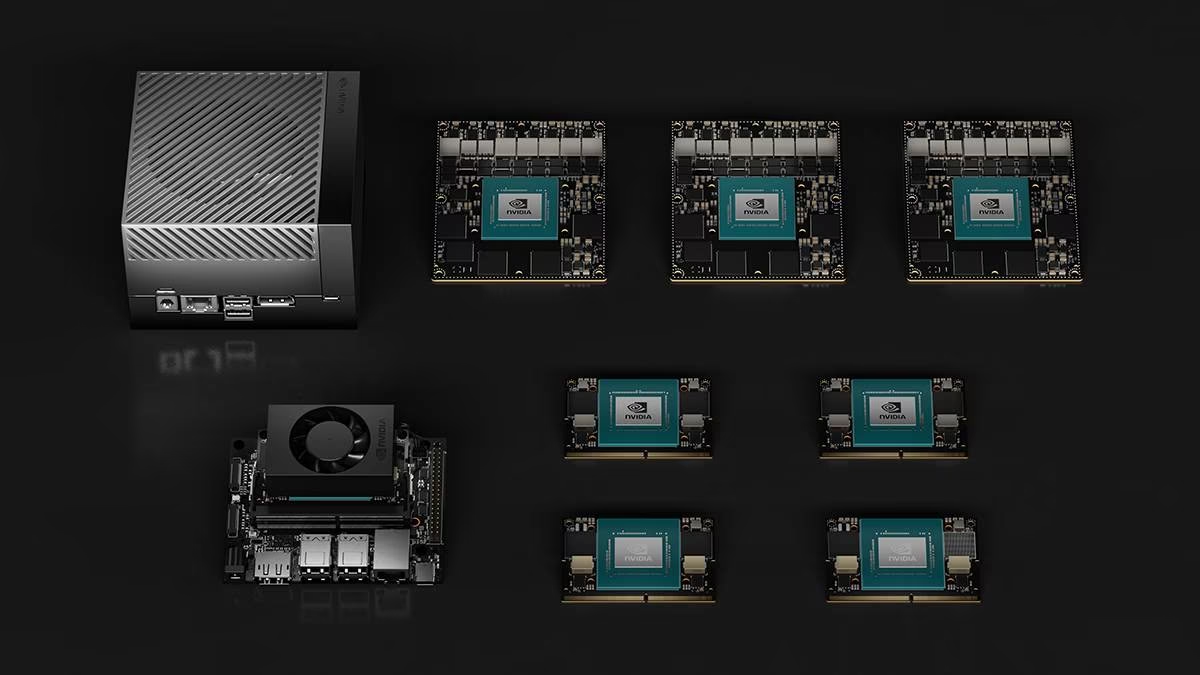
Hướng dẫn này đã được kiểm thử với NVIDIA Jetson AGX Thor Developer Kit (Jetson T5000) và NVIDIA Jetson AGX Orin Developer Kit (64GB) chạy bản JetPack 7.2 ổn định mới nhất, NVIDIA Jetson Orin Nano Super Developer Kit chạy bản phát hành JetPack JP6.1, Seeed Studio reComputer J4012 dựa trên NVIDIA Jetson Orin NX 16GB chạy bản phát hành JetPack JP6.0/ JP5.1.3, và Seeed Studio reComputer J1020 v2 dựa trên NVIDIA Jetson Nano 4GB chạy bản phát hành JetPack JP4.6.1. Dự kiến hướng dẫn này sẽ hoạt động trên toàn bộ dòng phần cứng NVIDIA Jetson, bao gồm cả thiết bị mới nhất và các thiết bị đời cũ.
NVIDIA Jetson là gì?#
NVIDIA Jetson là dòng bo mạch tính toán nhúng được thiết kế để đưa khả năng tính toán AI (trí tuệ nhân tạo) tăng tốc đến thiết bị biên. Những thiết bị nhỏ gọn và mạnh mẽ này được xây dựng dựa trên kiến trúc GPU của NVIDIA, có thể chạy trực tiếp các thuật toán AI phức tạp và model học sâu trên thiết bị mà không cần phụ thuộc vào tài nguyên điện toán đám mây. Bo mạch Jetson thường được sử dụng trong robot, xe tự hành, tự động hóa công nghiệp và các ứng dụng khác cần thực hiện suy luận AI cục bộ với độ trễ thấp và hiệu suất cao. Ngoài ra, các bo mạch này dựa trên kiến trúc ARM64 và tiêu thụ ít điện năng hơn so với các thiết bị tính toán GPU truyền thống.
So sánh các dòng NVIDIA Jetson#
NVIDIA Jetson AGX Thor là phiên bản mới nhất của dòng NVIDIA Jetson, dựa trên kiến trúc NVIDIA Blackwell và mang lại hiệu năng AI cao hơn đáng kể so với các thế hệ trước. Bảng dưới đây so sánh một số thiết bị Jetson trong hệ sinh thái.
| Jetson AGX Thor (T5000) | Jetson AGX Orin 64GB | Jetson Orin NX 16GB | Jetson Orin Nano Super | Jetson AGX Xavier | Jetson Xavier NX | Jetson Nano | |
|---|---|---|---|---|---|---|---|
| Hiệu năng AI | 2070 TFLOPS | 275 TOPS | 100 TOPS | 67 TOPS | 32 TOPS | 21 TOPS | 472 GFLOPS |
| GPU | GPU kiến trúc NVIDIA Blackwell với 2560 lõi và 96 Tensor Core | GPU kiến trúc NVIDIA Ampere với 2048 lõi và 64 Tensor Core | GPU kiến trúc NVIDIA Ampere với 1024 lõi và 32 Tensor Core | GPU kiến trúc NVIDIA Ampere với 1024 lõi và 32 Tensor Core | GPU kiến trúc NVIDIA Volta với 512 lõi và 64 Tensor Core | GPU kiến trúc NVIDIA Volta™ với 384 lõi và 48 Tensor Core | GPU kiến trúc NVIDIA Maxwell™ với 128 lõi |
| Tần số tối đa của GPU | 1.57 GHz | 1.3 GHz | 918 MHz | 1020 MHz | 1377 MHz | 1100 MHz | 921MHz |
| CPU | CPU Arm® Neoverse®-V3AE 64-bit 14 lõi, 1MB L2 + 16MB L3 | CPU NVIDIA Arm® Cortex A78AE v8.2 64-bit 12 lõi, 3MB L2 + 6MB L3 | CPU NVIDIA Arm® Cortex A78AE v8.2 64-bit 8 lõi, 2MB L2 + 4MB L3 | CPU Arm® Cortex®-A78AE v8.2 64-bit 6 lõi, L2 1.5MB + L3 4MB | CPU NVIDIA Carmel Arm®v8.2 64-bit 8 lõi, L2 8MB + L3 4MB | CPU NVIDIA Carmel Arm®v8.2 64-bit 6 lõi, L2 6MB + L3 4MB | Bộ xử lý Quad-Core Arm® Cortex®-A57 MPCore |
| Tần số tối đa của CPU | 2.6 GHz | 2.2 GHz | 2.0 GHz | 1.7 GHz | 2.2 GHz | 1.9 GHz | 1.43GHz |
| Bộ nhớ | 128GB 256-bit LPDDR5X 273GB/s | 64GB 256-bit LPDDR5 204.8GB/s | 16GB 128-bit LPDDR5 102.4GB/s | 8GB 128-bit LPDDR5 102 GB/s | 32GB 256-bit LPDDR4x 136.5GB/s | 8GB 128-bit LPDDR4x 59.7GB/s | 4GB 64-bit LPDDR4 25.6GB/s |
NVIDIA JetPack là gì?#
NVIDIA JetPack SDK cung cấp năng lượng cho các module Jetson và môi trường phát triển đầy đủ để xây dựng ứng dụng AI tăng tốc từ đầu đến cuối. JetPack bao gồm Jetson Linux với bootloader, Linux kernel, môi trường desktop Ubuntu và bộ thư viện hoàn chỉnh để tăng tốc tính toán GPU, đa phương tiện, đồ họa và thị giác máy tính. JetPack cũng bao gồm các ví dụ, tài liệu và công cụ dành cho cả máy chủ lẫn bộ công cụ phát triển, đồng thời hỗ trợ các SDK cấp cao hơn như DeepStream để phân tích video truyền phát, Isaac cho robot và Riva cho AI hội thoại.
Flash JetPack lên NVIDIA Jetson#
Bước đầu tiên sau khi có thiết bị NVIDIA Jetson là flash NVIDIA JetPack lên thiết bị. Có một số cách khác nhau để flash thiết bị NVIDIA Jetson.
- Đối với JetPack 7.2 trên bộ công cụ phát triển AGX Thor, AGX Orin hoặc Orin Nano chính thức, hãy tải ISO Jetson hợp nhất, ghi ISO vào USB flash và làm theo hướng dẫn bắt đầu nhanh dành riêng cho thiết bị AGX Thor, AGX Orin hoặc Orin Nano. Kể từ JetPack 7.2, Orin Nano không còn sử dụng image thẻ SD có thể tải xuống; quá trình cài đặt bằng ISO trên USB sẽ cài Jetson Linux vào thẻ microSD hoặc SSD NVMe của thiết bị.
- Nếu bạn chủ động sử dụng JetPack 6 trên bộ công cụ phát triển Jetson Orin Nano, hãy làm theo hướng dẫn cập nhật JetPack 6.x và sử dụng thẻ SD của NVIDIA.
- Nếu sở hữu bộ công cụ phát triển NVIDIA khác, bạn có thể flash JetPack lên thiết bị bằng SDK Manager.
- Nếu sở hữu thiết bị Seeed Studio reComputer J4012, bạn có thể flash JetPack lên SSD đi kèm; nếu sở hữu thiết bị Seeed Studio reComputer J1020 v2, bạn có thể flash JetPack lên eMMC/ SSD.
- Nếu sở hữu thiết bị bên thứ ba khác được trang bị module NVIDIA Jetson, bạn nên làm theo hướng dẫn flash qua dòng lệnh.
Với các phương pháp 1, 4 và 5 ở trên, sau khi flash hệ thống và khởi động thiết bị, chạy sudo apt update && sudo apt install nvidia-jetpack -y trong terminal của thiết bị để cài đặt các thành phần JetPack còn lại cần thiết.
Hỗ trợ JetPack theo thiết bị Jetson#
Bảng dưới đây nêu các phiên bản NVIDIA JetPack được hỗ trợ trên từng thiết bị NVIDIA Jetson.
| JetPack 4 | JetPack 5 | JetPack 6 | JetPack 7 | |
|---|---|---|---|---|
| Jetson Nano | ✅ | ❌ | ❌ | ❌ |
| Jetson TX2 | ✅ | ❌ | ❌ | ❌ |
| Jetson Xavier NX | ✅ | ✅ | ❌ | ❌ |
| Jetson AGX Xavier | ✅ | ✅ | ❌ | ❌ |
| Jetson AGX Orin | ❌ | ✅ | ✅ | ✅ |
| Jetson Orin NX | ❌ | ✅ | ✅ | ✅ |
| Jetson Orin Nano | ❌ | ✅ | ✅ | ✅ |
| Jetson AGX Thor | ❌ | ❌ | ❌ | ✅ |
Bắt đầu nhanh với Docker#
Cách nhanh nhất để bắt đầu sử dụng Ultralytics YOLO26 trên NVIDIA Jetson là chạy các image Docker dựng sẵn cho Jetson. Tham khảo bảng phía trên và chọn phiên bản JetPack phù hợp với thiết bị Jetson của bạn.
t=ultralytics/ultralytics:latest-jetson-jetpack4
sudo docker pull $t && sudo docker run -it --ipc=host --runtime=nvidia $tImage latest-nvidia-arm64 sử dụng NVIDIA PyTorch 26.10, bao gồm CUDA 13.4 và TensorRT 11.4. NVIDIA liệt kê JetPack 7.1 cho PyTorch trong bảng tương thích, nhưng TensorRT 11 không hỗ trợ JetPack, bao gồm cả Thor. Chỉ sử dụng image này cho các workload PyTorch trên host được hỗ trợ. Để export TensorRT cho Jetson, hãy dùng phương thức cài đặt native bên dưới với runtime TensorRT 10.x được hỗ trợ trong bản JetPack của bạn. JetPack 7.2 trên Thor hoặc Orin cần được xác thực riêng cho container. Hãy build lại engine cho GPU mục tiêu và phiên bản TensorRT.
Đối với image JetPack 4, 5 và 6, hãy tiếp tục xem Sử dụng TensorRT trên NVIDIA Jetson. Image JetPack 7.1 ở trên chỉ dành cho workload PyTorch.
Bắt đầu với cài đặt gốc#
Để cài đặt gốc mà không dùng Docker, hãy tham khảo các bước dưới đây.
Chạy trên JetPack 7.2#
Cài đặt package Ultralytics#
Cài đặt package Ultralytics trên Jetson. Các dependency phục vụ export sẽ được tự động cài đặt trong lần đầu export model, vì vậy ở đây chỉ cần package cơ bản. Hướng dẫn này tập trung vào export NVIDIA TensorRT vì TensorRT mang lại hiệu năng tốt nhất trên thiết bị Jetson.
-
Cập nhật danh sách package, cài đặt pip và nâng cấp lên phiên bản mới nhất
sudo apt update sudo apt install python3-pip -y pip install -U pip -
Cài đặt package pip
ultralyticspip install ultralytics -
Khởi động lại thiết bị
sudo reboot
Cài đặt PyTorch và Torchvision#
Lệnh cài đặt ultralytics ở trên sẽ cài Torch và Torchvision. Tuy nhiên, hai package này được cài qua pip không tương thích với thiết bị JetPack 7.2 chạy CUDA 13, do đó cần cài đặt thủ công.
Cài đặt torch và torchvision phù hợp với JP7.2
pip install torch torchvision --index-url https://download.pytorch.org/whl/cu130Cài đặt onnxruntime-gpu#
Sử dụng wheel ONNX Runtime GPU tương thích với các phiên bản JetPack, Python và CUDA của bạn. Các bản phát hành PyPI hiện tại có wheel ARM64, nhưng không thể thay thế các package dành riêng cho thiết bị ở mọi phiên bản JetPack.
Tải xuống và cài đặt onnxruntime-gpu 1.24.0 có hỗ trợ Python3.12.
pip install https://github.com/ultralytics/assets/releases/download/v0.0.0/onnxruntime_gpu-1.24.0-cp312-cp312-linux_aarch64.whlChạy trên JetPack 6.1#
Cài đặt package Ultralytics#
Cài đặt package Ultralytics trên Jetson. Các dependency phục vụ export sẽ được tự động cài đặt trong lần đầu export model, vì vậy ở đây chỉ cần package cơ bản. Hướng dẫn này tập trung vào export NVIDIA TensorRT vì TensorRT mang lại hiệu năng tốt nhất trên thiết bị Jetson.
-
Cập nhật danh sách package, cài đặt pip và nâng cấp lên phiên bản mới nhất
sudo apt update sudo apt install python3-pip -y pip install -U pip -
Cài đặt package pip
ultralyticspip install ultralytics -
Khởi động lại thiết bị
sudo reboot
Cài đặt PyTorch và Torchvision#
Lệnh cài đặt ultralytics ở trên sẽ cài Torch và Torchvision. Tuy nhiên, hai package này được cài qua pip không tương thích với nền tảng Jetson dựa trên kiến trúc ARM64, vì vậy bạn cần cài thủ công một pip wheel PyTorch dựng sẵn và biên dịch hoặc cài Torchvision từ mã nguồn.
Cài đặt torch 2.10.0 và torchvision 0.25.0 phù hợp với JP6.1
pip install https://github.com/ultralytics/assets/releases/download/v0.0.0/torch-2.10.0-cp310-cp310-linux_aarch64.whl
pip install https://github.com/ultralytics/assets/releases/download/v0.0.0/torchvision-0.25.0-cp310-cp310-linux_aarch64.whlTruy cập trang PyTorch cho Jetson để xem tất cả phiên bản PyTorch dành cho từng phiên bản JetPack. Để xem danh sách chi tiết hơn về khả năng tương thích giữa PyTorch và Torchvision, hãy truy cập trang tương thích PyTorch và Torchvision.
Cài đặt cuDSS để khắc phục sự cố dependency với torch 2.10.0
wget https://developer.download.nvidia.com/compute/cudss/0.7.1/local_installers/cudss-local-tegra-repo-ubuntu2204-0.7.1_0.7.1-1_arm64.deb
sudo dpkg -i cudss-local-tegra-repo-ubuntu2204-0.7.1_0.7.1-1_arm64.deb
sudo cp /var/cudss-local-tegra-repo-ubuntu2204-0.7.1/cudss-*-keyring.gpg /usr/share/keyrings/
sudo apt-get update
sudo apt-get -y install cudss
Cài đặt onnxruntime-gpu#
Sử dụng wheel ONNX Runtime GPU tương thích với các phiên bản JetPack, Python và CUDA của bạn. Các bản phát hành PyPI hiện tại có wheel ARM64, nhưng không thể thay thế các package dành riêng cho thiết bị ở mọi phiên bản JetPack.
Bạn có thể tìm thấy tất cả package onnxruntime-gpu hiện có — được sắp xếp theo phiên bản JetPack, phiên bản Python và các chi tiết tương thích khác — trong ma trận tương thích ONNX Runtime của Jetson Zoo.
Đối với JetPack 6 có hỗ trợ Python 3.10, bạn có thể cài đặt onnxruntime-gpu 1.23.0:
pip install https://github.com/ultralytics/assets/releases/download/v0.0.0/onnxruntime_gpu-1.23.0-cp310-cp310-linux_aarch64.whlNgoài ra, đối với onnxruntime-gpu 1.20.0:
pip install https://github.com/ultralytics/assets/releases/download/v0.0.0/onnxruntime_gpu-1.20.0-cp310-cp310-linux_aarch64.whlChạy trên JetPack 5.1.2#
Cài đặt package Ultralytics#
Cài đặt package Ultralytics trên Jetson. Các dependency phục vụ export sẽ được tự động cài đặt trong lần đầu export model, vì vậy ở đây chỉ cần package cơ bản. Hướng dẫn này tập trung vào export NVIDIA TensorRT vì TensorRT mang lại hiệu năng tốt nhất trên thiết bị Jetson.
-
Cập nhật danh sách package, cài đặt pip và nâng cấp lên phiên bản mới nhất
sudo apt update sudo apt install python3-pip -y pip install -U pip -
Cài đặt package pip
ultralyticspip install ultralytics -
Khởi động lại thiết bị
sudo reboot
Cài đặt PyTorch và Torchvision#
Lệnh cài đặt ultralytics ở trên sẽ cài Torch và Torchvision. Tuy nhiên, hai package này được cài qua pip không tương thích với nền tảng Jetson dựa trên kiến trúc ARM64, vì vậy bạn cần cài thủ công một pip wheel PyTorch dựng sẵn và biên dịch hoặc cài Torchvision từ mã nguồn.
-
Gỡ cài đặt PyTorch và Torchvision hiện có
pip uninstall torch torchvision -
Cài đặt
torch 2.1.0vàtorchvision 0.16.2phù hợp với JP5.1.2pip install https://github.com/ultralytics/assets/releases/download/v0.0.0/torch-2.1.0a0+41361538.nv23.06-cp38-cp38-linux_aarch64.whl pip install https://github.com/ultralytics/assets/releases/download/v0.0.0/torchvision-0.16.2+c6f3977-cp38-cp38-linux_aarch64.whl
Truy cập trang PyTorch cho Jetson để xem tất cả phiên bản PyTorch dành cho từng phiên bản JetPack. Để xem danh sách chi tiết hơn về khả năng tương thích giữa PyTorch và Torchvision, hãy truy cập trang tương thích PyTorch và Torchvision.
Cài đặt onnxruntime-gpu#
Sử dụng wheel ONNX Runtime GPU tương thích với các phiên bản JetPack, Python và CUDA của bạn. Các bản phát hành PyPI hiện tại có wheel ARM64, nhưng không thể thay thế các package dành riêng cho thiết bị ở mọi phiên bản JetPack.
Bạn có thể tìm tất cả các package onnxruntime-gpu hiện có — được sắp xếp theo phiên bản JetPack, phiên bản Python và các chi tiết tương thích khác — trong ma trận tương thích ONNX Runtime của Jetson Zoo. Tải xuống và cài đặt onnxruntime-gpu 1.17.0 có hỗ trợ Python3.8.
wget https://nvidia.box.com/shared/static/zostg6agm00fb6t5uisw51qi6kpcuwzd.whl -O onnxruntime_gpu-1.17.0-cp38-cp38-linux_aarch64.whl
pip install onnxruntime_gpu-1.17.0-cp38-cp38-linux_aarch64.whlonnxruntime-gpu tự động nâng cấp NumPy lên phiên bản mới nhất, vì vậy hãy cài đặt lại NumPy 1.23.5 để khắc phục vấn đề phát sinh:
pip install numpy==1.23.5
Sử dụng TensorRT trên NVIDIA Jetson#
Trong số tất cả các định dạng export model được Ultralytics hỗ trợ, TensorRT mang lại hiệu năng suy luận cao nhất trên thiết bị NVIDIA Jetson, vì vậy đây là lựa chọn hàng đầu của chúng tôi cho các triển khai Jetson. Trước khi export, hãy cài đặt các Python binding TensorRT được cung cấp cho bản JetPack của bạn và xác minh chúng bằng python3 -c "import tensorrt; print(tensorrt.__version__)". Duy trì runtime TensorRT 10.x được hỗ trợ trên JetPack 6/7; không thay thế runtime này bằng TensorRT 11. Để xem hướng dẫn thiết lập và cách sử dụng nâng cao, hãy tham khảo hướng dẫn tích hợp TensorRT chuyên biệt.
Bạn cũng có thể export ngay trên trình duyệt mà không cần cấu hình môi trường build cục bộ. Trong tab Export model của Ultralytics Platform, hãy chọn TensorRT và thiết bị Jetson mục tiêu. Các lựa chọn Thor được xác thực trên phần cứng Thor thực tế. Sáu lựa chọn Orin hiện tạo ra các engine ứng viên được build cho AGX-Orin; hãy xác thực các engine này trên SKU Orin dự kiến trước khi triển khai.
TensorRT xây dựng và tinh chỉnh engine trên GPU dùng để build. Hãy khớp kiến trúc GPU và runtime TensorRT/CUDA với thiết bị đích, đồng thời xác thực mọi engine đã tải xuống trên thiết bị triển khai. Các SKU Orin có cùng kiến trúc không mặc nhiên đảm bảo khả năng chuyển đổi, và hiệu chuẩn INT8 nên được thực hiện trên thiết bị đích để đạt kết quả tốt nhất.
Chuyển đổi model sang TensorRT và chạy inference#
Model YOLO26n ở định dạng PyTorch được chuyển đổi sang TensorRT để chạy suy luận bằng model đã export.
from ultralytics import YOLO

# Tải model YOLO26n PyTorch
model = YOLO("yolo26n.pt")

# Export model sang TensorRT
model.export(format="engine")  # # tạo 'yolo26n.engine'

# Tải model TensorRT đã export
trt_model = YOLO("yolo26n.engine")

# Chạy suy luận
results = trt_model("https://ultralytics.com/images/bus.jpg")
Sử dụng NVIDIA Deep Learning Accelerator (DLA)#
NVIDIA Deep Learning Accelerator (DLA) là thành phần phần cứng chuyên dụng được tích hợp trong thiết bị NVIDIA Jetson, giúp tối ưu inference deep learning về hiệu quả năng lượng và hiệu năng. Bằng cách chuyển tác vụ khỏi GPU (giải phóng GPU cho các quy trình chuyên sâu hơn), DLA cho phép model chạy với mức tiêu thụ điện năng thấp hơn mà vẫn duy trì thông lượng cao, phù hợp với các hệ thống nhúng và ứng dụng AI thời gian thực.
NVIDIA liệt kê TensorRT 10.7 là bản phát hành cuối cùng có hỗ trợ DLA; TensorRT 11.x không hỗ trợ DLA. Hãy sử dụng bản TensorRT có hỗ trợ DLA tương thích với phiên bản JetPack của bạn. TensorRT 11 không hỗ trợ JetPack, kể cả các bản export chỉ dùng GPU.
Các thiết bị Jetson sau đây được trang bị phần cứng DLA:
| Thiết bị Jetson | Số lõi DLA | Tần số tối đa của DLA |
|---|---|---|
| Dòng Jetson AGX Orin | 2 | 1.6 GHz |
| Jetson Orin NX 16GB | 2 | 614 MHz |
| Jetson Orin NX 8GB | 1 | 614 MHz |
| Dòng Jetson AGX Xavier | 2 | 1.4 GHz |
| Dòng Jetson Xavier NX | 2 | 1.1 GHz |
from ultralytics import YOLO

# Tải model YOLO26n PyTorch
model = YOLO("yolo26n.pt")

# Export model sang TensorRT khi bật DLA (chỉ hoạt động với FP16 hoặc INT8)
model.export(format="engine", device="dla:0", quantize=16)  # dla:0 hoặc dla:1 tương ứng với các lõi DLA

# Tải model TensorRT đã export
trt_model = YOLO("yolo26n.engine")

# Chạy suy luận
results = trt_model("https://ultralytics.com/images/bus.jpg")Khi sử dụng export DLA, một số layer có thể không được DLA hỗ trợ và sẽ chuyển sang GPU để thực thi. Việc chuyển đổi này có thể làm tăng độ trễ và ảnh hưởng đến hiệu năng inference tổng thể. Vì vậy, mục đích chính của DLA không phải là giảm độ trễ inference so với TensorRT chạy hoàn toàn trên GPU. Thay vào đó, mục đích chính của DLA là tăng thông lượng và cải thiện hiệu quả năng lượng.
Benchmark YOLO26 trên NVIDIA Jetson#
Nhóm Ultralytics đã benchmark YOLO26 trên 11 định dạng model khác nhau, đo tốc độ và độ chính xác: PyTorch, TorchScript, ONNX, OpenVINO, TensorRT, TF SavedModel, TF GraphDef, TF Lite, MNN, NCNN, ExecuTorch. Các benchmark được chạy trên NVIDIA Jetson AGX Thor Developer Kit, NVIDIA Jetson AGX Orin Developer Kit (64GB), NVIDIA Jetson Orin Nano Super Developer Kit và Seeed Studio reComputer J4012 sử dụng Jetson Orin NX 16GB, với độ chính xác FP32 và kích thước ảnh đầu vào mặc định là 640.
Biểu đồ so sánh#
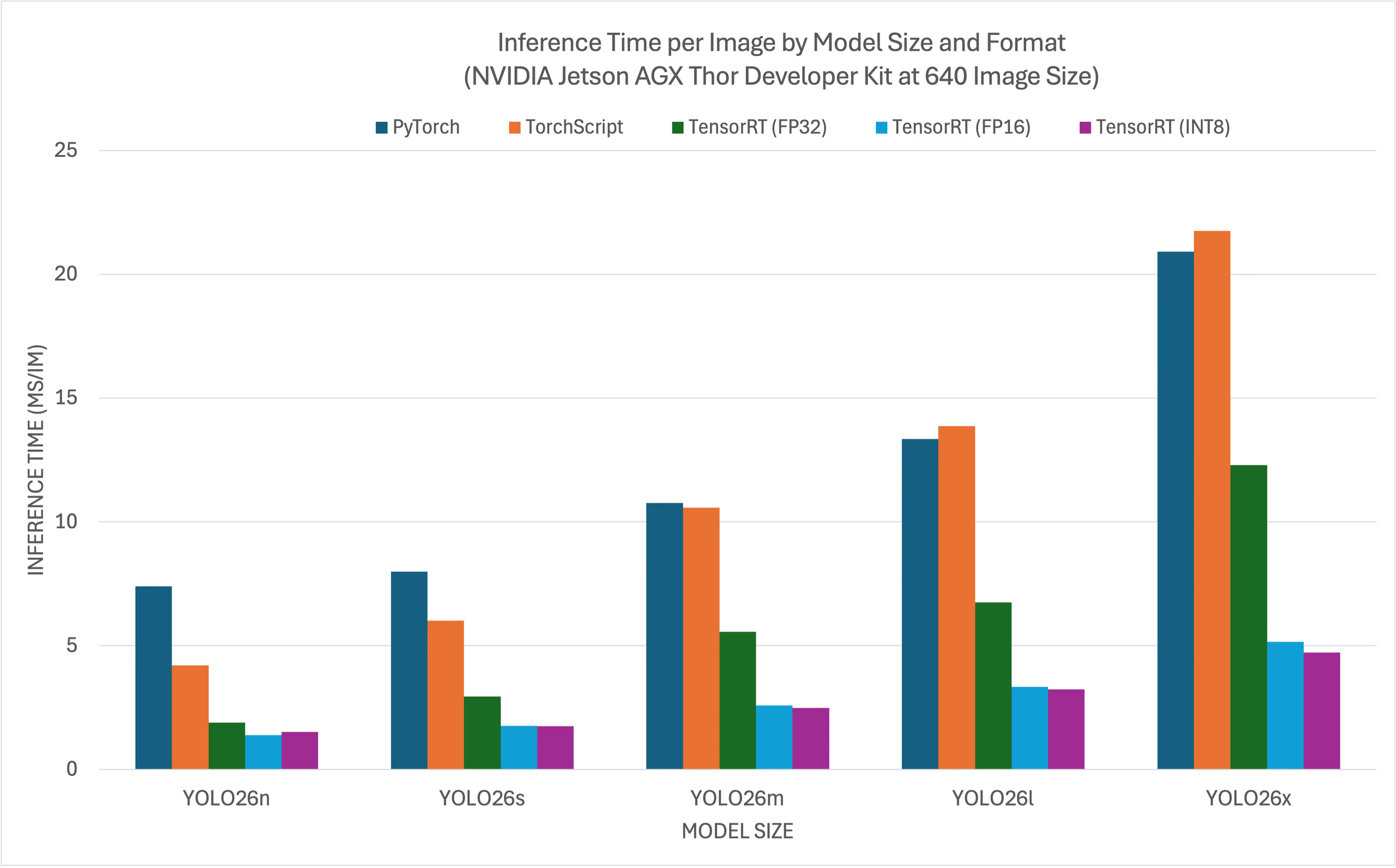
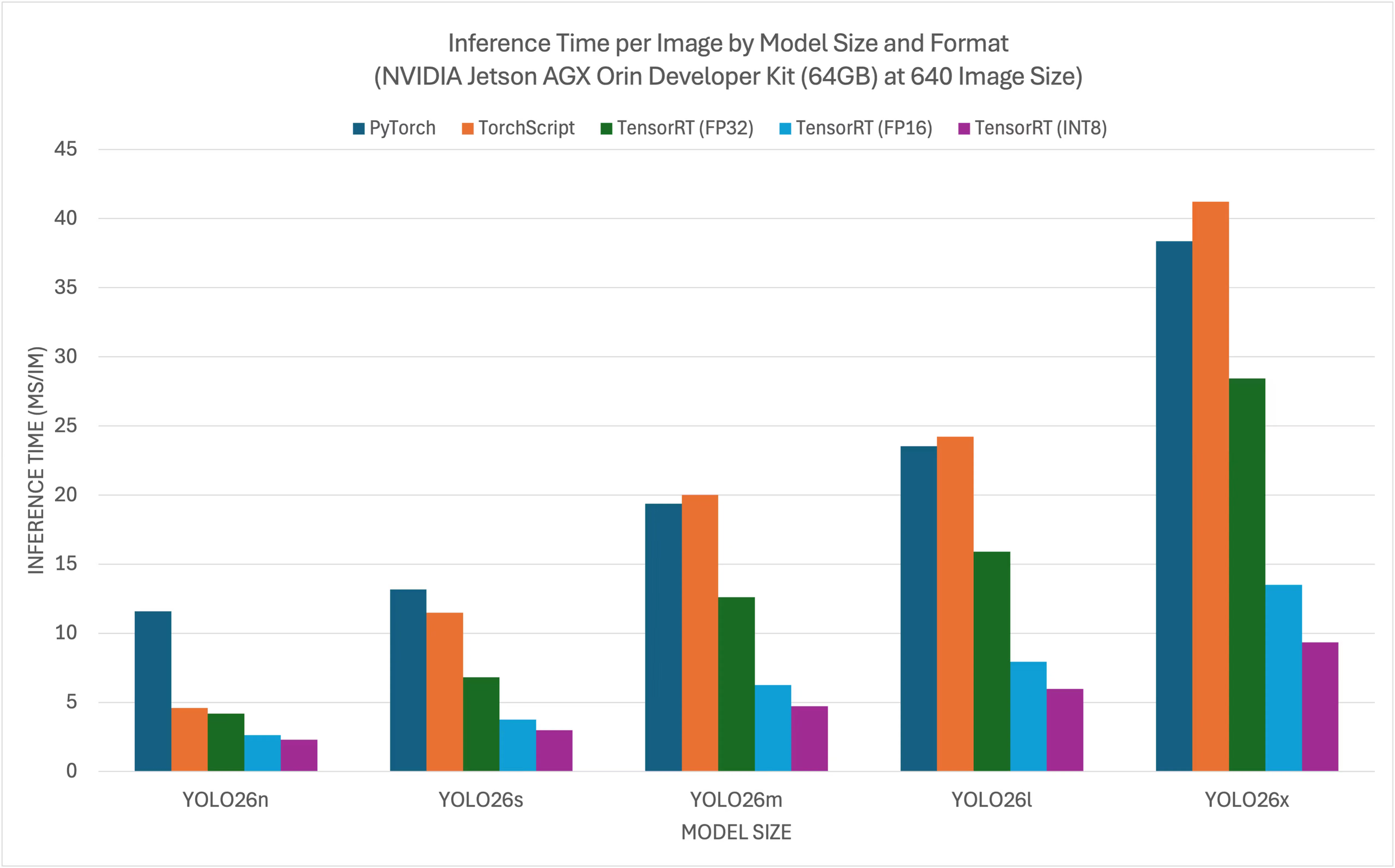
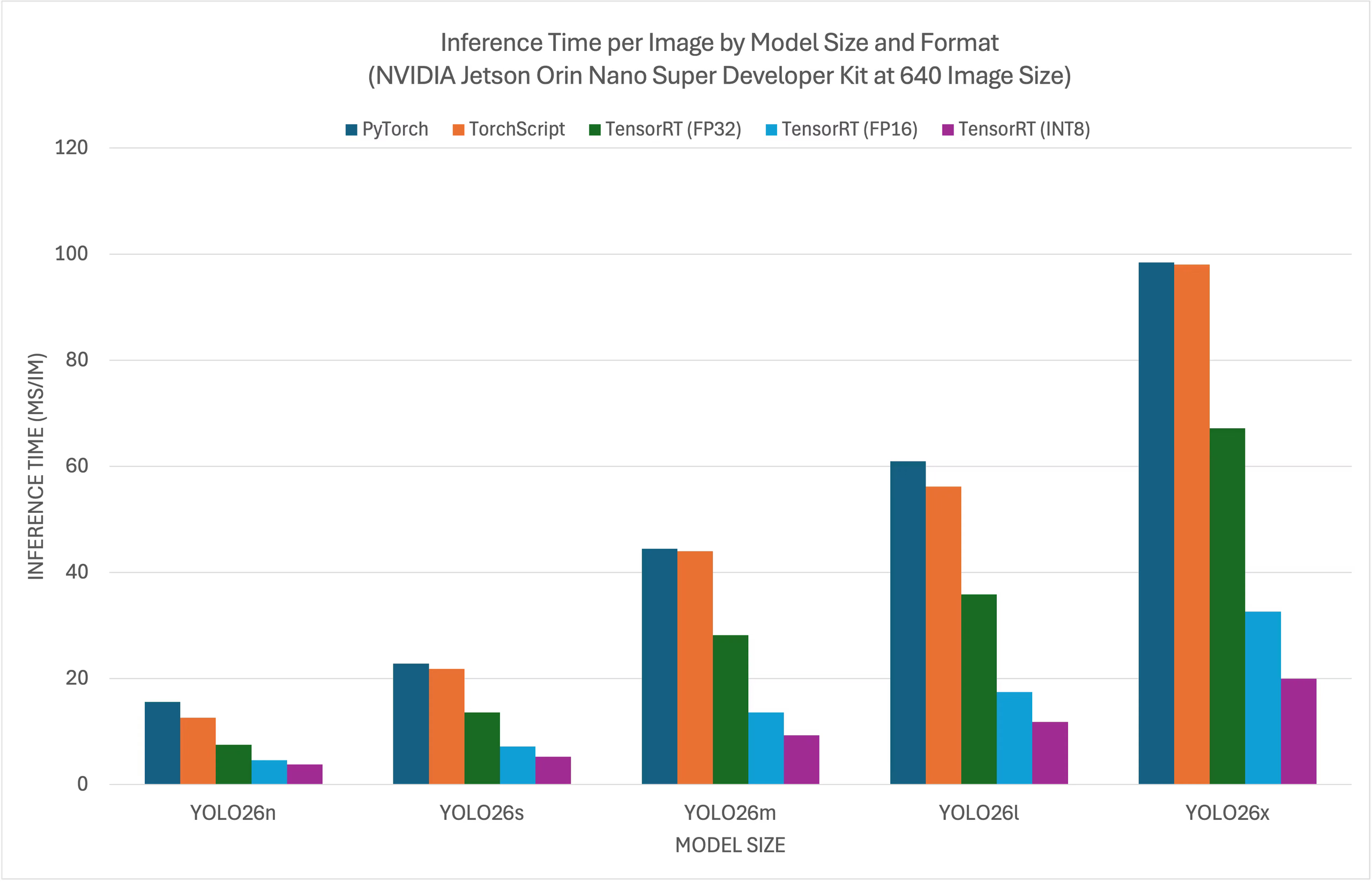
Mặc dù tất cả bản xuất model đều chạy được trên NVIDIA Jetson, biểu đồ so sánh bên dưới chỉ bao gồm PyTorch, TorchScript và TensorRT. Bạn có thể tìm thấy benchmark cho tất cả bản xuất trong phần sau biểu đồ này.
Bộ công cụ dành cho nhà phát triển NVIDIA Jetson AGX Thor#
Bộ công cụ dành cho nhà phát triển NVIDIA Jetson AGX Orin (64GB)#
Bộ công cụ dành cho nhà phát triển NVIDIA Jetson Orin Nano Super#
NVIDIA Jetson Orin NX 16GB#
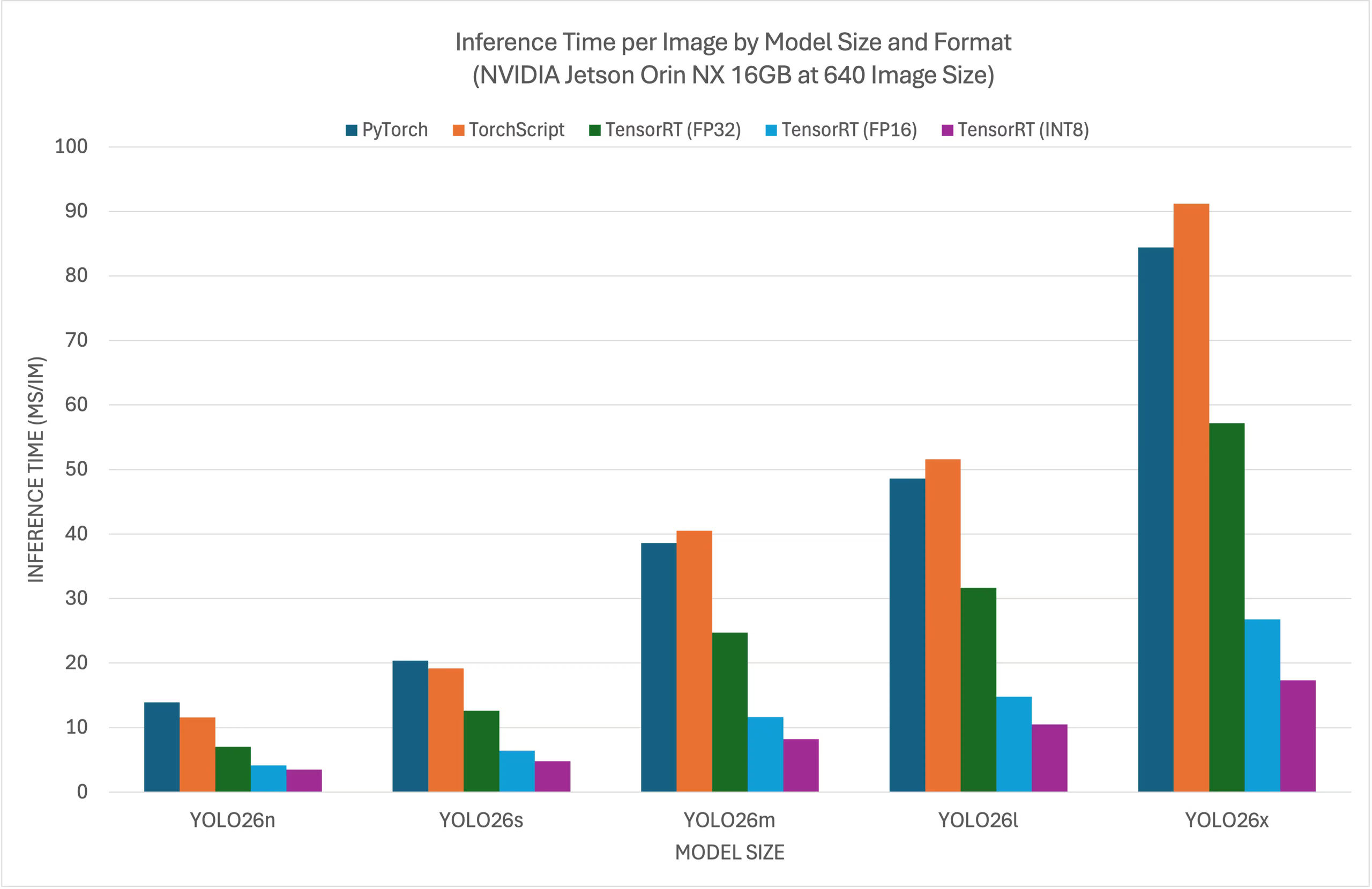
Bảng so sánh chi tiết#
Bảng dưới đây trình bày kết quả benchmark của năm model YOLO26 khác nhau (YOLO26n, YOLO26s, YOLO26m, YOLO26l, YOLO26x) trên 11 định dạng khác nhau (PyTorch, TorchScript, ONNX, OpenVINO, TensorRT, TF SavedModel, TF GraphDef, TF Lite, MNN, NCNN, ExecuTorch), bao gồm trạng thái, kích thước, metric mAP50-95(B) và thời gian suy luận cho từng tổ hợp.
Bộ công cụ dành cho nhà phát triển NVIDIA Jetson AGX Thor#
| Định dạng | Trạng thái | Dung lượng trên ổ đĩa (MB) | mAP50-95(B) | Thời gian suy luận (ms/ảnh) |
|---|---|---|---|---|
| PyTorch | ✅ | 5.3 | 0.4798 | 7.39 |
| TorchScript | ✅ | 9.8 | 0.4789 | 4.21 |
| ONNX | ✅ | 9.5 | 0.4767 | 6.58 |
| OpenVINO | ✅ | 10.1 | 0.4794 | 17.50 |
| TensorRT (FP32) | ✅ | 13.9 | 0.4791 | 1.90 |
| TensorRT (FP16) | ✅ | 7.6 | 0.4797 | 1.39 |
| TensorRT (INT8) | ✅ | 6.5 | 0.4273 | 1.52 |
| TF SavedModel | ✅ | 25.7 | 0.4764 | 47.24 |
| TF GraphDef | ✅ | 9.5 | 0.4764 | 45.98 |
| TF Lite | ✅ | 9.9 | 0.4764 | 182.04 |
| MNN | ✅ | 9.4 | 0.4784 | 21.83 |
Được benchmark bằng Ultralytics 8.4.7
Thời gian suy luận không bao gồm tiền xử lý/hậu xử lý.
Bộ công cụ dành cho nhà phát triển NVIDIA Jetson AGX Orin (64GB)#
| Định dạng | Trạng thái | Dung lượng trên ổ đĩa (MB) | mAP50-95(B) | Thời gian suy luận (ms/ảnh) |
|---|---|---|---|---|
| PyTorch | ✅ | 5.3 | 0.4790 | 11.58 |
| TorchScript | ✅ | 9.8 | 0.4770 | 4.60 |
| ONNX | ✅ | 9.5 | 0.4770 | 9.87 |
| OpenVINO | ✅ | 9.6 | 0.4820 | 28.80 |
| TensorRT (FP32) | ✅ | 11.5 | 0.4770 | 4.18 |
| TensorRT (FP16) | ✅ | 7.9 | 0.4789 | 2.62 |
| TensorRT (INT8) | ✅ | 5.4 | 0.4640 | 2.30 |
| TF SavedModel | ✅ | 24.6 | 0.4760 | 71.10 |
| TF GraphDef | ✅ | 9.5 | 0.4760 | 70.02 |
| TF Lite | ✅ | 9.9 | 0.4760 | 227.94 |
| MNN | ✅ | 9.4 | 0.4760 | 32.46 |
| NCNN | ✅ | 9.3 | 0.4810 | 29.93 |
Được benchmark bằng Ultralytics 8.4.32
Thời gian suy luận không bao gồm tiền xử lý/hậu xử lý.
Bộ công cụ dành cho nhà phát triển NVIDIA Jetson Orin Nano Super#
| Định dạng | Trạng thái | Dung lượng trên ổ đĩa (MB) | mAP50-95(B) | Thời gian suy luận (ms/ảnh) |
|---|---|---|---|---|
| PyTorch | ✅ | 5.3 | 0.4790 | 15.60 |
| TorchScript | ✅ | 9.8 | 0.4770 | 12.60 |
| ONNX | ✅ | 9.5 | 0.4760 | 15.76 |
| OpenVINO | ✅ | 9.6 | 0.4820 | 56.23 |
| TensorRT (FP32) | ✅ | 11.3 | 0.4770 | 7.53 |
| TensorRT (FP16) | ✅ | 8.1 | 0.4800 | 4.57 |
| TensorRT (INT8) | ✅ | 5.3 | 0.4490 | 3.80 |
| TF SavedModel | ✅ | 24.6 | 0.4760 | 118.33 |
| TF GraphDef | ✅ | 9.5 | 0.4760 | 116.30 |
| TF Lite | ✅ | 9.9 | 0.4760 | 286.00 |
| MNN | ✅ | 9.4 | 0.4760 | 68.77 |
| NCNN | ✅ | 9.3 | 0.4810 | 47.50 |
Được benchmark bằng Ultralytics 8.4.33
Thời gian suy luận không bao gồm tiền xử lý/hậu xử lý.
NVIDIA Jetson Orin NX 16GB#
| Định dạng | Trạng thái | Dung lượng trên ổ đĩa (MB) | mAP50-95(B) | Thời gian suy luận (ms/ảnh) |
|---|---|---|---|---|
| PyTorch | ✅ | 5.3 | 0.4799 | 13.90 |
| TorchScript | ✅ | 9.8 | 0.4787 | 11.60 |
| ONNX | ✅ | 9.5 | 0.4763 | 14.18 |
| OpenVINO | ✅ | 9.6 | 0.4819 | 40.19 |
| TensorRT (FP32) | ✅ | 11.4 | 0.4770 | 7.01 |
| TensorRT (FP16) | ✅ | 8.0 | 0.4789 | 4.13 |
| TensorRT (INT8) | ✅ | 5.5 | 0.4489 | 3.49 |
| TF SavedModel | ✅ | 24.6 | 0.4764 | 92.34 |
| TF GraphDef | ✅ | 9.5 | 0.4764 | 92.06 |
| TF Lite | ✅ | 9.9 | 0.4764 | 254.43 |
| MNN | ✅ | 9.4 | 0.4760 | 48.55 |
| NCNN | ✅ | 9.3 | 0.4805 | 34.31 |
Được benchmark bằng Ultralytics 8.4.33
Thời gian suy luận không bao gồm tiền xử lý/hậu xử lý.
Tìm hiểu thêm về các hoạt động benchmark của Seeed Studio chạy trên các phiên bản phần cứng NVIDIA Jetson khác nhau.
Tái tạo kết quả của chúng tôi#
Để tái tạo các benchmark Ultralytics ở trên trên tất cả định dạng xuất, hãy chạy đoạn mã này:
from ultralytics import YOLO

# Tải model YOLO26n PyTorch
model = YOLO("yolo26n.pt")

# Benchmark tốc độ và độ chính xác của YOLO26n trên tập dữ liệu COCO128 cho tất cả định dạng xuất
results = model.benchmark(data="coco128.yaml", imgsz=640)
Lưu ý rằng kết quả benchmark có thể thay đổi tùy theo cấu hình phần cứng và phần mềm cụ thể của hệ thống, cũng như khối lượng công việc hiện tại của hệ thống tại thời điểm chạy benchmark. Để có kết quả đáng tin cậy nhất, hãy sử dụng tập dữ liệu có nhiều ảnh, ví dụ: data='coco.yaml' (5000 ảnh val).
Các phương pháp hay nhất khi sử dụng NVIDIA Jetson#
Hãy áp dụng các phương pháp tối ưu sau để đạt hiệu năng tối đa từ YOLO26 trên NVIDIA Jetson.
-
Bật chế độ nguồn MAX
Bật MAX Power Mode trên Jetson để đảm bảo tất cả lõi CPU và GPU đều được bật.
sudo nvpmodel -m 0 -
Bật Jetson Clocks
Bật Jetson Clocks để đảm bảo xung nhịp của tất cả lõi CPU và GPU đạt mức tối đa.
sudo jetson_clocks -
Cài đặt ứng dụng Jetson Stats
Sử dụng ứng dụng jetson-stats để theo dõi nhiệt độ các thành phần hệ thống, xem mức sử dụng CPU, GPU và RAM, thay đổi chế độ nguồn, đặt xung nhịp tối đa và kiểm tra thông tin JetPack.
sudo apt update
sudo pip install jetson-stats
sudo reboot
jtop
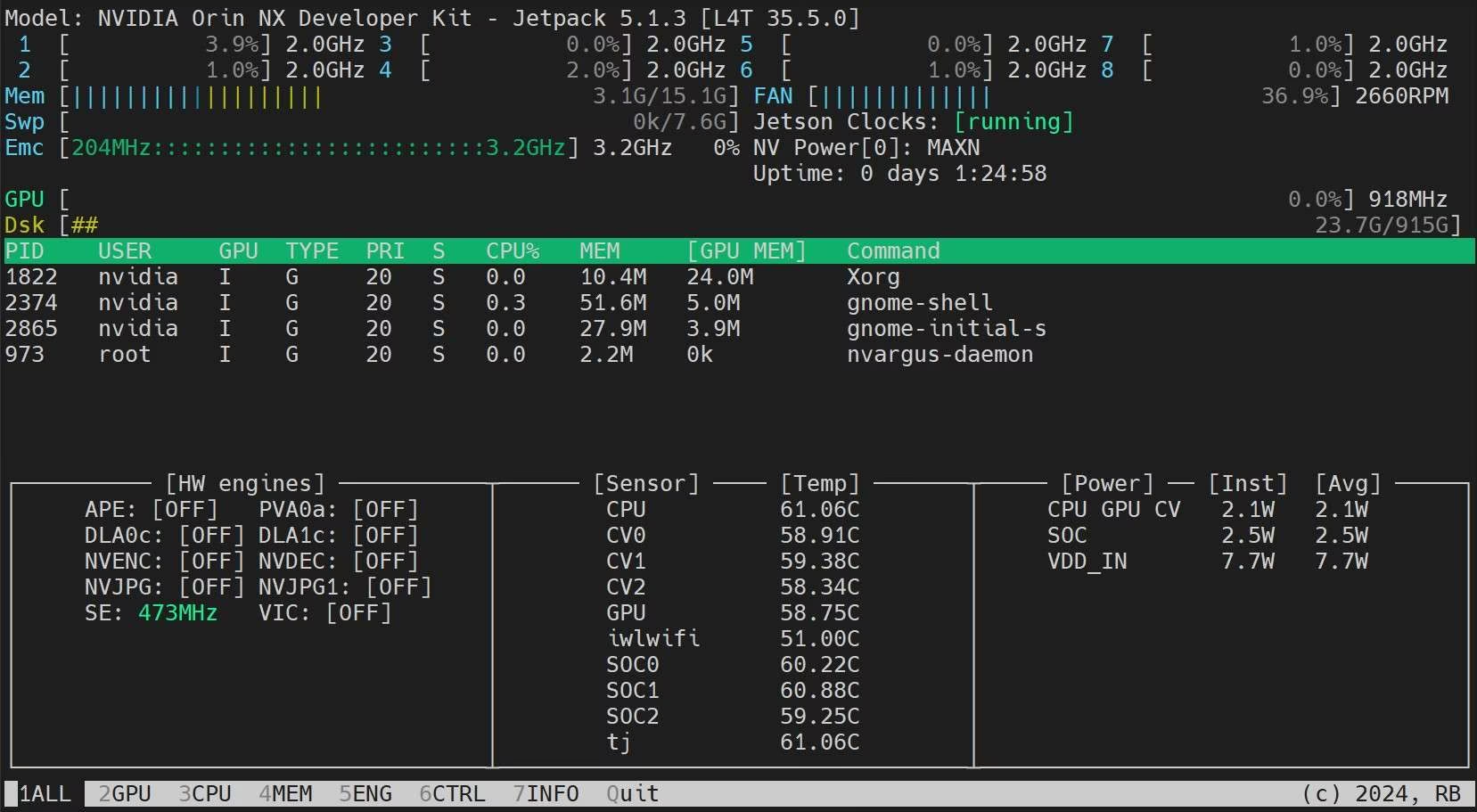
Mẹo tối ưu hóa bộ nhớ cho NVIDIA Jetson#
Bộ nhớ khả dụng thường là yếu tố giới hạn trên các thiết bị Jetson, đặc biệt là các phiên bản có ít bộ nhớ như Jetson Orin Nano (8 GB) hoặc Orin NX 8 GB. Các mẹo dưới đây là những thay đổi thiết thực, ít rủi ro, có thể kết hợp để giải phóng vài trăm megabyte và cho phép chạy các model YOLO lớn hơn hoặc hỗ trợ thêm các tác vụ song song. Để tìm hiểu toàn diện, hãy xem bài viết trên blog NVIDIA về tối đa hóa hiệu quả bộ nhớ trên Jetson.
1. Chuyển sang khởi động không giao diện (Headless)#
Nếu Jetson của bạn được kết nối qua SSH hoặc chạy như một thiết bị chuyên dụng trong môi trường production mà không gắn màn hình, việc loại bỏ môi trường desktop và display server có thể thu hồi tối đa 865 MB RAM:
sudo systemctl set-default multi-user.target
sudo reboot
Để khôi phục desktop sau đó:
sudo systemctl set-default graphical.target
sudo reboot
2. Tắt các dịch vụ hệ thống không sử dụng#
Các dịch vụ nền không thiết yếu (Bluetooth, trình quản lý kết nối, daemon phần cứng không sử dụng) tiêu thụ tổng cộng khoảng 32 MB. Liệt kê các dịch vụ đang hoạt động và tắt mọi dịch vụ không cần thiết cho quá trình triển khai của bạn:
# List running services
systemctl list-units --type=service --state=running

# Disable a service
sudo systemctl disable SERVICE_NAME
3. Phân tích mức sử dụng bộ nhớ#
Trước khi tối ưu hóa, hãy xác định tiến trình nào thực sự đang tiêu thụ RAM. procrank sắp xếp các tiến trình theo PSS (Proportional Set Size), chỉ số phản ánh chính xác hơn mức tiêu thụ bộ nhớ thực tế của từng tiến trình so với RSS (Resident Set Size, tổng số trang RAM vật lý được ánh xạ bởi một tiến trình, bao gồm cả các trang dùng chung với tiến trình khác):
git clone https://github.com/csimmonds/procrank_linux.git
cd procrank_linux && make
sudo ./procrank
Để xem mức cấp phát GPU và NvMap (đường dẫn xử lý CUDA/video) theo từng tiến trình:
sudo cat /sys/kernel/debug/nvmap/iovmm/clients4. Chạy suy luận mà không cần màn hình trong môi trường production#
Với các pipeline suy luận không yêu cầu xem trước trực tiếp, việc tắt các thành phần liên quan đến hiển thị (Tiler, OSD, DisplaySink) có thể tiết kiệm riêng 200+ MB từ pipeline. Với Ultralytics YOLO, hãy tắt trình xem và ghi kết quả ra ổ đĩa:
from ultralytics import YOLO

model = YOLO("yolo26n.engine")

# show=False ngăn mọi cửa sổ hiển thị; save=True ghi kết quả đã chú thích ra ổ đĩa
results = model.predict(source="video.mp4", show=False, save=True)
Tác động cộng dồn#
| Tối ưu hóa | Bộ nhớ ước tính được giải phóng |
|---|---|
| Tắt giao diện đồ họa desktop | ~865 MB |
| Tắt các dịch vụ OS không sử dụng | ~32 MB |
| Pipeline suy luận không giao diện (không hiển thị) | ~200+ MB |
| Tổng cộng (các cách dễ thực hiện) | ~1 GB+ |
Kết hợp các thay đổi này đặc biệt hữu ích khi triển khai model TensorRT INT8 trên thiết bị có bộ nhớ hạn chế — đây có thể là yếu tố quyết định liệu một biến thể model lớn hơn có vừa bộ nhớ hay không.
Các bước tiếp theo#
Để tìm hiểu thêm và nhận hỗ trợ, hãy xem Tài liệu Ultralytics YOLO26.
Câu hỏi thường gặp#
Để triển khai Ultralytics YOLO26 trên thiết bị NVIDIA Jetson, trước tiên hãy flash thiết bị Jetson bằng NVIDIA JetPack SDK. Sau đó, dùng image Docker dựng sẵn để thiết lập nhanh hoặc cài đặt thủ công các package cần thiết.
Các model YOLO26 đã được benchmark trên NVIDIA Jetson AGX Thor, AGX Orin, Orin Nano Super và Orin NX; định dạng TensorRT mang lại hiệu năng suy luận tốt nhất. Phần Bảng so sánh chi tiết liệt kê mAP50-95 và thời gian suy luận cho từng model và định dạng xuất.
TensorRT được khuyến nghị để triển khai model YOLO26 trên NVIDIA Jetson vì cung cấp tốc độ suy luận nhanh nhất trong tất cả định dạng xuất bằng cách tối ưu model cho GPU của Jetson.
Để cài đặt PyTorch và Torchvision trên NVIDIA Jetson, trước tiên hãy gỡ cài đặt mọi phiên bản hiện có được cài qua pip. Sau đó, cài đặt thủ công các phiên bản PyTorch và Torchvision tương thích với kiến trúc ARM64 của Jetson. Hướng dẫn chi tiết về quy trình này có trong phần Cài đặt PyTorch và Torchvision.
Để tối đa hóa hiệu năng của YOLO26 trên NVIDIA Jetson, hãy thực hiện các phương pháp hay nhất sau:
- Bật chế độ nguồn MAX để sử dụng tất cả lõi CPU và GPU.
- Bật Jetson Clocks để tất cả lõi chạy ở tần số tối đa.
- Cài đặt ứng dụng Jetson Stats để theo dõi các chỉ số hệ thống.
Để biết các lệnh và thông tin chi tiết bổ sung, hãy tham khảo phần Các phương pháp hay nhất khi sử dụng NVIDIA Jetson.
RAM khả dụng thường là nút thắt cổ chai trên các thiết bị Jetson có ít bộ nhớ. Ba cách đơn giản có thể kết hợp để giải phóng hơn 1 GB:
- Chuyển sang khởi động không giao diện (
sudo systemctl set-default multi-user.target) để loại bỏ giao diện đồ họa desktop (tiết kiệm ~865 MB). - Tắt các dịch vụ không sử dụng như Bluetooth hoặc trình quản lý kết nối (tiết kiệm ~32 MB).
- Chạy suy luận không cần màn hình bằng cách đặt
show=Falsetrong lệnh gọi YOLOpredict, tránh cấp phát bộ nhớ cho pipeline hiển thị (tiết kiệm ~200+ MB).
Dùng
procrankđể phân tích mức sử dụng RAM theo từng tiến trình vàsudo cat /sys/kernel/debug/nvmap/iovmm/clientsđể kiểm tra mức cấp phát GPU. Xem phần Mẹo tối ưu hóa bộ nhớ để biết đầy đủ chi tiết.- Chuyển sang khởi động không giao diện (
TensorRT 10.3.0 đi kèm JetPack 6 có một lỗi đã biết khiến không thể tạo engine INT8 với đầu ra không dùng NMS (
nms=False) hoặc có NMS nhúng (nms=True). Khi Ultralytics phát hiện tổ hợp này, Ultralytics chọn head một-nhiều cho các bản xuất không dùng NMS và dừng các bản xuấtnms=Truekèm thông báo lỗi.Để khôi phục khả năng xuất INT8, hãy nâng cấp TensorRT lên phiên bản mới hơn (ví dụ: 10.7.0 trở lên):
wget https://developer.download.nvidia.com/compute/cuda/repos/ubuntu2204/arm64/cuda-keyring_1.1-1_all.deb
sudo dpkg -i cuda-keyring_1.1-1_all.deb
sudo apt-get update
sudo apt-get install -y tensorrt
Sau khi nâng cấp, hãy chạy lại quá trình export. Để biết thêm chi tiết, xem sự cố #23841 trên GitHub và sự cố #26655.


Bình luận194
Đặt câu hỏi, chia sẻ kết quả hoặc giúp đỡ người khác.
LG973641114
您好,如何用c++在jetson上部署YOLO26,有相关例子吗
1pknowler
Struggling with this on a new Jetson Orin Nano JP6.1. All good following the steps and installs to give torch.cuda.is_available as TRUE. The TensorRT export fails though with a number of dependency errors and I can’t re-install it with anything. Any pointers please?
1 Glenn JocherUltralytics
@pknowler it seems like the dependency errors during TensorRT export might stem from compatibility issues. Please ensure you’ve installed the required JetPack-compatible versions of PyTorch, Torchvision, and TensorRT as outlined in the Jetson Quick Start Guide. Additionally, verify that
onnxruntime-gpuandcuSPARSELtare correctly installed per the guide. If the issue persists, you can try reinstalling TensorRT using the NVIDIA SDK Manager for your JetPack version. Let me know if you need further clarification!Thank you. I will try again working through all of the steps and let you know how it goes!
I’ve tried again but this as far as I get… I have followed everything carefully.
WARNING ⚠️ TensorRT requires GPU export, automatically assigning device=0 Ultralytics 8.3.57 🚀 Python-3.10.16 torch-2.5.0a0+872d972e41.nv24.08 CUDA:0 (Orin, 7620MiB) YOLO11n summary (fused): 238 layers, 2,616,248 parameters, 0 gradients, 6.5 GFLOPs
PyTorch: starting from 'yolo11n.pt' with input shape (1, 3, 640, 640) BCHW and output shape(s) (1, 84, 8400) (5.4 MB)
ONNX: starting export with onnx 1.17.0 opset 19... ONNX: slimming with onnxslim 0.1.46... ONNX: export success ✅ 3.1s, saved as 'yolo11n.onnx' (10.2 MB) requirements: Ultralytics requirement ['tensorrt>7.0.0,!=10.1.0'] not found, attempting AutoUpdate... error: subprocess-exited-with-error
× python setup.py egg_info did not run successfully. │ exit code: 1 ╰─> [6 lines of output] Traceback (most recent call last): File "", line 2, in File "", line 34, in File "/tmp/pip-install-d0ljzl60/tensorrt-cu12_db0552ac431148489703f6f75df6764f/setup.py", line 71, in raise RuntimeError("TensorRT does not currently build wheels for Tegra systems") RuntimeError: TensorRT does not currently build wheels for Tegra systems [end of output]
note: This error originates from a subprocess, and is likely not a problem with pip. error: metadata-generation-failed
× Encountered error while generating package metadata. ╰─> See above for output.
note: This is an issue with the package mentioned above, not pip. hint: See above for details. Retry 1/2 failed: Command 'pip install --no-cache-dir "tensorrt>7.0.0,!=10.1.0" ' returned non-zero exit status 1. error: subprocess-exited-with-error
× python setup.py egg_info did not run successfully. │ exit code: 1 ╰─> [6 lines of output] Traceback (most recent call last): File "", line 2, in File "", line 34, in File "/tmp/pip-install-782zjqf9/tensorrt-cu12_44d261aea7c5489db3e9ce15cec8ee64/setup.py", line 71, in raise RuntimeError("TensorRT does not currently build wheels for Tegra systems") RuntimeError: TensorRT does not currently build wheels for Tegra systems [end of output]
note: This error originates from a subprocess, and is likely not a problem with pip. error: metadata-generation-failed
× Encountered error while generating package metadata. ╰─> See above for output.
note: This is an issue with the package mentioned above, not pip. hint: See above for details.
And I have TensorRT 10.7.0.23-1+cuda12.6
- Glenn JocherUltralytics
@pknowler it seems your TensorRT version is not compatible with the Jetson's ARM64 architecture. TensorRT does not provide pre-built Python wheels for Tegra systems. Please ensure you have TensorRT installed via the NVIDIA SDK Manager as part of the JetPack installation, and confirm compatibility with your JetPack version. The Jetson Quick Start Guide might also help clarify setup specifics. Let me know if further assistance is needed!
@glenn-jocher thank you. I have found the issue now. I am using miniconda and for some reason TensorRT Python bindings are not available in conda envs. So I can import Torch with no problem but the import TensorRT fails. I have re-installed without conda and all works as expected! 👍🏻
RasoulZardeyni
Which one reduce inference time using TensorRT or deepstream?
1 Paula DerrengerUltralytics(đã chỉnh sửa)
In terms of reducing inference time on your NVIDIA Jetson device, using TensorRT is generally recommended. TensorRT is specifically designed to provide high performance for NVIDIA hardware by optimizing deep learning models for inference. It accelerates models by fusing layers, pruning unused layers, and quantizing variables, among other optimizations. 🚀
DeepStream, on the other hand, is more focused on streaming analytics and can utilize TensorRT-optimized models. For most cases, directly using TensorRT for model optimization is your go-to for minimizing inference times.
Here's a quick example of exporting a YOLO model to TensorRT and running inference, tailored for your convenience:
from ultralytics import YOLO

# Load your YOLO model
model = YOLO('yolo26n.pt')

# Export to TensorRT format
model.export(format='engine')

# Load the TensorRT model
trt_model = YOLO('yolo26n.engine')

# Run inference using the TensorRT model
results = trt_model('your_image_or_video.jpg')
Feel free to explore more about deploying on NVIDIA Jetson with our Quick Start Guide for NVIDIA Jetson. Happy inferencing! 🌟
2Thanks!
1- Paula DerrengerUltralytics(đã chỉnh sửa)
Hey there! 😊 It looks like you're interested in speeding up your inference times. Between TensorRT and DeepStream on NVIDIA Jetson devices, TensorRT typically offers more direct optimization for reducing inference time for individual models by providing lower-level optimizations and quantization options.
DeepStream is a comprehensive framework for building end-to-end video analytics applications, which utilizes TensorRT under the hood for model inference. DeepStream excels in scenarios involving video streams, multi-stream input, and complex pipelines involving multiple AI models and analytics. If your primary goal is solely to minimize inference time for a specific model, direct optimization via TensorRT can provide more focused improvements.
A quick example of exporting a YOLO model to TensorRT:
from ultralytics import YOLO

# Load your YOLO model
model = YOLO('yolo26n.pt')

# Export to TensorRT format
model.export(format='engine')  # This creates 'yolo26n.engine'

# Done! Now you can use 'yolo26n.engine' for faster inference.
However, if your application benefits from a broader video analytics pipeline, incorporating DeepStream into your workflow can optimize and streamline these processes on top of efficiently handling inference with TensorRT optimized models. 🚀
Hope this gives you a clearer picture! If you have more questions, feel free to ask.
1
 Yufeng Wu(đã chỉnh sửa)
Hi, ultralytics team. I'm trying yolo26n-pose on Jetson orin agx 64gb and have this problem: I tried building engine with dynamic=true but failed, with the log saying ForeignNode[/model.23/Sigmoid.../model.23/Flatten] (Myelin) Skipping tactic ... Incompatible effective shapes in operation /model_23/Sub between: Unsqueeze_18_output_0 f32[1,2,33600] and Slice_output_0 f32[1,2,21504] Could not find any implementation for node {ForeignNode[/model.23/Sigmoid.../model.23/Flatten]} Is there a way to fix it?
- Glenn JocherUltralytics
This indicates a TensorRT dynamic-shape profile failure in the pose head. As a workaround, export a fixed-resolution engine, e.g.
yolo export model=yolo26n-pose.pt format=engine imgsz=640 batch=1 dynamic=False; build separate engines if multiple resolutions are required. If dynamic shapes are essential, please open a new issue with the full text log,yolo checksoutput, and JetPack/TensorRT/Ultralytics versions so we can reproduce it; see the TensorRT export guide.
 Haotian Gong(đã chỉnh sửa)
Hi, everyone,
I'd like to flag two issues with the Jetson installation guide that may need updating.
1. PyTorch 2.10.0 / Torchvision 0.25.0 doesn't work on JetPack 6.1
Following the "Start with naive installation" and "Run on JetPack 6.1" sections, I installed Pytorch 2.10.0 and Torchvision 0.25.0 as instructed.
Running my script then throws:
ImportError: libcublas.so.13: cannot open shared object file: No such file or directorySo I have to install Pytorch 2.8.0 with the guide:
https://forums.developer.nvidia.com/t/jetson-orin-nano-issues-running-yolo-ultralytics-due-to-pytorch-torchvision-compatibility-jetpack-6-x-cuda-12-6/365683/9And this version of Pytorch works. So maybe is the guide on Jetson obsolete or mistaken?
2. CSI camera requires the JetPack-bundled OpenCV, not the PyPI one
On Jetson, using a CSI camera (via
nvarguscamerasrc) requires the OpenCV that ships with JetPack, because the PyPIopencv-pythonwheel on aarch64 is built without GStreamer support.However,
pip install ultralyticspulls inopencv-pythonas a dependency, which shadows the JetPack-bundled version and silently breaks CSI camera pipelines.pip uninstall -y opencv-python opencv-python-headless sudo apt install -y python3-opencv # JetPack-bundled OpenCV with GStreamerThanks!
 Lakshantha DissanayakeUltralytics
Hi @ZephyrKeXiner Could you please double check whether you are using JetPack 6.1 system with CUDA 12.6? I have just verified on my JetPack 6.1 system with CUDA 12.6 with
torch-2.10.0andtorchvision-0.25.0as mentioned in the Ultralytics Jetson Guide and it works well.For JetPack 6.1, output of
cat /etc/nv_tegra_releaseshould look like below:(env) nvidia@ubuntu:~/yolo26/ultralytics$ cat /etc/nv_tegra_release # R36 (release), REVISION: 4.3, GCID: 38968081, BOARD: generic, EABI: aarch64, DATE: Wed Jan 8 01:49:37 UTC 2025 # KERNEL_VARIANT: oot TARGET_USERSPACE_LIB_DIR=nvidia TARGET_USERSPACE_LIB_DIR_PATH=usr/lib/aarch64-linux-gnu/nvidiaCould you also share yours please? Thanks!
cc: @raimbekovm
1- Haotian Gong
Hi @lakshanthad,
My output of
cat /etc/nv_tegra_releaseis below:$ cat /etc/nv_tegra_release # R36 (release), REVISION: 5.0, GCID: 43688277, BOARD: generic, EABI: aarch64, DATE: Fri Jan 16 03:50:45 UTC 2026 # KERNEL_VARIANT: oot TARGET_USERSPACE_LIB_DIR=nvidia TARGET_USERSPACE_LIB_DIR_PATH=usr/lib/aarch64-linux-gnu/nvidiaI notice that the revision is 5.0 not 4.3. Maybe does it cause the error?
smbunn(đã chỉnh sửa)
I would have thought the Jetson Orin Nano could do more than 5 streams, the deepstream examples with cars handles 16 streams of 1080p at what appears to be full framerate.
As a control systems engineer by training, edge devices seem a much better way to go so I prefer your jetson design. Even if one Jetson has an issue you are still processing 45 streams whereas a problem on your centralised server in option 2 takes everything down.
Are you going to set up an MQTT feed for alerts from each stream? Maybe consider secondary processing and a buffer, so the edge device detects what it thinks is an issue and a centralised server grabs 5 seconds of video of the incident and double checks.
Simon BUNN
General
From: Yash Patel @.> Sent: Friday, 22 May 2026 4:00 am To: ultralytics/ultralytics @.> Cc: Bunn, Simon @.>; Mention @.> Subject: Re: [ultralytics/ultralytics] guides/nvidia-jetson/ (Discussion #9942)
Hi, I am designing an AI-based CCTV surveillance system for a residential society with 50 RTSP camera streams. My current architecture uses multiple NVIDIA Jetson Orin Nano Super Developer Kit devices for distributed inference processing. I ZjQcmQRYFpfptBannerStart Attention The sender's identity could not be verified and someone may be impersonating the sender. L'identité de l'expéditeur n'a pas pu être vérifiée et quelqu'un pourrait se faire passer pour l'expéditeur.
ZjQcmQRYFpfptBannerEnd
Hi, I am designing an AI-based CCTV surveillance system for a residential society with 50 RTSP camera streams. My current architecture uses multiple NVIDIA Jetson Orin Nano Super Developer Kit devices for distributed inference processing. I estimate that one Jetson Orin Nano Super (8GB) can process around 5 RTSP streams at usable real-time FPS. This requires approximately 10 Jetson devices for the full deployment. Each device costs around ₹33,000 (~USD 395). The total estimated hardware cost is ₹330,000 (~USD 3,950). I want to compare this setup against a centralized Linux-based custom PC/server with NVIDIA GPU acceleration under the same budget. The comparison focuses on AI inference performance, scalability, reliability, and 24/7 operational efficiency. The workload mainly includes multi-stream YOLO/object detection inference on live RTSP feeds. I want to determine which architecture provides the best computation-to-cost ratio for this surveillance use case.
— Reply to this email directly, view it on GitHubhttps://urldefense.com/v3/__https://github.com/orgs/ultralytics/discussions/9942*discussioncomment-17006943__;Iw!!ElGdukoduuk!URiPjKkgDoMT_k2Y6pEd3XMEBGMDjhwgtQmwWXR9F4R4L7ymNloZD79NanOjYVg9YYmaARqyZGbgFv7U15KzgdcU$, or unsubscribehttps://urldefense.com/v3/__https://github.com/notifications/unsubscribe-auth/ABAAMILYUP7PPODNHDR3HC3434RYLAVCNFSM6AAAAABGAK2IGGVHI2DSMVQWIX3LMV43URDJONRXK43TNFXW4Q3PNVWWK3TUHMYTOMBQGY4TIMY__;!!ElGdukoduuk!URiPjKkgDoMT_k2Y6pEd3XMEBGMDjhwgtQmwWXR9F4R4L7ymNloZD79NanOjYVg9YYmaARqyZGbgFv7U1zjhi4YU$. Triage notifications on the go with GitHub Mobile for iOShttps://urldefense.com/v3/__https://apps.apple.com/app/apple-store/id1477376905?ct=notification-email&mt=8&pt=524675__;!!ElGdukoduuk!URiPjKkgDoMT_k2Y6pEd3XMEBGMDjhwgtQmwWXR9F4R4L7ymNloZD79NanOjYVg9YYmaARqyZGbgFv7U13gOq1qb$ or Androidhttps://urldefense.com/v3/__https://play.google.com/store/apps/details?id=com.github.android&referrer=utm_campaign*3Dnotification-email*26utm_medium*3Demail*26utm_source*3Dgithub__;JSUlJSU!!ElGdukoduuk!URiPjKkgDoMT_k2Y6pEd3XMEBGMDjhwgtQmwWXR9F4R4L7ymNloZD79NanOjYVg9YYmaARqyZGbgFv7U1zOl3XaF$. You are receiving this because you were mentioned.Message ID: @.***>
- Glenn JocherUltralytics
5streams on an Orin Nano Super is just a conservative YOLO/Python estimate; with a headless TensorRT or DeepStream pipeline, MAX power mode, andjetson_clocks, higher 1080p stream counts are definitely possible and depend heavily on the model size, input resolution, decode/encode, and any tracking or alert logic you add, so please drop your exactmodel,imgsz, FPS target, and RTSP resolution here and we can help size it more accurately using the Jetson deployment guide and DeepStream Jetson guide.
yashpatel2010
Hi, I am designing an AI-based CCTV surveillance system for a residential society with 50 RTSP camera streams. My current architecture uses multiple NVIDIA Jetson Orin Nano Super Developer Kit devices for distributed inference processing. I estimate that one Jetson Orin Nano Super (8GB) can process around 5 RTSP streams at usable real-time FPS. This requires approximately 10 Jetson devices for the full deployment. Each device costs around ₹33,000 (~USD 395). The total estimated hardware cost is ₹330,000 (~USD 3,950). I want to compare this setup against a centralized Linux-based custom PC/server with NVIDIA GPU acceleration under the same budget. The comparison focuses on AI inference performance, scalability, reliability, and 24/7 operational efficiency. The workload mainly includes multi-stream YOLO/object detection inference on live RTSP feeds. I want to determine which architecture provides the best computation-to-cost ratio for this surveillance use case.
RotatingGiraffe
Hi there, I am trying to run a fine-tuned YOLO26 based model for an OBB task on a Xavier NX running JetPack 5. I am using your container (ultralytics/ultralytics:latest-jetson-jetpack5) and trying to compile from PyTorch to TensorRT. I get the error: "mymodel.pt requires numpy>=1.26.1, however numpy==1.23.5 is installed."
Previously I have successfully the file on my host machine from PT to ONNX, copied ONNX to Jetson and then used tensorrtexec to compile to Engine. But the resulting models did not create any bounding boxes.
I wanted to ask if JetPack 5 even supports Yolo26 or if the model contains some incompatible layers? YOLO11 OBB works fine which I find extra-weird. Or is there likely an error somewhere else in my script?
- Glenn JocherUltralytics
Thanks for posting this here—JetPack 5 on Xavier NX is supported for YOLO26/TensorRT in our Jetson guide, so the
numpy>=1.26.1error points more to an environment/checkpoint mismatch than unsupported OBB layers; please paste the full text traceback andyolo checksoutput, and note that an engine built withtensorrtexeccan still produce empty OBB results if the Ultralytics export metadata/postprocessing is not preserved. Hi there, I tried to create a minimal reproducible example for you, based on what I am doing. I hope it helps with debugging.
The yolo checks you asked for is in the script output, along with the export script. I've also included the bit where I export via trtexex just for the sake of completion - it might very well be possible that I omit required metadata with this. My prefered goal would be that everything works via the Ultralytics Python API, but I had to search for workaround due to the NumPy error when compiling PT files.
I am now using the Ultralytics base image in the MRE which I hoped would be easier to debug for us. The NumPy error persists on the new image. Previously I was using something built upon l4t-ml.
Additionally, ONNX fails with an error ( `GLIBCXX_3.4.29' not found I think it was) but that is not a concern to me since I engine would be my prefered way to go. I have not installed any additional packages and kept it very vanilla (see dockerfile). The MRE also weirdly produced a new error during engine inference, but I'd say lets just focus on getting the Ultralytics native pipeline to work and then maybe all the other issues were just from my workarounds and disappear.
Execution Command
sudo docker compose up --buildDirectory Structure
obb-test-repro/
 ┣ 📂data/
 ┃ ┗ 📜mydataset.yaml
 ┣ 📂models/
 ┃ ┣ 📜my-yolo26m-model.onnx
 ┃ ┗ 📜my-yolo26m-model.pt
 ┣ 📂src/
 ┃ ┗ 📜main.py
 ┣ 📜docker-compose.yml
 ┣ 📜Dockerfile
 ┗ 📜requirements.txt
Dockerfile
FROM ultralytics/ultralytics:latest-jetson-jetpack5

WORKDIR /app

# Copy the test app
COPY src/ ./src/

# Run the test
CMD ["python3", "src/main.py"]
docker-compose.yml
version: '3.8'

services:
  obb-test-jp5:
    image: obb-test:latest
    container_name: obb_test_jp5
    build:
      context: .
      dockerfile: Dockerfile
    runtime: nvidia
    network_mode: host
    ipc: host
    restart: "no"
    volumes:
      - ./models:/app/models
      - ./data:/app/data
    environment:
      - NVIDIA_VISIBLE_DEVICES=all
      - NVIDIA_DRIVER_CAPABILITIES=all
main.py
"""
Minimal OBB model test script.

Behavior:
- Runs `yolo checks` to output environment details.
- Uses files in `/app/models` (container path mapped from `obb-test/models`).
- Expects two files (hard-coded):
  - `/app/models/my-yolo26m-model.pt` (optional) — used for Ultralytics native export
  - `/app/models/my-yolo26m-model.onnx` (optional) — used for trtexec compilation
- Runs both export methods (if files exist) and validates inference on each compiled engine using mydataset dataset.
"""

import logging
import sys
import subprocess
import os
from pathlib import Path
from ultralytics import YOLO

# Configure logging
logging.basicConfig(
    level=logging.INFO,
    format='%(asctime)s - %(levelname)s - %(message)s'
)
logger = logging.getLogger(__name__)


def run_yolo_checks():
    """Execute yolo checks via CLI to log environment details."""
    logger.info("=" * 60)
    logger.info("Environment Verification (yolo checks)")
    logger.info("=" * 60)
    try:
        res = subprocess.run(["yolo", "checks"], capture_output=True, text=True, check=True)
        logger.info("\n" + res.stdout.strip())
    except subprocess.CalledProcessError as e:
        logger.error(f"yolo checks failed:\n{e.stderr}")
    except FileNotFoundError:
        logger.error("yolo CLI command not found. Ensure ultralytics is installed in this environment.")


def test_export_to_engine():
    models_dir = Path("/app/models")
    pt_path = models_dir / "my-yolo26m-model.pt"
    onnx_path = models_dir / "my-yolo26m-model.onnx"
    dataset_yaml = "/app/data/mydataset.yaml"

    logger.info("=" * 60)
    logger.info("Minimal OBB Test - Export & Validation")
    logger.info("=" * 60)

    engines_tested = []

    # Part 1: Ultralytics native export (PT -> Engine)
    if pt_path.exists():
        try:
            logger.info(f"\nRunning Ultralytics native export for: {pt_path.name}")
            model = YOLO(str(pt_path))
            exported = model.export(format="engine", imgsz=1024, device=0, half=True)

            # Resolve the exported engine path
            native_engine = str(exported) if isinstance(exported, (str, Path)) else str(pt_path.with_suffix('.engine'))

            if os.path.exists(native_engine):
                logger.info(f"Ultralytics export successfully produced: {native_engine}")
                engines_tested.append(native_engine)
            else:
                logger.error(f"Ultralytics export completed, but engine file was not found at {native_engine}")
        except Exception as e:
            logger.error(f"Ultralytics native export failed: {e}", exc_info=True)
    else:
        logger.info(f"PT file not found ({pt_path}); skipping Ultralytics native export.")

    # Part 2: trtexec compilation (ONNX -> Engine)
    if onnx_path.exists():
        try:
            logger.info(f"\nRunning trtexec to compile ONNX: {onnx_path.name}")
            trt_engine = str(onnx_path.with_suffix('.trt.engine'))
            cmd = [
                "/usr/src/tensorrt/bin/trtexec",
                f"--onnx={onnx_path}",
                f"--saveEngine={trt_engine}",
                "--fp16",
                "--memPoolSize=workspace:768", # Prevents Out of Memory
            ]
            logger.info(f"Running command: {' '.join(cmd)}")
            res = subprocess.run(cmd, capture_output=True, text=True)

            if res.returncode != 0:
                logger.error("trtexec compilation failed.")
                logger.error(f"trtexec stderr:\n{res.stderr}")
            else:
                if os.path.exists(trt_engine):
                    logger.info(f"trtexec successfully saved engine to {trt_engine}")
                    engines_tested.append(trt_engine)
                else:
                    logger.error(f"trtexec returned success, but engine file was not found at {trt_engine}")
        except Exception as e:
            logger.error(f"trtexec execution failed: {e}", exc_info=True)
    else:
        logger.info(f"ONNX file not found ({onnx_path}); skipping trtexec compilation.")

    if not engines_tested:
        logger.error("\nNo engines are available to test. Exiting validation phase.")
        return False

    # Part 3: Inference Validation
    validation_success = True
    for eng in engines_tested:
        try:
            logger.info(f"\nValidating inference with engine: {eng}")

            model = YOLO(eng, task="obb")
            metrics = model.val(data=dataset_yaml, imgsz=1024, batch=1, verbose=False)

            logger.info(f"Validation metrics for {eng}: mAP50-95={metrics.box.map:.4f}, mAP50={metrics.box.map50:.4f}")
        except Exception as e:
            logger.error(f"Validation failed on {eng}: {e}", exc_info=True)
            validation_success = False

    logger.info("\nExecution complete.")
    return validation_success


if __name__ == "__main__":
    run_yolo_checks()

    try:
        success = test_export_to_engine()
        logger.info("\n" + "=" * 60)
        if success:
            logger.info("✓ Test passed")
        else:
            logger.info("✗ Test failed")
        logger.info("=" * 60)
        sys.exit(0 if success else 1)
    except Exception as e:
        logger.error(f"Unhandled script exception: {e}", exc_info=True)
        sys.exit(1)
Output
obb_test_jp5  | Creating new Ultralytics Settings v0.0.6 file ✅
obb_test_jp5  | View Ultralytics Settings with 'yolo settings' or at '/root/.config/Ultralytics/settings.json'
obb_test_jp5  | Update Settings with 'yolo settings key=value', i.e. 'yolo settings runs_dir=path/to/dir'. For help see https://docs.ultralytics.com/quickstart/#ultralytics-settings.
obb_test_jp5  | 2026-05-14 12:51:35,392 - INFO - ============================================================
obb_test_jp5  | 2026-05-14 12:51:35,392 - INFO - Environment Verification (yolo checks)
obb_test_jp5  | 2026-05-14 12:51:35,392 - INFO - ============================================================
obb_test_jp5  | 2026-05-14 12:51:50,554 - INFO -
obb_test_jp5  | Ultralytics 8.4.50 🚀 Python-3.8.10 torch-2.1.0a0+41361538.nv23.06 CUDA:0 (Xavier, 6833MiB)
obb_test_jp5  | Setup complete ✅ (2 CPUs, 6.7 GB RAM, 91.7/107.6 GB disk)
obb_test_jp5  |
obb_test_jp5  | OS                     Linux-5.10.216-tegra-aarch64-with-glibc2.29
obb_test_jp5  | Environment            Docker
obb_test_jp5  | Python                 3.8.10
obb_test_jp5  | Install                git
obb_test_jp5  | Path                   /ultralytics/ultralytics
obb_test_jp5  | RAM                    6.67 GB
obb_test_jp5  | Disk                   91.7/107.6 GB
obb_test_jp5  | CPU                    ARMv8 Processor rev 0 (v8l)
obb_test_jp5  | CPU count              2
obb_test_jp5  | GPU                    Xavier, 6833MiB
obb_test_jp5  | GPU count              1
obb_test_jp5  | CUDA                   11.4
obb_test_jp5  |
obb_test_jp5  | numpy                  ✅ 1.23.5>=1.23.0
obb_test_jp5  | matplotlib             ✅ 3.7.5>=3.3.0
obb_test_jp5  | opencv-python-headless ✅ 4.13.0.92>=4.6.0
obb_test_jp5  | pillow                 ✅ 10.4.0>=7.1.2
obb_test_jp5  | pyyaml                 ✅ 6.0.3>=5.3.1
obb_test_jp5  | requests               ✅ 2.32.4>=2.23.0
obb_test_jp5  | scipy                  ✅ 1.10.1>=1.4.1
obb_test_jp5  | torch                  ✅ 2.1.0a0+41361538.nv23.6>=1.8.0
obb_test_jp5  | torchvision            ✅ 0.16.2+c6f3977>=0.9.0
obb_test_jp5  | psutil                 ✅ 7.2.2>=5.8.0
obb_test_jp5  | polars                 ✅ 1.8.2>=0.20.0
obb_test_jp5  | ultralytics-thop       ✅ 2.0.19>=2.0.18
obb_test_jp5  | torch                  ✅ 2.1.0a0+41361538.nv23.6!=2.4.0,>=1.8.0; sys_platform == "win32"
obb_test_jp5  | 2026-05-14 12:51:50,562 - INFO - ============================================================
obb_test_jp5  | 2026-05-14 12:51:50,563 - INFO - Minimal OBB Test - Export & Validation
obb_test_jp5  | 2026-05-14 12:51:50,564 - INFO - ============================================================
obb_test_jp5  | 2026-05-14 12:51:50,565 - INFO -
obb_test_jp5  | Running Ultralytics native export for: my-yolo26m-model.pt
obb_test_jp5  | 2026-05-14 12:51:51,353 - ERROR - Ultralytics native export failed: ERROR ❌️ /app/models/my-yolo26m-model.pt requires numpy>=1.26.1, however numpy==1.23.5 is installed.
obb_test_jp5  | Traceback (most recent call last):
obb_test_jp5  |   File "/ultralytics/ultralytics/nn/tasks.py", line 1466, in torch_safe_load
obb_test_jp5  |     ckpt = _load()
obb_test_jp5  |   File "/ultralytics/ultralytics/nn/tasks.py", line 1463, in _load
obb_test_jp5  |     return torch_load(file, map_location="cpu")
obb_test_jp5  |   File "/ultralytics/ultralytics/utils/patches.py", line 181, in torch_load
obb_test_jp5  |     return torch.load(*args, **kwargs)
obb_test_jp5  |   File "/usr/local/lib/python3.8/dist-packages/torch/serialization.py", line 877, in load
obb_test_jp5  |     return _load(opened_zipfile, map_location, pickle_module, **pickle_load_args)
obb_test_jp5  |   File "/usr/local/lib/python3.8/dist-packages/torch/serialization.py", line 1253, in _load
obb_test_jp5  |     result = unpickler.load()
obb_test_jp5  |   File "/usr/local/lib/python3.8/dist-packages/torch/serialization.py", line 1246, in find_class
obb_test_jp5  |     return super().find_class(mod_name, name)
obb_test_jp5  | ModuleNotFoundError: No module named 'numpy._core'
obb_test_jp5  |
obb_test_jp5  | The above exception was the direct cause of the following exception:
obb_test_jp5  |
obb_test_jp5  | Traceback (most recent call last):
obb_test_jp5  |   File "src/minimal.py", line 58, in test_export_to_engine
obb_test_jp5  |     model = YOLO(str(pt_path))
obb_test_jp5  |   File "/ultralytics/ultralytics/models/yolo/model.py", line 76, in __init__
obb_test_jp5  |     super().__init__(model=model, task=task, verbose=verbose)
obb_test_jp5  |   File "/ultralytics/ultralytics/engine/model.py", line 144, in __init__
obb_test_jp5  |     self._load(model, task=task)
obb_test_jp5  |   File "/ultralytics/ultralytics/engine/model.py", line 283, in _load
obb_test_jp5  |     self.model, self.ckpt = load_checkpoint(weights)
obb_test_jp5  |   File "/ultralytics/ultralytics/nn/tasks.py", line 1537, in load_checkpoint
obb_test_jp5  |     ckpt, weight = torch_safe_load(weight)  # load ckpt
obb_test_jp5  |   File "/ultralytics/ultralytics/nn/tasks.py", line 1489, in torch_safe_load
obb_test_jp5  |     raise ModuleNotFoundError(
obb_test_jp5  | ModuleNotFoundError: ERROR ❌️ /app/models/my-yolo26m-model.pt requires numpy>=1.26.1, however numpy==1.23.5 is installed.
obb_test_jp5  | 2026-05-14 12:51:51,382 - INFO -
obb_test_jp5  | Running trtexec to compile ONNX: my-yolo26m-model.onnx
obb_test_jp5  | 2026-05-14 12:51:51,382 - INFO - Running command: /usr/src/tensorrt/bin/trtexec --onnx=/app/models/my-yolo26m-model.onnx --saveEngine=/app/models/my-yolo26m-model.trt.engine --fp16 --memPoolSize=workspace:768
obb_test_jp5  | 2026-05-14 13:21:39,214 - INFO - trtexec successfully saved engine to /app/models/my-yolo26m-model.trt.engine
obb_test_jp5  | 2026-05-14 13:21:39,217 - INFO -
obb_test_jp5  | Validating inference with engine: /app/models/my-yolo26m-model.trt.engine
obb_test_jp5  | Ultralytics 8.4.50 🚀 Python-3.8.10 torch-2.1.0a0+41361538.nv23.06 CUDA:0 (Xavier, 6833MiB)
obb_test_jp5  | Loading /app/models/my-yolo26m-model.trt.engine for TensorRT inference...
obb_test_jp5  | [05/14/2026-13:21:41] [TRT] [I] Loaded engine size: 43 MiB
obb_test_jp5  | [05/14/2026-13:21:45] [TRT] [I] [MemUsageChange] Init cuBLAS/cuBLASLt: CPU +260, GPU +306, now: CPU 648, GPU 5277 (MiB)
obb_test_jp5  | [05/14/2026-13:21:46] [TRT] [I] [MemUsageChange] Init cuDNN: CPU +82, GPU +156, now: CPU 730, GPU 5433 (MiB)
obb_test_jp5  | [05/14/2026-13:21:46] [TRT] [I] [MemUsageChange] TensorRT-managed allocation in engine deserialization: CPU +0, GPU +41, now: CPU 0, GPU 41 (MiB)
obb_test_jp5  | [05/14/2026-13:21:46] [TRT] [I] [MemUsageChange] Init cuBLAS/cuBLASLt: CPU +0, GPU +28, now: CPU 687, GPU 5422 (MiB)
obb_test_jp5  | [05/14/2026-13:21:46] [TRT] [I] [MemUsageChange] Init cuDNN: CPU +0, GPU +32, now: CPU 687, GPU 5454 (MiB)
obb_test_jp5  | [05/14/2026-13:21:46] [TRT] [I] [MemUsageChange] TensorRT-managed allocation in IExecutionContext creation: CPU +0, GPU +92, now: CPU 0, GPU 133 (MiB)
obb_test_jp5  | Setting batch=1 input of shape (1, 3, 1024, 1024)
obb_test_jp5  | 2026-05-14 13:21:54,562 - INFO - generated new fontManager
obb_test_jp5  | val: Fast image access ✅ (ping: 1.1±0.9 ms, read: 479.2±146.1 MB/s, size: 2563.4 KB)
val: Scanning /app/data/labels/rec26.cache... 2940 images, 26 backgrounds, 0 corrupt: 100% ━━━━━━━━━━━━ 2940/2940 14.4Mit/s 0.0s
obb_test_jp5  | 2026-05-14 13:22:01,033 - ERROR - Validation failed on /app/models/my-yolo26m-model.trt.engine: CUDA error: no kernel image is available for execution on the device
obb_test_jp5  | CUDA kernel errors might be asynchronously reported at some other API call, so the stacktrace below might be incorrect.
obb_test_jp5  | For debugging consider passing CUDA_LAUNCH_BLOCKING=1.
obb_test_jp5  | Compile with `TORCH_USE_CUDA_DSA` to enable device-side assertions.
obb_test_jp5  | Traceback (most recent call last):
obb_test_jp5  |   File "src/minimal.py", line 114, in test_export_to_engine
obb_test_jp5  |     metrics = model.val(data=dataset_yaml, imgsz=1024, batch=1, verbose=False)
obb_test_jp5  |   File "/ultralytics/ultralytics/engine/model.py", line 615, in val
obb_test_jp5  |     validator(model=self.model)
obb_test_jp5  |   File "/usr/local/lib/python3.8/dist-packages/torch/utils/_contextlib.py", line 115, in decorate_context
obb_test_jp5  |     return func(*args, **kwargs)
obb_test_jp5  |   File "/ultralytics/ultralytics/engine/validator.py", line 210, in __call__
obb_test_jp5  |     model.warmup(imgsz=(1 if pt else self.args.batch, self.data["channels"], imgsz, imgsz))  # warmup
obb_test_jp5  |   File "/ultralytics/ultralytics/nn/autobackend.py", line 313, in warmup
obb_test_jp5  |     non_max_suppression(warmup_boxes)  # warmup NMS
obb_test_jp5  |   File "/ultralytics/ultralytics/utils/nms.py", line 154, in non_max_suppression
obb_test_jp5  |     i = torchvision.ops.nms(boxes, scores, iou_thres)
obb_test_jp5  |   File "/usr/local/lib/python3.8/dist-packages/torchvision/ops/boxes.py", line 41, in nms
obb_test_jp5  |     return torch.ops.torchvision.nms(boxes, scores, iou_threshold)
obb_test_jp5  |   File "/usr/local/lib/python3.8/dist-packages/torch/_ops.py", line 646, in __call__
obb_test_jp5  |     return self._op(*args, **kwargs or {})
obb_test_jp5  | RuntimeError: CUDA error: no kernel image is available for execution on the device
obb_test_jp5  | CUDA kernel errors might be asynchronously reported at some other API call, so the stacktrace below might be incorrect.
obb_test_jp5  | For debugging consider passing CUDA_LAUNCH_BLOCKING=1.
obb_test_jp5  | Compile with `TORCH_USE_CUDA_DSA` to enable device-side assertions.
obb_test_jp5  |
obb_test_jp5  | 2026-05-14 13:22:01,521 - INFO -
obb_test_jp5  | Execution complete.
obb_test_jp5  | 2026-05-14 13:22:01,524 - INFO -
obb_test_jp5  | ============================================================
obb_test_jp5  | 2026-05-14 13:22:01,526 - INFO - ✗ Test failed
obb_test_jp5  | 2026-05-14 13:22:01,529 - INFO - ============================================================
obb_test_jp5 exited with code 1
Export Device
This is a bit of info on where my ONNX files come from and what my PC environment looks like where I compiled them.
Yolo Checks on the ONNX Export Device
Ultralytics 8.4.48 🚀 Python-3.13.9 torch-2.11.0+cu130 CPU (AMD Ryzen 5 5600G with Radeon Graphics)
Setup complete ✅ (12 CPUs, 15.0 GB RAM, 744.1/878.1 GB disk)

OS                     Linux-6.17.0-23-generic-x86_64-with-glibc2.39
Environment            Linux
Python                 3.13.9
Install                git
Path                   /home/myuser/projects/myproject/.venv/lib/python3.13/site-packages/ultralytics
RAM                    15.01 GB
Disk                   744.1/878.1 GB
CPU                    AMD Ryzen 5 5600G with Radeon Graphics
CPU count              12
GPU                    None
GPU count              None
CUDA                   None

numpy                  ✅ 2.4.4>=1.23.0
matplotlib             ✅ 3.10.9>=3.3.0
opencv-python          ✅ 4.13.0.92>=4.6.0
pillow                 ✅ 12.2.0>=7.1.2
pyyaml                 ✅ 6.0.3>=5.3.1
requests               ✅ 2.33.1>=2.23.0
scipy                  ✅ 1.17.1>=1.4.1
torch                  ✅ 2.11.0>=1.8.0
torch                  ✅ 2.11.0!=2.4.0,>=1.8.0; sys_platform == "win32"
torchvision            ✅ 0.26.0>=0.9.0
psutil                 ✅ 7.2.2>=5.8.0
polars                 ✅ 1.40.1>=0.20.0
ultralytics-thop       ✅ 2.0.19>=2.0.18
Export Code
from ultralytics import YOLO

# 1. Load the model weights
model_path = "my-yolo26m-model.pt"
model = YOLO(model_path)

# 2. Export the model
# Configured for OBB (Oriented Bounding Boxes) and legacy TensorRT compatibility
success = model.export(
    format="onnx",
    imgsz=1024,      # Target resolution
    opset=13,       # ONNX operator set version, also tried 12
    simplify=True,   # I hoped this would help
    task="obb",
    half=False,      # I tried this with True and False
    end2end=False    # For legacy TensorRT support...?
)

print(f"Export successful: {success}")
YOLO26m-obb summary (fused): 175 layers, 23,443,236 parameters, 0 gradients, 71.5 GFLOPs PyTorch: starting from 'my-yolo26m-model.pt' with input shape (1, 3, 1024, 1024) BCHW and output shape(s) (1, 6, 21504) (90.8 MB) ONNX: starting export with onnx 1.21.0 opset 13... ONNX: slimming with onnxslim 0.1.93... ONNX: export success ✅ 2.5s, saved as 'my-yolo26m-model.onnx' (81.3 MB) Export complete (4.3s)Old Container
Jut in case it is relevant, this is the yolo checks of my self-made container which is based on l4t-ml.
root@xaviernx-desktop:/app# yolo checks WARNING ⚠️ user config directory '/root/.config/Ultralytics' is not writable, using '/tmp/Ultralytics'. Set YOLO_CONFIG_DIR to override. Creating new Ultralytics Settings v0.0.6 file ✅ View Ultralytics Settings with 'yolo settings' or at '/tmp/Ultralytics/settings.json' Update Settings with 'yolo settings key=value', i.e. 'yolo settings runs_dir=path/to/dir'. For help see https://docs.ultralytics.com/quickstart/#ultralytics-settings. Ultralytics 8.4.49 🚀 Python-3.8.10 torch-2.0.0+nv23.05 CUDA:0 (Xavier, 6833MiB) Setup complete ✅ (2 CPUs, 6.7 GB RAM, 84.9/107.6 GB disk) OS Linux-5.10.216-tegra-aarch64-with-glibc2.29 Environment Docker Python 3.8.10 Install pip Path /usr/local/lib/python3.8/dist-packages/ultralytics RAM 6.67 GB Disk 84.9/107.6 GB CPU ARMv8 Processor rev 0 (v8l) CPU count 2 GPU Xavier, 6833MiB GPU count 1 CUDA 11.4 numpy ✅ 1.23.5>=1.23.0 matplotlib ✅ 3.7.5>=3.3.0 opencv-python ❌ (not installed)>=4.6.0 pillow ✅ 10.2.0>=7.1.2 pyyaml ✅ 5.3.1>=5.3.1 requests ✅ 2.32.4>=2.23.0 scipy ✅ 1.10.1>=1.4.1 torch ✅ 2.0.0+nv23.5>=1.8.0 torch ✅ 2.0.0+nv23.5!=2.4.0,>=1.8.0; sys_platform == "win32" torchvision ✅ 0.15.1a0+42759b1>=0.9.0 psutil ✅ 5.9.6>=5.8.0 polars ❌ (not installed)>=0.20.0 ultralytics-thop ❌ (not installed)>=2.0.18 Murat Raimbekov
Thanks for the detailed MRE. I reproduced the numpy failure end-to-end with
torch.save/torch.loadand have a verified fix. There are two independent issues here.1.
numpy._core/ "requires numpy>=1.26.1" — root cause and fixYour
.ptwas saved on your PC with numpy 2.x / Python 3.13, so the checkpoint pickle embeds the numpy-2numpy._coremodule path. JetPack 5 on Xavier NX runs Python 3.8, whose maximum numpy is 1.24.x, and Xavier cannot move to JetPack 6 (Orin-only). I verified that even numpy 1.26.x does not fully read such a checkpoint, so "upgrade numpy" is not a real option on JP5.The reliable fix is a small compatibility shim that aliases
numpy._coreto the legacynumpy.core, injected before the model is loaded. I confirmed this loads a numpy-2torch.savecheckpoint correctly under numpy 1.23.5 with the model and all fields intact. Put this at the very top of yourmain.py, beforefrom ultralytics import YOLO:import sys, numpy, numpy.core sys.modules["numpy._core"] = numpy.core for _s in ("multiarray", "numeric", "umath", "_multiarray_umath"): try: sys.modules[f"numpy._core.{_s}"] = __import__(f"numpy.core.{_s}", fromlist=[_s]) except Exception: passAlternatively, fix the checkpoint once on the PC (where numpy 2.x can read it) so the device never needs the shim — load it and re-save it after converting the auxiliary numpy fields, then copy the new
.ptto the Jetson.2. Empty boxes /
CUDA error: no kernel image is available for execution on the deviceThese are separate from numpy:
- The
trtexec-built engine produces no detections because a rawtrtexecengine carries none of the Ultralytics export metadata, so the OBB decoding/post-processing is never applied. Build the engine on the Jetson with Ultralytics directly from the.pt(after applying the shim above) so metadata is embedded:YOLO("model.pt").export(format="engine", imgsz=1024, half=True, device=0). no kernel image is availableis raised insidetorchvision.ops.nmson the GPU: the PyTorch/torchvision inultralytics/ultralytics:latest-jetson-jetpack5is built for Orin (SM 8.7), while Xavier NX is SM 7.2. That is exactly why YOLO11 OBB works in your older l4t-ml-based container (torch 2.0.0+nv23.5) but the official image fails. Recommended path: stay on the container that already works on your Xavier,pip install ultralytics opencv-python-headlessthere, and run the Ultralyticsexport(format="engine")+val()entirely on-device.
TL;DR: the numpy error is a pickle module-path mismatch from the numpy-2 export PC (fix with the shim above — verified), and the empty/CUDA errors are a raw-
trtexecmetadata loss plus a torch/torchvision build that doesn't target Xavier's SM 7.2.1- The
Hi there, thank you for the help! I just recently got around to trying out the shim and now everything works just fine, thank you for your help!
How to run deepstream for YOLO26 models in my jetson orin nano developer kit?
Is there any documentation for deepstream on jetson? I don't want any installation errors of version missmatch.
So give me any perfect guide link so that I will not miss anything while installation and run inference on live RTSP streams
githubwalt(đã chỉnh sửa)
Here you go: https://docs.ultralytics.com/guides/deepstream-nvidia-jetson/
Have a look in jtop (info) for your board compute capability (CUDA Arch BIN). If it's also 8.7, then see my posts here above to avoid problems with torch.
- Glenn JocherUltralytics
Adding one detail for
Jetson Orin Nano: keep the versions paired asJetPack 6.1+DeepStream 7.1from the Jetson quick-start and NVIDIA DeepStream getting started; for live RTSP, set theuriindeepstream_app_config.txtto your stream, and if you hit any mismatch please post the full text traceback plusyolo checksoutput here so the team can help. Thanks for your reply. Just onemore doubt to clear. docker pull nvcr.io/nvidia/deepstream:7.1-triton-multiarch
if I use above docker container for my jetpack6.1 so it there is no issue of version missmatch of deepstream right?
is it works very well with Yolo26 deepstream settings which is showing in this doc? https://docs.ultralytics.com/guides/deepstream-nvidia-jetson/
what is your recommendation to run Multiple RTSP streams with deepstream with docker containers or without docker containers manual installation?
- Glenn JocherUltralytics
Yes,
nvcr.io/nvidia/deepstream:7.1-triton-multiarchis the correct DeepStream 7.1 Jetson container forJetPack 6.1, but it still depends on the host having the JetPack BSP and NVIDIA container runtime installed, so it lowers mismatch risk rather than removing it completely; for YOLO26 + RTSP, the DeepStream multi-stream section is the right reference, and I’d suggest native setup first since that’s the install path used in the guide, then move to Docker once your pipeline is stable. (docs.ultralytics.com) Thanks. For native setup Is it good to install deepstream 7.1 while installing jetpack6.1 only?
- Glenn JocherUltralytics
Yes—on
Jetson Orin Nanonative setup,JetPack 6.1+DeepStream 7.1is the correct pairing; installJetPack 6.1first, boot and verify the system, then installDeepStream 7.1separately using the versions listed in the Jetson + YOLO26 guide and the DeepStream on Jetson guide to avoid mismatches.
Installing torch 2.11.0 from the official website pytorch.org on an AGX Orin 64Gb (dev kit) with JP6.2.2 or installing torch 2.10.0 and torchvision 0.25.0 following this page, give complaints about not being compatible with the Compute Capability (CC) of my machine which has 8.7, whatever that means. Only installing the previous versions torch 2.8.0 and torchvision 0.23.0 do work.
I understand that torch needs to be tailored specifically for the Jetson family and that is what this page is all about, so why do I have this issue if I follow the instructions given here? Is it because I am on Jetpack 6.2.2 and here it's 6.1?
I forgot the warning and error output when running a python test script:
UserWarning: Found GPU0 Orin which is of compute capability (CC) 8.7.The following list shows the CCs this version of PyTorch was built for and the hardware CCs it supports:- 8.0 which supports hardware CC >=8.0,<9.0 except {8.7}- 9.0 which supports hardware CC >=9.0,<10.0
torch.AcceleratorError CUDA error: no kernel image is available for execution on the device
- Glenn JocherUltralytics
Thanks, that traceback helps —
CC 8.7is the AGX Orin GPU architecture, andno kernel image is availablemeans the installed PyTorch wheel was built withoutsm_87support. So yes, this is most likely a JetPack/PyTorch wheel mismatch: the native steps in the JetPack 6.1 section don’t necessarily map cleanly toJP6.2.2, even though the page includesJP6.2benchmark coverage. For now I’d stick with the workingtorch 2.8.0+torchvision 0.23.0pair or use the JetPack 6 Docker setup; if you want us to check your exact environment, please postyolo checksand the full text traceback here in the discussion. Thanks, will stick to 2.8 🙂 👍 (I also posted on the guide page https://docs.ultralytics.com/guides/nvidia-jetson/#what-are-the-best-practices-for-maximizing-performance-on-nvidia-jetson-when-using-yolo26 , so you could ignore that if you like, can't delete my post there 😏 )
- Glenn JocherUltralytics
No worries — the duplicate is fine, and if you later confirm a stable
JP6.2.2+ PyTorch pairing on AGX Orin, please add it here so we can reflect it in the Jetson guide. Will do. Now trying to get the most out of the AGX. Experimenting with number of workers on a batch size of 16. So far 12 workers gave memory issues ... I chose 12 because of 12 cores, but that was a little too much. Now running with 8 workers ... so far so good. To be continued 🙂
Hi Glenn, I can confirm a stable JP6.2.2 + Pytorch (torch 2.8.0 and torchvision 0.23.0) on the AGX Orin.