Guida introduttiva: NVIDIA Jetson con Ultralytics YOLO26
Questa guida illustra la distribuzione di Ultralytics YOLO26 sui dispositivi NVIDIA Jetson e include benchmark delle prestazioni che mostrano le capacità di YOLO26 su questi dispositivi compatti ed efficienti dal punto di vista energetico.
Abbiamo aggiornato questa guida con il più recente NVIDIA Jetson AGX Thor Developer Kit, che offre fino a 2070 TFLOPS FP4 di potenza di calcolo AI e 128 GB di memoria, con potenza configurabile tra 40 W e 130 W. Offre una potenza di calcolo AI oltre 7,5 volte superiore a NVIDIA Jetson AGX Orin, con un'efficienza energetica 3,5 volte maggiore nell'esecuzione dei modelli AI più diffusi.
Guarda: Sblocca un'inferenza più veloce con Ultralytics YOLO26 sui dispositivi NVIDIA Jetson 🚀
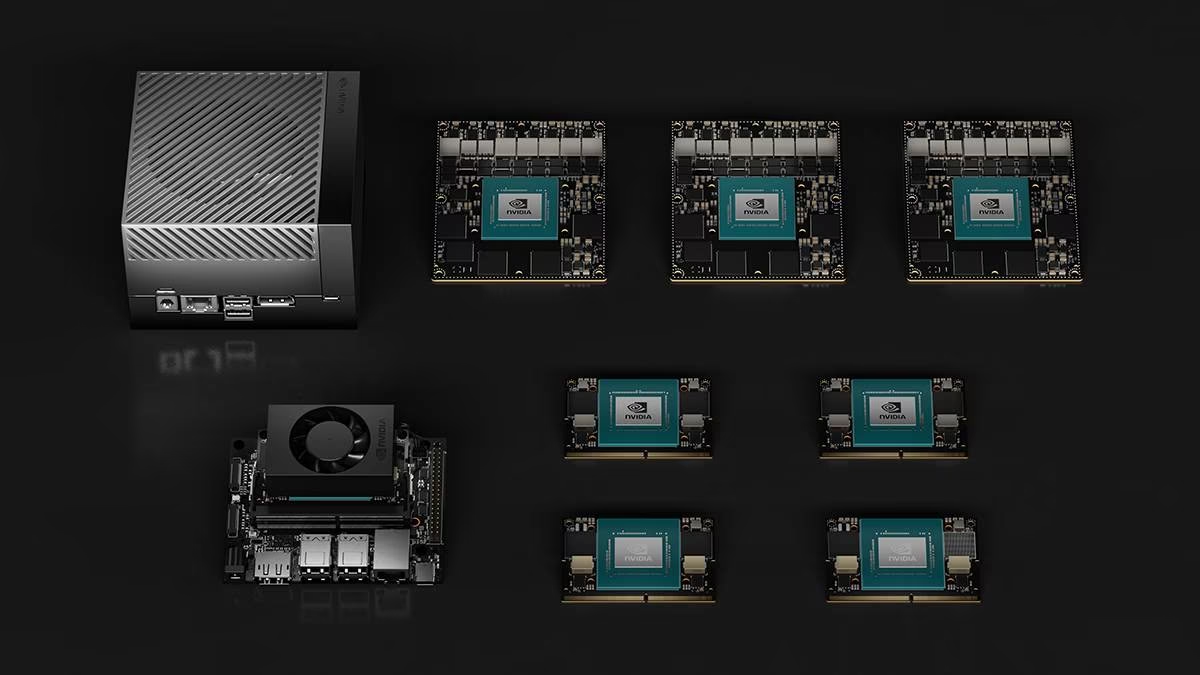
Questa guida è stata testata con NVIDIA Jetson AGX Thor Developer Kit (Jetson T5000) e NVIDIA Jetson AGX Orin Developer Kit (64GB), con l'ultima versione stabile di JetPack 7.2; con NVIDIA Jetson Orin Nano Super Developer Kit, con la versione JP6.1 di JetPack; con Seeed Studio reComputer J4012, basato su NVIDIA Jetson Orin NX 16GB e con la versione JP6.0/JP5.1.3 di JetPack; e con Seeed Studio reComputer J1020 v2, basato su NVIDIA Jetson Nano 4GB e con la versione JP4.6.1 di JetPack. È previsto che funzioni con l'intera gamma di hardware NVIDIA Jetson, compresi i dispositivi più recenti e quelli meno recenti.
Che cos'è NVIDIA Jetson?#
NVIDIA Jetson è una serie di schede di calcolo embedded progettate per portare l'elaborazione accelerata dell'intelligenza artificiale (AI) sui dispositivi edge. Questi dispositivi compatti e potenti si basano sull'architettura GPU di NVIDIA e possono eseguire direttamente sul dispositivo algoritmi complessi di intelligenza artificiale e modelli di apprendimento profondo, senza dipendere da risorse di elaborazione cloud. Le schede Jetson sono spesso utilizzate nella robotica, nei veicoli autonomi, nell'automazione industriale e in altre applicazioni in cui l'inferenza AI deve essere eseguita localmente con bassa latenza ed elevata efficienza. Inoltre, queste schede si basano sull'architettura ARM64 e consumano meno energia rispetto ai tradizionali dispositivi di calcolo GPU.
Confronto tra le serie NVIDIA Jetson#
NVIDIA Jetson AGX Thor è l'ultima versione della famiglia NVIDIA Jetson, basata sull'architettura NVIDIA Blackwell, che offre prestazioni AI nettamente superiori rispetto alle generazioni precedenti. La tabella seguente confronta alcuni dispositivi Jetson dell'ecosistema.
| Jetson AGX Thor (T5000) | Jetson AGX Orin 64GB | Jetson Orin NX 16GB | Jetson Orin Nano Super | Jetson AGX Xavier | Jetson Xavier NX | Jetson Nano | |
|---|---|---|---|---|---|---|---|
| Prestazioni AI | 2070 TFLOPS | 275 TOPS | 100 TOPS | 67 TOPS | 32 TOPS | 21 TOPS | 472 GFLOPS |
| GPU | GPU con architettura NVIDIA Blackwell a 2560 core e 96 Tensor Core | GPU con architettura NVIDIA Ampere a 2048 core e 64 Tensor Core | GPU con architettura NVIDIA Ampere a 1024 core e 32 Tensor Core | GPU con architettura NVIDIA Ampere a 1024 core e 32 Tensor Core | GPU con architettura NVIDIA Volta a 512 core e 64 Tensor Core | GPU con architettura NVIDIA Volta™ a 384 core e 48 Tensor Core | GPU con architettura NVIDIA Maxwell™ a 128 core |
| Frequenza massima della GPU | 1.57 GHz | 1.3 GHz | 918 MHz | 1020 MHz | 1377 MHz | 1100 MHz | 921MHz |
| CPU | CPU Arm® Neoverse®-V3AE a 64 bit e 14 core, 1 MB L2 + 16 MB L3 | CPU NVIDIA Arm® Cortex A78AE v8.2 a 64 bit e 12 core, 3 MB L2 + 6 MB L3 | CPU NVIDIA Arm® Cortex A78AE v8.2 a 64 bit e 8 core, 2 MB L2 + 4 MB L3 | CPU Arm® Cortex®-A78AE v8.2 a 64 bit e 6 core, 1,5 MB L2 + 4 MB L3 | CPU NVIDIA Carmel Arm®v8.2 a 64 bit e 8 core, 8 MB L2 + 4 MB L3 | CPU NVIDIA Carmel Arm®v8.2 a 64 bit e 6 core, 6 MB L2 + 4 MB L3 | Processore quad-core Arm® Cortex®-A57 MPCore |
| Frequenza massima della CPU | 2.6 GHz | 2.2 GHz | 2.0 GHz | 1.7 GHz | 2.2 GHz | 1.9 GHz | 1.43GHz |
| Memoria | 128 GB 256-bit LPDDR5X 273 GB/s | 64 GB 256-bit LPDDR5 204,8 GB/s | 16 GB 128-bit LPDDR5 102,4 GB/s | 8 GB 128-bit LPDDR5 102 GB/s | 32 GB 256-bit LPDDR4x 136,5 GB/s | 8 GB 128-bit LPDDR4x 59,7 GB/s | 4 GB 64-bit LPDDR4 25,6 GB/s |
Che cos'è NVIDIA JetPack?#
NVIDIA JetPack SDK alimenta i moduli Jetson e fornisce un ambiente di sviluppo completo per creare applicazioni AI accelerate end-to-end. JetPack include Jetson Linux con bootloader, kernel Linux, ambiente desktop Ubuntu e una suite completa di librerie per accelerare il calcolo GPU, i contenuti multimediali, la grafica e la visione artificiale. Include anche esempi, documentazione e strumenti per sviluppatori sia per il computer host sia per il kit di sviluppo, e supporta SDK di livello superiore come DeepStream per l'analisi video in streaming, Isaac per la robotica e Riva per l'AI conversazionale.
Installa JetPack su NVIDIA Jetson#
Il primo passaggio dopo aver ricevuto un dispositivo NVIDIA Jetson è installare NVIDIA JetPack sul dispositivo. Esistono diversi metodi per installare NVIDIA JetPack sui dispositivi NVIDIA Jetson.
- Per JetPack 7.2 su un Jetson AGX Thor, AGX Orin o Orin Nano Developer Kit ufficiale, scarica l'ISO unificata Jetson, scrivila su un'unità flash USB e segui la guida introduttiva specifica per AGX Thor, AGX Orin o Orin Nano. A partire da JetPack 7.2, Orin Nano non utilizza più un'immagine della scheda SD scaricabile; l'ISO su USB installa Jetson Linux sulla scheda microSD o sull'SSD NVMe del dispositivo.
- Se vuoi utilizzare JetPack 6 su un Jetson Orin Nano Developer Kit, segui le istruzioni di NVIDIA per l'aggiornamento a JetPack 6.x e l'uso della scheda SD.
- Se possiedi un altro Development Kit NVIDIA, puoi installare JetPack sul dispositivo con SDK Manager.
- Se possiedi un dispositivo Seeed Studio reComputer J4012, puoi installare JetPack sull'SSD incluso; se invece possiedi un dispositivo Seeed Studio reComputer J1020 v2, puoi installare JetPack sull'eMMC/ SSD.
- Se possiedi un altro dispositivo di terze parti basato sul modulo NVIDIA Jetson, ti consigliamo di seguire la procedura di installazione tramite riga di comando.
Per i metodi 1, 4 e 5 riportati sopra, dopo aver eseguito il flashing del sistema e avviato il dispositivo, esegui sudo apt update && sudo apt install nvidia-jetpack -y nel terminale del dispositivo per installare tutti i componenti JetPack rimanenti necessari.
Supporto di JetPack in base al dispositivo Jetson#
La tabella seguente mostra le versioni di NVIDIA JetPack supportate dai diversi dispositivi NVIDIA Jetson.
| JetPack 4 | JetPack 5 | JetPack 6 | JetPack 7 | |
|---|---|---|---|---|
| Jetson Nano | ✅ | ❌ | ❌ | ❌ |
| Jetson TX2 | ✅ | ❌ | ❌ | ❌ |
| Jetson Xavier NX | ✅ | ✅ | ❌ | ❌ |
| Jetson AGX Xavier | ✅ | ✅ | ❌ | ❌ |
| Jetson AGX Orin | ❌ | ✅ | ✅ | ✅ |
| Jetson Orin NX | ❌ | ✅ | ✅ | ✅ |
| Jetson Orin Nano | ❌ | ✅ | ✅ | ✅ |
| Jetson AGX Thor | ❌ | ❌ | ❌ | ✅ |
Guida introduttiva a Docker#
Il modo più rapido per iniziare a usare Ultralytics YOLO26 su NVIDIA Jetson è eseguire le immagini Docker precompilate per Jetson. Consulta la tabella sopra e scegli la versione di JetPack in base al dispositivo Jetson che possiedi.
t=ultralytics/ultralytics:latest-jetson-jetpack4
sudo docker pull $t && sudo docker run -it --ipc=host --runtime=nvidia $tL'immagine latest-nvidia-arm64 usa NVIDIA PyTorch 26.10, che include CUDA 13.4 e TensorRT 11.4. NVIDIA indica JetPack 7.1 per PyTorch nella propria tabella di compatibilità, ma TensorRT 11 non supporta JetPack, Thor incluso. Usa questa immagine solo per carichi di lavoro PyTorch su un host supportato. Per le esportazioni TensorRT su Jetson, usa l'installazione nativa riportata di seguito con il runtime TensorRT 10.x supportato dalla tua versione di JetPack. JetPack 7.2 su Thor o Orin richiede una convalida separata del container. Ricrea i motori per la GPU di destinazione e la versione di TensorRT.
Per le immagini JetPack 4, 5 e 6, continua con Usa TensorRT su NVIDIA Jetson. L'immagine JetPack 7.1 qui sopra è solo per i carichi di lavoro PyTorch.
Inizia con l'installazione nativa#
Per un'installazione nativa senza Docker, segui i passaggi riportati di seguito.
Esegui su JetPack 7.2#
Installa il pacchetto Ultralytics#
Installa il pacchetto Ultralytics su Jetson. Le dipendenze per l'esportazione vengono installate automaticamente la prima volta che esporti un modello, quindi qui basta il pacchetto di base. Questa guida si concentra sulle esportazioni NVIDIA TensorRT, perché TensorRT offre le migliori prestazioni sui dispositivi Jetson.
-
Aggiorna l'elenco dei pacchetti, installa pip e aggiorna pip all'ultima versione
sudo apt update sudo apt install python3-pip -y pip install -U pip -
Installa il pacchetto pip
ultralyticspip install ultralytics -
Riavvia il dispositivo
sudo reboot
Installa PyTorch e Torchvision#
L'installazione di ultralytics descritta sopra installerà Torch e Torchvision. Tuttavia, questi due pacchetti installati tramite pip non sono compatibili con i dispositivi JetPack 7.2 che eseguono CUDA 13, quindi devono essere installati manualmente.
Installa torch e torchvision in base a JP7.2
pip install torch torchvision --index-url https://download.pytorch.org/whl/cu130Installa onnxruntime-gpu#
Usa un wheel GPU di ONNX Runtime compatibile con le versioni di JetPack, Python e CUDA. Le versioni attuali di PyPI includono wheel ARM64, ma non sostituiscono i pacchetti specifici del dispositivo per ogni versione di JetPack.
Scarica e installa onnxruntime-gpu 1.24.0 con il supporto Python3.12.
pip install https://github.com/ultralytics/assets/releases/download/v0.0.0/onnxruntime_gpu-1.24.0-cp312-cp312-linux_aarch64.whlEsegui su JetPack 6.1#
Installa il pacchetto Ultralytics#
Installa il pacchetto Ultralytics su Jetson. Le dipendenze per l'esportazione vengono installate automaticamente la prima volta che esporti un modello, quindi qui basta il pacchetto di base. Questa guida si concentra sulle esportazioni NVIDIA TensorRT, perché TensorRT offre le migliori prestazioni sui dispositivi Jetson.
-
Aggiorna l'elenco dei pacchetti, installa pip e aggiorna pip all'ultima versione
sudo apt update sudo apt install python3-pip -y pip install -U pip -
Installa il pacchetto pip
ultralyticspip install ultralytics -
Riavvia il dispositivo
sudo reboot
Installa PyTorch e Torchvision#
L'installazione di ultralytics descritta sopra installerà Torch e Torchvision. Tuttavia, questi due pacchetti installati tramite pip non sono compatibili con la piattaforma Jetson, basata sull'architettura ARM64, quindi devi installare manualmente un wheel PyTorch precompilato per pip e compilare o installare Torchvision dai sorgenti.
Installa torch 2.10.0 e torchvision 0.25.0 in base a JP6.1
pip install https://github.com/ultralytics/assets/releases/download/v0.0.0/torch-2.10.0-cp310-cp310-linux_aarch64.whl
pip install https://github.com/ultralytics/assets/releases/download/v0.0.0/torchvision-0.25.0-cp310-cp310-linux_aarch64.whlVisita la pagina PyTorch per Jetson per accedere a tutte le diverse versioni di PyTorch per le diverse versioni di JetPack. Per un elenco più dettagliato della compatibilità tra PyTorch e Torchvision, visita la pagina sulla compatibilità di PyTorch e Torchvision.
Installa cuDSS per risolvere un problema di dipendenza con torch 2.10.0
wget https://developer.download.nvidia.com/compute/cudss/0.7.1/local_installers/cudss-local-tegra-repo-ubuntu2204-0.7.1_0.7.1-1_arm64.deb
sudo dpkg -i cudss-local-tegra-repo-ubuntu2204-0.7.1_0.7.1-1_arm64.deb
sudo cp /var/cudss-local-tegra-repo-ubuntu2204-0.7.1/cudss-*-keyring.gpg /usr/share/keyrings/
sudo apt-get update
sudo apt-get -y install cudss
Installa onnxruntime-gpu#
Usa un wheel GPU di ONNX Runtime compatibile con le versioni di JetPack, Python e CUDA. Le versioni attuali di PyPI includono wheel ARM64, ma non sostituiscono i pacchetti specifici del dispositivo per ogni versione di JetPack.
Puoi trovare tutti i pacchetti onnxruntime-gpu disponibili, organizzati per versione di JetPack, versione di Python e altri dettagli di compatibilità, nella matrice di compatibilità di Jetson Zoo ONNX Runtime.
Per JetPack 6 con supporto Python 3.10, puoi installare onnxruntime-gpu 1.23.0:
pip install https://github.com/ultralytics/assets/releases/download/v0.0.0/onnxruntime_gpu-1.23.0-cp310-cp310-linux_aarch64.whlIn alternativa, per onnxruntime-gpu 1.20.0:
pip install https://github.com/ultralytics/assets/releases/download/v0.0.0/onnxruntime_gpu-1.20.0-cp310-cp310-linux_aarch64.whlEsegui su JetPack 5.1.2#
Installa il pacchetto Ultralytics#
Installa il pacchetto Ultralytics su Jetson. Le dipendenze per l'esportazione vengono installate automaticamente la prima volta che esporti un modello, quindi qui basta il pacchetto di base. Questa guida si concentra sulle esportazioni NVIDIA TensorRT, perché TensorRT offre le migliori prestazioni sui dispositivi Jetson.
-
Aggiorna l'elenco dei pacchetti, installa pip e aggiorna pip all'ultima versione
sudo apt update sudo apt install python3-pip -y pip install -U pip -
Installa il pacchetto pip
ultralyticspip install ultralytics -
Riavvia il dispositivo
sudo reboot
Installa PyTorch e Torchvision#
L'installazione di ultralytics descritta sopra installerà Torch e Torchvision. Tuttavia, questi due pacchetti installati tramite pip non sono compatibili con la piattaforma Jetson, basata sull'architettura ARM64, quindi devi installare manualmente un wheel PyTorch precompilato per pip e compilare o installare Torchvision dai sorgenti.
-
Disinstalla PyTorch e Torchvision attualmente installati
pip uninstall torch torchvision -
Installa
torch 2.1.0etorchvision 0.16.2in base a JP5.1.2pip install https://github.com/ultralytics/assets/releases/download/v0.0.0/torch-2.1.0a0+41361538.nv23.06-cp38-cp38-linux_aarch64.whl pip install https://github.com/ultralytics/assets/releases/download/v0.0.0/torchvision-0.16.2+c6f3977-cp38-cp38-linux_aarch64.whl
Visita la pagina PyTorch per Jetson per accedere a tutte le diverse versioni di PyTorch per le diverse versioni di JetPack. Per un elenco più dettagliato della compatibilità tra PyTorch e Torchvision, visita la pagina sulla compatibilità di PyTorch e Torchvision.
Installa onnxruntime-gpu#
Usa un wheel GPU di ONNX Runtime compatibile con le versioni di JetPack, Python e CUDA. Le versioni attuali di PyPI includono wheel ARM64, ma non sostituiscono i pacchetti specifici del dispositivo per ogni versione di JetPack.
Puoi trovare tutti i pacchetti onnxruntime-gpu disponibili, organizzati per versione di JetPack, versione di Python e altri dettagli di compatibilità, nella matrice di compatibilità di Jetson Zoo ONNX Runtime. Scarica e installa onnxruntime-gpu 1.17.0 con il supporto Python3.8.
wget https://nvidia.box.com/shared/static/zostg6agm00fb6t5uisw51qi6kpcuwzd.whl -O onnxruntime_gpu-1.17.0-cp38-cp38-linux_aarch64.whl
pip install onnxruntime_gpu-1.17.0-cp38-cp38-linux_aarch64.whlonnxruntime-gpu aggiorna automaticamente NumPy all'ultima versione; reinstalla quindi NumPy 1.23.5 per risolvere il problema risultante:
pip install numpy==1.23.5
Usa TensorRT su NVIDIA Jetson#
Tra tutti i formati di esportazione dei modelli supportati da Ultralytics, TensorRT offre le prestazioni di inferenza più elevate sui dispositivi NVIDIA Jetson, perciò è la nostra scelta consigliata per le distribuzioni su Jetson. Prima di esportare, installa i binding Python di TensorRT forniti per la tua versione di JetPack e verificali con python3 -c "import tensorrt; print(tensorrt.__version__)". Mantieni il runtime TensorRT 10.x supportato su JetPack 6/7; non sostituirlo con TensorRT 11. Per istruzioni di configurazione e uso avanzato, consulta la nostra guida dedicata all'integrazione di TensorRT.
Puoi anche esportare dal browser senza configurare localmente l'ambiente di compilazione. Nella scheda Esportazione del modello della Ultralytics Platform, seleziona TensorRT e il Jetson di destinazione. Le selezioni Thor vengono convalidate su hardware Thor fisico. Le sei selezioni Orin producono attualmente motori candidati compilati per AGX-Orin; convalidali sul modello Orin previsto prima della distribuzione.
TensorRT crea e ottimizza un engine sulla GPU usata per la compilazione. Usa la stessa architettura GPU e lo stesso runtime TensorRT/CUDA del dispositivo di destinazione, quindi convalida ogni engine scaricato sul dispositivo di distribuzione. Le varianti Orin con la stessa architettura non garantiscono automaticamente la portabilità, e la calibrazione INT8 dovrebbe essere eseguita sul dispositivo di destinazione per ottenere i migliori risultati.
Converti il modello in TensorRT ed esegui l'inferenza#
Il modello YOLO26n in formato PyTorch viene convertito in TensorRT per eseguire l'inferenza con il modello esportato.
from ultralytics import YOLO

# Carica un modello YOLO26n PyTorch
model = YOLO("yolo26n.pt")

# Esporta il modello in TensorRT
model.export(format="engine")  # crea 'yolo26n.engine'

# Carica il modello TensorRT esportato
trt_model = YOLO("yolo26n.engine")

# Esegui l'inferenza
results = trt_model("https://ultralytics.com/images/bus.jpg")
Usa NVIDIA Deep Learning Accelerator (DLA)#
NVIDIA Deep Learning Accelerator (DLA) è un componente hardware specializzato integrato nei dispositivi NVIDIA Jetson, che ottimizza l'inferenza di deep learning per l'efficienza energetica e le prestazioni. Scaricando le attività dalla GPU (e lasciandola libera per i processi più intensivi), DLA consente ai modelli di funzionare con un consumo energetico inferiore mantenendo un throughput elevato, una caratteristica ideale per i sistemi embedded e le applicazioni di IA in tempo reale.
NVIDIA indica TensorRT 10.7 come l'ultima versione con supporto DLA; TensorRT 11.x non supporta DLA. Usa una versione di TensorRT con supporto DLA compatibile con la tua versione di JetPack. TensorRT 11 non supporta JetPack, nemmeno per le esportazioni che usano solo la GPU.
I seguenti dispositivi Jetson sono dotati di hardware DLA:
| Dispositivo Jetson | Core DLA | Frequenza massima DLA |
|---|---|---|
| Serie Jetson AGX Orin | 2 | 1.6 GHz |
| Jetson Orin NX 16GB | 2 | 614 MHz |
| Jetson Orin NX 8GB | 1 | 614 MHz |
| Serie Jetson AGX Xavier | 2 | 1.4 GHz |
| Serie Jetson Xavier NX | 2 | 1.1 GHz |
from ultralytics import YOLO

# Carica un modello YOLO26n PyTorch
model = YOLO("yolo26n.pt")

# Esporta il modello in TensorRT con DLA abilitato (funziona solo con FP16 o INT8)
model.export(format="engine", device="dla:0", quantize=16)  # dla:0 o dla:1 corrisponde ai core DLA

# Carica il modello TensorRT esportato
trt_model = YOLO("yolo26n.engine")

# Esegui l'inferenza
results = trt_model("https://ultralytics.com/images/bus.jpg")Quando usi le esportazioni DLA, alcuni layer potrebbero non essere supportati da DLA e verranno eseguiti dalla GPU. Questo fallback può introdurre latenza aggiuntiva e influire sulle prestazioni complessive dell'inferenza. Pertanto, rispetto a TensorRT eseguito interamente sulla GPU, DLA non è progettato principalmente per ridurre la latenza dell'inferenza. Il suo scopo principale è invece aumentare il throughput e migliorare l'efficienza energetica.
Benchmark NVIDIA Jetson YOLO26#
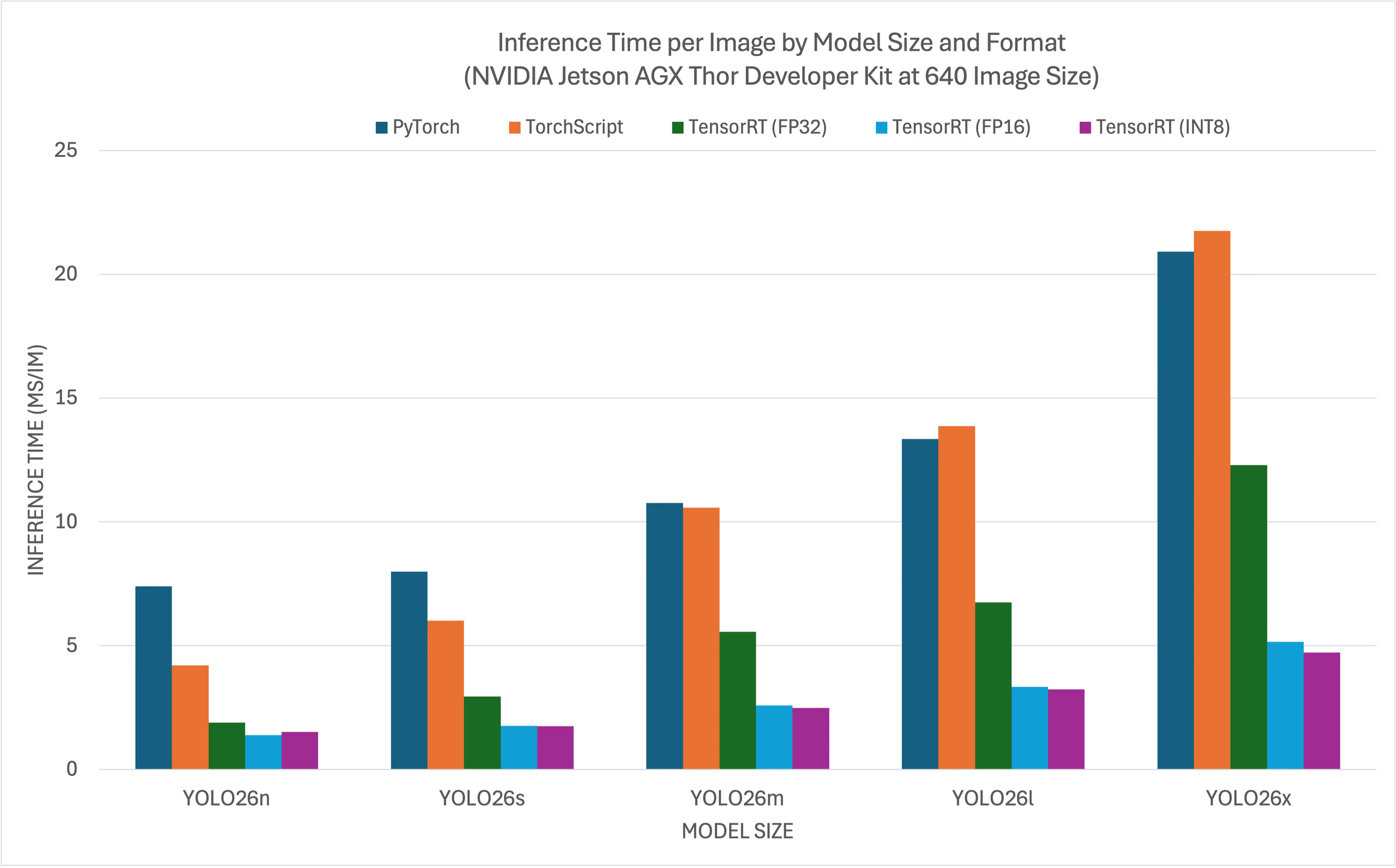
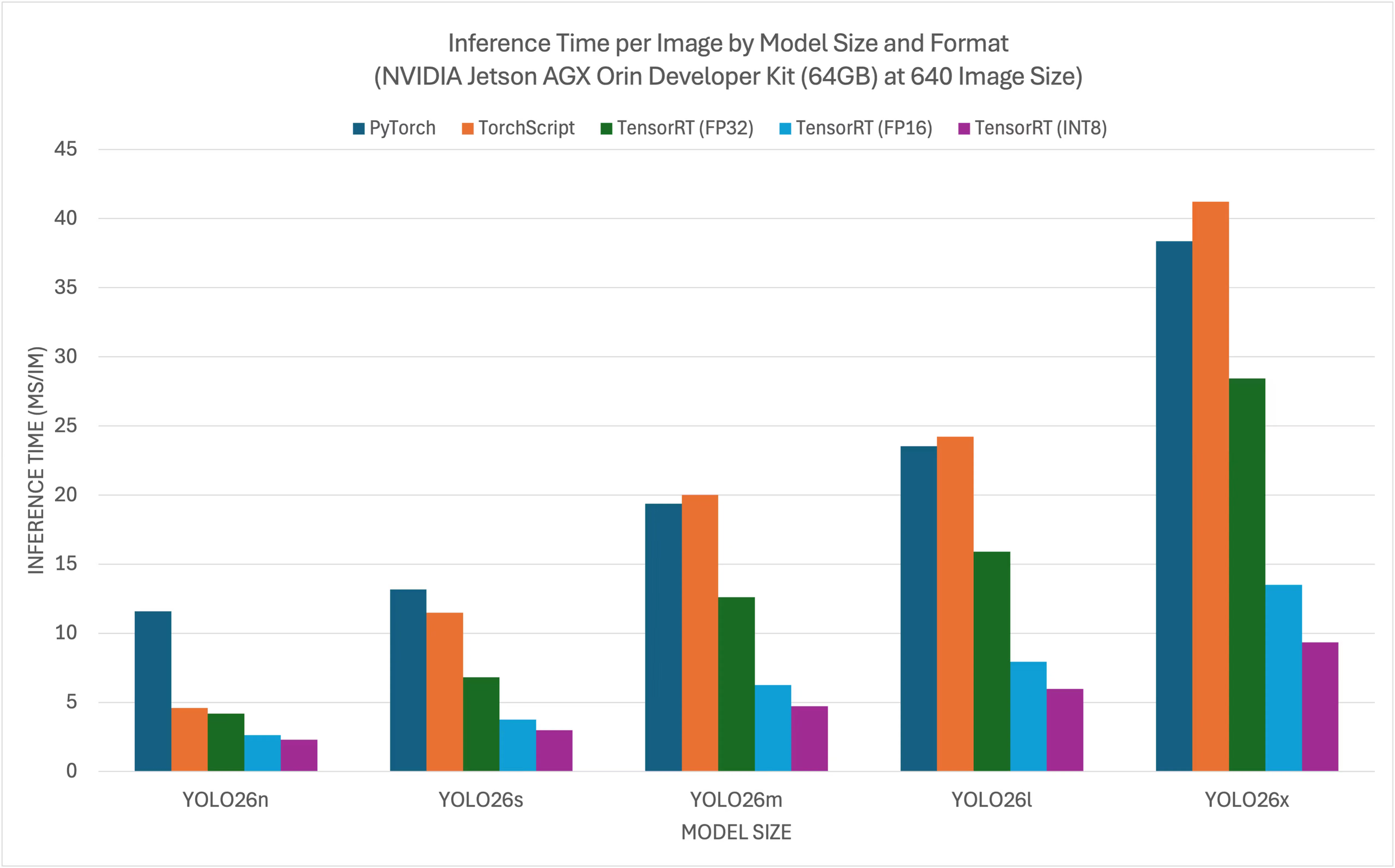
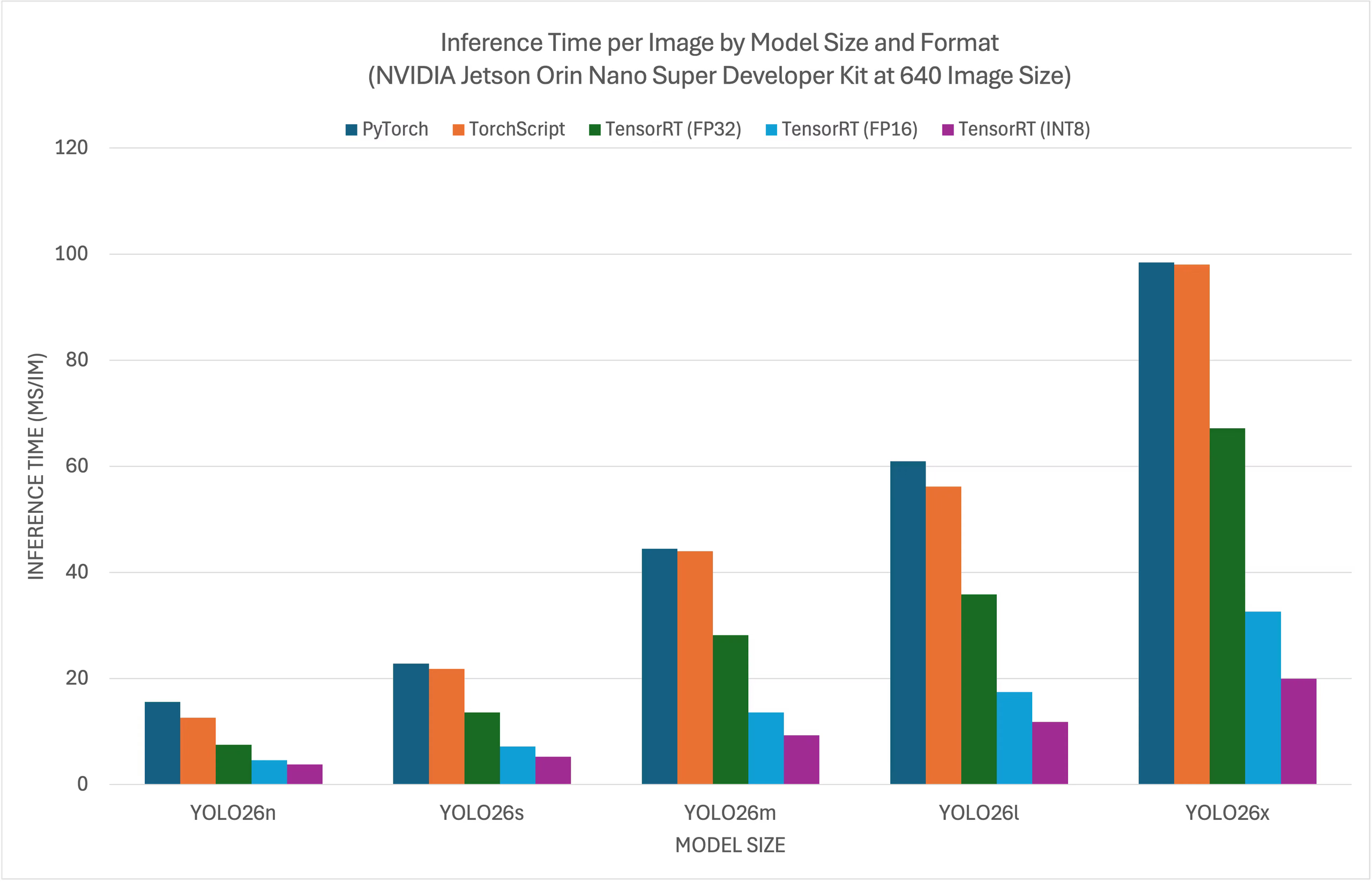
Il team Ultralytics ha eseguito benchmark di YOLO26 su 11 formati di modello diversi, misurando velocità e precisione: PyTorch, TorchScript, ONNX, OpenVINO, TensorRT, TF SavedModel, TF GraphDef, TF Lite, MNN, NCNN, ExecuTorch. I benchmark sono stati eseguiti su NVIDIA Jetson AGX Thor Developer Kit, NVIDIA Jetson AGX Orin Developer Kit (64GB), NVIDIA Jetson Orin Nano Super Developer Kit e Seeed Studio reComputer J4012 con Jetson Orin NX 16GB, a precisione FP32 e con la dimensione predefinita dell'immagine di input pari a 640.
Grafici comparativi#
Anche se tutte le esportazioni dei modelli funzionano su NVIDIA Jetson, il grafico comparativo qui sotto include solo PyTorch, TorchScript e TensorRT. Puoi trovare i benchmark di tutte le esportazioni nella sezione successiva al grafico.
Kit per sviluppatori NVIDIA Jetson AGX Thor#
Kit per sviluppatori NVIDIA Jetson AGX Orin (64GB)#
Kit per sviluppatori NVIDIA Jetson Orin Nano Super#
NVIDIA Jetson Orin NX 16GB#
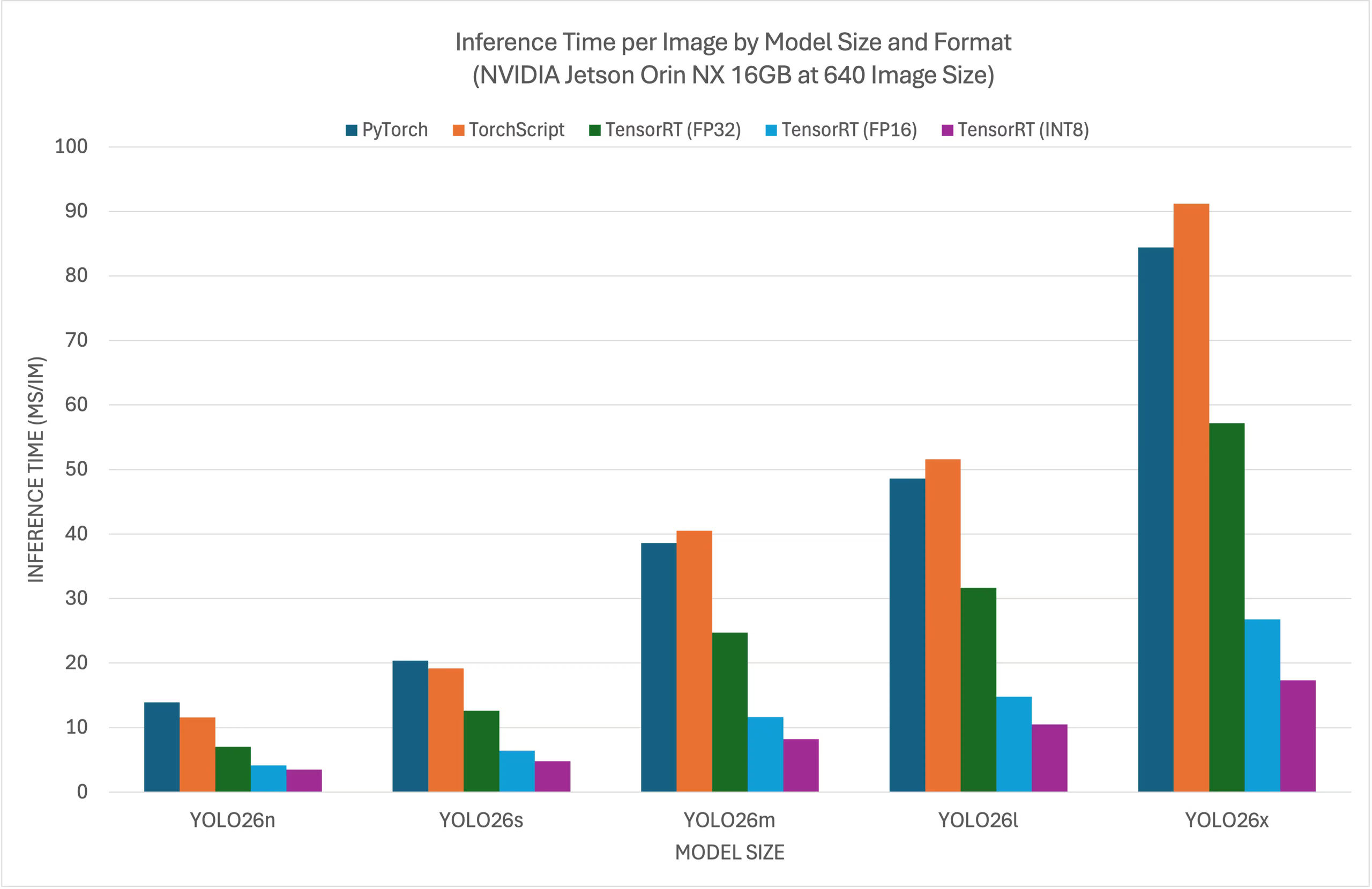
Tabelle di confronto dettagliate#
La tabella seguente mostra i risultati dei benchmark per cinque diversi modelli YOLO26 (YOLO26n, YOLO26s, YOLO26m, YOLO26l, YOLO26x) in 11 formati diversi (PyTorch, TorchScript, ONNX, OpenVINO, TensorRT, TF SavedModel, TF GraphDef, TF Lite, MNN, NCNN, ExecuTorch), indicando lo stato, le dimensioni, la metrica mAP50-95(B) e il tempo di inferenza per ogni combinazione.
Kit per sviluppatori NVIDIA Jetson AGX Thor#
| Formato | Stato | Dimensioni su disco (MB) | mAP50-95(B) | Tempo di inferenza (ms/im) |
|---|---|---|---|---|
| PyTorch | ✅ | 5.3 | 0.4798 | 7.39 |
| TorchScript | ✅ | 9.8 | 0.4789 | 4.21 |
| ONNX | ✅ | 9.5 | 0.4767 | 6.58 |
| OpenVINO | ✅ | 10.1 | 0.4794 | 17.50 |
| TensorRT (FP32) | ✅ | 13.9 | 0.4791 | 1.90 |
| TensorRT (FP16) | ✅ | 7.6 | 0.4797 | 1.39 |
| TensorRT (INT8) | ✅ | 6.5 | 0.4273 | 1.52 |
| TF SavedModel | ✅ | 25.7 | 0.4764 | 47.24 |
| TF GraphDef | ✅ | 9.5 | 0.4764 | 45.98 |
| TF Lite | ✅ | 9.9 | 0.4764 | 182.04 |
| MNN | ✅ | 9.4 | 0.4784 | 21.83 |
Benchmark eseguito con Ultralytics 8.4.7
Il tempo di inferenza non include la pre/post-elaborazione.
Kit per sviluppatori NVIDIA Jetson AGX Orin (64GB)#
| Formato | Stato | Dimensioni su disco (MB) | mAP50-95(B) | Tempo di inferenza (ms/im) |
|---|---|---|---|---|
| PyTorch | ✅ | 5.3 | 0.4790 | 11.58 |
| TorchScript | ✅ | 9.8 | 0.4770 | 4.60 |
| ONNX | ✅ | 9.5 | 0.4770 | 9.87 |
| OpenVINO | ✅ | 9.6 | 0.4820 | 28.80 |
| TensorRT (FP32) | ✅ | 11.5 | 0.4770 | 4.18 |
| TensorRT (FP16) | ✅ | 7.9 | 0.4789 | 2.62 |
| TensorRT (INT8) | ✅ | 5.4 | 0.4640 | 2.30 |
| TF SavedModel | ✅ | 24.6 | 0.4760 | 71.10 |
| TF GraphDef | ✅ | 9.5 | 0.4760 | 70.02 |
| TF Lite | ✅ | 9.9 | 0.4760 | 227.94 |
| MNN | ✅ | 9.4 | 0.4760 | 32.46 |
| NCNN | ✅ | 9.3 | 0.4810 | 29.93 |
Benchmark eseguito con Ultralytics 8.4.32
Il tempo di inferenza non include la pre/post-elaborazione.
Kit per sviluppatori NVIDIA Jetson Orin Nano Super#
| Formato | Stato | Dimensioni su disco (MB) | mAP50-95(B) | Tempo di inferenza (ms/im) |
|---|---|---|---|---|
| PyTorch | ✅ | 5.3 | 0.4790 | 15.60 |
| TorchScript | ✅ | 9.8 | 0.4770 | 12.60 |
| ONNX | ✅ | 9.5 | 0.4760 | 15.76 |
| OpenVINO | ✅ | 9.6 | 0.4820 | 56.23 |
| TensorRT (FP32) | ✅ | 11.3 | 0.4770 | 7.53 |
| TensorRT (FP16) | ✅ | 8.1 | 0.4800 | 4.57 |
| TensorRT (INT8) | ✅ | 5.3 | 0.4490 | 3.80 |
| TF SavedModel | ✅ | 24.6 | 0.4760 | 118.33 |
| TF GraphDef | ✅ | 9.5 | 0.4760 | 116.30 |
| TF Lite | ✅ | 9.9 | 0.4760 | 286.00 |
| MNN | ✅ | 9.4 | 0.4760 | 68.77 |
| NCNN | ✅ | 9.3 | 0.4810 | 47.50 |
Benchmark eseguito con Ultralytics 8.4.33
Il tempo di inferenza non include la pre/post-elaborazione.
NVIDIA Jetson Orin NX 16GB#
| Formato | Stato | Dimensioni su disco (MB) | mAP50-95(B) | Tempo di inferenza (ms/im) |
|---|---|---|---|---|
| PyTorch | ✅ | 5.3 | 0.4799 | 13.90 |
| TorchScript | ✅ | 9.8 | 0.4787 | 11.60 |
| ONNX | ✅ | 9.5 | 0.4763 | 14.18 |
| OpenVINO | ✅ | 9.6 | 0.4819 | 40.19 |
| TensorRT (FP32) | ✅ | 11.4 | 0.4770 | 7.01 |
| TensorRT (FP16) | ✅ | 8.0 | 0.4789 | 4.13 |
| TensorRT (INT8) | ✅ | 5.5 | 0.4489 | 3.49 |
| TF SavedModel | ✅ | 24.6 | 0.4764 | 92.34 |
| TF GraphDef | ✅ | 9.5 | 0.4764 | 92.06 |
| TF Lite | ✅ | 9.9 | 0.4764 | 254.43 |
| MNN | ✅ | 9.4 | 0.4760 | 48.55 |
| NCNN | ✅ | 9.3 | 0.4805 | 34.31 |
Benchmark eseguito con Ultralytics 8.4.33
Il tempo di inferenza non include la pre/post-elaborazione.
Scopri altri benchmark condotti da Seeed Studio su diverse versioni dell'hardware NVIDIA Jetson.
Riproduci i nostri risultati#
Per riprodurre i benchmark Ultralytics qui sopra con tutti i formati di esportazione, esegui questo codice:
from ultralytics import YOLO

# Carica un modello YOLO26n PyTorch
model = YOLO("yolo26n.pt")

# Esegui il benchmark di velocità e accuratezza di YOLO26n sul dataset COCO128 per tutti i formati di esportazione
results = model.benchmark(data="coco128.yaml", imgsz=640)
I risultati dei benchmark possono variare in base alla configurazione hardware e software esatta del sistema e al carico di lavoro del sistema al momento dell'esecuzione dei benchmark. Per ottenere risultati più affidabili, usa un dataset con un numero elevato di immagini, ad es. data='coco.yaml' (5000 immagini di convalida).
Best practice per l'utilizzo di NVIDIA Jetson#
Segui queste best practice per ottenere le massime prestazioni da YOLO26 su NVIDIA Jetson.
-
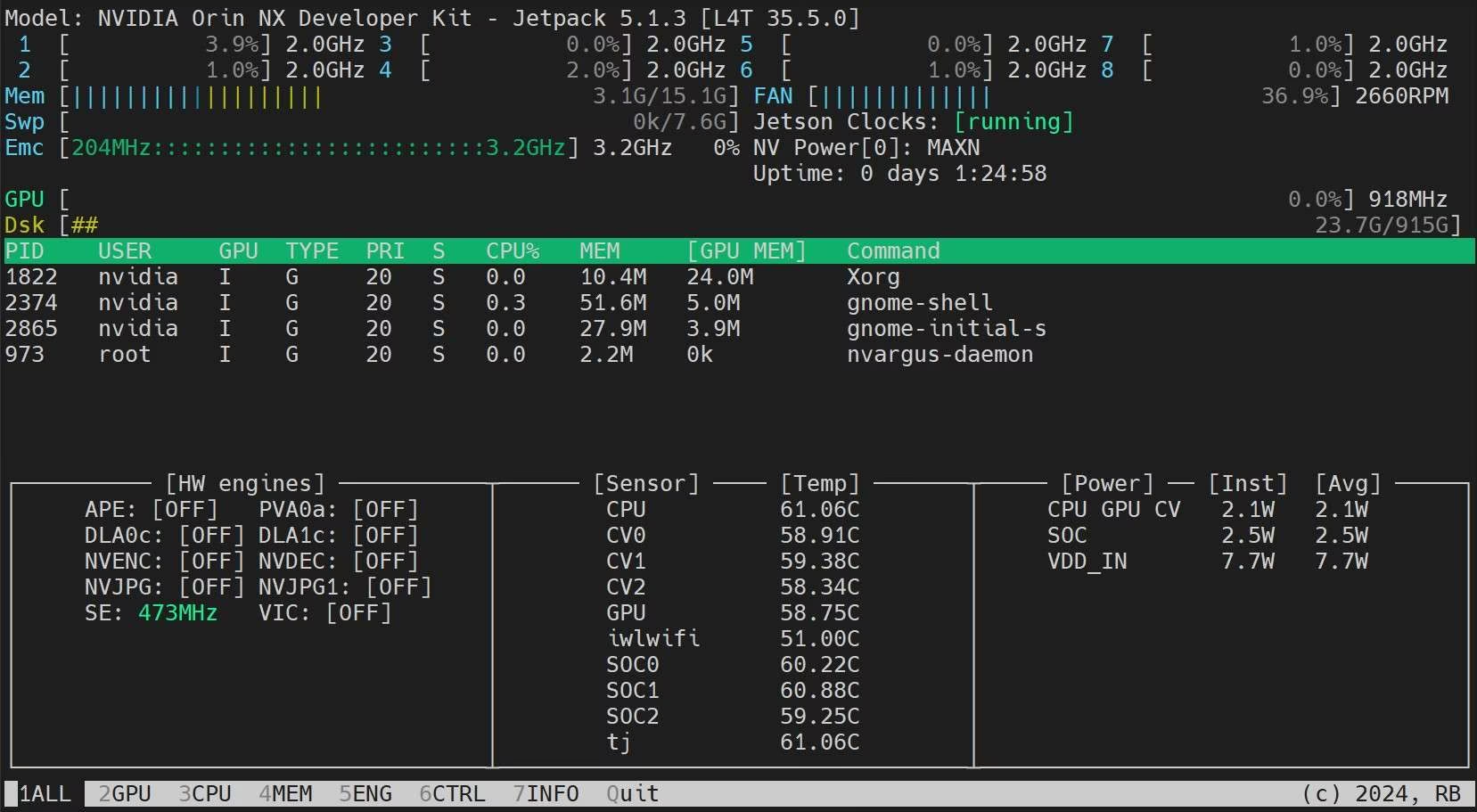
Attiva la modalità di alimentazione MAX
L'attivazione della modalità MAX Power su Jetson garantisce che tutti i core CPU e GPU siano attivi.
sudo nvpmodel -m 0 -
Attiva Jetson Clocks
L'attivazione di Jetson Clocks garantisce che tutti i core CPU e GPU funzionino alla frequenza massima.
sudo jetson_clocks -
Installa l'applicazione Jetson Stats
Usa l'applicazione jetson-stats per monitorare le temperature dei componenti del sistema, visualizzare l'utilizzo di CPU, GPU e RAM, cambiare le modalità di alimentazione, impostare le frequenze massime e controllare le informazioni su JetPack.
sudo apt update
sudo pip install jetson-stats
sudo reboot
jtop
Suggerimenti per ottimizzare la memoria su NVIDIA Jetson#
La memoria disponibile è spesso il fattore limitante sui dispositivi Jetson, in particolare sulle varianti con meno memoria, come Jetson Orin Nano (8 GB) o Orin NX 8 GB. I suggerimenti seguenti sono modifiche pratiche e a basso rischio che, nel loro insieme, possono liberare diverse centinaia di megabyte e consentirti di eseguire modelli YOLO più grandi o supportare ulteriori carichi di lavoro paralleli. Per una trattazione completa, consulta il blog NVIDIA sull'ottimizzazione dell'efficienza della memoria su Jetson.
1. Passa all'avvio headless (senza interfaccia grafica)#
Se il tuo Jetson è collegato tramite SSH o viene usato come dispositivo di produzione senza display, eliminare l'ambiente desktop e il server grafico può liberare fino a 865 MB di RAM:
sudo systemctl set-default multi-user.target
sudo reboot
Per ripristinare in seguito l'ambiente desktop:
sudo systemctl set-default graphical.target
sudo reboot
2. Disattiva i servizi di sistema inutilizzati#
I servizi in background non essenziali (Bluetooth, gestori della connettività, demoni hardware inutilizzati) consumano complessivamente circa 32 MB. Elenca i servizi attivi e disattiva quelli non necessari per la tua distribuzione:
# List running services
systemctl list-units --type=service --state=running

# Disable a service
sudo systemctl disable SERVICE_NAME
3. Analizza l'utilizzo della memoria#
Prima di ottimizzare, individua i processi che consumano effettivamente RAM. procrank ordina i processi in base a PSS (dimensione proporzionale del set), che riflette l'impronta di memoria effettiva per processo con maggiore precisione rispetto a RSS (dimensione del set residente, ovvero il totale delle pagine di RAM fisica mappate da un processo, incluse quelle condivise con altri processi):
git clone https://github.com/csimmonds/procrank_linux.git
cd procrank_linux && make
sudo ./procrank
Per visualizzare le allocazioni GPU e NvMap (pipeline CUDA/video) per processo:
sudo cat /sys/kernel/debug/nvmap/iovmm/clients4. Esegui l'inferenza senza display in produzione#
Per le pipeline di inferenza che non richiedono un'anteprima in tempo reale, disattivare i componenti relativi al display (Tiler, OSD, DisplaySink) può far risparmiare oltre 200 MB solo dalla pipeline. Con Ultralytics YOLO, disattiva il visualizzatore e salva invece i risultati su disco:
from ultralytics import YOLO

model = YOLO("yolo26n.engine")

# show=False impedisce l'apertura di qualsiasi finestra di visualizzazione; save=True scrive su disco i risultati annotati
results = model.predict(source="video.mp4", show=False, save=True)
Impatto complessivo#
| Ottimizzazione | Memoria risparmiata (circa) |
|---|---|
| Disattiva l'interfaccia grafica desktop | ~865 MB |
| Disattiva i servizi del sistema operativo inutilizzati | ~32 MB |
| Pipeline di inferenza headless (senza display) | ~200+ MB |
| Totale (interventi semplici) | ~1 GB+ |
Combinare queste modifiche è particolarmente utile quando si usano modelli TensorRT INT8 su dispositivi con memoria limitata: può fare la differenza tra riuscire o meno a caricare in memoria una variante di modello più grande.
Prossimi passaggi#
Per approfondire e ricevere supporto, consulta la documentazione Ultralytics YOLO26.
Domande frequenti#
Per distribuire Ultralytics YOLO26 sui dispositivi NVIDIA Jetson, esegui prima il flashing del dispositivo Jetson con NVIDIA JetPack SDK. Poi, usa un'immagine Docker precompilata per una configurazione rapida oppure installa manualmente i pacchetti richiesti.
I modelli YOLO26 sono stati sottoposti a benchmark sui dispositivi NVIDIA Jetson AGX Thor, AGX Orin, Orin Nano Super e Orin NX; il formato TensorRT offre le migliori prestazioni di inferenza. La sezione Tabelle comparative dettagliate elenca mAP50-95 e il tempo di inferenza per ogni modello e formato di esportazione.
TensorRT è consigliato per distribuire i modelli YOLO26 su NVIDIA Jetson perché offre l'inferenza più rapida tra tutti i formati di esportazione, ottimizzando il modello per la GPU Jetson.
Per installare PyTorch e Torchvision su NVIDIA Jetson, disinstalla prima le eventuali versioni esistenti installate tramite pip. Poi installa manualmente le versioni compatibili di PyTorch e Torchvision per l'architettura ARM64 di Jetson. Trovi le istruzioni dettagliate per questa procedura nella sezione Installa PyTorch e Torchvision.
Per massimizzare le prestazioni di YOLO26 su NVIDIA Jetson, segui queste best practice:
- Attiva la modalità di alimentazione MAX per usare tutti i core CPU e GPU.
- Attiva Jetson Clocks per eseguire tutti i core alla frequenza massima.
- Installa l'applicazione Jetson Stats per monitorare le metriche del sistema.
Per i comandi e ulteriori dettagli, consulta la sezione Best practice per l'utilizzo di NVIDIA Jetson.
La RAM disponibile è spesso il collo di bottiglia sui dispositivi Jetson con meno memoria. Ecco tre semplici interventi che, insieme, possono liberare oltre 1 GB:
- Passa all'avvio headless (
sudo systemctl set-default multi-user.target) per eliminare l'interfaccia grafica desktop (~865 MB liberati). - Disattiva i servizi inutilizzati, come Bluetooth o i gestori della connettività (~32 MB liberati).
- Esegui l'inferenza senza display impostando
show=Falsenella chiamata YOLOpredict, evitando così di allocare memoria per la pipeline del display (~200+ MB liberati).
Usa
procrankper analizzare l'utilizzo della RAM per processo esudo cat /sys/kernel/debug/nvmap/iovmm/clientsper esaminare le allocazioni GPU. Consulta la sezione Suggerimenti per ottimizzare la memoria per tutti i dettagli.- Passa all'avvio headless (
TensorRT 10.3.0 incluso in JetPack 6 presenta un problema noto che impedisce di compilare motori INT8 con output senza NMS (
nms=False) o con NMS integrata (nms=True). Quando Ultralytics rileva questa combinazione, seleziona la testa one-to-many per le esportazioni senza NMS e interrompe le esportazioninms=Truecon un errore.Per ripristinare queste esportazioni INT8, aggiorna TensorRT a una versione più recente (ad es. 10.7.0 o successiva):
wget https://developer.download.nvidia.com/compute/cuda/repos/ubuntu2204/arm64/cuda-keyring_1.1-1_all.deb
sudo dpkg -i cuda-keyring_1.1-1_all.deb
sudo apt-get update
sudo apt-get install -y tensorrt
Dopo l'aggiornamento, esegui di nuovo l'esportazione. Per maggiori dettagli, consulta il problema GitHub #23841 e il problema #26655.


Commenti194
Fai una domanda, condividi i tuoi risultati o aiuta qualcun altro.
LG973641114
您好,如何用c++在jetson上部署YOLO26,有相关例子吗
1pknowler
Struggling with this on a new Jetson Orin Nano JP6.1. All good following the steps and installs to give torch.cuda.is_available as TRUE. The TensorRT export fails though with a number of dependency errors and I can’t re-install it with anything. Any pointers please?
1 Glenn JocherUltralytics
@pknowler it seems like the dependency errors during TensorRT export might stem from compatibility issues. Please ensure you’ve installed the required JetPack-compatible versions of PyTorch, Torchvision, and TensorRT as outlined in the Jetson Quick Start Guide. Additionally, verify that
onnxruntime-gpuandcuSPARSELtare correctly installed per the guide. If the issue persists, you can try reinstalling TensorRT using the NVIDIA SDK Manager for your JetPack version. Let me know if you need further clarification!Thank you. I will try again working through all of the steps and let you know how it goes!
I’ve tried again but this as far as I get… I have followed everything carefully.
WARNING ⚠️ TensorRT requires GPU export, automatically assigning device=0 Ultralytics 8.3.57 🚀 Python-3.10.16 torch-2.5.0a0+872d972e41.nv24.08 CUDA:0 (Orin, 7620MiB) YOLO11n summary (fused): 238 layers, 2,616,248 parameters, 0 gradients, 6.5 GFLOPs
PyTorch: starting from 'yolo11n.pt' with input shape (1, 3, 640, 640) BCHW and output shape(s) (1, 84, 8400) (5.4 MB)
ONNX: starting export with onnx 1.17.0 opset 19... ONNX: slimming with onnxslim 0.1.46... ONNX: export success ✅ 3.1s, saved as 'yolo11n.onnx' (10.2 MB) requirements: Ultralytics requirement ['tensorrt>7.0.0,!=10.1.0'] not found, attempting AutoUpdate... error: subprocess-exited-with-error
× python setup.py egg_info did not run successfully. │ exit code: 1 ╰─> [6 lines of output] Traceback (most recent call last): File "", line 2, in File "", line 34, in File "/tmp/pip-install-d0ljzl60/tensorrt-cu12_db0552ac431148489703f6f75df6764f/setup.py", line 71, in raise RuntimeError("TensorRT does not currently build wheels for Tegra systems") RuntimeError: TensorRT does not currently build wheels for Tegra systems [end of output]
note: This error originates from a subprocess, and is likely not a problem with pip. error: metadata-generation-failed
× Encountered error while generating package metadata. ╰─> See above for output.
note: This is an issue with the package mentioned above, not pip. hint: See above for details. Retry 1/2 failed: Command 'pip install --no-cache-dir "tensorrt>7.0.0,!=10.1.0" ' returned non-zero exit status 1. error: subprocess-exited-with-error
× python setup.py egg_info did not run successfully. │ exit code: 1 ╰─> [6 lines of output] Traceback (most recent call last): File "", line 2, in File "", line 34, in File "/tmp/pip-install-782zjqf9/tensorrt-cu12_44d261aea7c5489db3e9ce15cec8ee64/setup.py", line 71, in raise RuntimeError("TensorRT does not currently build wheels for Tegra systems") RuntimeError: TensorRT does not currently build wheels for Tegra systems [end of output]
note: This error originates from a subprocess, and is likely not a problem with pip. error: metadata-generation-failed
× Encountered error while generating package metadata. ╰─> See above for output.
note: This is an issue with the package mentioned above, not pip. hint: See above for details.
And I have TensorRT 10.7.0.23-1+cuda12.6
- Glenn JocherUltralytics
@pknowler it seems your TensorRT version is not compatible with the Jetson's ARM64 architecture. TensorRT does not provide pre-built Python wheels for Tegra systems. Please ensure you have TensorRT installed via the NVIDIA SDK Manager as part of the JetPack installation, and confirm compatibility with your JetPack version. The Jetson Quick Start Guide might also help clarify setup specifics. Let me know if further assistance is needed!
@glenn-jocher thank you. I have found the issue now. I am using miniconda and for some reason TensorRT Python bindings are not available in conda envs. So I can import Torch with no problem but the import TensorRT fails. I have re-installed without conda and all works as expected! 👍🏻
RasoulZardeyni
Which one reduce inference time using TensorRT or deepstream?
1 Paula DerrengerUltralytics(modificato)
In terms of reducing inference time on your NVIDIA Jetson device, using TensorRT is generally recommended. TensorRT is specifically designed to provide high performance for NVIDIA hardware by optimizing deep learning models for inference. It accelerates models by fusing layers, pruning unused layers, and quantizing variables, among other optimizations. 🚀
DeepStream, on the other hand, is more focused on streaming analytics and can utilize TensorRT-optimized models. For most cases, directly using TensorRT for model optimization is your go-to for minimizing inference times.
Here's a quick example of exporting a YOLO model to TensorRT and running inference, tailored for your convenience:
from ultralytics import YOLO

# Load your YOLO model
model = YOLO('yolo26n.pt')

# Export to TensorRT format
model.export(format='engine')

# Load the TensorRT model
trt_model = YOLO('yolo26n.engine')

# Run inference using the TensorRT model
results = trt_model('your_image_or_video.jpg')
Feel free to explore more about deploying on NVIDIA Jetson with our Quick Start Guide for NVIDIA Jetson. Happy inferencing! 🌟
2Thanks!
1- Paula DerrengerUltralytics(modificato)
Hey there! 😊 It looks like you're interested in speeding up your inference times. Between TensorRT and DeepStream on NVIDIA Jetson devices, TensorRT typically offers more direct optimization for reducing inference time for individual models by providing lower-level optimizations and quantization options.
DeepStream is a comprehensive framework for building end-to-end video analytics applications, which utilizes TensorRT under the hood for model inference. DeepStream excels in scenarios involving video streams, multi-stream input, and complex pipelines involving multiple AI models and analytics. If your primary goal is solely to minimize inference time for a specific model, direct optimization via TensorRT can provide more focused improvements.
A quick example of exporting a YOLO model to TensorRT:
from ultralytics import YOLO

# Load your YOLO model
model = YOLO('yolo26n.pt')

# Export to TensorRT format
model.export(format='engine')  # This creates 'yolo26n.engine'

# Done! Now you can use 'yolo26n.engine' for faster inference.
However, if your application benefits from a broader video analytics pipeline, incorporating DeepStream into your workflow can optimize and streamline these processes on top of efficiently handling inference with TensorRT optimized models. 🚀
Hope this gives you a clearer picture! If you have more questions, feel free to ask.
1
 Yufeng Wu(modificato)
Hi, ultralytics team. I'm trying yolo26n-pose on Jetson orin agx 64gb and have this problem: I tried building engine with dynamic=true but failed, with the log saying ForeignNode[/model.23/Sigmoid.../model.23/Flatten] (Myelin) Skipping tactic ... Incompatible effective shapes in operation /model_23/Sub between: Unsqueeze_18_output_0 f32[1,2,33600] and Slice_output_0 f32[1,2,21504] Could not find any implementation for node {ForeignNode[/model.23/Sigmoid.../model.23/Flatten]} Is there a way to fix it?
- Glenn JocherUltralytics
This indicates a TensorRT dynamic-shape profile failure in the pose head. As a workaround, export a fixed-resolution engine, e.g.
yolo export model=yolo26n-pose.pt format=engine imgsz=640 batch=1 dynamic=False; build separate engines if multiple resolutions are required. If dynamic shapes are essential, please open a new issue with the full text log,yolo checksoutput, and JetPack/TensorRT/Ultralytics versions so we can reproduce it; see the TensorRT export guide.
 Haotian Gong(modificato)
Hi, everyone,
I'd like to flag two issues with the Jetson installation guide that may need updating.
1. PyTorch 2.10.0 / Torchvision 0.25.0 doesn't work on JetPack 6.1
Following the "Start with naive installation" and "Run on JetPack 6.1" sections, I installed Pytorch 2.10.0 and Torchvision 0.25.0 as instructed.
Running my script then throws:
ImportError: libcublas.so.13: cannot open shared object file: No such file or directorySo I have to install Pytorch 2.8.0 with the guide:
https://forums.developer.nvidia.com/t/jetson-orin-nano-issues-running-yolo-ultralytics-due-to-pytorch-torchvision-compatibility-jetpack-6-x-cuda-12-6/365683/9And this version of Pytorch works. So maybe is the guide on Jetson obsolete or mistaken?
2. CSI camera requires the JetPack-bundled OpenCV, not the PyPI one
On Jetson, using a CSI camera (via
nvarguscamerasrc) requires the OpenCV that ships with JetPack, because the PyPIopencv-pythonwheel on aarch64 is built without GStreamer support.However,
pip install ultralyticspulls inopencv-pythonas a dependency, which shadows the JetPack-bundled version and silently breaks CSI camera pipelines.pip uninstall -y opencv-python opencv-python-headless sudo apt install -y python3-opencv # JetPack-bundled OpenCV with GStreamerThanks!
 Lakshantha DissanayakeUltralytics
Hi @ZephyrKeXiner Could you please double check whether you are using JetPack 6.1 system with CUDA 12.6? I have just verified on my JetPack 6.1 system with CUDA 12.6 with
torch-2.10.0andtorchvision-0.25.0as mentioned in the Ultralytics Jetson Guide and it works well.For JetPack 6.1, output of
cat /etc/nv_tegra_releaseshould look like below:(env) nvidia@ubuntu:~/yolo26/ultralytics$ cat /etc/nv_tegra_release # R36 (release), REVISION: 4.3, GCID: 38968081, BOARD: generic, EABI: aarch64, DATE: Wed Jan 8 01:49:37 UTC 2025 # KERNEL_VARIANT: oot TARGET_USERSPACE_LIB_DIR=nvidia TARGET_USERSPACE_LIB_DIR_PATH=usr/lib/aarch64-linux-gnu/nvidiaCould you also share yours please? Thanks!
cc: @raimbekovm
1- Haotian Gong
Hi @lakshanthad,
My output of
cat /etc/nv_tegra_releaseis below:$ cat /etc/nv_tegra_release # R36 (release), REVISION: 5.0, GCID: 43688277, BOARD: generic, EABI: aarch64, DATE: Fri Jan 16 03:50:45 UTC 2026 # KERNEL_VARIANT: oot TARGET_USERSPACE_LIB_DIR=nvidia TARGET_USERSPACE_LIB_DIR_PATH=usr/lib/aarch64-linux-gnu/nvidiaI notice that the revision is 5.0 not 4.3. Maybe does it cause the error?
smbunn(modificato)
I would have thought the Jetson Orin Nano could do more than 5 streams, the deepstream examples with cars handles 16 streams of 1080p at what appears to be full framerate.
As a control systems engineer by training, edge devices seem a much better way to go so I prefer your jetson design. Even if one Jetson has an issue you are still processing 45 streams whereas a problem on your centralised server in option 2 takes everything down.
Are you going to set up an MQTT feed for alerts from each stream? Maybe consider secondary processing and a buffer, so the edge device detects what it thinks is an issue and a centralised server grabs 5 seconds of video of the incident and double checks.
Simon BUNN
General
From: Yash Patel @.> Sent: Friday, 22 May 2026 4:00 am To: ultralytics/ultralytics @.> Cc: Bunn, Simon @.>; Mention @.> Subject: Re: [ultralytics/ultralytics] guides/nvidia-jetson/ (Discussion #9942)
Hi, I am designing an AI-based CCTV surveillance system for a residential society with 50 RTSP camera streams. My current architecture uses multiple NVIDIA Jetson Orin Nano Super Developer Kit devices for distributed inference processing. I ZjQcmQRYFpfptBannerStart Attention The sender's identity could not be verified and someone may be impersonating the sender. L'identité de l'expéditeur n'a pas pu être vérifiée et quelqu'un pourrait se faire passer pour l'expéditeur.
ZjQcmQRYFpfptBannerEnd
Hi, I am designing an AI-based CCTV surveillance system for a residential society with 50 RTSP camera streams. My current architecture uses multiple NVIDIA Jetson Orin Nano Super Developer Kit devices for distributed inference processing. I estimate that one Jetson Orin Nano Super (8GB) can process around 5 RTSP streams at usable real-time FPS. This requires approximately 10 Jetson devices for the full deployment. Each device costs around ₹33,000 (~USD 395). The total estimated hardware cost is ₹330,000 (~USD 3,950). I want to compare this setup against a centralized Linux-based custom PC/server with NVIDIA GPU acceleration under the same budget. The comparison focuses on AI inference performance, scalability, reliability, and 24/7 operational efficiency. The workload mainly includes multi-stream YOLO/object detection inference on live RTSP feeds. I want to determine which architecture provides the best computation-to-cost ratio for this surveillance use case.
— Reply to this email directly, view it on GitHubhttps://urldefense.com/v3/__https://github.com/orgs/ultralytics/discussions/9942*discussioncomment-17006943__;Iw!!ElGdukoduuk!URiPjKkgDoMT_k2Y6pEd3XMEBGMDjhwgtQmwWXR9F4R4L7ymNloZD79NanOjYVg9YYmaARqyZGbgFv7U15KzgdcU$, or unsubscribehttps://urldefense.com/v3/__https://github.com/notifications/unsubscribe-auth/ABAAMILYUP7PPODNHDR3HC3434RYLAVCNFSM6AAAAABGAK2IGGVHI2DSMVQWIX3LMV43URDJONRXK43TNFXW4Q3PNVWWK3TUHMYTOMBQGY4TIMY__;!!ElGdukoduuk!URiPjKkgDoMT_k2Y6pEd3XMEBGMDjhwgtQmwWXR9F4R4L7ymNloZD79NanOjYVg9YYmaARqyZGbgFv7U1zjhi4YU$. Triage notifications on the go with GitHub Mobile for iOShttps://urldefense.com/v3/__https://apps.apple.com/app/apple-store/id1477376905?ct=notification-email&mt=8&pt=524675__;!!ElGdukoduuk!URiPjKkgDoMT_k2Y6pEd3XMEBGMDjhwgtQmwWXR9F4R4L7ymNloZD79NanOjYVg9YYmaARqyZGbgFv7U13gOq1qb$ or Androidhttps://urldefense.com/v3/__https://play.google.com/store/apps/details?id=com.github.android&referrer=utm_campaign*3Dnotification-email*26utm_medium*3Demail*26utm_source*3Dgithub__;JSUlJSU!!ElGdukoduuk!URiPjKkgDoMT_k2Y6pEd3XMEBGMDjhwgtQmwWXR9F4R4L7ymNloZD79NanOjYVg9YYmaARqyZGbgFv7U1zOl3XaF$. You are receiving this because you were mentioned.Message ID: @.***>
- Glenn JocherUltralytics
5streams on an Orin Nano Super is just a conservative YOLO/Python estimate; with a headless TensorRT or DeepStream pipeline, MAX power mode, andjetson_clocks, higher 1080p stream counts are definitely possible and depend heavily on the model size, input resolution, decode/encode, and any tracking or alert logic you add, so please drop your exactmodel,imgsz, FPS target, and RTSP resolution here and we can help size it more accurately using the Jetson deployment guide and DeepStream Jetson guide.
yashpatel2010
Hi, I am designing an AI-based CCTV surveillance system for a residential society with 50 RTSP camera streams. My current architecture uses multiple NVIDIA Jetson Orin Nano Super Developer Kit devices for distributed inference processing. I estimate that one Jetson Orin Nano Super (8GB) can process around 5 RTSP streams at usable real-time FPS. This requires approximately 10 Jetson devices for the full deployment. Each device costs around ₹33,000 (~USD 395). The total estimated hardware cost is ₹330,000 (~USD 3,950). I want to compare this setup against a centralized Linux-based custom PC/server with NVIDIA GPU acceleration under the same budget. The comparison focuses on AI inference performance, scalability, reliability, and 24/7 operational efficiency. The workload mainly includes multi-stream YOLO/object detection inference on live RTSP feeds. I want to determine which architecture provides the best computation-to-cost ratio for this surveillance use case.
RotatingGiraffe
Hi there, I am trying to run a fine-tuned YOLO26 based model for an OBB task on a Xavier NX running JetPack 5. I am using your container (ultralytics/ultralytics:latest-jetson-jetpack5) and trying to compile from PyTorch to TensorRT. I get the error: "mymodel.pt requires numpy>=1.26.1, however numpy==1.23.5 is installed."
Previously I have successfully the file on my host machine from PT to ONNX, copied ONNX to Jetson and then used tensorrtexec to compile to Engine. But the resulting models did not create any bounding boxes.
I wanted to ask if JetPack 5 even supports Yolo26 or if the model contains some incompatible layers? YOLO11 OBB works fine which I find extra-weird. Or is there likely an error somewhere else in my script?
- Glenn JocherUltralytics
Thanks for posting this here—JetPack 5 on Xavier NX is supported for YOLO26/TensorRT in our Jetson guide, so the
numpy>=1.26.1error points more to an environment/checkpoint mismatch than unsupported OBB layers; please paste the full text traceback andyolo checksoutput, and note that an engine built withtensorrtexeccan still produce empty OBB results if the Ultralytics export metadata/postprocessing is not preserved. Hi there, I tried to create a minimal reproducible example for you, based on what I am doing. I hope it helps with debugging.
The yolo checks you asked for is in the script output, along with the export script. I've also included the bit where I export via trtexex just for the sake of completion - it might very well be possible that I omit required metadata with this. My prefered goal would be that everything works via the Ultralytics Python API, but I had to search for workaround due to the NumPy error when compiling PT files.
I am now using the Ultralytics base image in the MRE which I hoped would be easier to debug for us. The NumPy error persists on the new image. Previously I was using something built upon l4t-ml.
Additionally, ONNX fails with an error ( `GLIBCXX_3.4.29' not found I think it was) but that is not a concern to me since I engine would be my prefered way to go. I have not installed any additional packages and kept it very vanilla (see dockerfile). The MRE also weirdly produced a new error during engine inference, but I'd say lets just focus on getting the Ultralytics native pipeline to work and then maybe all the other issues were just from my workarounds and disappear.
Execution Command
sudo docker compose up --buildDirectory Structure
obb-test-repro/
 ┣ 📂data/
 ┃ ┗ 📜mydataset.yaml
 ┣ 📂models/
 ┃ ┣ 📜my-yolo26m-model.onnx
 ┃ ┗ 📜my-yolo26m-model.pt
 ┣ 📂src/
 ┃ ┗ 📜main.py
 ┣ 📜docker-compose.yml
 ┣ 📜Dockerfile
 ┗ 📜requirements.txt
Dockerfile
FROM ultralytics/ultralytics:latest-jetson-jetpack5

WORKDIR /app

# Copy the test app
COPY src/ ./src/

# Run the test
CMD ["python3", "src/main.py"]
docker-compose.yml
version: '3.8'

services:
  obb-test-jp5:
    image: obb-test:latest
    container_name: obb_test_jp5
    build:
      context: .
      dockerfile: Dockerfile
    runtime: nvidia
    network_mode: host
    ipc: host
    restart: "no"
    volumes:
      - ./models:/app/models
      - ./data:/app/data
    environment:
      - NVIDIA_VISIBLE_DEVICES=all
      - NVIDIA_DRIVER_CAPABILITIES=all
main.py
"""
Minimal OBB model test script.

Behavior:
- Runs `yolo checks` to output environment details.
- Uses files in `/app/models` (container path mapped from `obb-test/models`).
- Expects two files (hard-coded):
  - `/app/models/my-yolo26m-model.pt` (optional) — used for Ultralytics native export
  - `/app/models/my-yolo26m-model.onnx` (optional) — used for trtexec compilation
- Runs both export methods (if files exist) and validates inference on each compiled engine using mydataset dataset.
"""

import logging
import sys
import subprocess
import os
from pathlib import Path
from ultralytics import YOLO

# Configure logging
logging.basicConfig(
    level=logging.INFO,
    format='%(asctime)s - %(levelname)s - %(message)s'
)
logger = logging.getLogger(__name__)


def run_yolo_checks():
    """Execute yolo checks via CLI to log environment details."""
    logger.info("=" * 60)
    logger.info("Environment Verification (yolo checks)")
    logger.info("=" * 60)
    try:
        res = subprocess.run(["yolo", "checks"], capture_output=True, text=True, check=True)
        logger.info("\n" + res.stdout.strip())
    except subprocess.CalledProcessError as e:
        logger.error(f"yolo checks failed:\n{e.stderr}")
    except FileNotFoundError:
        logger.error("yolo CLI command not found. Ensure ultralytics is installed in this environment.")


def test_export_to_engine():
    models_dir = Path("/app/models")
    pt_path = models_dir / "my-yolo26m-model.pt"
    onnx_path = models_dir / "my-yolo26m-model.onnx"
    dataset_yaml = "/app/data/mydataset.yaml"

    logger.info("=" * 60)
    logger.info("Minimal OBB Test - Export & Validation")
    logger.info("=" * 60)

    engines_tested = []

    # Part 1: Ultralytics native export (PT -> Engine)
    if pt_path.exists():
        try:
            logger.info(f"\nRunning Ultralytics native export for: {pt_path.name}")
            model = YOLO(str(pt_path))
            exported = model.export(format="engine", imgsz=1024, device=0, half=True)

            # Resolve the exported engine path
            native_engine = str(exported) if isinstance(exported, (str, Path)) else str(pt_path.with_suffix('.engine'))

            if os.path.exists(native_engine):
                logger.info(f"Ultralytics export successfully produced: {native_engine}")
                engines_tested.append(native_engine)
            else:
                logger.error(f"Ultralytics export completed, but engine file was not found at {native_engine}")
        except Exception as e:
            logger.error(f"Ultralytics native export failed: {e}", exc_info=True)
    else:
        logger.info(f"PT file not found ({pt_path}); skipping Ultralytics native export.")

    # Part 2: trtexec compilation (ONNX -> Engine)
    if onnx_path.exists():
        try:
            logger.info(f"\nRunning trtexec to compile ONNX: {onnx_path.name}")
            trt_engine = str(onnx_path.with_suffix('.trt.engine'))
            cmd = [
                "/usr/src/tensorrt/bin/trtexec",
                f"--onnx={onnx_path}",
                f"--saveEngine={trt_engine}",
                "--fp16",
                "--memPoolSize=workspace:768", # Prevents Out of Memory
            ]
            logger.info(f"Running command: {' '.join(cmd)}")
            res = subprocess.run(cmd, capture_output=True, text=True)

            if res.returncode != 0:
                logger.error("trtexec compilation failed.")
                logger.error(f"trtexec stderr:\n{res.stderr}")
            else:
                if os.path.exists(trt_engine):
                    logger.info(f"trtexec successfully saved engine to {trt_engine}")
                    engines_tested.append(trt_engine)
                else:
                    logger.error(f"trtexec returned success, but engine file was not found at {trt_engine}")
        except Exception as e:
            logger.error(f"trtexec execution failed: {e}", exc_info=True)
    else:
        logger.info(f"ONNX file not found ({onnx_path}); skipping trtexec compilation.")

    if not engines_tested:
        logger.error("\nNo engines are available to test. Exiting validation phase.")
        return False

    # Part 3: Inference Validation
    validation_success = True
    for eng in engines_tested:
        try:
            logger.info(f"\nValidating inference with engine: {eng}")

            model = YOLO(eng, task="obb")
            metrics = model.val(data=dataset_yaml, imgsz=1024, batch=1, verbose=False)

            logger.info(f"Validation metrics for {eng}: mAP50-95={metrics.box.map:.4f}, mAP50={metrics.box.map50:.4f}")
        except Exception as e:
            logger.error(f"Validation failed on {eng}: {e}", exc_info=True)
            validation_success = False

    logger.info("\nExecution complete.")
    return validation_success


if __name__ == "__main__":
    run_yolo_checks()

    try:
        success = test_export_to_engine()
        logger.info("\n" + "=" * 60)
        if success:
            logger.info("✓ Test passed")
        else:
            logger.info("✗ Test failed")
        logger.info("=" * 60)
        sys.exit(0 if success else 1)
    except Exception as e:
        logger.error(f"Unhandled script exception: {e}", exc_info=True)
        sys.exit(1)
Output
obb_test_jp5  | Creating new Ultralytics Settings v0.0.6 file ✅
obb_test_jp5  | View Ultralytics Settings with 'yolo settings' or at '/root/.config/Ultralytics/settings.json'
obb_test_jp5  | Update Settings with 'yolo settings key=value', i.e. 'yolo settings runs_dir=path/to/dir'. For help see https://docs.ultralytics.com/quickstart/#ultralytics-settings.
obb_test_jp5  | 2026-05-14 12:51:35,392 - INFO - ============================================================
obb_test_jp5  | 2026-05-14 12:51:35,392 - INFO - Environment Verification (yolo checks)
obb_test_jp5  | 2026-05-14 12:51:35,392 - INFO - ============================================================
obb_test_jp5  | 2026-05-14 12:51:50,554 - INFO -
obb_test_jp5  | Ultralytics 8.4.50 🚀 Python-3.8.10 torch-2.1.0a0+41361538.nv23.06 CUDA:0 (Xavier, 6833MiB)
obb_test_jp5  | Setup complete ✅ (2 CPUs, 6.7 GB RAM, 91.7/107.6 GB disk)
obb_test_jp5  |
obb_test_jp5  | OS                     Linux-5.10.216-tegra-aarch64-with-glibc2.29
obb_test_jp5  | Environment            Docker
obb_test_jp5  | Python                 3.8.10
obb_test_jp5  | Install                git
obb_test_jp5  | Path                   /ultralytics/ultralytics
obb_test_jp5  | RAM                    6.67 GB
obb_test_jp5  | Disk                   91.7/107.6 GB
obb_test_jp5  | CPU                    ARMv8 Processor rev 0 (v8l)
obb_test_jp5  | CPU count              2
obb_test_jp5  | GPU                    Xavier, 6833MiB
obb_test_jp5  | GPU count              1
obb_test_jp5  | CUDA                   11.4
obb_test_jp5  |
obb_test_jp5  | numpy                  ✅ 1.23.5>=1.23.0
obb_test_jp5  | matplotlib             ✅ 3.7.5>=3.3.0
obb_test_jp5  | opencv-python-headless ✅ 4.13.0.92>=4.6.0
obb_test_jp5  | pillow                 ✅ 10.4.0>=7.1.2
obb_test_jp5  | pyyaml                 ✅ 6.0.3>=5.3.1
obb_test_jp5  | requests               ✅ 2.32.4>=2.23.0
obb_test_jp5  | scipy                  ✅ 1.10.1>=1.4.1
obb_test_jp5  | torch                  ✅ 2.1.0a0+41361538.nv23.6>=1.8.0
obb_test_jp5  | torchvision            ✅ 0.16.2+c6f3977>=0.9.0
obb_test_jp5  | psutil                 ✅ 7.2.2>=5.8.0
obb_test_jp5  | polars                 ✅ 1.8.2>=0.20.0
obb_test_jp5  | ultralytics-thop       ✅ 2.0.19>=2.0.18
obb_test_jp5  | torch                  ✅ 2.1.0a0+41361538.nv23.6!=2.4.0,>=1.8.0; sys_platform == "win32"
obb_test_jp5  | 2026-05-14 12:51:50,562 - INFO - ============================================================
obb_test_jp5  | 2026-05-14 12:51:50,563 - INFO - Minimal OBB Test - Export & Validation
obb_test_jp5  | 2026-05-14 12:51:50,564 - INFO - ============================================================
obb_test_jp5  | 2026-05-14 12:51:50,565 - INFO -
obb_test_jp5  | Running Ultralytics native export for: my-yolo26m-model.pt
obb_test_jp5  | 2026-05-14 12:51:51,353 - ERROR - Ultralytics native export failed: ERROR ❌️ /app/models/my-yolo26m-model.pt requires numpy>=1.26.1, however numpy==1.23.5 is installed.
obb_test_jp5  | Traceback (most recent call last):
obb_test_jp5  |   File "/ultralytics/ultralytics/nn/tasks.py", line 1466, in torch_safe_load
obb_test_jp5  |     ckpt = _load()
obb_test_jp5  |   File "/ultralytics/ultralytics/nn/tasks.py", line 1463, in _load
obb_test_jp5  |     return torch_load(file, map_location="cpu")
obb_test_jp5  |   File "/ultralytics/ultralytics/utils/patches.py", line 181, in torch_load
obb_test_jp5  |     return torch.load(*args, **kwargs)
obb_test_jp5  |   File "/usr/local/lib/python3.8/dist-packages/torch/serialization.py", line 877, in load
obb_test_jp5  |     return _load(opened_zipfile, map_location, pickle_module, **pickle_load_args)
obb_test_jp5  |   File "/usr/local/lib/python3.8/dist-packages/torch/serialization.py", line 1253, in _load
obb_test_jp5  |     result = unpickler.load()
obb_test_jp5  |   File "/usr/local/lib/python3.8/dist-packages/torch/serialization.py", line 1246, in find_class
obb_test_jp5  |     return super().find_class(mod_name, name)
obb_test_jp5  | ModuleNotFoundError: No module named 'numpy._core'
obb_test_jp5  |
obb_test_jp5  | The above exception was the direct cause of the following exception:
obb_test_jp5  |
obb_test_jp5  | Traceback (most recent call last):
obb_test_jp5  |   File "src/minimal.py", line 58, in test_export_to_engine
obb_test_jp5  |     model = YOLO(str(pt_path))
obb_test_jp5  |   File "/ultralytics/ultralytics/models/yolo/model.py", line 76, in __init__
obb_test_jp5  |     super().__init__(model=model, task=task, verbose=verbose)
obb_test_jp5  |   File "/ultralytics/ultralytics/engine/model.py", line 144, in __init__
obb_test_jp5  |     self._load(model, task=task)
obb_test_jp5  |   File "/ultralytics/ultralytics/engine/model.py", line 283, in _load
obb_test_jp5  |     self.model, self.ckpt = load_checkpoint(weights)
obb_test_jp5  |   File "/ultralytics/ultralytics/nn/tasks.py", line 1537, in load_checkpoint
obb_test_jp5  |     ckpt, weight = torch_safe_load(weight)  # load ckpt
obb_test_jp5  |   File "/ultralytics/ultralytics/nn/tasks.py", line 1489, in torch_safe_load
obb_test_jp5  |     raise ModuleNotFoundError(
obb_test_jp5  | ModuleNotFoundError: ERROR ❌️ /app/models/my-yolo26m-model.pt requires numpy>=1.26.1, however numpy==1.23.5 is installed.
obb_test_jp5  | 2026-05-14 12:51:51,382 - INFO -
obb_test_jp5  | Running trtexec to compile ONNX: my-yolo26m-model.onnx
obb_test_jp5  | 2026-05-14 12:51:51,382 - INFO - Running command: /usr/src/tensorrt/bin/trtexec --onnx=/app/models/my-yolo26m-model.onnx --saveEngine=/app/models/my-yolo26m-model.trt.engine --fp16 --memPoolSize=workspace:768
obb_test_jp5  | 2026-05-14 13:21:39,214 - INFO - trtexec successfully saved engine to /app/models/my-yolo26m-model.trt.engine
obb_test_jp5  | 2026-05-14 13:21:39,217 - INFO -
obb_test_jp5  | Validating inference with engine: /app/models/my-yolo26m-model.trt.engine
obb_test_jp5  | Ultralytics 8.4.50 🚀 Python-3.8.10 torch-2.1.0a0+41361538.nv23.06 CUDA:0 (Xavier, 6833MiB)
obb_test_jp5  | Loading /app/models/my-yolo26m-model.trt.engine for TensorRT inference...
obb_test_jp5  | [05/14/2026-13:21:41] [TRT] [I] Loaded engine size: 43 MiB
obb_test_jp5  | [05/14/2026-13:21:45] [TRT] [I] [MemUsageChange] Init cuBLAS/cuBLASLt: CPU +260, GPU +306, now: CPU 648, GPU 5277 (MiB)
obb_test_jp5  | [05/14/2026-13:21:46] [TRT] [I] [MemUsageChange] Init cuDNN: CPU +82, GPU +156, now: CPU 730, GPU 5433 (MiB)
obb_test_jp5  | [05/14/2026-13:21:46] [TRT] [I] [MemUsageChange] TensorRT-managed allocation in engine deserialization: CPU +0, GPU +41, now: CPU 0, GPU 41 (MiB)
obb_test_jp5  | [05/14/2026-13:21:46] [TRT] [I] [MemUsageChange] Init cuBLAS/cuBLASLt: CPU +0, GPU +28, now: CPU 687, GPU 5422 (MiB)
obb_test_jp5  | [05/14/2026-13:21:46] [TRT] [I] [MemUsageChange] Init cuDNN: CPU +0, GPU +32, now: CPU 687, GPU 5454 (MiB)
obb_test_jp5  | [05/14/2026-13:21:46] [TRT] [I] [MemUsageChange] TensorRT-managed allocation in IExecutionContext creation: CPU +0, GPU +92, now: CPU 0, GPU 133 (MiB)
obb_test_jp5  | Setting batch=1 input of shape (1, 3, 1024, 1024)
obb_test_jp5  | 2026-05-14 13:21:54,562 - INFO - generated new fontManager
obb_test_jp5  | val: Fast image access ✅ (ping: 1.1±0.9 ms, read: 479.2±146.1 MB/s, size: 2563.4 KB)
val: Scanning /app/data/labels/rec26.cache... 2940 images, 26 backgrounds, 0 corrupt: 100% ━━━━━━━━━━━━ 2940/2940 14.4Mit/s 0.0s
obb_test_jp5  | 2026-05-14 13:22:01,033 - ERROR - Validation failed on /app/models/my-yolo26m-model.trt.engine: CUDA error: no kernel image is available for execution on the device
obb_test_jp5  | CUDA kernel errors might be asynchronously reported at some other API call, so the stacktrace below might be incorrect.
obb_test_jp5  | For debugging consider passing CUDA_LAUNCH_BLOCKING=1.
obb_test_jp5  | Compile with `TORCH_USE_CUDA_DSA` to enable device-side assertions.
obb_test_jp5  | Traceback (most recent call last):
obb_test_jp5  |   File "src/minimal.py", line 114, in test_export_to_engine
obb_test_jp5  |     metrics = model.val(data=dataset_yaml, imgsz=1024, batch=1, verbose=False)
obb_test_jp5  |   File "/ultralytics/ultralytics/engine/model.py", line 615, in val
obb_test_jp5  |     validator(model=self.model)
obb_test_jp5  |   File "/usr/local/lib/python3.8/dist-packages/torch/utils/_contextlib.py", line 115, in decorate_context
obb_test_jp5  |     return func(*args, **kwargs)
obb_test_jp5  |   File "/ultralytics/ultralytics/engine/validator.py", line 210, in __call__
obb_test_jp5  |     model.warmup(imgsz=(1 if pt else self.args.batch, self.data["channels"], imgsz, imgsz))  # warmup
obb_test_jp5  |   File "/ultralytics/ultralytics/nn/autobackend.py", line 313, in warmup
obb_test_jp5  |     non_max_suppression(warmup_boxes)  # warmup NMS
obb_test_jp5  |   File "/ultralytics/ultralytics/utils/nms.py", line 154, in non_max_suppression
obb_test_jp5  |     i = torchvision.ops.nms(boxes, scores, iou_thres)
obb_test_jp5  |   File "/usr/local/lib/python3.8/dist-packages/torchvision/ops/boxes.py", line 41, in nms
obb_test_jp5  |     return torch.ops.torchvision.nms(boxes, scores, iou_threshold)
obb_test_jp5  |   File "/usr/local/lib/python3.8/dist-packages/torch/_ops.py", line 646, in __call__
obb_test_jp5  |     return self._op(*args, **kwargs or {})
obb_test_jp5  | RuntimeError: CUDA error: no kernel image is available for execution on the device
obb_test_jp5  | CUDA kernel errors might be asynchronously reported at some other API call, so the stacktrace below might be incorrect.
obb_test_jp5  | For debugging consider passing CUDA_LAUNCH_BLOCKING=1.
obb_test_jp5  | Compile with `TORCH_USE_CUDA_DSA` to enable device-side assertions.
obb_test_jp5  |
obb_test_jp5  | 2026-05-14 13:22:01,521 - INFO -
obb_test_jp5  | Execution complete.
obb_test_jp5  | 2026-05-14 13:22:01,524 - INFO -
obb_test_jp5  | ============================================================
obb_test_jp5  | 2026-05-14 13:22:01,526 - INFO - ✗ Test failed
obb_test_jp5  | 2026-05-14 13:22:01,529 - INFO - ============================================================
obb_test_jp5 exited with code 1
Export Device
This is a bit of info on where my ONNX files come from and what my PC environment looks like where I compiled them.
Yolo Checks on the ONNX Export Device
Ultralytics 8.4.48 🚀 Python-3.13.9 torch-2.11.0+cu130 CPU (AMD Ryzen 5 5600G with Radeon Graphics)
Setup complete ✅ (12 CPUs, 15.0 GB RAM, 744.1/878.1 GB disk)

OS                     Linux-6.17.0-23-generic-x86_64-with-glibc2.39
Environment            Linux
Python                 3.13.9
Install                git
Path                   /home/myuser/projects/myproject/.venv/lib/python3.13/site-packages/ultralytics
RAM                    15.01 GB
Disk                   744.1/878.1 GB
CPU                    AMD Ryzen 5 5600G with Radeon Graphics
CPU count              12
GPU                    None
GPU count              None
CUDA                   None

numpy                  ✅ 2.4.4>=1.23.0
matplotlib             ✅ 3.10.9>=3.3.0
opencv-python          ✅ 4.13.0.92>=4.6.0
pillow                 ✅ 12.2.0>=7.1.2
pyyaml                 ✅ 6.0.3>=5.3.1
requests               ✅ 2.33.1>=2.23.0
scipy                  ✅ 1.17.1>=1.4.1
torch                  ✅ 2.11.0>=1.8.0
torch                  ✅ 2.11.0!=2.4.0,>=1.8.0; sys_platform == "win32"
torchvision            ✅ 0.26.0>=0.9.0
psutil                 ✅ 7.2.2>=5.8.0
polars                 ✅ 1.40.1>=0.20.0
ultralytics-thop       ✅ 2.0.19>=2.0.18
Export Code
from ultralytics import YOLO

# 1. Load the model weights
model_path = "my-yolo26m-model.pt"
model = YOLO(model_path)

# 2. Export the model
# Configured for OBB (Oriented Bounding Boxes) and legacy TensorRT compatibility
success = model.export(
    format="onnx",
    imgsz=1024,      # Target resolution
    opset=13,       # ONNX operator set version, also tried 12
    simplify=True,   # I hoped this would help
    task="obb",
    half=False,      # I tried this with True and False
    end2end=False    # For legacy TensorRT support...?
)

print(f"Export successful: {success}")
YOLO26m-obb summary (fused): 175 layers, 23,443,236 parameters, 0 gradients, 71.5 GFLOPs PyTorch: starting from 'my-yolo26m-model.pt' with input shape (1, 3, 1024, 1024) BCHW and output shape(s) (1, 6, 21504) (90.8 MB) ONNX: starting export with onnx 1.21.0 opset 13... ONNX: slimming with onnxslim 0.1.93... ONNX: export success ✅ 2.5s, saved as 'my-yolo26m-model.onnx' (81.3 MB) Export complete (4.3s)Old Container
Jut in case it is relevant, this is the yolo checks of my self-made container which is based on l4t-ml.
root@xaviernx-desktop:/app# yolo checks WARNING ⚠️ user config directory '/root/.config/Ultralytics' is not writable, using '/tmp/Ultralytics'. Set YOLO_CONFIG_DIR to override. Creating new Ultralytics Settings v0.0.6 file ✅ View Ultralytics Settings with 'yolo settings' or at '/tmp/Ultralytics/settings.json' Update Settings with 'yolo settings key=value', i.e. 'yolo settings runs_dir=path/to/dir'. For help see https://docs.ultralytics.com/quickstart/#ultralytics-settings. Ultralytics 8.4.49 🚀 Python-3.8.10 torch-2.0.0+nv23.05 CUDA:0 (Xavier, 6833MiB) Setup complete ✅ (2 CPUs, 6.7 GB RAM, 84.9/107.6 GB disk) OS Linux-5.10.216-tegra-aarch64-with-glibc2.29 Environment Docker Python 3.8.10 Install pip Path /usr/local/lib/python3.8/dist-packages/ultralytics RAM 6.67 GB Disk 84.9/107.6 GB CPU ARMv8 Processor rev 0 (v8l) CPU count 2 GPU Xavier, 6833MiB GPU count 1 CUDA 11.4 numpy ✅ 1.23.5>=1.23.0 matplotlib ✅ 3.7.5>=3.3.0 opencv-python ❌ (not installed)>=4.6.0 pillow ✅ 10.2.0>=7.1.2 pyyaml ✅ 5.3.1>=5.3.1 requests ✅ 2.32.4>=2.23.0 scipy ✅ 1.10.1>=1.4.1 torch ✅ 2.0.0+nv23.5>=1.8.0 torch ✅ 2.0.0+nv23.5!=2.4.0,>=1.8.0; sys_platform == "win32" torchvision ✅ 0.15.1a0+42759b1>=0.9.0 psutil ✅ 5.9.6>=5.8.0 polars ❌ (not installed)>=0.20.0 ultralytics-thop ❌ (not installed)>=2.0.18 Murat Raimbekov
Thanks for the detailed MRE. I reproduced the numpy failure end-to-end with
torch.save/torch.loadand have a verified fix. There are two independent issues here.1.
numpy._core/ "requires numpy>=1.26.1" — root cause and fixYour
.ptwas saved on your PC with numpy 2.x / Python 3.13, so the checkpoint pickle embeds the numpy-2numpy._coremodule path. JetPack 5 on Xavier NX runs Python 3.8, whose maximum numpy is 1.24.x, and Xavier cannot move to JetPack 6 (Orin-only). I verified that even numpy 1.26.x does not fully read such a checkpoint, so "upgrade numpy" is not a real option on JP5.The reliable fix is a small compatibility shim that aliases
numpy._coreto the legacynumpy.core, injected before the model is loaded. I confirmed this loads a numpy-2torch.savecheckpoint correctly under numpy 1.23.5 with the model and all fields intact. Put this at the very top of yourmain.py, beforefrom ultralytics import YOLO:import sys, numpy, numpy.core sys.modules["numpy._core"] = numpy.core for _s in ("multiarray", "numeric", "umath", "_multiarray_umath"): try: sys.modules[f"numpy._core.{_s}"] = __import__(f"numpy.core.{_s}", fromlist=[_s]) except Exception: passAlternatively, fix the checkpoint once on the PC (where numpy 2.x can read it) so the device never needs the shim — load it and re-save it after converting the auxiliary numpy fields, then copy the new
.ptto the Jetson.2. Empty boxes /
CUDA error: no kernel image is available for execution on the deviceThese are separate from numpy:
- The
trtexec-built engine produces no detections because a rawtrtexecengine carries none of the Ultralytics export metadata, so the OBB decoding/post-processing is never applied. Build the engine on the Jetson with Ultralytics directly from the.pt(after applying the shim above) so metadata is embedded:YOLO("model.pt").export(format="engine", imgsz=1024, half=True, device=0). no kernel image is availableis raised insidetorchvision.ops.nmson the GPU: the PyTorch/torchvision inultralytics/ultralytics:latest-jetson-jetpack5is built for Orin (SM 8.7), while Xavier NX is SM 7.2. That is exactly why YOLO11 OBB works in your older l4t-ml-based container (torch 2.0.0+nv23.5) but the official image fails. Recommended path: stay on the container that already works on your Xavier,pip install ultralytics opencv-python-headlessthere, and run the Ultralyticsexport(format="engine")+val()entirely on-device.
TL;DR: the numpy error is a pickle module-path mismatch from the numpy-2 export PC (fix with the shim above — verified), and the empty/CUDA errors are a raw-
trtexecmetadata loss plus a torch/torchvision build that doesn't target Xavier's SM 7.2.1- The
Hi there, thank you for the help! I just recently got around to trying out the shim and now everything works just fine, thank you for your help!
How to run deepstream for YOLO26 models in my jetson orin nano developer kit?
Is there any documentation for deepstream on jetson? I don't want any installation errors of version missmatch.
So give me any perfect guide link so that I will not miss anything while installation and run inference on live RTSP streams
githubwalt(modificato)
Here you go: https://docs.ultralytics.com/guides/deepstream-nvidia-jetson/
Have a look in jtop (info) for your board compute capability (CUDA Arch BIN). If it's also 8.7, then see my posts here above to avoid problems with torch.
- Glenn JocherUltralytics
Adding one detail for
Jetson Orin Nano: keep the versions paired asJetPack 6.1+DeepStream 7.1from the Jetson quick-start and NVIDIA DeepStream getting started; for live RTSP, set theuriindeepstream_app_config.txtto your stream, and if you hit any mismatch please post the full text traceback plusyolo checksoutput here so the team can help. Thanks for your reply. Just onemore doubt to clear. docker pull nvcr.io/nvidia/deepstream:7.1-triton-multiarch
if I use above docker container for my jetpack6.1 so it there is no issue of version missmatch of deepstream right?
is it works very well with Yolo26 deepstream settings which is showing in this doc? https://docs.ultralytics.com/guides/deepstream-nvidia-jetson/
what is your recommendation to run Multiple RTSP streams with deepstream with docker containers or without docker containers manual installation?
- Glenn JocherUltralytics
Yes,
nvcr.io/nvidia/deepstream:7.1-triton-multiarchis the correct DeepStream 7.1 Jetson container forJetPack 6.1, but it still depends on the host having the JetPack BSP and NVIDIA container runtime installed, so it lowers mismatch risk rather than removing it completely; for YOLO26 + RTSP, the DeepStream multi-stream section is the right reference, and I’d suggest native setup first since that’s the install path used in the guide, then move to Docker once your pipeline is stable. (docs.ultralytics.com) Thanks. For native setup Is it good to install deepstream 7.1 while installing jetpack6.1 only?
- Glenn JocherUltralytics
Yes—on
Jetson Orin Nanonative setup,JetPack 6.1+DeepStream 7.1is the correct pairing; installJetPack 6.1first, boot and verify the system, then installDeepStream 7.1separately using the versions listed in the Jetson + YOLO26 guide and the DeepStream on Jetson guide to avoid mismatches.
Installing torch 2.11.0 from the official website pytorch.org on an AGX Orin 64Gb (dev kit) with JP6.2.2 or installing torch 2.10.0 and torchvision 0.25.0 following this page, give complaints about not being compatible with the Compute Capability (CC) of my machine which has 8.7, whatever that means. Only installing the previous versions torch 2.8.0 and torchvision 0.23.0 do work.
I understand that torch needs to be tailored specifically for the Jetson family and that is what this page is all about, so why do I have this issue if I follow the instructions given here? Is it because I am on Jetpack 6.2.2 and here it's 6.1?
I forgot the warning and error output when running a python test script:
UserWarning: Found GPU0 Orin which is of compute capability (CC) 8.7.The following list shows the CCs this version of PyTorch was built for and the hardware CCs it supports:- 8.0 which supports hardware CC >=8.0,<9.0 except {8.7}- 9.0 which supports hardware CC >=9.0,<10.0
torch.AcceleratorError CUDA error: no kernel image is available for execution on the device
- Glenn JocherUltralytics
Thanks, that traceback helps —
CC 8.7is the AGX Orin GPU architecture, andno kernel image is availablemeans the installed PyTorch wheel was built withoutsm_87support. So yes, this is most likely a JetPack/PyTorch wheel mismatch: the native steps in the JetPack 6.1 section don’t necessarily map cleanly toJP6.2.2, even though the page includesJP6.2benchmark coverage. For now I’d stick with the workingtorch 2.8.0+torchvision 0.23.0pair or use the JetPack 6 Docker setup; if you want us to check your exact environment, please postyolo checksand the full text traceback here in the discussion. Thanks, will stick to 2.8 🙂 👍 (I also posted on the guide page https://docs.ultralytics.com/guides/nvidia-jetson/#what-are-the-best-practices-for-maximizing-performance-on-nvidia-jetson-when-using-yolo26 , so you could ignore that if you like, can't delete my post there 😏 )
- Glenn JocherUltralytics
No worries — the duplicate is fine, and if you later confirm a stable
JP6.2.2+ PyTorch pairing on AGX Orin, please add it here so we can reflect it in the Jetson guide. Will do. Now trying to get the most out of the AGX. Experimenting with number of workers on a batch size of 16. So far 12 workers gave memory issues ... I chose 12 because of 12 cores, but that was a little too much. Now running with 8 workers ... so far so good. To be continued 🙂
Hi Glenn, I can confirm a stable JP6.2.2 + Pytorch (torch 2.8.0 and torchvision 0.23.0) on the AGX Orin.